The storm did not stop simply because we had found the house.
Rain continued striking the roof above us.
Wind moved through the grove.
Somewhere down the slope, water rushed toward the lower ground.
But inside the unfinished building, my children were no longer standing in its path.
I kept reminding myself of that.
We were uphill.
We had walls around us.
We had reached a place Dmitri had marked for me.
And all five children were together.
I counted them again.
I had begun doing that whenever I was frightened.
Julia.
Peter.
Anna.
Luke.
The baby.
Five.
I knew their faces.
I knew their voices.
I knew how each one looked when tired.
Still, I counted.
I think that was what losing Dmitri had done to me.
It had taught me how quickly a family could change.
How one missing person could alter every room.
How a name spoken aloud could suddenly become painful.
I could not bear another loss.
So I counted my children.
And then I counted them again.
Julia noticed.
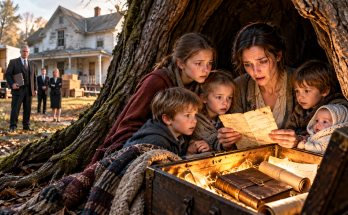
She was sitting with the carved jewelry box in her lap.
“You've already checked, Mother.”
I looked at her.
She gave me a small smile.
“We're here.”
I nodded.
I wanted to laugh at myself.
Instead, I sat beside her.
“I know.”
She opened the box.
Her father's letter was folded inside.
She took it out and read it once more.
I watched her eyes move across the paper.
I had not asked to read it again.
It was hers.
But I remembered what Dmitri had written.
He had wanted her to stop believing she must always be the strong one.
I looked at the unfinished walls.
I wondered how much strength he had expected me to have.
Perhaps he had not thought about it that way.
Perhaps he had only wanted to leave us something solid.
But the truth was that he had left behind a place that still needed work.
And I was the one who would have to decide what happened next.
I could feel the weight of that decision before I even knew what it involved.
Peter sat near one of the walls.
He had taken out the wooden boat.
He turned it in his hands.
The little pocketknife lay beside him.
I watched him study the carved edges.
His father had made the boat with care.
A small thing.
Something a boy could hold.
It did not solve our problems.
But it reminded Peter that he had been loved.
I thought of how often adults overlook that.
We think children need explanations for everything.
Sometimes they do.
But sometimes they need one familiar object that proves a person has not forgotten them.
Peter held the boat close.
I let him.
Anna had opened her music box.
The lullaby moved softly through the unfinished room.
Its notes sounded different here.
At the farmhouse, the song had belonged to ordinary evenings.
Now it seemed to fill the spaces where the walls had not yet been completed.
Luke sat beside her with his carved horse.
The black mane caught the lantern light.
He moved the little animal along the floor.
I watched him for a while.
He seemed calmer than he had in the passage.
Perhaps he was tired.
Perhaps the house felt safer.
Perhaps the horse helped.
I did not ask.
I had learned that children did not always need their feelings named for them.
Sometimes they only needed to be allowed to feel them.
The baby slept in the knitted blanket.
I touched the small edge near the child's cheek.
Dmitri had thought of that blanket.
He had thought of something soft and warm for our youngest.
And I had nearly lost it all before finding the cellar.
The bank had taken the farmhouse.
The storm had damaged the cedar.
Floodwater had entered the underground shelter.
Yet the little blanket had stayed with us.
I looked at the other gifts.
The carved flowers on Julia's box.
The smooth wooden boat.
The music box.
The black mane of Luke's horse.
They were all things I could picture Dmitri holding.
I thought of his hands.
They had been rough from work.
He often came home with small cuts.
Sometimes I complained because he would keep working when he should have rested.
He usually smiled and said there was something he wanted to finish.
I used to think he meant the job in front of him.
Now I wondered how often he had been thinking about Cross Ridge.
I looked around the house.
There were so many unfinished places.
A section of wall that still needed work.
An opening where a window belonged.
Lengths of timber waiting to become something useful.
I could imagine Dmitri studying them.
I could imagine him checking his notebook.
I could imagine him working through a problem without wanting anyone to know how worried he was.
That last thought brought back my anger.
I did not want to lose it entirely.
Not because I wished to punish a dead man.
But because I needed to be truthful with myself.
Dmitri had loved us.
He had worked hard.
He had left land, supplies, gifts, and the beginnings of a house.
He had also hidden things that I had a right to know.
I had stood beside him as his wife.
I had shared the children.
The work.
The meals.
The difficult days.
I would have shared the fear too.
If only he had allowed it.
I looked at the notebook lying beside me.
Hope.
That was the name he had given it.
I had read the word in his message.
At first, I had thought it was merely a comforting name.
Something a husband might write because he wanted his wife to feel better after he was gone.
Now I understood it differently.
The notebook contained measurements because he had been building.
It contained a map because he had prepared a route.
It contained the location of the cellar because he had stocked a shelter.
And it contained the plans that matched the house where we were sitting.
He had called it Hope because it described a future he had been trying to create.
A future he had not completed.
But one he had left within our reach.
I opened the notebook again.
The lantern was close enough for me to see the cramped writing.
I turned slowly through the pages.
I did not rush.
I wanted to understand what I could.
There were drawings I still could not interpret.
Figures that meant little to me.
Lists of timber.
Measurements of walls and openings.
I traced one line with my finger.
Then I looked toward the corresponding part of the house.
It matched.
Not perfectly in every detail I could recognize.
But enough that I knew I was looking at the same plan.
I felt a strange closeness to Dmitri.
It was not the closeness of having him beside me.
Nothing could replace that.
It was the closeness of seeing the work he had cared about.
I had spent years watching him repair wagons and sharpen tools.
I knew he could make broken things useful again.
But I had never imagined him quietly preparing an entire piece of land for us.
Forty-two acres.
The number still felt too large.
I had to say it to myself.
Forty-two acres.
A spring.
An orchard.
A cedar grove.
A cellar.
And this unfinished house.
I thought of the old farmhouse.
I would always miss it.
I knew where the light fell in the afternoon.
I knew the sound of the floor when Peter hurried across it.
I knew where Anna liked to sit.
I knew which doorway Luke leaned against.
I knew the place where Dmitri put down his tools.
Those memories belonged to that house.
The bank could take the building.
It could not take the years we had lived there.
But I also knew memories could not keep the rain off a child.
They could not feed five children.
They could not make an unsafe place safe.
I needed more than memories.
For the first time, I could see that Dmitri had left us something more.
Not a finished life.
Not a solution to every problem.
But a place where work might begin.
I looked toward the door that led down into the passage.
I could no longer hear the water as clearly.
Perhaps the storm was weakening.
Perhaps the distance and the walls were muffling the sound.
I did not know.
I was not going back down while the danger remained.
The cellar had held food and supplies that we might need.
I hoped the water had not ruined them.
But I would not risk the children to find out.
We had already escaped once.
That was enough for the night.
I closed the notebook.
Julia looked at me.
“Do you understand it now?”
I thought about her question.
I understood the deed.
I understood why the iron key had opened the narrow door.
I understood where the passage led.
I understood that the drawings belonged to the house.
But I did not understand everything Dmitri had done.
And I would never fully understand why he had been unable to tell me.
“Some of it,” I said.
She waited.
“Your father was trying to make us another home.”
Julia looked around.
She touched the wooden wall beside her.
“Here?”
“Yes.”
The word came more easily this time.
She studied the unfinished room.
Then she looked toward the others.
“Can we live here?”
I wanted to answer immediately.
I wanted to give her the certainty she had been asking me for since we left the farmhouse.
But the place was unfinished.
We had come to it through a flooding passage.
We had not yet seen it properly in daylight.
And I had no idea how much work remained.
I could not pretend those things did not matter.
“We'll have to see what it needs,” I said.
She nodded.
I saw disappointment pass over her face.
Then she looked at the letter in her hands.
I knew she was already thinking about how to help.
I touched her shoulder.
“Julia.”
She looked up.
“You don't have to solve everything.”
Her eyes filled.
For a moment, she looked surprised.
Then she lowered her head.
“I know.”
I was not sure she did.
I was not sure I did either.
We had both grown used to carrying whatever was put before us.
But Dmitri's letter had been right about one thing.
Being strong did not mean refusing help.
And if this house was to become a home, I could not build our future out of pride alone.
I looked at Peter.
At Anna.
At Luke.
At the baby.
They had all lost more than they knew how to explain.
Yet here they were.
Together.
Tired.
Frightened.
Still finding comfort in small things.
I moved the lantern closer.
The music box had gone quiet.
Peter put his boat away.
Luke held his horse against his chest.
Julia folded her father's letter.
I helped settle the baby.
Outside, rain continued to fall.
I did not know what the morning would reveal.
I did not know whether the cellar would still be usable.
I did not know how much of the house could be finished with what Dmitri had left behind.
But I knew the land belonged to me.
I knew the bank's foreclosure against our old farmhouse had not taken it.
And I knew we had reached the house because Dmitri had left a map and a key.
Those were facts.
Not wishes.
Not promises I had invented to comfort the children.
Facts I could hold.
I placed the deed beside the notebook.
The county seal was visible on the folded paper.
It seemed almost strange that something so ordinary could change the way I felt about the ground beneath us.
Only yesterday, I had been ashamed to lead my children into a hollow cedar.
Now I was sitting in a house their father had begun, on land he had placed in my name.
I could not call it happiness.
Not yet.
There was too much grief.
Too much unfinished work.
Too many questions I would never be able to put to Dmitri.
But I felt something I had not felt since his death.
The possibility of another morning that might be different from the one before it.
I looked once more at the notebook.
Hope.
I finally understood why he had chosen the name.
Not because he had guaranteed us an easy life.
Not because the house was complete.
But because he had believed there could still be a place for us after the farmhouse was gone.
I wished he had lived long enough to see us find it.
I wished he could have heard Anna's music box inside those walls.
I wished he could have watched Luke hold the horse he had made.
I wished he could have seen Julia read her letter and Peter examine his wooden boat.
I wished he could have held the baby in that little blanket.
Those wishes hurt.
They always would.
But when I looked at the children, I no longer saw only what we had lost.
I saw what remained.
I stayed beside them while the storm moved over Cross Ridge.
And for the first time in many days, I allowed myself to believe we might have a future here.
Source: news1.shoptonytv.net