I never stopped missing the farmhouse.
That is the first thing I want to say.
I did not wake one morning at Cross Ridge and decide the old place no longer mattered.
I did not suddenly feel grateful that the bank had taken it.
I did not decide Dmitri's secret made everything right.
It didn't.
The farmhouse had been ours for years.
It held the ordinary life we built together.
The children's voices.
The sound of Dmitri coming home.
The familiar rooms.
The little places where our belongings had rested.
Losing it hurt.
Even after I found the deed.
Even after I discovered the cellar.
Even after the iron key led us to the unfinished house.
The loss remained.
I had to learn that one good thing did not erase another terrible thing.
I had spent so much time searching for the meaning of Dmitri's secret that I almost expected it to answer everything.
But it could not.
It could not explain every decision he made.
It could not undo the debts.
It could not return the farmhouse.
And it could not bring him back.
What it could do was give us somewhere to begin again.
That was the truth.
Simple.
Painful.
Enough.
I remember sitting inside the unfinished house with the deed in my lap.
The children were nearby.
Julia was reading her father's letter.
Peter had his small wooden boat.
Anna was listening to the music box.
Luke held the horse with the black mane.
The baby slept beneath the little knitted blanket.
I looked at them one by one.
Then I looked at the document.
Forty-two acres.
A freshwater spring.
An old orchard.
The cedar grove.
And the land beneath the house where we were sitting.
Dmitri had bought it.
He had paid for it through years of extra work.
Repairing wagons.
Sharpening farm tools.
Working nights at the sawmill.
He had completed the payments eight months before his death.
He had placed the deed in my name.
The property was free of mortgage debt.
The bank's foreclosure against our old farmhouse did not take Cross Ridge.
Those facts were the foundation of our future.
I could hold the paper.
I could read the county seal.
I could see my name.
And I could look out the window at the ground it described.
That mattered.
For a long time, I had believed we had been left with nothing.
Now I understood that we had been left with something very real.
Not a finished house.
Not an easy life.
Land.
Plans.
Supplies.
A way through the hill.
And the work Dmitri had not completed.
I looked at the notebook.
Hope.
The name no longer seemed mysterious.
Dmitri had written it on the pages containing his drawings.
He had used it for the work he was doing in secret.
At first, he wanted to surprise me.
Then the debts grew.
He was ashamed.
He believed he could fix everything before I learned how serious the trouble had become.
I knew that because he had written it himself.
I had read those words until I could almost recite them.
I wanted to forgive him completely.
Sometimes I thought I had.
Then I remembered the day the bank took the farmhouse.
I remembered standing outside with five children.
I remembered not knowing where to go.
And the anger returned.
I stopped fighting that feeling.
I understood that loving Dmitri did not require me to pretend he had done everything right.
He had failed to tell me the truth.
He had failed to share the burden.
He had allowed shame to make decisions that affected all of us.
Those mistakes were real.
But so was his love.
I looked around at the house.
He had planned it carefully.
Every wall.
Every opening.
Every length of lumber he could calculate.
I had begun recognizing the drawings.
I could see how much work remained.
But I could also see how much he had already done.
The house had sheltered us during the storm.
The passage had led us to it from the flooding cellar.
The deed had proved it stood on land belonging to me.
Dmitri had left us the beginning of another home.
I did not want to turn that into a perfect ending.
It wasn't one.
He should have been there.
He should have been standing beside me, explaining which wall he intended to finish first.
He should have been answering Peter's questions.
He should have been listening to Anna's music box.
He should have been watching Luke carry the carved horse.
He should have been holding the baby.
He should have been telling Julia that she did not have to take care of everyone.
Instead, he was gone.
And I was left with all the things he had meant to do.
That was the cost.
Not only the work.
The absence.
Every unfinished part of the house reminded me of it.
I could see where his hands had stopped.
I could see places that waited for more timber.
I could see the shape of the rooms without knowing exactly when they would be ready.
The building was full of possibility.
It was also full of grief.
I had to learn to live with both.
One day, Julia sat beside me with her jewelry box.
She opened it and took out the letter.
Her father's handwriting filled the page.
She read it quietly.
Then she looked at me.
“He said I didn't have to do everything.”
I smiled.
“Yes.”
She lowered her eyes.
“I still want to help.”
“You can.”
She looked relieved.
I put my arm around her.
“But helping isn't the same as carrying everyone's worries.”
She nodded.
I hoped she understood.
I hoped I would keep reminding her.
Dmitri had seen how brave she was.
He had also seen how easily bravery could become a burden.
I wanted her to grow up knowing she could be strong and still ask for comfort.
I wanted her to know she was loved even when she did nothing useful.
She was my daughter.
That was enough.
Peter came over with his wooden boat.
He showed me the smooth edge again.
I had seen it many times.
I looked anyway.
Dmitri had carved it with care.
Peter was proud of that.
I could see it.
I wondered whether he would someday use his father's pocketknife to make something of his own.
Perhaps he would.
Perhaps he would keep the knife untouched.
I did not know.
I would let that choice belong to him.
Anna opened her music box.
The lullaby filled the unfinished room.
I listened without crying.
That surprised me.
The song still reminded me of Dmitri.
But it no longer belonged only to the pain of losing him.
It belonged to Anna.
To the cellar where she first discovered it.
To the passage we had escaped through.
To the house where we now listened together.
The melody had followed us.
It had gathered new memories.
I was grateful for that.
Luke sat beside her.
He held his carved horse.
The black mane had become familiar to me.
Dmitri had once promised him a horse.
He had not been able to give him the living animal.
But he had remembered.
He had carved a small one.
Luke carried it everywhere.
I watched his fingers close around it.
I thought about how children remembered promises.
Some promises could be kept.
Some could not.
And sometimes a parent tried to leave something smaller in place of what had been hoped for.
The little horse was not the promise fulfilled.
It was proof that Dmitri had not forgotten.
That mattered to Luke.
It mattered to me.
The baby slept in the knitted blanket.
I touched the edge.
Such a small gift.
Yet it had been useful every day since we found it.
It had kept the baby warm during the storm.
It had gone through the passage with us.
It had become part of our life in the unfinished house.
I thought Dmitri would have liked that.
He had always valued things that were useful.
The blanket was soft.
Plain.
Made for a child who needed warmth.
Nothing grand.
But full of care.
I looked at all five children.
They had opened their boxes in the cellar.
They had cried without trying to hide it.
I remembered that moment more clearly than almost anything else.
For the first time since the funeral, they had allowed themselves to grieve openly.
I had watched them and realized how much they had been holding inside.
I had been so busy trying to survive that I had nearly forgotten they needed time to mourn.
The gifts had given them permission.
Not because Dmitri had intended them for grief.
But because they had carried something familiar.
His attention.
His hands.
His love.
I was grateful for that.
I thought of the sixth box.
Mine.
At first, I had been disappointed.
The children received beautiful, personal things.
I received papers and a key.
I wanted something I could hold against my chest and pretend was Dmitri for a moment.
Instead, he had left me responsibility.
A deed.
An iron key.
A letter.
And a notebook full of plans.
I had been angry.
I had wanted to ask why he could not leave me something simple.
Then I began to understand.
He had placed the land in my name.
He had given me the means to reach the house.
He had left instructions that led us away from the flood.
He had tried to provide a future.
That was his gift.
It was not the one I would have chosen.
But it was real.
I could use it.
And I could decide what it would become.
I looked toward the cedar grove.
The enormous tree still stood.
Its broken branch lay beside it.
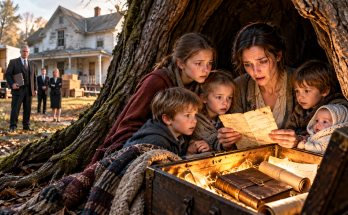
I would never forget the night we sheltered inside its hollow trunk.
I had entered that tree believing I had failed my children.
I had been ashamed to offer them such a place.
Now I understood something different.
I had kept them together.
I had found shelter when we had nowhere else to go.
And when the storm made that shelter dangerous, I had moved them.
The tree had not been a proper home.
It had not been safe during the flood.
But it had been the place where I found the notebook.
The notebook led me to the map.
The map led me to the three stones.
The stones concealed the hatch.
The hatch opened into the cellar.
The cellar held the gifts, the deed, and the key.
The key opened the passage.
And the passage led us here.
I could follow the chain of discoveries now.
Each part connected to the next.
What had seemed like separate mysteries belonged to the same work.
Dmitri had been preparing Cross Ridge for his family.
I finally understood that.
But understanding did not mean I had to call every choice wise.
He had tried to protect us by keeping secrets.
And the secrets had left me frightened and unprepared.
I decided I would not repeat that mistake.
I wanted my children to grow up knowing that problems could be spoken about.
That fear was not shameful.
That asking for help did not mean weakness.
That a family could face difficulties together instead of pretending one person could solve everything alone.
I had learned those lessons because Dmitri had failed to live by them.
That made me sad.
But perhaps it could still do some good.
I returned to the deed.
I unfolded it one last time.
The county seal was clear.
The property description remained the same.
My name was there.
Maria.
I traced the letters with my finger.
Then I folded the paper carefully.
I placed it beside the notebook.
The two things belonged together.
One proved what we owned.
The other showed what Dmitri had hoped to build.
Neither could finish the work for us.
That would have to happen through decisions made afterward.
I looked around the unfinished house.
I could see the places where work remained.
I could see the protected area where we had settled.
I could see the window openings and the timber Dmitri had measured.
I did not pretend the house was complete.
I did not know how quickly we could make it so.
I did not know exactly what supplies remained usable in the cellar after the flood.
I did not know every difficulty we would face.
But I knew where we stood.
On our own land.
Inside a house we had the right to make our home.
That was more certainty than I had possessed since losing the farmhouse.
I sat beside the children.
Julia rested against me.
Peter held his boat.
Anna closed the music box.
Luke placed the horse beside him.
The baby slept.
For a while, nobody spoke.
The quiet did not frighten me.
I listened to the wind moving beyond the window.
I listened to the children breathing.
I listened to the ordinary sounds of a family together.
And I realized something.
I had been waiting for the moment when our life would feel exactly as it had before Dmitri died.
I had wanted the old certainty.
The old rooms.
The old routines.
The old sense that someone else knew how to fix whatever went wrong.
But that life was gone.
I could remember it.
I could love it.
I could grieve for it.
I could not return to it.
Cross Ridge would have to become something different.
Not a replacement for our old home.
Not a way to pretend Dmitri had never died.
A place where the children could grow while remembering him.
A place where we could be honest about what frightened us.
A place where I could learn to make decisions without waiting for him.
I looked at Julia.
Then Peter.
Anna.
Luke.
And the baby.
Five children.
Five lives still unfolding.
I had once looked at them and seen only the terrible responsibility of keeping them safe.
Now I saw something else.
People who would help shape whatever came next.
Not by taking on my burdens.
Not by becoming adults before their time.
Simply by living.
By playing their music.
By keeping their little treasures.
By asking questions.
By growing older.
By filling the unfinished house with memories that belonged to them.
I thought of Dmitri's notebook.
Hope.
He had chosen the word for a future he wanted to give us.
I would keep the notebook.
I would keep the deed safe.
I would keep the iron key.
And I would keep the children's gifts where they could be found.
But I would not spend the rest of my life trying to complete every part of Dmitri's dream exactly as he imagined it.
I could not know everything he wanted.
I could only decide what we needed.
Safety.
Honesty.
A place to belong.
Room to grieve.
Room to live.
The house might take time.
There would be work.
There would be difficult days.
There would be mornings when I missed Dmitri so badly that I could barely speak.
And there would be evenings when Anna's music box played and the children laughed, and I would feel happy before remembering that he was not there to hear them.
I would have to live with that.
I could.
I looked toward the cedar one final time.
The tree remained rooted below the house.
It was damaged.
Still standing.
I thought of the night we entered it with nowhere else to go.
I had believed it was the end of our family's life as we knew it.
In one sense, I was right.
The old life had ended.
But the cedar had also been where I found the first words of Dmitri's confession.
Those words had hurt me.
They had changed the way I understood my marriage.
They had led me toward land I did not know I owned.
And finally, they had brought us here.
I could not thank Dmitri in person.
I could not ask him to explain everything.
I could not tell him how angry I had been.
I could not tell him how grateful I was.
So I said the words quietly, where only I could hear them.
“I wish you'd told me.”
I looked down at the notebook.
Then I added something else.
“But I understand what you were trying to leave us.”
The children were settling near me.
I put the papers away.
I set the iron key beside them.
Then I reached for the baby.
The little knitted blanket was warm.
Julia leaned against my shoulder.
Peter put the boat safely beside him.
Anna placed her music box near the blankets.
Luke held the carved horse against his chest.
I looked around at the unfinished walls.
We had lost our farmhouse.
We had lost Dmitri.
And nothing I found on Cross Ridge could erase those losses.
But we had not lost one another.
We still had land beneath our feet.
We still had a place where a home could be made.
And we still had the chance to live differently from the way fear had taught us.
I had entered the hollow cedar believing my husband had left us with nothing.
I came out understanding that he had left us a beginning.
What happened after that belonged to the people still standing.
To Julia.
To Peter.
To Anna.
To Luke.
To the baby.
And to me.
I closed the notebook.
Outside, the wind moved gently through the cedar grove.
Inside, my five children were safe beside me.
The house was unfinished.
Our future was uncertain.
But for the first time, I did not need to know every step before believing we could take the next one.
We had somewhere to begin.
And we would begin together.
Source: news1.shoptonytv.net
The End
Read more original stories on lastestdrama.