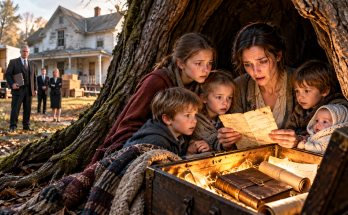
Three days after burying her daughter beneath a cottonwood tree, Eliza Mercer stood helpless as milk spread across the front of her dress. That night, a frantic widower begged for help feeding his newborn twins, but Eliza’s brother-in-law shut the door in his face. Before sunrise, she would find Caleb Foster holding one screaming baby while the other barely had enough strength to breathe.
Part 1
Eliza’s daughter had been named Ada June Mercer.
She survived for two hours and nineteen minutes.
In that brief time, Eliza studied the delicate folds of her ears and counted all ten fingers again and again. She held Ada against her chest and felt the infant’s mouth search weakly for milk before the midwife finally carried her away.
The doctor explained that Ada’s lungs had never fully opened. He spoke gently, but his conclusion was merciless: no medicine, prayer, or skilled hand could have saved her.
Eliza had already learned how quickly a life could vanish.
Five months before Ada’s birth, her husband, Thomas, had been killed when a wagon overturned along a logging road. At twenty-seven, Eliza became a widow while still preparing to be a mother. Then she became a mother whose arms were empty.
Her older sister, Martha, brought her into the small farmhouse she shared with her husband, Amos Pike. Martha offered Eliza a bed in the spare room, but Amos made it clear that his charity had limits.
So Eliza worked to justify every bite of food. She cooked their meals, scrubbed their clothes, repaired torn shirts, and kept her voice low. She ate small portions and tried to leave no trace of herself in the house.
But sorrow could not be folded away like a blanket.
Neither could the milk her body kept producing for a baby who was no longer there.
Each morning before anyone woke, Eliza leaned over a basin and expressed the milk into folded cloths. Then she carried them outside and emptied the basin onto the frozen earth, unable to stop thinking that somewhere, something living might have needed it.
On the third evening after Ada’s burial, someone pounded on the front door.
Eliza was in the kitchen when she heard a man’s strained voice from the entryway. “Please, sir. They’ve taken almost nothing since yesterday. They can’t go another night like this.”
Amos blocked the doorway with one hand on the frame. “Then you need a physician, not this household.”
“He’s the one who told me to come,” the stranger answered. “He said I had to find a nursing woman.”
Eliza froze, gripping the edge of the table.
Amos lowered his voice, but not enough. “There is no one here who can help you. Leave.”
The door closed. The bolt slid into place.
Eliza entered the front room before Amos could turn away. “Who was that?”
Martha stood beside the stove, twisting her apron in both hands. “Caleb Foster.”
Everyone around Pine Hollow knew the name. Caleb ran Cedar Run Ranch, the large spread beyond the creek. His wife, Lydia, had died six weeks earlier while delivering twin babies.
Eliza stared at the door. “You knew why he came, and you still refused him?”
Amos’s expression hardened. “I will not have you entering a lone man’s home and nursing his children.”
“He isn’t some bachelor inviting me over,” Eliza said. “He buried his wife.”
“That doesn’t make it proper.”
“It means those babies have no mother.”
Color climbed into Amos’s face. “It means nothing to you. They are his responsibility, not yours.”
Eliza turned to Martha, waiting for her sister to speak. Martha’s lips parted, but her eyes dropped to the floor.
That silence gave Eliza her answer.
She walked into the spare room and closed the door. Her hands trembled as she packed two blouses, a shawl, Thomas’s Bible, a comb, and her sewing kit. When she emptied her pocket onto the bed, two nickels and two pennies landed on the quilt.
Twelve cents. That was everything she owned.
Eliza wrapped the shawl tightly around her shoulders and slipped out into the December darkness. The cold seized her lungs immediately. Her body still ached from childbirth, and each step pulled painfully through her hips and abdomen.
Cedar Run Ranch stood three miles away.
Frozen snow snapped beneath her boots as she crossed the fields. Wind drove through her skirt, and ice gathered along the fringe of her shawl, but she kept moving.
At the creek, Eliza stopped.
The black water slid between shelves of ice. Behind her waited warmth, shelter, and a family that might never welcome her back if she continued. Ahead lay a widower she had never met and two infants she had no right to claim.
She nearly turned around.
Then a thin cry traveled across the fields.
A second baby answered, the sound sharper and more desperate.
Eliza lifted her skirt away from the snow and followed their voices.
Beyond a line of bare cottonwoods, Cedar Run Ranch emerged from the darkness. Warm light glowed in every window, yet no one appeared outside. The whole place looked awake and strangely abandoned at the same time.
Eliza climbed the porch steps and knocked.
The door opened almost at once.
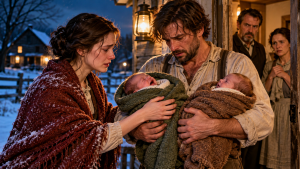
Caleb Foster stood beneath the lantern with a newborn cradled in each arm. He was tall and unshaven, his dark hair falling across his forehead. His shirt had been fastened into the wrong buttonholes, as if he had dressed while holding both babies and never noticed.
The infant against his shoulder screamed inside a thick green blanket. The second, wrapped in brown, rested lower against his chest and made faint, breathless noises.
Eliza’s attention fixed on the quieter child.
“I’m Eliza Mercer,” she said.
Recognition slowly crossed Caleb’s exhausted face. “Amos Pike’s widowed sister-in-law.”
“Yes.”
His arms tightened protectively around the twins. “I already heard his answer. I didn’t send for you.”
Part 2
“I know.”
The weaker baby opened its mouth, but no real cry came out.
Something shifted inside Eliza. It was not the crushing emptiness she had felt when Ada died. This was sharper—a door inside her opening onto a choice she could still make.
“My daughter died three days ago,” Eliza said, her voice shaking. “My body hasn’t understood that yet.”
Caleb looked at the damp fabric beneath her shawl, then back at her face. He said nothing.
Tears blurred the two tiny bundles in his arms. “I can’t give my milk to Ada now.”
Eliza reached toward the green blanket, stopping just before her fingers touched it.
“But if you let me inside, I may be able to keep your babies alive.”
For several long seconds, Caleb remained in the doorway, caught between fear and hope. Then the quieter twin gave one shallow gasp, and his expression changed.
Caleb stepped back.
Eliza crossed the threshold.
The warmth inside Cedar Run struck Eliza so quickly that pain flashed through her frozen hands. Caleb closed the door against the wind, then stood uncertainly in the entryway as both infants cried against him.
“Which one stopped feeding first?” Eliza asked.
Caleb glanced at the quieter bundle. “Samuel. His sister, Grace, still takes a little, but not enough.”
Eliza removed her damp shawl and set down her bag. There would be time later for explanations, embarrassment, and whatever judgment awaited them in Pine Hollow. For now, there were two hungry children and one of them was fading.
“Bring me clean cloths, warm water, and every bottle or cup you’ve used for them today.”
Caleb blinked, as if no one had given him a clear order in weeks. Then he carried the twins into the sitting room and hurried toward the kitchen.
Eliza sat near the stove with Grace in her arms. The infant rooted frantically, but her movements were disorganized from hunger. Eliza steadied the tiny head and whispered until the child finally latched.
The first pull nearly broke her.
Her body answered Grace as though it had been waiting for Ada. Milk came with a sharp ache, followed by a rush of grief so powerful that Eliza bent over the baby and struggled to breathe.
She did not let go.
Grace drank greedily, one fist pressed beneath her chin. With each swallow, a little color returned to her cheeks.
Caleb came back carrying a basin, several folded towels, and two glass feeding bottles. Relief flickered across his face when he saw his daughter nursing, but it vanished when Samuel made a shallow, rasping sound from the crook of his arm.
“Give him to me,” Eliza said.
Caleb hesitated. “He feels colder than she does.”
“That’s why you must give him to me now.”
Samuel weighed almost nothing. His eyelids fluttered when Eliza touched his cheek, but he did not turn toward her. She rubbed his back through the blanket, spoke close to his ear, and tried again.
His mouth opened, then slipped away without drawing milk.
Caleb lowered himself into the chair opposite her. “Is he too weak?”
“He’s weak,” Eliza answered. “But that isn’t all.”
She pressed one finger lightly against Samuel’s palm. His hand barely closed around it. His breathing was slow rather than frantic, and a strange sweet odor clung to the corner of his mouth.
Eliza had smelled it once before. The midwife had opened a brown bottle after Ada’s birth and placed a small amount on a cloth to dull Eliza’s pain. The scent had filled the room—sugar, alcohol, and something bitter beneath both.
Her gaze moved to the bottles Caleb had brought.
“What have you given him to make him sleep?”
Caleb’s head snapped up. “Nothing.”
“Someone has.”
“No.” His voice sharpened from fear rather than anger. “I tried goat’s milk. Broth once, because I didn’t know what else to do. Dr. Harlan told me to stop both yesterday.”
Eliza lifted Samuel closer and smelled his breath again. The odor was faint but unmistakable.
“This child has had a sleeping medicine.”
Caleb stared at her. “Dr. Harlan left no medicine.”
“Who else has cared for them?”
For the first time, Caleb looked away. He named a neighbor who had stayed two nights, an older ranch cook who had attempted to feed the twins, and Lydia’s brother, who had visited twice since the funeral. A hired woman named Ruth Talbot had helped most often, but she had left that afternoon after Samuel began refusing food.
“She said her own boy had developed a fever,” Caleb explained. “She promised to return tomorrow.”
“Did she prepare the bottles?”
“Sometimes.”
Eliza shifted Grace to Caleb’s arms and rose with Samuel held against her chest. “Show me where they sleep.”
The nursery was at the end of the hall. Two small cradles stood beneath a window, surrounded by folded blankets, feeding cloths, and baskets of clothing that looked recently sewn. A faded blue dress hung behind the door.
Caleb stopped when he saw Eliza looking at it. “Lydia made nearly everything before they came.”
Eliza said nothing. There were some griefs that recognized each other without introduction.
She laid Samuel in the nearer cradle and examined the feeding cloth beside it. The same sweet smell rose from one corner. Beneath the cloth was a pale brown stain Caleb apparently had not noticed.
Eliza held it out. “Was this here when Ruth left?”
“I don’t know. I haven’t slept more than an hour at a time.”
Part 3
“Then we search everything.”
Caleb opened the cabinet while Eliza checked the basket beneath the cradle. There were clean gowns, wool stockings, and a tin of salve. Nothing explained the stain.
Then her fingers touched a hard object hidden inside the cradle lining.
Eliza pulled back the mattress. A narrow amber vial had been pushed into a split in the wicker frame. Its paper label had been scraped away, leaving only a patch of glue.
Caleb took one step toward her. “That isn’t mine.”
The vial contained only a trace of dark liquid, but when Eliza loosened the stopper, the same sickly sweetness reached her.
Grace began crying in Caleb’s arms. Samuel did not react at all.
“We need the doctor,” Eliza said. “Not in the morning. Now.”
“The road is drifting shut.”
“Then wake every ranch hand you have. Send two men with the strongest horses, and tell them Samuel may have been drugged.”
Caleb’s expression tightened. “If someone did this deliberately—”
“We don’t accuse anyone until the child is safe.” Eliza replaced the stopper and wrapped the vial in a clean cloth. “But nobody enters this room alone. Nobody feeds either baby unless one of us is watching.”
He nodded and turned toward the door, then stopped when Eliza called his name.
Something white protruded from the tear where the vial had been hidden. Eliza worked it free with the tip of her sewing scissors.
It was a folded piece of paper no larger than her palm.
Four words had been written across it in dark pencil.
FOR THE SMALLER CHILD ONLY.
Caleb returned slowly. “Let me see.”
On the reverse side, another sentence had been pressed so heavily into the paper that the pencil had nearly torn through.
KEEP CALEB FROM FINDING OUT.
The room seemed to contract around them. Eliza looked from the note to the nearly motionless infant in the cradle.
“Do you recognize the writing?”
Caleb read it twice. All the remaining color left his face.
“Yes,” he whispered.
Eliza tightened her hold on the hidden vial. “Who wrote it?”
Caleb raised his eyes to hers, but before he could answer, a horse thundered into the yard and someone began pounding on the front door.
Caleb’s eyes remained on the note. “That handwriting belongs to Ruth Talbot.”
The pounding downstairs came again, followed by a man’s command to open the door. Eliza wrapped Samuel more tightly and slipped the amber vial into her pocket while Caleb carried Grace into the hall.
“Stay behind me,” he said.
“No.” Eliza stepped beside him. “If Ruth has returned, I want to see her face when she learns what we found.”
Caleb opened the front door.
Ruth stood on the porch in a dark traveling coat, snow clinging to its hem. Amos Pike was beside her, and behind them waited Pine Hollow’s constable, Nathan Cole, with one gloved hand resting near the iron cuffs on his belt.
Amos looked past Caleb and fixed his gaze on Eliza. “There she is.”
Constable Cole removed a folded document from his coat. “Mr. Foster, a complaint has been filed concerning the condition of your children. I have an order from Justice Webb authorizing their temporary removal until a physician examines them.”
Caleb’s face hardened. “A complaint filed by whom?”
“I filed it,” Ruth answered.
Eliza studied her. Ruth showed no surprise at finding her inside the house, nor did she ask why Samuel was being carried instead of sleeping in his cradle.
“You left him sick this afternoon,” Eliza said. “Now you return with a constable instead of a doctor.”
Ruth’s mouth tightened. “I left two exhausted babies with their father. Then Amos found me and said a grieving woman had vanished from his home after behaving irrationally for days.”
Amos stepped through the doorway without invitation. “Eliza lost her child and hasn’t been herself since. She took medicine from the room where the midwife treated her.”
Eliza felt the shape of the vial against her skirt.
“What medicine?” she asked.
Amos pointed directly at her pocket. “The bottle you’re hiding.”
The room went still.
Caleb turned toward her, but Eliza did not look away from Amos. “You couldn’t know I had a bottle unless someone told you.”
Ruth answered too quickly. “The constable should search her.”
“That wasn’t my question.”
Samuel gave a faint shudder against Eliza’s chest. His lips had begun to pale again, and she could feel long pauses forming between his breaths.
She moved toward the stove, but Ruth blocked her path. “Give him to me.”
Eliza stopped so abruptly that their skirts nearly touched. “You will not put your hands on him.”
Ruth’s composure cracked. “I have cared for those children since their mother died.”
“And one of them weakened whenever you prepared his bottle.”
“That is a lie.”
“Then how did you know the vial was hidden in the nursery?”
Ruth glanced at Amos.
It lasted less than a second, but Caleb saw it.
He handed Grace to Eliza, reached into her pocket for the wrapped vial, and placed it on the table before Constable Cole. Then he produced the note.
“This was concealed beneath Samuel’s mattress,” Caleb said. “Read it before you carry my children anywhere.”
The constable unfolded the paper. His eyes moved across both messages, then shifted to Ruth.
She did not deny the handwriting.
Instead, she laughed once, quietly. “You found a scrap with four words on it, and now this stranger has convinced you that I tried to murder your son.”
“Eliza is not a stranger to me anymore.”
The statement silenced everyone, including Eliza.
Ruth recovered first. “Look at him, Constable. He hasn’t slept. His wife is dead, his children are starving, and he has allowed a woman he met tonight to tear apart the nursery. Neither of them is thinking clearly.”
Cole examined the vial but did not open it. “This proves something was hidden. It doesn’t prove who used it.”
“The handwriting proves who intended it for,” Caleb said.
“It proves Mrs. Talbot wrote the note,” the constable replied. “She claims it referred to a remedy prescribed for the smaller child.”
“No physician prescribed that,” Eliza said.
Amos folded his arms. “And you know because you’re a doctor now?”
Part 4
Eliza ignored him. She watched Ruth instead.
Ruth’s attention kept drifting toward the end of the hallway—not toward Samuel, but toward the nursery door. There was something in that room she feared they had found.
Constable Cole held out his hand. “Mrs. Mercer, I need the boy.”
Eliza stepped back. “He may not survive a wagon ride into town.”
“The order covers both children.”
“You came to remove a freezing infant without bringing blankets, a nurse, or a physician,” she said. “That is not protection. It is transportation.”
Cole’s jaw tightened. “Do not make this harder.”
Grace began to cry. The sound stirred Samuel enough that his mouth moved weakly against Eliza’s dress, but he still could not feed.
Caleb positioned himself between her and the constable. “No one takes them until Dr. Harlan arrives.”
Ruth’s expression changed at the doctor’s name. “He isn’t coming.”
Caleb turned slowly. “How would you know?”
She hesitated. “The northern road is buried.”
“My men took the river road.”
For the first time, fear showed plainly in Ruth’s eyes.
Then Amos seized Caleb’s shoulder. Caleb shoved him away, and Constable Cole stepped between them. In the confusion, Ruth snatched the note from the table.
Eliza saw the movement and lunged, but Ruth reached the stove first.
The paper curled black the instant it touched the flame.
Caleb dragged it out with the fireplace tongs, but the writing had already vanished. Only a scorched corner remained.
“Our evidence,” he whispered.
Ruth faced the constable with tears suddenly brightening her eyes. “He attacked me.”
“You destroyed that note,” Eliza said.
“I panicked because you were using it to accuse me of killing a baby.”
Constable Cole took the vial and slipped it into his coat. “Enough. The note is gone, the bottle has no label, and I have a lawful order. Mr. Foster, stand aside.”
For one terrible moment, it appeared Ruth had won.
Then Eliza remembered the faded blue dress hanging behind the nursery door.
Lydia had sewn nearly every garment in that room with tiny, even stitches. But when Eliza had first entered, she had noticed the dress’s lower hem sagged on one side. The thread there was darker and clumsier than the rest.
Someone other than Lydia had closed that hem.
Eliza handed Grace back to Caleb and hurried into the nursery with Samuel. Ruth followed immediately.
“Stop her!”
Eliza pulled her sewing scissors from her bag and cut three stitches. A folded document slid from inside the blue hem and landed beside the cradle.
Ruth threw herself toward it.
Eliza reached it first.
The paper was a copy of Lydia’s father’s will. One paragraph had been marked in pencil: Cedar Run belonged to Lydia’s surviving children. If both died before reaching adulthood, the property would pass to Lydia’s brother, Owen Ward.
Caleb read the clause over Eliza’s shoulder. “Owen gets everything if Samuel and Grace die.”
On the back was a line in the same heavy handwriting as the burned note.
RUTH TALBOT HAS AGREED TO HELP.
The constable stared at it, but Ruth’s shock lasted only an instant.
“That was planted,” she said. “She had scissors. She could have put it there herself.”
Amos nodded eagerly. “Eliza brought a sewing kit from my house.”
The earlier clue turned against her as quickly as it had saved her.
Constable Cole looked from the document to Eliza’s open bag. Doubt settled over his face once more.
Samuel suddenly went limp.
Eliza pressed her ear near his mouth. A thread of breath touched her cheek, then nothing followed.
At the same moment, Cole opened the front door and called for the waiting driver to bring the wagon around.
“Mrs. Mercer,” he said, “hand me that child now, or I will place you under arrest.”
Eliza looked at the snow beyond the door, at Ruth reaching for Samuel, and at Caleb holding Grace while the constable moved toward them.
If Eliza surrendered the twins, Ruth would control what happened next.
If she resisted, Cole could drag her away while Samuel was barely breathing.
The constable extended his arms.
Eliza had only one heartbeat left to choose.
Eliza did not place Samuel in the constable’s arms.
She lowered him onto the sturdy table beside the stove, loosened the blanket around his chest, and tilted his head just enough to open his airway. “Caleb, warm a clean cloth. Cole, keep Ruth away from this table.”
The authority in her voice stopped all three men.
Eliza wiped a thin line of fluid from Samuel’s mouth, rubbed his chest, and breathed gently against his lips. Nothing happened. She tried again, refusing to look at the open door or the wagon waiting beyond it.
Samuel’s chest lifted.
A faint breath escaped him, followed by another terrible pause.
“That child needs a physician,” Cole said.
“He needs one here,” Eliza replied without stopping. “Your order says the twins are to be held until a physician examines them. It does not say you can risk killing Samuel on the way to that examination.”
Cole’s hand moved toward his coat, where he had placed the vial. His expression changed as he reconsidered the language of the document.
Ruth stepped closer. “She is delaying because she knows what the doctor will find.”
“No,” Eliza said. “You’re afraid of what he’ll find.”
Caleb handed her the warmed cloth. Eliza wrapped it around Samuel’s feet and continued rubbing his back until a weak, broken cry finally came from him.
It was barely louder than the stove’s hiss, but Caleb closed his eyes in relief.
Grace began crying in his other arm. He held both hands around her protectively while staring at his son. “Keep fighting, Samuel. Please.”
Ruth edged toward the front door.
Constable Cole noticed. “You aren’t leaving.”
“I came as a witness, not a prisoner.”
“You burned evidence in front of me.”
“I destroyed a vicious accusation written on an unsigned scrap.”
Eliza looked up from Samuel. “Then you should have wanted it preserved.”
Hoofbeats sounded outside before Ruth could answer. Two horses skidded into the yard, followed by the ranch hands Caleb had sent earlier. Dr. Harlan dismounted before his horse had fully stopped and crossed the porch carrying a black medical case.
Ruth backed into Amos.
Part 5
The doctor removed his coat and went directly to Samuel. He listened to the baby’s chest, examined his pupils, then smelled the cloth from the cradle that Eliza had kept beside the document.
“What was in his last feeding?” he asked.
Caleb answered, “Whatever Ruth prepared before she left.”
“That proves nothing,” Ruth said. “Samuel was already sick.”
Dr. Harlan extended his hand toward Cole. “I was told there was a bottle.”
The constable produced the wrapped vial. The doctor opened it carefully, touched none of the residue, and held it near the lantern.
His expression became grim. “This contains an opiate mixture. Stronger than anything appropriate for an infant.”
Ruth lifted her chin. “You told me a small amount could calm him.”
Dr. Harlan turned toward her. “I told you never to give either child a sleeping remedy. I wrote those instructions in Caleb’s household ledger yesterday because you argued with me.”
Caleb stared at her. “You argued?”
“He was crying for hours,” Ruth said. “I was trying to help.”
“Samuel was the quiet one,” Eliza replied. “Grace was the child who cried.”
Ruth’s face emptied.
It was a small mistake, but everyone heard it.
Dr. Harlan looked at Cole. “If the boy received repeated doses, the weakness, poor feeding, slowed breathing, and unusual odor all fit. He must not be moved unless this house becomes unsafe.”
The constable folded the removal order and returned it to his pocket. “Then the children remain here under the doctor’s care.”
Amos stepped forward. “That woman still stole medicine from my home.”
Eliza kept one hand on Samuel while addressing Cole. “Ask him when he discovered it missing.”
Amos’s eyes shifted toward Ruth. “Yesterday.”
“My midwife packed every bottle after Ada died,” Eliza said. “Martha watched her do it. Amos never entered that room while the medicine was there.”
“You cannot prove what I saw.”
“But you signed a complaint, didn’t you?”
Cole’s silence gave her the answer.
Eliza continued. “Read the time beside his signature.”
The constable removed a second folded sheet from inside his coat. His eyes moved to the bottom. “Nine forty-five tonight.”
Caleb looked at the clock on the mantel. It was not yet eleven.
“At nine forty-five,” Eliza said, “I was crossing the creek. I had never entered this house, never seen Samuel’s cradle, and never touched that vial. Yet Amos’s complaint describes me hiding medicine after interfering with the twins.”
Cole read the statement again, more slowly this time.
Amos’s confidence collapsed. “Ruth told me Eliza would do it.”
“So you swore to events that had not happened,” Cole said.
“I was protecting my household.”
“You were helping her create an explanation before anyone found the bottle,” Eliza replied.
Ruth suddenly shoved Amos aside and ran for the door.
Caleb caught her sleeve, but the fabric tore in his hand. One of the ranch hands blocked the porch steps while Cole seized Ruth’s wrists and pulled her arms behind her.
As he fastened the cuffs, a wooden pencil fell from her coat and rolled beneath the table.
Eliza picked it up. The tip was broad and flattened on one side. She placed it near the writing on Lydia’s will copy without touching either mark.
“Preserve that too,” she said. “And the burned paper in the stove. The scorched corner may still show enough to compare the pressure and graphite.”
Cole nodded to one of the ranch hands. “Bring me a clean tin. Nobody touches the ashes.”
Ruth twisted against the cuffs. “You cannot build a case from a pencil.”
“No,” Eliza said. “But the vial, the false complaint, the doctor’s ledger, the hidden document, and your attempt to destroy the note can build one together.”
Cole took custody of the pencil and the will copy. Then he faced Amos. “You will come to town and explain your statement to Justice Webb.”
Amos looked toward Eliza as if he expected her to rescue him from the consequences.
She returned her attention to Samuel.
Dr. Harlan worked beside her for nearly an hour. Slowly, the pauses between the baby’s breaths shortened. His color remained poor, but when Eliza brushed her knuckle along his cheek, his mouth finally turned toward the touch.
“He’s trying to feed,” she said.
“Only a little,” the doctor cautioned. “Keep him upright and watch every breath.”
Eliza lifted Samuel against her. His first attempt was too weak, and his second ended in a cough. On the third, he latched for several seconds before resting his face against her.
Across the room, Caleb bowed over Grace and wept without making a sound.
Constable Cole placed Ruth in the waiting wagon and assigned a ranch hand to guard her. Amos was ordered into the seat beside the driver. Before leaving, Cole paused near Eliza.
“I should have examined the complaint more carefully.”
“Yes,” she said.
He appeared surprised that she offered no comfort.
Eliza adjusted Samuel’s blanket. “Find Owen Ward before he learns the document was discovered. And send someone to Martha. She may know when Amos first met with Ruth.”
Cole nodded. “I’ll have a deputy at Owen’s property before daylight.”
But daylight brought no arrest.
A rider returned from Owen’s house with news that the stove was still warm, the stable was empty, and fresh wheel tracks led south toward the county line.
Ruth remained in custody. Amos’s sworn statement was seized. Dr. Harlan’s ledger and the amber vial were sealed for Justice Webb. Yet the man who stood to inherit Cedar Run had escaped into the storm.
By sunrise, Grace was sleeping safely in Caleb’s arms. Samuel lay in a cradle beside the stove, breathing on his own but still too weak to be left unwatched.
Caleb approached Eliza while the doctor prepared another examination. “When this is over, you will be free to leave. I won’t turn what you did into a debt.”
Eliza looked at the pale infant, then at the daughter’s Bible inside her open bag.
“I’m not staying because I owe you anything,” she said. “And I’m not leaving while someone is still trying to erase these children.”
Samuel stirred at the sound of her voice. His tiny hand opened beneath the blanket, and Eliza placed one finger against his palm.
This time, he held on.