I did not expect the music box to make me cry again.
It had already done that in the cellar.
I thought I had become used to its song.
But one evening, Anna opened it while the light faded through the unfinished window openings.
The familiar lullaby began.
And suddenly I was back in the farmhouse.
Not the day the bank took it.
Not the day we left.
An ordinary evening.
Dmitri was still alive in my memory.
The children were younger.
The house was full of the small noises that once seemed unimportant.
I could almost hear a door opening.
Almost hear his footsteps.
Almost hear him asking whether the children were asleep.
Then the music stopped.
I opened my eyes.
The farmhouse was gone.
I was sitting on the floor of an unfinished building at Cross Ridge.
And Dmitri would never come home.
I pressed my hands together.
I did not want Anna to see how badly the song had hurt.
But she had already noticed.
“Mother?”
I looked at her.
“I'm all right.”
The words came automatically.
Then I remembered what I had promised myself.
No more pretending everything was fine when it wasn't.
I shook my head.
“I'm sad.”
Anna looked down at the music box.
“Because of Father?”
“Yes.”
She came closer.
I put my arm around her.
“It's a beautiful song.”
She nodded.
“He remembered.”
I closed my eyes for a moment.
“Yes. He did.”
That was what made it so difficult.
Dmitri had remembered the little things.
He had remembered which lullaby Anna loved.
He had remembered the horse he promised Luke.
He had remembered Peter's interest in small wooden things.
He had seen how Julia carried everyone else's worries.
He had thought of a blanket for the baby.
He had remembered all of them.
Yet he had kept the most important part of his work from me.
I still could not make those two sides of him fit comfortably together.
I wondered whether I ever would.
Anna rested against me until the last light faded.
Luke came over with his wooden horse.
He sat beside us.
For a while, he moved it slowly across the floor.
Then he stopped.
“Do you think Father would like this house?”
I looked around.
The unfinished walls stood in the dim light.
The roof had held through the storm.
The floor was dry where we sat.
But the place still needed work.
I thought about Dmitri's plans.
The corrections.
The lists of lumber.
The careful measurements.
“He must have believed it could be a good home,” I said.
Luke looked satisfied.
He returned to his horse.
I watched him.
He had been so close to the falling branch.
That memory still came without warning.
Sometimes I saw him standing near the cedar opening.
Sometimes I heard his voice calling about the water.
Sometimes I imagined what might have happened if I had moved more slowly.
I tried not to dwell on it.
But a mother does not easily forget the moment danger came close to her child.
I reached over and touched his shoulder.
He looked up.
“What?”
“Nothing.”
He frowned.
I smiled.
“I just wanted to know you were close.”
He moved nearer.
That was enough.
Peter came into the room carrying the wooden boat.
He had been examining the edge where two carved surfaces met.
I watched him sit near the wall.
He held the boat in one hand and looked at the timber around him.
I wondered whether he was trying to imagine his father working here.
Perhaps all the children were.
The house was full of Dmitri's absence.
Every unfinished place reminded us that he had intended to return.
That was how it felt to me.
A board waiting to be fitted.
A window opening waiting to be completed.
A wall that stopped before the work was done.
The building seemed to be expecting him.
I was too.
Sometimes I caught myself looking toward a doorway as though I might hear his footsteps.
Then I remembered.
I hated those moments.
They were small.
Brief.
And painful enough to leave me standing still.
Julia sat beside her jewelry box.
She had been reading the letter again.
I had seen her do that several times.
Sometimes she folded it quickly when someone came near.
Sometimes she held it openly.
I had stopped asking.
Her father's words belonged to her.
She needed to return to them in her own way.
I looked at the carved flowers.
They were delicate.
Dmitri had never been a man who wasted effort on things he did not care about.
He had taken time with that box.
He had known Julia would notice.
I wondered how long he had kept the gifts hidden in the cellar.
Had he finished them one by one?
Had he made them during evenings when I believed he was simply repairing something?
Had he planned to give them to the children when the house was finished?
I did not know.
I only knew the boxes had been waiting.
Five small boxes.
One larger one.
All arranged against the cellar wall.
I remembered seeing them for the first time.
For a moment, I had thought they might hold tools or supplies.
Then I saw the names.
I had felt as though Dmitri had reached across the distance between life and death to touch each child.
I still felt that way.
But grief did not always make me gentle.
Sometimes it made me angry.
Sometimes I wanted to ask why he had prepared gifts instead of telling me the truth.
Then I remembered the deed.
The land.
The cellar.
The house.
He had done both kinds of work.
He had tried to provide practical protection and personal comfort.
The mistake was not that he had failed to love us.
The mistake was that he believed love required him to hide his fear.
I thought about that for a long time.
Dmitri had been proud.
Not loudly.
Not in a way that made him boast.
He simply disliked admitting that something was beyond him.
When a wagon needed repairing, he worked until he found the problem.
When a tool was damaged, he tried to restore it.
When the farmhouse began slipping away, he had tried to solve the difficulty without telling me how serious it had become.
That was where his strength had turned against him.
I had loved his determination.
I had relied on it.
Now I was living with the cost.
I looked around at the children.
I did not want Julia to grow up believing she must carry every problem alone.
I did not want Peter to think asking for help meant weakness.
I did not want Anna or Luke to hide their fear because they thought it would protect me.
And I wanted the baby to grow up in a home where difficult truths could be spoken.
I could not change Dmitri's choices.
But I could decide what we learned from them.
That thought gave me something to hold on to.
I called the children closer.
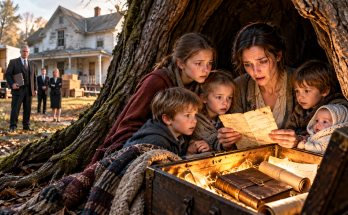
They gathered around the blankets.
I did not make a speech.
I had no desire to turn our grief into a lesson they had to memorize.
I simply looked at them.
“If you're frightened, you can tell me.”
Peter looked up.
I continued.
“If something is wrong, we talk about it.”
Julia lowered her eyes.
I knew she understood why I was saying it.
I looked at her.
“You don't have to keep every worry to yourself.”
She nodded.
Then Anna asked a question.
“Even if it makes you sad?”
I felt my throat tighten.
“Even then.”
She leaned against me.
I put my arm around her.
I wanted them to know that sadness was something we could share.
It did not have to be hidden behind silence.
I wished Dmitri had known that.
Perhaps he had known it and simply could not live by it.
I would never be sure.
Later, when the children were settled, I opened the notebook.
I read the first message again.
Dmitri had admitted he had failed to speak while he was alive.
He had hoped his work would protect us.
I no longer read those words only with anger.
I read them as an admission from a frightened man.
That did not excuse everything.
But it made him human again.
For a while after the funeral, I had treated him in my mind as two different people.
The husband I loved.
And the man whose debts had cost us our farmhouse.
Now I was beginning to understand they had always been the same person.
A man could be loving and mistaken.
Careful and secretive.
Hardworking and afraid.
Dmitri had been all of those things.
I looked at the unfinished walls.
I was learning that I could be more than one thing too.
A grieving widow.
A frightened mother.
A woman angry with her husband.
A woman grateful for what he had left.
And the owner of forty-two acres of land.
None of those truths canceled the others.
I set the notebook aside.
The baby stirred.
I lifted the little one and adjusted the knitted blanket.
Its edge was soft against my fingers.
I remembered Dmitri holding the baby.
I remembered his hands looking too large around such a small body.
I remembered the care he took.
For a moment, I let myself miss him without being angry.
Just miss him.
It was painful.
But it was also a relief.
I had spent so much time trying to understand what he had done that I sometimes forgot I was allowed to mourn him.
I sat with the baby until the little one settled.
Then I looked toward the window.
The cedar grove was dark.
The great tree stood below us.
I wondered whether we would ever use its hollow trunk again.
I hoped we would never need to.
But I knew I would always remember it.
The night we entered.
The fear.
The strange shelter.
The notebook.
The map.
The three stones.
The hatch.
Everything had begun to change there.
I did not know whether Dmitri would have wanted us to find his secret in such a desperate way.
Probably not.
But the cedar had led us to it.
I looked at the children sleeping.
Their gifts were close.
The music box.
The wooden boat.
The carved horse.
The jewelry box.
The knitted blanket.
I knew those objects would follow us wherever we went.
Not because they were valuable in money.
Because they were proof that Dmitri had known his children.
I reached for the iron key.
It lay beside the notebook.
Such a small thing.
Yet it had opened the door that saved us from the flooding cellar.
I closed my fingers around it.
I thought about how many times I had wished Dmitri would come back and tell me what to do.
He could not.
But he had left tools for understanding.
A key.
A map.
Plans.
A deed.
And the beginnings of a home.
I would have to do the rest.
That frightened me.
But it no longer felt impossible to begin.
I placed the key back beside the notebook.
Then I settled near the children.
For the first time, I allowed myself to think of the unfinished building not merely as Dmitri's secret.
It was becoming the place where we would remember him.
And where we would have to learn how to live without him.
Source: news1.shoptonytv.net