I had been thinking about the land as though it were a gift.
Forty-two acres.
A spring.
An old orchard.
A grove of cedar trees.
An unfinished house.
That was what the deed described.
But the longer I sat with it, the more I understood that land could not answer every question.
It could not tell me why Dmitri had been ashamed.
It could not explain why he had kept the debts from me until the farmhouse was beyond saving.
It could not give our children another evening with their father.
And it could not finish the house.
Those were the things I was beginning to understand.
I sat beside the nearest window opening with the deed unfolded across my knees.
The county seal was visible.
My name was written where it mattered.
I read it again.
Then I read the description of the property.
I had already done that several times.
Still, I needed to see it.
The old farmhouse was gone.
The bank had taken it.
For days, that fact had felt like the end of everything.
But the deed in my hands belonged to a different property.
Dmitri had purchased Cross Ridge in installments.
He had made the final payment eight months earlier.
There was no mortgage secured against it.
The foreclosure that had taken the farmhouse did not give the bank ownership of this land.
I understood those things.
I had read them carefully.
Yet I still looked around the unfinished room as though someone might appear and tell us to leave.
That fear embarrassed me.
It was difficult to admit how deeply losing the farmhouse had changed me.
I had stopped feeling certain about anything.
A door could be closed to us.
A familiar room could belong to someone else.
A lifetime of work could disappear beneath official papers.
I knew that now.
So I held the deed close.
I treated it like something fragile.
Even though the land itself was not fragile in the same way.
It stood beneath us.
It had been there before we arrived.
It would remain whether or not I found the courage to make a home on it.
I looked toward the cedar grove.
The storm had left broken branches scattered across the ground.
The enormous cedar still stood.
Its hollow trunk was dark.
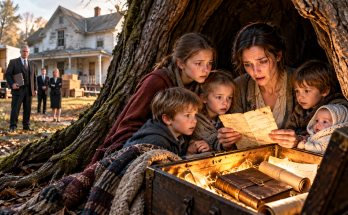
I remembered leading the children toward it.
How ashamed I had felt.
How certain I had been that everyone would see a mother who had failed.
I had called it shelter because I could not bear to call it desperation.
Looking back, that was unfair to myself.
I had done what I could with what I knew.
I had kept the children together.
I had found somewhere for them to spend the night.
Then, when the weather changed, I had moved them away from danger.
I had made mistakes.
I had hesitated.
I had been frightened.
But I had not abandoned them.
I needed to remember that.
I had spent too much time measuring myself against Dmitri.
He would have understood the land.
He would have known how to work the timber.
He would have recognized the strength of the cellar walls.
He would have made sense of the notebook without needing to study every page.
But he was gone.
And there were things I had understood that he had not.
I knew how frightening it was to be left without answers.
I knew what it felt like to watch five children lose their home.
I knew how difficult it was to discover a secret after the person who kept it could no longer explain.
I had lived those things.
Dmitri had not been there to see all of them.
That was the part of his plan he could not control.
I looked down at his handwriting.
The notebook rested beside the deed.
I opened it to the first message.
He had admitted that he had failed to tell me the truth while he was alive.
I read that admission slowly.
He had known.
Some part of him had understood that silence could hurt us.
He had hoped what he left behind would still protect us.
I looked around the room.
The unfinished walls were evidence that he had tried.
The passage had already protected us from the flood.
The cellar had held supplies.
The gifts had given the children something of their father.
The deed had given me legal ownership of land the bank had not taken.
Those things were real.
I could be grateful for them.
But I could not pretend the secrecy had been harmless.
I wished he had trusted me enough to explain.
I wished he had allowed me to share the worry.
I wished we could have sat together and discussed what needed doing.
I could imagine that conversation.
Not the exact words.
Not how it would have ended.
But the two of us sitting across from each other, frightened and tired, trying to make a decision together.
That was what I missed.
Not simply being protected.
Being included.
Julia came to sit beside me.
She had her jewelry box.
The flowers carved into the wood caught the daylight.
“Are you reading Father's letter again?”
“Yes.”
She looked toward the notebook.
“Does it still make you sad?”
I smiled faintly.
“Very.”
She lowered her eyes.
“Mine does too.”
I reached for her hand.
We sat quietly.
Then she opened the box.
Her letter was folded inside.
She touched it but did not lift it out.
“He knew I worried about everyone.”
“Yes.”
She looked at me.
“Did he know you worried too?”
The question surprised me.
I thought about Dmitri.
About the nights when he told me not to worry.
About the way he smiled when I asked whether the bills were getting worse.
About how relieved I had been to accept his answers.
“I think he knew,” I said.
Julia frowned.
“Then why didn't he tell you?”
I looked down at the notebook.
There it was.
The question I had been asking myself since finding his message.
Why?
I could give her the explanation Dmitri had written.
He had wanted a surprise.
Then the debts had become frightening.
He had been ashamed.
He thought he could solve everything before I needed to know.
But those reasons did not make the choice simple.
“He was trying to fix things by himself,” I said.
Julia looked toward the walls.
“Like when he worked late?”
“Yes.”
She thought for a moment.
“Was that wrong?”
I took my time answering.
“Working hard wasn't wrong.”
She waited.
“Keeping me from knowing how much trouble we were in was.”
Julia looked at her letter.
Then she nodded.
I wondered whether she would remember that conversation when she was older.
I hoped so.
I wanted her to know that love did not require silence.
That a person could be brave and still ask for help.
That protecting someone did not always mean hiding the truth.
Dmitri had tried to tell her something similar in his own letter.
Perhaps we had both been learning the same lesson too late.
Peter came over with the wooden boat.
He sat near the unfinished wall.
He turned the boat in his hands.
“Do you think Father wanted us to live here forever?”
I looked around.
The question seemed too large for the room.
“I think he wanted us to have a home.”
Peter looked at the boat.
“This one?”
“I believe so.”
He nodded.
Then he studied the wall again.
“It's not done.”
“No.”
He looked at me.
“Can it be finished?”
I felt the old fear rise.
I did not know enough to promise him that everything would be easy.
I did not know how much work remained.
I did not know whether we could use all the materials Dmitri had listed.
I did not know what condition the cellar was in after the storm.
But the house was standing.
The plans were there.
And the land belonged to us.
“I think we can find a way to keep working on it,” I said.
Peter nodded.
He seemed satisfied that I had not dismissed the possibility.
I was grateful.
I could not give him certainty.
But I could give him an intention.
I would try.
I would learn.
I would make decisions as carefully as I could.
And I would not hide every difficulty from the children merely because I wished to appear strong.
That did not mean telling them every frightening thought.
They were children.
They deserved protection.
But I wanted them to know that a problem could be faced without pretending it did not exist.
Anna opened her music box nearby.
The lullaby played.
Luke moved his horse across the floor.
The baby slept.
I looked at all five of them.
They had begun using the unfinished house as a place to be together.
Not because it was complete.
Because we were there.
That seemed important.
At the farmhouse, I had believed the walls made us a family.
Now I knew better.
The walls had sheltered us.
They had held our belongings and memories.
But losing them had not taken away the bonds between us.
We were still a family inside the cedar.
Still a family in the cellar.
Still a family in the dark passage.
And still a family here.
I watched Anna close the music box.
I watched Peter put away the boat.
I watched Julia fold her letter.
I watched Luke settle beside his sister.
The baby moved beneath the small blanket.
Those objects had crossed every place we had been since finding the cellar.
They had become familiar.
I thought of Dmitri making the boxes.
Writing each name.
Choosing each gift.
He had given the children something they could hold when they missed him.
He had given me documents and a key.
For a moment, that difference had hurt.
I had wanted something personal.
Something that belonged only to our marriage.
But then I looked at the notebook.
The pages were filled with his work.
His careful measurements.
His corrections.
His hopes for a home.
And his admission that he had kept the truth from me.
Perhaps that was the most personal thing he had left.
Not because it was easy to read.
Because it showed both the man I loved and the mistake he had made.
I closed the notebook gently.
I looked toward the passage door.
The cellar remained below us.
I would still need to find out what the flood had done.
There were supplies we might need.
There were things Dmitri had prepared that could help us make the house livable.
But I would not rush.
We had survived the storm because we followed the route to higher ground.
I would not ignore that lesson.
I returned my attention to the house.
The daylight revealed its unfinished places clearly.
I could see what needed examination.
I could see where our blankets were arranged.
I could see where the children had put their small gifts.
Nothing about it was grand.
Nothing about it resembled the secure home I had once imagined for us.
But it was ours.
That mattered more with every passing hour.
I unfolded the deed one last time.
I looked at the name.
Maria.
Dmitri had placed this land in my name.
I had spent so long feeling powerless that seeing it still surprised me.
I was not merely someone who had lost a house.
I was the owner of a place where another one had been begun.
The difference did not erase my grief.
But it changed what I could do next.
I folded the document.
Placed it beside the notebook.
Then I looked at my children.
“We're going to take care of what your father left.”
Julia nodded.
Peter looked toward the walls.
Anna held her music box.
Luke pressed the little horse against his chest.
The baby slept.
I did not make a grand promise.
I did not say everything would be easy.
I did not tell them we would never be afraid again.
I knew better.
Instead, I looked around the unfinished house and made a quieter decision.
We would understand what we had.
We would protect what mattered.
We would work with what remained.
And we would not confuse silence with strength.
Dmitri had left me Hope.
The notebook.
The land.
The unfinished house.
But he had also left me the responsibility of deciding what that hope would become.
I could not ask him to finish it.
I could only begin.
Source: news1.shoptonytv.net