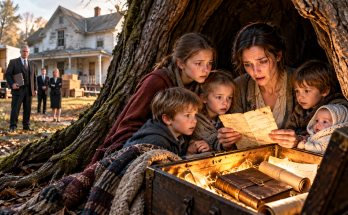
Julia read her father's letter while I stood beside her in the cellar.
She did not read it aloud at first.
Her eyes moved over the lines.
Then she stopped.
I knew the look on her face.
It was the same expression she wore when she was trying not to cry in front of the younger children.
I wanted to spare her.
But the words were hers.
Dmitri had written them for his eldest daughter, not for me.
I waited.
Finally, she turned the paper slightly so I could see it.
He had told her how proud he was of her courage.
He had noticed the way she tried to take responsibility for everyone around her.
He wanted her to understand that she did not have to be the strong one every moment.
She was allowed to lean on other people.
She was allowed to need them.
Julia made a small sound.
Then she pressed the letter to her chest.
I put my arm around her.
For weeks, she had seemed to grow older every time something went wrong.
She had helped after Dmitri's death.
She had watched the bank take the farmhouse.
She had walked beside me toward the cedar without asking why I could not find something better.
And now her father was telling her, from a piece of paper, that she did not have to carry everything.
I wished he had been there to say it himself.
Julia leaned against me.
I held her for as long as she needed.
Neither of us tried to speak.
The lantern gave a soft light against the cellar walls.
I could hear the faint rustling of the paper between us.
It was such a small sound.
But I have never forgotten it.
When Julia finally lifted her head, she wiped her face with her sleeve.
“Can I keep it with me?”
“Yes.”
She folded the letter carefully.
Then she placed it back inside the carved jewelry box.
She held the box in both hands.
There was something about the way she carried it that reminded me of Dmitri.
Careful.
Protective.
As though she had been given something that could not be replaced.
Because she had.
We brought the other children into the cellar.
Peter was the first to look toward the shelves.
I watched his face as he understood what was there.
Food.
Candles.
Wood.
Blankets.
He looked at me with questions in his eyes.
I shook my head slightly.
I could not answer them yet.
Then I showed him the boxes.
His name was written on one of them.
He crouched beside it.
For a moment, he did nothing.
I wondered whether he was afraid to open it.
I had felt the same fear with the notebook.
There was comfort in finding something left by Dmitri.
But every discovery reminded us that he would never hand it to us himself.
Peter finally lifted the lid.
Inside lay a pocketknife.
Beside it was a small wooden boat.
He picked up the boat first.
I watched his thumb pass over its smooth edge.
Dmitri had always enjoyed making small things from wood.
A boat like that was exactly the sort of object he would have shaped by hand.
Not because it was expensive.
Because it was meant for one particular child.
Peter turned it over.
He studied the details.
Then he picked up the knife.
He looked at both objects for a long time.
I did not ask him what he was thinking.
His silence belonged to him.
I knew only that his father had remembered him.
Not simply as one of five children.
As Peter.
A boy who could receive a small boat and a useful tool and know they had been chosen for him.
Peter put them back carefully.
Then he opened the box again, as if he needed to see them once more.
Anna waited beside us.
When I told her which box was hers, she knelt in front of it.
She lifted the lid.
Inside was a music box.
She looked at me before touching it.
I nodded.
She opened it.
A familiar lullaby began to play.
I felt my knees weaken.
I knew that tune.
It had been part of our home.
The sort of melody that could make an ordinary room feel peaceful.
And now it was rising through a hidden cellar while my children stood around a lantern.
Anna listened without moving.
I watched her mouth tremble.
The tune was quiet.
So was she.
I wanted to tell her that her father had remembered which lullaby she loved.
But she already knew.
That was why she was crying.
For the first time since the funeral, I let the tears come without trying to stop them.
I had been so busy thinking about survival that I had almost forgotten how much the children needed room to grieve.
They had lost Dmitri too.
Not just the man who earned money and repaired things.
They had lost the person who knew which small gift would make each of them feel loved.
The music continued.
Then it ended.
Anna closed the box gently.
She held it near her chest.
Luke had been watching Peter and Anna.
He came closer when I pointed to his name.
His box seemed to interest him immediately.
He opened it with both hands.
Inside was a carved horse.
Its mane had been painted black.
I recognized what Dmitri had done.
He had once promised Luke a horse.
The promise had stayed in Luke's mind long after it was spoken.
Children remembered those things.
Adults sometimes forgot how seriously they were taken.
But Dmitri had not forgotten.
Luke lifted the little horse and looked at it from every side.
He touched the painted mane.
Then he looked at me.
“Father made this?”
“I believe he did.”
Luke nodded.
He held it tightly.
I could see him trying to fit the small wooden animal together with the larger horse he had once expected.
I wanted to explain that it was not the same.
But he did not need me to tell him.
He knew.
Still, he kept the horse in his hand.
He did not put it down while we looked at the last small box.
That one belonged to the baby.
Inside was a tiny knitted blanket.
I lifted it out slowly.
It was soft.
Small enough to remind me how little our youngest child still was.
Of all the things Dmitri had left, that blanket brought back the simplest memories.
The baby against his chest.
His hands holding such a little body with surprising gentleness.
His habit of checking whether the child was warm enough.
I had watched him do those things so often that I had stopped noticing.
Now every memory felt precious.
I pressed the blanket against my face for one moment.
Then I wrapped it around the baby.
The younger children stood close.
Nobody rushed us.
Nobody asked what everything was worth.
Nobody spoke about the bank.
For a little while, we were simply a family remembering the person who was missing.
Julia still held her jewelry box.
Peter had his wooden boat and knife.
Anna kept her music box close.
Luke carried the horse.
And the baby rested in Dmitri's small blanket.
I looked at all five of them.
My husband had known them so well.
He had known what Julia needed to hear.
He had remembered Peter's small pleasures.
He had remembered Anna's song.
He had remembered Luke's promise.
He had thought of the baby.
My throat hurt.
I had been angry with Dmitri since discovering the truth about the debts.
I was still angry.
But the anger had become harder to hold in one shape.
Because here, in a cellar nobody had told me about, was proof that he had been thinking of us.
He had not forgotten his family.
He had hidden things from us.
Those were different truths.
And I was beginning to understand that both could exist together.
I sat on one of the chairs.
The children stayed near their boxes.
Then Julia turned toward the far end of the wall.
“Mother, there's another one.”
I followed her gaze.
A sixth wooden box stood apart from the five small ones.
It was larger.
I had been so focused on the children that I had hardly noticed it.
I went closer.
One name had been written on the lid.
Mine.
Maria.
For a moment, I could not touch it.
I had watched the children receive their father's gifts.
I had seen the care in every one.
But I was not prepared to find something meant only for me.
I had spent so long being their mother that I had nearly forgotten I was also Dmitri's wife.
The woman he had loved.
The woman he had failed to confide in.
The woman who had buried him without knowing what he had been trying to do.
Julia came beside me.
“Open it, Mother.”
I set my hands on the lid.
The wood felt smooth beneath my fingers.
I lifted it.
Inside was an envelope.
An iron key.
And a folded paper bearing the county seal.
I knew immediately that these were not ordinary gifts.
There was no little carved object.
No music.
No soft blanket.
Only things that looked like they belonged to business Dmitri had never explained.
I picked up the folded document.
The seal caught my eye again.
I had seen official papers before.
After everything that had happened with the bank, the sight of one was enough to make my stomach tighten.
I did not want another demand.
I did not want another reminder of what we owed.
I wanted one thing in my life to be simple.
But Dmitri had left the document in a box with my name on it.
So I opened it.
I read the first lines.
Then I read them again.
The paper concerned land at Cross Ridge.
Not the farmhouse we had lost.
Not the debt the bank had enforced.
Another property.
Forty-two acres.
The abandoned farm.
The freshwater spring.
The old orchard.
The grove where the great cedar stood.
I could hardly breathe.
Dmitri had bought it.
Three years earlier, he had begun purchasing the entire property.
Not with a single payment.
He had paid for it little by little.
I knew where that money had come from.
The wagon repairs.
The farm tools he sharpened.
The hours he worked after dark at the sawmill.
The nights when he came home so tired that he could barely finish his meal.
I had believed all that work was part of keeping our farmhouse going.
And some of it must have been.
But here was an entirely different purpose.
A piece of land he had never told me he was buying.
I kept reading.
The final payment had been made eight months before.
Eight months.
I stared at those words.
Dmitri had finished paying for this land while he was still alive.
He had completed what he had started.
Then I saw the name on the deed.
Mine.
Not his.
Maria.
He had registered the property in my name.
I looked up at Julia.
She was watching me closely.
“What does it say?”
I could barely form the words.
“Your father bought this land.”
She looked around the cellar.
“Here?”
I nodded.
“All of it?”
I looked down again to be certain.
“Forty-two acres.”
The number seemed impossible.
I read the description once more.
The spring.
The orchard.
The cedar grove.
The ground beneath the shelter where we had spent the previous night.
It was ours.
No.
The legal document said something even more astonishing.
It was mine.
And it was paid for.
There was no mortgage against this land.
The debt that had cost us the farmhouse had been secured against that old property.
It did not give the bank the right to seize Cross Ridge in the same foreclosure.
I lowered myself into a chair.
My legs would not hold me properly.
For days, I had been thinking of myself as a woman with nowhere left to stand.
I had walked into the cedar ashamed that I could offer my children nothing better than a hollow trunk.
And all along, the ground beneath that tree had belonged to me.
I began to cry.
Not quietly this time.
Julia knelt beside me.
I put my hand over the paper.
I could not let go of it.
I kept thinking of Dmitri.
Of how hard he had worked.
Of how foolish he had been to hide the truth.
Of how much I wished he had spoken to me while there was still time.
He had left us without the farmhouse.
He had also left us something I had not known existed.
The two facts sat beside each other.
Neither erased the other.
I looked around at my children.
They were watching me with the same uncertain expressions they had worn when we first arrived at the cedar.
But this time I had something real to tell them.
“We have land,” I said.
Julia held my arm.
Peter looked from me to the document.
Anna kept her music box close.
Luke stood with the carved horse in his hand.
The baby slept in the little blanket.
I looked back at the deed.
I had spent so much time believing everything had been taken that I had forgotten there might still be something left to find.
Then I noticed the iron key.
It was resting in the larger box beside the envelope.
A small note had been attached to it.
I picked it up.
Dmitri had written another instruction.
He wanted me to follow the spring toward the higher ground.
He said I would understand there why he had given his notebook its name.
Hope.
I looked at the key in my hand.
Then at the notebook.
Then at the deed bearing my name.
I had found my husband's secret purchase.
I had found the gifts he had left for our children.
But the drawings of walls and windows still had no explanation.
Neither did the key.
Somewhere beyond the cellar, the spring ran down the slope.
I remembered the little watercourse near the cedar.
I remembered the higher ground on the northern side.
Dmitri wanted me to go that way.
I folded the deed carefully and placed it inside its envelope.
For the first time since the bank took our house, I was holding a document that did not describe something being taken away.
It described something that was ours.
Outside, thunder sounded over Cross Ridge.
I looked toward the stairs.
The light beyond the hatch had changed.
Clouds were gathering over the grove.
I thought about waiting until the next morning before following the spring.
The children had already endured enough that day.
They needed rest.
I needed time to understand what I had just read.
I placed the iron key beside the notebook.
Then I looked once more at the five small boxes.
Dmitri had prepared something for every child.
And something for me.
I still did not know the full meaning of it.
But I finally understood one thing.
He had not simply been hiding money or property from his wife.
He had been trying, in his own stubborn and terribly lonely way, to make sure his family would have somewhere to go.
I wished he had let me help him.
I wished we had stood together over those plans.
I wished he had trusted me with the fear as well as the hope.
But wishing could not bring him back.
I put the deed safely away.
I kept the key within reach.
And as the thunder rolled again, I looked at my children and knew that the ground beneath us was no longer a place where we had come only because we were desperate.
It was our land.
For that moment, it was enough.
Source: news1.shoptonytv.net