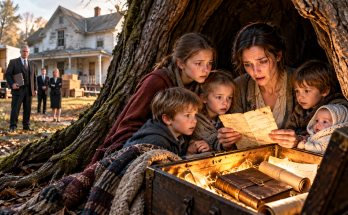
I remember the way Julia looked at the map before we left the cedar.
She looked from the drawn tree to the real one.
Then she looked toward the north.
She was trying to understand something I could not explain.
So was I.
I had married Dmitri.
I had known his hands, his habits, the way he frowned when a measurement did not make sense.
Yet I was standing beside our daughter with a notebook that made me feel like a stranger to part of his life.
Julia brought the shovel.
It was her father's.
The sight of it hurt me in a way I had not expected.
I had seen that shovel countless times.
Dmitri had carried it without thinking.
He had used tools every day, then put them aside and come home to his family.
Now even an ordinary handle could make me remember that he would never take it from my hands again.
I gripped it and tried to steady myself.
Julia waited.
“Show me where,” she said.
I opened the map again.
The great cedar was the reference point.
From there, Dmitri had marked the direction and distance toward the northern rise.
I counted out the space as carefully as I could.
The ground was difficult.
Brush caught at our clothing.
Fallen branches lay across the way.
Moss covered stones and roots.
More than once, I stopped to check the drawing.
I worried I had misunderstood it.
Dmitri could make a map seem obvious when he stood beside me and pointed things out.
Without him, the same lines looked uncertain.
Julia stayed close.
“Are we going the right way?”
“I think so.”
She did not complain.
That was one of the things her father had written about her.
She had always tried to carry more than she should.
Even then, with no proper place to call home, she was helping me search instead of asking what would happen to her.
I wanted to tell her to rest.
I wanted to tell her to let me do it.
But I needed her.
And that was another truth I had to accept.
We moved farther into the undergrowth.
The cedar remained visible behind us.
I looked back several times to make certain I could still recognize the route.
A slope rose ahead.
There was nothing remarkable about it.
Just earth and stones and old growth.
I could not understand why Dmitri had drawn a circle there.
Then Julia noticed the stones.
“Mother, look.”
Three of them rested close together.
Not scattered at random.
They formed a triangle.
I bent down.
Leaves had collected around them.
The ground looked untouched.
I held the map over my knee and checked the position.
The circle was exactly where we stood.
My throat tightened.
Dmitri had known this place.
He had brought himself here and arranged something for us to recognize.
Or perhaps he had found an arrangement already there and recorded it.
I did not know.
What mattered was that the mark on the page matched the ground beneath our feet.
I handed Julia the notebook.
“Hold this.”
Then I began moving leaves away from the stones.
At first, I saw only dark earth.
Small twigs.
Old moss.
Nothing that explained the drawing.
I cleared more.
The shovel scraped against something solid.
Not stone.
Wood.
I stopped.
Julia crouched beside me.
“What is it?”
I did not answer.
I brushed away another layer of leaves.
A straight edge appeared.
I followed it with my fingers.
Then another.
There was a wooden covering beneath the ground.
A hatch.
For a moment, I simply stared.
I had expected something small, perhaps a buried box or a mark Dmitri had left.
I had not imagined a door.
Especially not one hidden beneath three ordinary stones.
Julia helped clear the remaining leaves.
The outline became visible.
I could see how carefully it had been concealed.
From a few steps away, it would have looked like part of the forest floor.
I wondered how many times we might have passed nearby without noticing it.
The thought made me uneasy.
Something had been here while our family lived in the farmhouse.
Something Dmitri had known about.
I touched the wooden surface.
It was real.
Not a drawing.
Not a promise.
A solid thing beneath my hand.
Julia looked at me.
“Did Father make this?”
“I don't know.”
I wanted to say yes.
His work had been so much a part of our home that I recognized care even when I could not recognize the object.
But I did not know who had built it.
And I had promised myself, after reading his letter, that I would stop pretending certainty when I had none.
We found where the hatch could be lifted.
I tried first.
It resisted.
Julia moved beside me.
“Together?”
I nodded.
We pulled.
The wood shifted.
For an instant, I thought it would fall back into place.
Then the hatch rose enough for us to see beneath it.
Darkness.
And steps.
I felt cold despite the effort of clearing the ground.
A staircase descended under the ridge.
I could not see its end.
Julia leaned closer, then stopped.
“Mother, there's a room down there?”
“Maybe.”
I looked back toward the cedar.
The children were only a short distance away, and I was suddenly aware of how exposed we had been since losing the farmhouse.
We had spent the night inside a tree.
And all that time, something had been hidden beneath the ground nearby.
I thought about Dmitri's opening words.
He had hoped he had still managed to protect us.
What did he mean?
Why leave a map instead of telling me where to go?
Why make me discover the place after he was gone?
I knew he had wanted a surprise at first.
But this was no small surprise.
He had built his silence around something that could be opened like a door.
Julia touched my arm.
“Should we go down?”
I looked at the stairs again.
I was afraid.
Not because I thought Dmitri meant us harm.
I had never believed that.
I was afraid of finding another piece of his life I had not shared.
I had already lost the husband I knew.
I did not want to discover that I had never fully known him at all.
But standing there would not change the truth.
I reached for the lantern.
The light revealed the first few steps.
They were made to be used.
The space was narrow but deliberate.
I checked the hatch above us.
Then I stepped down.
Julia followed.
The air changed as we descended.
It was cooler.
Still.
Different from the damp smell of the hollow tree.
The lantern light moved over stone and timber.
I held it forward.
At the bottom, the staircase opened into a cellar.
I stopped so suddenly that Julia nearly came against my back.
There was space to stand.
There were walls.
Shelves.
Supplies.
For several breaths, I could not make myself move.
The cellar was not a forgotten hole in the ground.
It had been prepared.
Someone had taken trouble over it.
Someone had arranged things as though people were expected to come.
I raised the lantern.
Sacks sat on the shelves.
Jars stood in rows.
There were candles, blankets, tools, and firewood.
I looked around slowly.
Our farmhouse had been taken because of debts.
We had carried our children into the cedar because we had nowhere safe to stay.
And beneath the ridge was a place containing things a family could use.
I looked at Julia.
She was staring too.
“Mother?”
“I see it.”
That was all I could manage.
I stepped toward the nearest shelf.
The sacks held flour.
The jars contained preserved vegetables.
I checked them, hardly trusting my own eyes.
They were not imaginary riches.
They were ordinary provisions.
Food.
Light.
Warmth.
The things I had been worrying about since we left the farmhouse.
I touched a folded blanket.
I had spent the night trying to keep the baby comfortable with what little we had carried.
Here were more blankets waiting in the dark.
My eyes filled.
I was angry with myself for crying over such a simple thing.
But it was not simple to me.
After the bank took our home, every useful object seemed to have become precious.
And here was a whole room of them.
I turned in place.
The cellar was dry.
It was larger than I had expected from the size of the hatch.
Stone supported the space.
Timber had been used with care.
The shelves were arranged neatly.
Dmitri had always liked things put where they could be found.
I could almost hear him explaining why he had placed one item beside another.
The thought made me press my hand against the nearest wall.
I needed a moment.
Julia moved toward the far side of the room.
“Mother, there are boxes.”
I turned.
Five small wooden boxes stood against one wall.
They were not the same as the sacks or jars.
They were too carefully made to be ordinary storage.
I went closer.
Each had a name written on it.
Julia.
Peter.
Anna.
Luke.
And the baby.
All five children.
All five names.
I felt as though someone had put a hand against my chest.
The cellar was not merely a hidden store of provisions.
It had been arranged for our family.
For my children.
For the very people who had been forced out of their home.
Julia reached toward the box with her name.
Then she stopped.
“May I?”
I looked at her.
The question nearly undid me.
Her father had written her name on the wood.
He was gone, yet she was asking me whether she was allowed to receive what he had left.
“Of course,” I said.
She lifted the lid carefully.
Inside was a wooden jewelry box.
Flowers had been carved into it.
I knew Dmitri's patience with small pieces of wood.
He could sit a long time over something that most people would never notice.
I imagined him working on those flowers.
Choosing where each curve should go.
Taking care because the finished thing would belong to Julia.
She lifted it out.
Underneath lay a letter.
She recognized his handwriting.
I saw it in the way her face changed.
For one moment, she looked younger.
Not like my eldest daughter trying to help me hold the family together.
Just a girl who had found something from her father.
She opened the paper.
I stayed beside her.
I had already learned how much a few lines in Dmitri's hand could hurt.
And how badly I needed to read them anyway.
Source: news1.shoptonytv.net