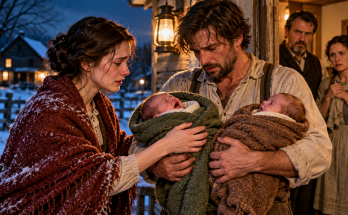
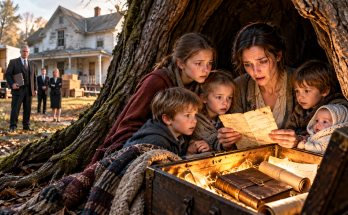
I used to believe a home was something nobody could take from you if you worked hard enough.
I was wrong.
By the time I understood that, my husband was dead, the bank had taken our farmhouse, and I had five children who still looked at me whenever they wanted to know what came next.
I had no answer for them.
That was the part I hated most.
Not the loss of our furniture.
Not the empty rooms.
Not even the knowledge that another family might someday sleep beneath the roof Dmitri and I had called ours.
It was the way my children kept waiting for me to say something that would make everything all right.
They trusted me.
I could hardly bear it.
My name is Maria, and before all of this happened, I thought I knew the man I had married.
Dmitri was not a man who talked much about what frightened him.
He worked.
He fixed things.
He came home tired and washed his hands before touching the baby.
When something went wrong, he usually said he would manage.
And most of the time, he did.
That was what made the debts so difficult for me to understand.
I knew we had bills.
I knew the farmhouse was no longer as secure as it had once seemed.
But I had not understood how far things had gone until there was nothing left for us to save.
By then, Dmitri could not explain himself.
I had buried him.
I had stood beside his grave and listened to people speak about what a hardworking, decent husband he had been.
They were telling the truth.
That made my anger worse.
Because a good man could still leave behind a terrible mess.
And the person who loved him could still be the one forced to clean it up.
I remember looking at the farmhouse after the bank took it.
I knew every uneven board near the entrance.
I knew which window let the cold air through.
I knew the place where the afternoon light fell across the floor.
None of those things belonged to us anymore.
Julia stood beside me.
She was my eldest, and she had already begun behaving as though growing older meant she was no longer allowed to be frightened.
She watched me instead of the house.
“Where are we going, Mother?”
I wish I could say that I answered her calmly.
I did not.
I kept looking at the door.
For one foolish moment, I wanted to walk back inside and pretend that nothing had happened.
I wanted Dmitri to come around the corner with his work clothes dusty and his hands full of something he had repaired.
I wanted him to tell me he had found a way.
But the door remained closed.
And Dmitri was gone.
“We'll find somewhere,” I said.
It was not a plan.
It was all I could give her.
Peter stood nearby with what little we could carry.
Anna stayed close to him.
Luke kept looking from one face to another, trying to understand why nobody was going back into the house.
And the baby needed warmth and care, no matter what had happened to the rest of us.
Five children.
Five different ways of being afraid.
I watched them and felt something inside me tighten.
I could not change what the bank had done.
I could not bring back their father.
But I could keep them together.
That much was still mine to do.
I had been thinking about the cedar grove for reasons I could not properly explain.
It belonged to the abandoned land around Cross Ridge, a place where the trees grew thick and the ground rose toward the northern slope.
I remembered the enormous cedar.
Its trunk had been hollowed by time.
The opening was large enough to enter.
Under ordinary circumstances, I would never have considered bringing my children there to sleep.
But those were no longer ordinary circumstances.
A hollow tree was not a house.
I knew that.
I also knew that night would come whether I found a roof or not.
So I made the decision.
“We're going toward the cedar,” I told Julia.
She looked at me for a moment.
“The large one?”
I nodded.
She did not ask whether I was certain.
Perhaps she already knew I wasn't.
We walked together.
Peter helped with our things.
Anna stayed near the others.
Luke grew quiet as the farmhouse disappeared behind us.
The baby slept for part of the way.
I remember watching the children's feet more than I watched the path.
I kept checking that nobody had fallen behind.
I kept counting them.
One.
Two.
Three.
Four.
Five.
I had never counted my own children so often before.
But grief had taught me how suddenly something familiar could disappear.
By the time we reached the grove, the light beneath the branches was beginning to fade.
The enormous cedar stood among the other trees, its trunk wider than any of the children could have reached around.
The hollow opening looked dark.
There was something humiliating about standing in front of it with my children.
I had once complained about the farmhouse being too small.
I remembered wishing for another room, another cupboard, a little more space.
Now I was asking five children to trust me inside a tree.
I stepped through the opening first.
The ground was uneven.
The air smelled of old wood and damp earth.
I looked up into the trunk, checking what I could see.
Then I turned toward the opening.
“Come inside.”
Julia entered first.
Peter followed with our belongings.
Anna took Luke's hand.
I helped settle the baby where I could keep the little one close.
For a while, nobody said very much.
The children looked around.
I tried to make the space seem less strange than it was.
“We'll stay together,” I told them.
It was the only comfort I could offer without lying.
Luke touched the inside of the trunk.
“Are we sleeping here?”
“Yes.”
“For tonight?”
I looked at the others.
“For now.”
He nodded as if that answered everything.
Children sometimes accept words because they have no choice.
I think about that even now.
Julia helped make a place for the younger ones.
Peter arranged what he had carried so it would not be underfoot.
Anna sat quietly, listening to the wind outside.
The baby stirred.
I held the little one close and listened to the cedar creak.
There were sounds everywhere.
Leaves moving.
Branches rubbing.
The faint noises of the children settling down.
I had lived with Dmitri long enough to become used to the noises of a wooden house.
At night, the farmhouse sometimes creaked as the temperature changed.
Dmitri had always been able to tell me which board or beam was making the sound.
Here, I knew nothing.
Every movement overhead made me glance upward.
I didn't want the children to see that.
So I kept my hands busy.
I straightened blankets.
I moved our things.
I checked on the baby.
Then I did it all again.
Julia watched me.
“You can sit down, Mother.”
I almost told her I was fine.
That had become such an easy answer.
Instead, I sat beside her.
For a while, we watched the opening together.
The last of the daylight was slipping away.
“I miss Father,” she said.
There was no warning in her voice.
No attempt to prepare me.
Just the words.
“I know.”
She lowered her eyes.
“He would know what to do.”
I wanted to agree.
I wanted to tell her he always knew.
But the bank had taken our home because there were things Dmitri had not managed to put right.
I loved him.
I missed him so badly that sometimes I reached for him before remembering.
And I was angry with him.
All three feelings lived in me at once.
“He would be trying,” I said.
Julia nodded.
Then she leaned against me.
For the first time that day, I stopped trying to appear strong.
I put my arm around her.
Outside, the cedar branches moved against the evening sky.
The tree was old.
Older than my children.
Older than the farmhouse.
Older, perhaps, than anything I had ever called mine.
It had stood through seasons I would never know about.
And now it was sheltering us.
I remember thinking that Dmitri would have liked that.
He had always noticed old wood.
He understood its grain and its weaknesses.
He could look at a broken board and tell whether it was worth saving.
I used to tease him for keeping pieces of timber other people would have thrown away.
He never liked wasting anything useful.
That memory hurt.
I looked around the hollow trunk again.
The children were growing tired.
I could not let myself think too far ahead.
Not about the next week.
Not about winter.
Not about how I would keep us fed and safe when I had no farmhouse to return to.
I needed to make it through one night.
Then another morning.
That was how small my world had become.
Before Dmitri died, I had measured our future in years.
Now I measured it in hours.
I wondered what he would have said if he could see us.
I wondered whether he had truly known how close we were to losing everything.
Most of all, I wondered why he had kept so much from me.
I was his wife.
I would have helped him.
I would have been frightened, yes.
I would have cried and worried.
But I would have stood beside him.
That was what marriage had meant to me.
Somewhere outside, the wind rose.
The branches answered.
I pulled the baby closer.
Then I looked at the faces around me.
Julia trying not to worry.
Peter pretending he didn't need rest.
Anna looking toward the dark entrance.
Luke already leaning against his sister.
Five children who had lost their father and their home.
I could not give them back either one.
But I could remain.
That night, inside the cedar, I made myself a promise.
Whatever happened next, my children would not have to face it alone.
I did not know then that Dmitri had left something for us on Cross Ridge.
I did not know there were words in his handwriting I had never seen.
I only knew that the man I had buried still seemed to be standing between me and the truth.
And I was beginning to wonder how much of our life together I had never understood.
Source: news1.shoptonytv.net