The first confirmed recovery came in the form of a figure written on Sarah Bennett's legal pad. It was not the entire amount stolen from Grandpa's account, and Sarah cautioned against treating it as money already restored to him. Investigators had identified funds and assets potentially subject to recovery through proceedings involving Heartland Ag Solutions and Prairie Development Holdings. Some accounts had been restrained while their ownership and the source of deposits were examined. Other assets remained disputed. Still, for the first time, the investigation had moved beyond identifying wrongdoing toward finding something that might be returned.
Grandpa was seated at Grandma's kitchen table when Sarah explained the development. He listened to the figure, then asked whether any part of it belonged to Walter Price. Sarah said Walter's investment was being investigated separately, and the available evidence did not yet permit a final allocation. Grandpa nodded. He had begun asking about Walter almost as often as he asked about his own savings. The retired mechanic's loss had become a reminder that the scheme had spread through people who believed the Doyle name represented fair dealing.
Sarah said the financial tracing was increasingly clear. Money from Grandpa's account entered Heartland Ag Solutions in seventeen transfers. From there, portions moved to Prairie Development Holdings, where they were mixed with other business funds. Some payments ultimately reached legitimate creditors of Doyle Implement. Others were recorded as consulting fees, administrative charges, or financing expenses. Investigators were examining whether those fees corresponded to genuine services or represented improper benefits.
Grandpa asked whether Grant had used the money to purchase personal property. Sarah answered that the records showed expenditures associated with his company, but she would not characterize every payment as personal spending. Some involved vehicles, professional fees, travel, and transfers between related accounts. Whether they constituted unlawful diversion depended on the full evidence. Grandpa seemed satisfied by the distinction. He did not want accusations exaggerated simply because the available facts were already serious.
The next day, Tom Callahan asked us to attend a meeting with the bank's independent review team. This time the setting was not his office. We gathered in a conference room without photographs or familiar furniture, attended by outside accountants and counsel. Tom explained that he had deliberately limited his personal role in the process because of his friendship with Grandpa. He remained responsible for the institution's response, but independent professionals were evaluating the conduct and determining appropriate corrective action.
One of the accountants presented a chronological map of the transactions. The first transfer from Grandpa's savings occurred in January, shortly after the questionable December collateral authorization. The payments increased in frequency as Doyle Implement's cash shortages worsened. When the dealership received funds through Prairie Development Holdings, some obligations were temporarily satisfied, creating records that made the business appear healthier than it was. But subsequent withdrawals and new fees quickly consumed the money.
I studied the chart and recognized the shape of the deception. Each temporary repair had made the underlying problem larger. Wade borrowed to avoid a missed payment. Grant arranged another transaction to conceal the weakness. Fees accumulated. False records became necessary to justify earlier false records. By the time Grandpa visited the bank for the combine belt, the arrangement depended on preventing him from seeing what had happened.
The accountant showed us how the transfers had been described internally. Several were labeled as approved business support or authorized family financing. Those descriptions gave ordinary bank employees a reason not to question the payments. Meanwhile, the false account warning portrayed Grandpa as unable to manage his own affairs. The same system that accepted questionable instructions from others was prepared to reject questions from the person whose money was being moved.
Grandpa asked whether anyone had attempted to contact him directly about the transfers. The review found several communications marked as completed, but the supporting records led back to telephone verifications arranged through Grant's department. Other notices had been mailed to the farmhouse, where Wade had been collecting correspondence. There was no reliable evidence that Grandpa had personally approved the transfers or received a clear explanation before they occurred.
The independent team also examined the December signature. A qualified document examiner had compared the questioned authorization with verified examples spanning several years. The examiner's preliminary opinion strongly supported that the signature was not written naturally by Grandpa. It appeared to have been produced through a copying or imitation process. The report did not identify who created it, but the conclusion further undermined the claim that Earl had voluntarily pledged his assets.
Grandpa asked to see the comparison. The examiner had marked characteristic differences in letter connections, pressure changes, and the final upward stroke. Grandpa examined the page through his glasses, then smiled without humor. He said the person who copied his name had remembered the broad shape but not the habit his injured hand had developed decades earlier. The small imperfection that once made his signature awkward had helped distinguish it from an imitation.
Tom looked at him for a long moment. He said he was sorry the bank had failed to detect what should have been questioned earlier. Grandpa answered that apologies mattered, but procedures mattered more. He wanted to know how Prairie State intended to prevent the same thing from happening to another customer who lacked influential friends or a granddaughter standing beside him.
The bank's review team described proposed changes. High-risk account notes would require stronger documentation and independent approval. Certain sensitive transactions would receive additional verification outside the originating department. Conflicts involving officers' private businesses would be reviewed more rigorously. The bank was also examining how employees interpreted warnings about vulnerable customers, particularly when such warnings could be used to restrict the customer's own access.
Grandpa listened carefully, then asked a question that silenced the room. What would have happened if Tom Callahan had not recognized his name in the lobby? The lead accountant admitted that the fraudulent transfers might have remained undiscovered longer and that the false warning could have continued interfering with ordinary account access. Grandpa said that was the weakness the bank had to correct. A customer's safety should not depend on being important to the president.
Tom lowered his eyes. He agreed. He had spent weeks confronting the fact that Earl's personal connection had allowed the situation to be corrected quickly, while another customer might have been sent away. The bank could not restore confidence by treating one well-known shareholder exceptionally. It had to treat every customer fairly, including those whose clothes, age, or manner did not match an employee's expectations.
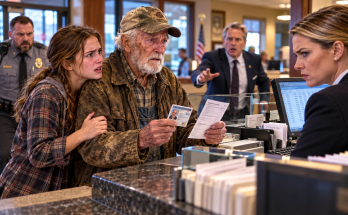
After the meeting, Denise Porter spoke privately with Grandpa and me. She said Kayla had been removed from customer-facing duties while the bank examined her conduct and provided additional training. An internal review found no evidence that she knowingly participated in the transfers or the false documentation. But her treatment of Grandpa had violated the institution's service and escalation standards. Denise said the bank had made clear that suspicion must be based on verifiable concerns, not assumptions about appearance.
Grandpa asked whether Kayla had lost her job. Denise said personnel decisions remained confidential, and she could not discuss every detail. Grandpa accepted that. He said he did not want revenge against a young employee who had behaved badly. He wanted her to understand why her conduct was wrong and why it mattered. He also wanted the bank to recognize that the false account note had created the conditions for the confrontation.
That afternoon, Deputy Ruiz contacted Sarah with confirmation that investigators had obtained additional communications involving Vivian Cross. Digital records connected her work device to the creation and handling of the disputed medical letter. A separate sequence linked her access credentials and file transfers to the selected bank photograph. Investigators were still determining who sent the threatening text, but the evidence supported allegations that she had knowingly helped prepare and distribute misleading material.
Ruiz also reported that a review of Grant's private companies had uncovered records showing he benefited from several fees tied to Doyle Implement's refinancing arrangements. Some fees had been disclosed as ordinary business charges. Others appeared to have been concealed from Prairie State or supported by questionable services. The financial motive was becoming clearer. Grant had not merely tried to prevent a loan from failing. His related business interests had received money while the dealership became increasingly dependent on his arrangements.
Grandpa listened through the speakerphone and asked whether Wade had known about those fees. Ruiz said Wade claimed he understood some charges but not their full extent. Investigators were comparing that account with emails, invoices, and bank transfers. Some messages suggested Wade had complained about the increasing costs. Others showed him accepting arrangements despite knowing they endangered his father's savings.
The distinction mattered to Grandpa. Wade might have been manipulated by Grant's financial leverage, but he had also made choices that allowed the manipulation to continue. He had provided information, concealed correspondence, and supported false documents. Grandpa could grieve the pressure his son experienced without pretending he had no responsibility for the harm.
The following week brought a second development. The guardianship petition was formally dismissed after Wade withdrew his request and the court considered the serious defects in its supporting evidence. Sarah obtained certified copies of the dismissal and arranged for the relevant records to reflect that no finding of incapacity had been made against Grandpa. The false medical letter remained part of the investigation, but it could no longer be used as an unchallenged basis for restricting his decisions.
Grandpa attended the hearing despite Sarah telling him his presence was not strictly necessary. He sat upright while the judge confirmed the dismissal. When it ended, he thanked Judge Marsh for allowing the evidence to be examined. He did not mention his son's betrayal. He simply said he was grateful that the court had listened to him as a person capable of speaking for himself.
Outside, Mom embraced him. I expected him to smile, but his eyes filled with tears. He said he had never imagined needing a judge's order to protect his right to decide where he lived or what he did with the farm. The relief was real, but it came with a sadness that no legal ruling could remove.
Wade was not present. His attorney had handled the withdrawal. Sarah said Wade remained in contact with investigators and was continuing to provide documents. Grandpa asked whether he had requested another meeting. Daniel Mercer had made no such request. Grandpa seemed disappointed, though he did not say so.
Two days later, the restructuring adviser reported that Doyle Implement could not continue under its existing ownership and financial arrangements. A supervised sale of certain legitimate assets offered the best prospect of preserving value and protecting customers. Several employees might be hired by an established equipment dealer interested in acquiring the service operation and inventory. Nothing was guaranteed, but the possibility was better than an uncontrolled closure.
Grandpa asked Martin Hale whether the sale could preserve the repair department where Walter Price had once worked. Martin said the prospective buyer was interested in maintaining a local service shop because the customer base remained valuable. The buyer had no intention of assuming undisclosed debts or questionable financing arrangements, but it might keep several mechanics and parts employees. Grandpa offered to introduce the prospective buyer to long-standing customers if that would help, provided the process remained transparent.
Mom worried that Grandpa was involving himself too deeply. He told her he wasn't trying to rebuild Wade's business. He was trying to make certain the workers and customers were not treated as disposable simply because management had failed them. The distinction was important to him. The farm had survived difficult years partly because neighbors helped one another through honest arrangements. He still believed that kind of help mattered.
The adviser later confirmed that several customer deposits could be matched to identifiable equipment or recoverable assets. Others would remain claims in the broader proceedings. Employees were informed about the likely changes and given access to information about wages and benefits. The situation remained painful, but for the first time the people affected were receiving explanations rather than assurances that everything would somehow work out.
One evening, Walter Price called Grandpa directly. His speech remained slow after the stroke, but he wanted to express gratitude for the efforts to trace the investment and preserve records. Grandpa told him the investigation was far from finished and that no recovery should be assumed until funds were actually returned. Walter said he understood. He was glad, he added, that someone had finally stopped pretending the debt didn't exist.
After the call, Grandpa sat beside Grandma's rolltop desk. He had begun returning some ordinary household papers to their compartments, though the legal documents remained with Sarah. He found an old receipt for a tractor repair Walter had performed decades earlier. Across the bottom, Walter had written that payment could wait until after harvest. Grandpa smiled at the handwriting.
He told me that trust had always been one of the community's strongest forms of credit. People lent tools, extended payment terms, and helped neighbors because they believed promises would be honored. Grant and Wade had used that culture of trust as cover for arrangements that took advantage of people. Restoring money would matter, but restoring confidence might take longer.
The next morning, Sarah called with news that formal proceedings were advancing against several individuals associated with the transactions. She could not yet discuss every count or outcome, but the investigation had reached a stage where allegations would be tested in a legal forum rather than remaining private suspicions. Wade's cooperation continued to be evaluated.
Grandpa asked whether Grant and Vivian had been given an opportunity to respond. Sarah said they were represented by counsel and would have the rights afforded to anyone facing allegations. Grandpa nodded. He wanted a fair process. After everything he had endured, he understood too well what it meant to be treated as guilty based on appearance or incomplete information.
Before ending the call, Sarah said the bank had begun a formal review of Grandpa's account for restitution. Independent specialists were calculating the unauthorized withdrawals, associated fees, lost interest, and any related damages that could be addressed through the applicable procedures. The precise amount remained subject to verification, but the process was moving forward.
Grandpa thanked her, then looked toward the fields. The harvest was complete. The combine stood cleaned and covered in the shed, ready for winter maintenance. For the first time in weeks, he had an afternoon without urgent machinery repairs, court hearings, or meetings at the bank.
He asked me whether I wanted to drive into town for lunch. I was surprised enough to laugh. He said he knew a diner where the coffee was terrible but the pie was worth enduring it. We went in his old Ford, the windshield wiper squeaking uselessly as always.
For nearly an hour, we talked about school, the harvest, and Grandma's habit of hiding spare money inside recipe books. Grandpa seemed lighter, though I knew the burden hadn't vanished. When the waitress asked whether everything was all right, he looked at me and answered that we were getting there.
That was the first time I believed him.