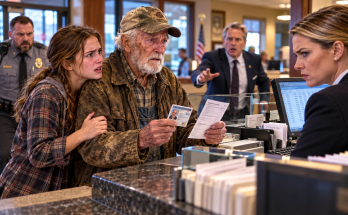
My mother fell asleep with her purse beside her chair.
I sat across from her.
The house was quiet.
The groceries had been put away.
The apples she'd insisted on choosing were in the kitchen.
And the photograph was back where she'd kept it.
Inside her purse.
I looked at her wrist.
The marks were beginning to fade.
I wished the memory would fade as quickly.
It didn't.
Every time I closed my eyes, I saw Derek holding her.
I heard the anger in his voice.
Then I heard my mother's frightened reply.
"You're hurting me."
I couldn't forget those words.
Not even after he cried.
Not even after he apologized.
Not even after he picked up her walker and placed it carefully in front of her.
Something about the order of those events bothered me.
He had hurt her first.
He had recognized her afterward.
And the recognition was what made him ashamed.
I wondered what would have happened if Mom hadn't been carrying that photograph.
If she hadn't noticed his name tag.
If she hadn't remembered his scar.
If she hadn't spent decades keeping a little piece of his childhood.
Would he have listened?
Would he have believed her?
I didn't know.
That was the part I couldn't stop thinking about.
The photograph had changed everything.
But my mother's innocence hadn't depended on it.
She had been innocent before she reached into her pocket.
She had been innocent while Derek was shouting.
She had been innocent while the crowd watched.
And she had been innocent when he refused to release her wrist.
I looked at her sleeping face.
Her expression had softened.
The lines around her mouth were relaxed.
She looked tired.
Very tired.
I thought about how pleased she'd been when we left for the supermarket.
She had argued with me about the apples.
Not because apples were especially important.
Because choosing them was something she could still do.
A small part of a life that had grown narrower after Dad died.
I had nearly taken that pleasure from her.
Then Derek had nearly taken it too.
For different reasons.
But the result might have been the same.
Mom could have decided that leaving home wasn't worth the trouble.
That people were too impatient.
That the world no longer had room for someone who moved slowly.
The thought frightened me.
She had already spent so much time inside.
I didn't want fear to keep her there.
But I couldn't decide for her.
That was what the day had been teaching me.
Again and again.
I looked toward the kitchen.
I could see the edge of the grocery bag I'd set aside.
It was empty now.
Nothing remarkable.
Just the remains of an ordinary errand.
I remembered abandoning my basket when I heard shouting.
I hadn't even thought about it.
One moment I was shopping.
The next I was running toward my mother's voice.
I had never moved so quickly.
Not because I expected anything terrible.
Because I knew she needed me.
I rubbed my hands together.
They had stopped shaking hours earlier.
But I could still remember the feeling.
Anger had carried me through the confrontation.
Afterward, fear had settled in its place.
I didn't like admitting that.
I wanted to think of myself as someone who could protect her.
Someone practical.
Someone capable.
But standing in that supermarket, I had discovered how little control I really had.
I could shout.
I could demand.
I could stand between Mom and someone who frightened her.
But I couldn't make that person listen.
Not until he chose to.
And Derek hadn't chosen to listen until he saw the photograph.
I looked at Mom.
She shifted slightly in her sleep.
Then settled again.
I waited.
When I was certain she was comfortable, I leaned back.
My mind returned to Derek's face.
The change had been astonishing.
He had gone pale.
His mouth had opened.
His fingers had trembled.
And when he recognized the photograph, he seemed unable to hold himself together.
I remembered the exact moment he spoke my mother's name.
Mrs. Hayes.
He hadn't said it like an adult addressing another adult.
He had sounded younger.
Almost like a boy recognizing his teacher.
I wondered whether Mom had heard that too.
She must have.
She had answered him as though no time had passed.
"Hello, Derek."
I had heard that tone before.
Not often.
But enough to recognize it.
She used it when someone from her teaching years approached her unexpectedly.
A warm familiarity.
A little surprise.
And the certainty that a person could change without becoming entirely disconnected from who they had once been.
I thought about the scar above Derek's eyebrow.
So small.
So easy to miss.
Mom had remembered the monkey bars.
The paper towel.
The knock-knock jokes.
Twenty minutes.
She had remembered the details of a childhood accident after more than thirty years.
I couldn't imagine remembering that much about someone I'd last seen in 1993.
Then again, I hadn't spent sixty years teaching.
I hadn't spent my days noticing children.
Their habits.
Their fears.
Their small attempts at courage.
My mother had.
I wondered how many former pupils still remembered her.
How many could recall something she had said.
How many carried memories she didn't know about.
Derek had certainly carried something.
The photograph proved it.
Or perhaps it revealed it.
I couldn't tell the difference.
I knew only that the little boy in the oversized cap still existed somewhere inside the man who had hurt her.
Not literally.
Not in any simple way.
But as a memory.
A person he'd once been.
Someone my parents had cared about.
I looked toward Mom's purse.
The photograph was inside.
The worn corners.
The yellowed border.
The handwriting.
I could picture it without seeing it.
I'd looked at it so many times that day.
Derek.
Summer 1993.
Brave boy.
We'll always leave the porch light on.
E & W.
I kept returning to the last line.
The porch light.
My parents had written that promise.
They hadn't explained it to me.
And I still didn't know the circumstances behind it.
I wondered whether it had been said in comfort.
Or encouragement.
Or simply as a way of telling a child he was welcome.
The words could mean many things.
I didn't want to guess.
But I understood one thing.
They were words of belonging.
Whatever else had happened, my parents wanted Derek to remember that he mattered.
I thought about Dad's hand on his shoulder.
Such a simple gesture.
It was the kind of thing my father did without thinking.
He liked people to feel encouraged.
I remembered him standing beside me when I was young.
His presence had always made ordinary achievements feel important.
I could imagine Derek feeling the same.
But I didn't know.
The photograph gave me the gesture.
It didn't give me the boy's thoughts.
That belonged to Derek.
And perhaps to Mom.
I looked at her again.
She was still asleep.
I felt a sudden ache.
I wanted Dad to be there.
I wanted to ask him about that summer.
I wanted to hear him talk about the boy.
I wanted to know what had made them write such a lasting promise.
But Dad was gone.
There would be no conversation with him.
No additional details from his memory.
That was one of grief's quieter cruelties.
You didn't simply lose a person.
You lost the things only that person could tell you.
Stories.
Answers.
A particular way of remembering an afternoon.
A different version of something you'd thought you understood.
I had spent years accepting that.
Then a photograph appeared and reminded me all over again.
I looked toward the window.
The light outside was changing.
I thought about the porch light mentioned on the photograph.
I imagined my parents writing those words in 1993.
I imagined the photograph being placed somewhere safe.
Then kept through the years.
Until Mom carried it into the supermarket.
Thirty-three years.
The number seemed impossible.
And yet it was written plainly on the back.
Summer 1993.
Now it was 2026.
Dad was gone.
Mom was eighty-five.
Derek was grown.
And the photograph had survived.
I wondered how many times it had been moved.
From one place to another.
From a drawer to a purse.
From Mom's purse to her sweater pocket.
Then into Derek's shaking hands.
Then onto the apples.
Then back into her purse.
So many ordinary movements.
And one terrible misunderstanding.
I looked down at my own hands.
Earlier that day, I'd reached toward Derek's arm.
I'd demanded that he release Mom.
He had acted as though I was interfering.
As though I didn't understand.
I could still feel the helplessness of that moment.
He'd been so certain.
Then he'd been so wrong.
I wondered whether that certainty had frightened Mom more than the physical pain.
Perhaps.
She had spent her life teaching children to question their assumptions.
To ask before accusing.
To listen before deciding.
And Derek had done the opposite.
I thought about telling her that when she woke.
Then I stopped.
She didn't need me to explain the injustice of what happened.
She understood it better than I did.
She had lived it.
I was the witness.
She was the person whose wrist had been held.
There was a difference.
I hadn't always respected that difference during the day.
I'd spoken for her.
I'd argued.
I'd tried to take control.
Some of that had been necessary.
Some of it had come from fear.
But when Mom had finally spoken for herself, everything changed.
She asked Derek to release her.
He did.
Then she reached into her pocket.
Not to prove herself innocent in the way he expected.
But to show him something he'd forgotten.
I remembered the way she'd adjusted her sweater first.
A small movement.
A teacher collecting herself.
A woman putting her dignity back in place.
It had been almost unbearable to watch.
And beautiful too.
Not because she should have needed to do it.
But because she refused to let his cruelty decide how she would behave.
I looked at her sleeping face.
I loved her.
That wasn't a discovery.
I'd always loved her.
But I was beginning to understand that love didn't automatically mean I knew her.
There were things she'd experienced before I was born.
Things she'd lived while I was busy with my own life.
People she'd cared about without telling me every detail.
Memories she'd kept privately.
I had no right to demand all of them.
The photograph was part of that larger life.
I wondered whether she'd been carrying it because she liked having Dad close.
Or because Derek had remained important to her.
Or for some reason she hadn't explained.
I couldn't know.
And I didn't need to invent an answer.
I could ask her when she was ready.
I looked at the fading marks on her wrist.
I thought about Derek's apology.
He had seemed sincere.
I believed he regretted what he'd done.
But regret wasn't the same as change.
Only his actions afterward could prove that.
And I might never know what those actions were.
I couldn't follow him through his life.
I couldn't stand beside every elderly person he encountered.
I couldn't make sure he treated strangers better.
That was his responsibility.
My responsibility was here.
In this house.
Beside my mother.
I could help her without taking over.
I could listen when she wanted to speak.
I could respect her when she wanted silence.
And I could remember what happened without allowing it to become the only thing I remembered about our day.
Mom stirred.
She opened her eyes.
Then looked at me.
"Have you been sitting there the whole time?"
I smiled.
"Most of it."
She shook her head slightly.
"You should have rested too."
I laughed quietly.
"Someone has to keep an eye on you."
She gave me a look.
"We've discussed that."
"I know."
She glanced toward her purse.
Then back at me.
"Still thinking about Derek?"
I nodded.
"Yes."
She sighed.
Not angrily.
Just tired.
"I suppose I am too."
I looked at her.
For a moment, I wanted to ask everything.
The photograph.
The porch light.
Dad.
The summer of 1993.
But her face told me enough.
She wasn't ready for another long conversation.
Neither was I.
So I reached for her hand.
She gave it to me.
We sat quietly.
And I made one decision.
I would not allow Derek's tears to become the most important thing about what had happened.
My mother's dignity mattered more.
Her safety mattered more.
Her right to be treated kindly before anyone knew her name mattered more.
I could feel compassion for the boy she remembered.
I could believe the man was sorry.
But I would not confuse his emotional reaction with the full repair of the harm he'd caused.
That was the first part of the day I finally understood.