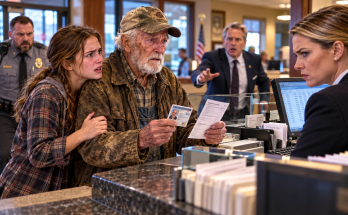
Grandpa held the court papers in one hand and waited for me to find Dr. Anil Mehta's telephone number. He had returned to the farmhouse kitchen, but he hadn't removed his boots or overalls. A thin line of grease ran along his wrist, and a spot of dust marked his cheek where he had pushed his glasses higher while examining the combine. He stood beside the kitchen table, reading the physician's letter again. His expression was almost unnaturally composed. Only the way he kept pressing his thumbnail into the folded paper revealed how deeply it had unsettled him.
I found the clinic's number in the contact list on Grandpa's phone. He still kept important numbers written in a small notebook, but Grandma had insisted years earlier that he save his doctor's information electronically. When I offered to make the call, he shook his head. He wanted to hear the answer himself. He dialed slowly, waited through the recorded greeting, and asked the receptionist whether Dr. Mehta was available. The woman explained that the doctor had retired in February and no longer saw patients at the clinic.
Grandpa glanced at the letter dated April 9. He asked whether the receptionist could provide a forwarding number. She couldn't disclose personal contact information, but she offered to pass along a message through the practice manager. Grandpa gave his name and explained that a medical document had been issued under Dr. Mehta's signature after his retirement. The receptionist's tone changed immediately. She asked him to hold while she consulted someone in the office.
We listened to several minutes of instrumental music that sounded thin through the phone's speaker. I kept staring at the medical letter spread across the table. The printed heading looked authentic, and the signature was carefully placed above the doctor's credentials. Whoever had prepared it had paid attention to the details most people would notice. But a convincing document was not necessarily a genuine one. The retirement date had created a contradiction that needed an explanation.
The practice manager finally answered. Her name was Helen Price, and she spoke with the guarded precision of someone accustomed to protecting confidential records. Grandpa explained that the letter had been submitted in connection with a court proceeding concerning his capacity to manage his affairs. He gave her the date and asked whether the clinic had issued it. Helen said she could not confirm medical information without verifying his identity and obtaining appropriate authorization. Grandpa accepted that. He asked whether there was a procedure for challenging a document he believed had been falsely attributed to his former physician.
Helen became quiet. She asked whether Grandpa could bring the letter to the clinic the following morning. He told her the matter was urgent because a court hearing had been scheduled without his knowledge. After another pause, she offered to contact Dr. Mehta and request that he speak with Grandpa directly. She could not promise when he would call, but she understood the seriousness of the allegation. Grandpa thanked her and ended the conversation.
He remained standing beside the table after the call. I asked whether he thought Wade had forged the letter. Grandpa said he didn't know who had prepared it, but someone had wanted a judge to believe he could no longer make decisions for himself. His voice faltered slightly on the word someone. He sat down, removed his glasses, and wiped them with the hem of his shirt. It was the first time I had seen him look genuinely uncertain about what to do next.
I suggested that we contact an attorney immediately. Grandpa had used a local lawyer for property transactions over the years, but the man had retired, and we had no obvious replacement. He asked me to search for someone who handled guardianship proceedings and financial exploitation. I found several firms within driving distance. Before we could decide whom to call, headlights swept across the kitchen wall. My mother's car turned into the lane, scattering gravel as she approached the house.
Mom entered without knocking. Her name was Laura Doyle Mercer, and she had inherited Grandpa's habit of moving directly toward a problem rather than circling it with unnecessary conversation. She crossed the kitchen, embraced him, and held on longer than usual. When she released him, she looked at his face as if checking for injuries. Grandpa told her he was fine. She glanced at the documents on the table and answered that she wasn't sure he understood what fine meant anymore.
We sat around the kitchen table while I explained the events at the bank. Mom listened without interrupting, occasionally writing something in a notebook she had brought from work. When I described the missing transfers, she pressed her pen hard enough to leave an indentation on the page. When I told her that Tom Callahan's credentials had been used to enter the false account warning, she stopped writing. She asked whether the bank had preserved the records. I said Tom had promised to do so and had restricted the account immediately.
Mom studied the guardianship petition. Her expression hardened when she reached Wade's name. She had spent years defending her brother from relatives who considered him irresponsible, but this was different. She asked Grandpa whether Wade had ever discussed taking control of his finances. Grandpa said no. He admitted that Wade had sometimes suggested hiring help, especially after Grandma died, but those conversations had concerned household chores and the physical demands of farming. He had never agreed to surrender authority over his money or property.
Mom turned to the attached medical letter. She recognized Dr. Mehta's name and remembered accompanying Grandpa to an appointment the previous winter. The doctor had discussed arthritis, blood pressure, and the importance of avoiding overexertion. There had been no diagnosis of dementia or serious cognitive impairment. Grandpa acknowledged that he occasionally forgot where he placed his keys and sometimes needed reminders about appointments. Then he looked directly at Mom and asked whether she believed those ordinary lapses meant he was incapable of running his own life.
Mom reached across the table and took his hand. She said that if she ever genuinely worried about his judgment, she would tell him honestly and help him obtain a proper assessment. She would not hide legal documents in his wife's desk or arrange a hearing behind his back. Grandpa lowered his eyes. He squeezed her fingers once and withdrew his hand, apparently embarrassed by the emotion gathering in the room.
We called an attorney named Sarah Bennett, whose office was in the county seat. She specialized in elder law, estate disputes, and contested guardianship cases. It was nearly six in the evening, and I expected to leave a message. Instead, she answered her emergency line herself. Mom briefly explained that a petition had been filed without Grandpa's knowledge and that supporting medical evidence appeared questionable. Sarah asked for the hearing date, the case number, and the names of the petitioner and proposed guardian.
Her manner was calm but urgent. She explained that a guardianship proceeding could have profound consequences, and that Grandpa needed representation before the scheduled hearing. She also emphasized that the petition itself did not mean Wade had already acquired legal authority. The court would need evidence and would be required to consider Grandpa's rights. That distinction mattered. For the first time since finding the papers, I felt that the situation had boundaries we might be able to navigate.
Sarah arranged to meet us the following morning. She instructed us to preserve the envelope, documents, and any related correspondence in their existing condition. We were not to write on them, remove staples, or discard anything that might establish how they had been delivered. She also recommended that we prepare a chronology of the suspicious bank transfers and record everyone who had access to Grandpa's financial information. Mom wrote each instruction carefully.
After ending the call, we ate a late supper of reheated stew and bread. Grandpa barely touched his food. He kept looking toward the empty chair where Grandma used to sit. Mom attempted to discuss ordinary matters, asking about the harvest and whether the combine was running again, but the conversation repeatedly returned to the papers on the table. The house felt crowded with things nobody wanted to say aloud.
At a little after eight, Grandpa's phone rang. The number was unfamiliar. He answered on speaker, and a man's voice asked for Earl Doyle. The speaker identified himself as Dr. Anil Mehta. His voice was deeper than I expected, with a careful, slightly tired quality. He said Helen Price had contacted him about a letter supposedly issued under his signature. He wanted to know whether Grandpa had the document in front of him.
Grandpa read the date and the opening paragraph. Dr. Mehta interrupted before he reached the second page. He said he had never written such a letter. He had retired from clinical practice before its stated date, and he had not conducted any medical evaluation of Grandpa that spring. He remembered his final appointment with Earl. They had discussed joint pain and the practical challenges of continuing heavy farm work at an advanced age. He had not diagnosed dementia, nor had he concluded that Earl lacked the capacity to manage financial affairs.
I watched Grandpa's shoulders relax slightly. The doctor continued, explaining that the letter contained language he would not use without a comprehensive assessment. It also referred to observations he had never made. He could not tell us who had created the document, but he was willing to provide a written statement confirming that it had not been issued by him. He would also cooperate with an appropriate investigation into the misuse of his name and credentials.
Grandpa thanked him. Dr. Mehta hesitated, then asked whether Earl felt safe at home. The question struck me as more personal than medical. Grandpa looked toward the kitchen window and said he was safe for the moment. The doctor advised him not to confront anyone he suspected of wrongdoing without support. He had seen situations in which disputes over money and independence caused families to behave in ways nobody would have predicted. Grandpa promised to be careful, though I knew how much he disliked making promises about his own safety.
After the call, Mom covered her mouth with one hand. She had been holding herself together through the bank revelations and the court papers, but hearing the doctor deny the letter seemed to release something she had been resisting. She whispered that Wade had crossed a line she never imagined he would approach. Grandpa corrected her gently. We still didn't know who had prepared the document. Mom looked at him for a long moment, then said she understood why he needed to believe that.
The telephone rang again before Grandpa could respond. This time the caller was Tom Callahan. He sounded exhausted. He said he had spent the afternoon coordinating with the bank's security staff and reviewing preliminary audit information. He had also arranged for the suspicious account activity to be referred for further investigation. Several findings concerned him, and he wanted to speak with Grandpa before the night was over.
Tom confirmed that the false account warning had been entered through his credentials while he was away from the bank. Access logs suggested that someone had used a workstation in a restricted administrative area. The entry had not been created from his home computer or an ordinary teller terminal. That meant the person responsible either possessed authorized access to the office area or had obtained help from someone who did.
He also reported that several suspicious transfers had been verified through the same internal telephone extension. The extension belonged to a department supervised by Grant Holloway. Tom stressed that the information did not establish who had made the calls or whether Grant personally approved them. The records required further examination. Still, the pattern suggested that the transactions had received assistance from inside the bank.
I looked at Mom. She had not heard about the notification on Grant's phone. I explained it quickly, and she asked Tom whether he knew of any business relationship between Grant and Wade. Tom said he was aware that Grant had handled commercial loans for local equipment dealers, including Doyle Implement. He had no reason to believe those relationships were improper, but given what we now knew, they would need to be reviewed.
Grandpa asked whether the bank had identified the person who received the money. Tom said the transfers went to Heartland Ag Solutions, but the beneficial ownership information had not yet been established. He had requested additional records and expected to learn more. He also said the bank's legal counsel had advised him to preserve communications and avoid discussing the investigation with employees who might be involved. His voice sounded strained when he admitted how difficult it was to suspect someone within an institution he had spent his life building.
Before ending the call, Tom told Grandpa that the incident at the teller window had prompted him to examine other account notes created through his credentials. He had discovered several entries that did not resemble his usual work. Some concerned customers involved in commercial lending relationships. He could not yet say whether they were connected to Earl's case, but the possibility worried him. Grandpa asked him to be careful. Tom replied that he would, then ended the call.
Mom sat back and closed her notebook. She said we needed to stop treating the matter as a family misunderstanding. Money had been diverted, a medical letter had been falsified, and internal banking records appeared to have been manipulated. Whatever Wade's involvement, the consequences extended beyond hurt feelings. Grandpa agreed, though he asked that we avoid telling neighbors until the facts were established. He did not want rumors to damage innocent people, especially those who worked at the bank.
Later, after Mom went upstairs to make up the guest room, I found Grandpa standing in the doorway of Grandma's study. The rolltop desk remained open, its compartments exposed under the yellow light. He touched the back of her chair but did not sit. I asked whether he wanted help putting the papers away. He shook his head and said he was thinking about the last conversation he had with Ruth concerning their savings.
Grandma had told him that money was useful only because it gave people choices. They had spent their lives working hard so they could decide where to live, whom to help, and how to spend their remaining years. Grandpa looked at the desk and said he had always assumed Wade understood that. The sadness in his voice was more difficult to hear than anger. He wasn't mourning the money alone. He was beginning to mourn the son he believed he knew.
I stood beside him until the house grew quiet. When he finally turned toward his bedroom, he asked me to lock the back door and make sure the keys were not hanging where visitors could reach them. Wade had possessed a spare key for years. We had no way of knowing whether he had made copies or who else might have access. I checked each entrance, then returned to the kitchen.
My phone vibrated while I was putting the court documents into a folder. A message had arrived from an unfamiliar number. There was no greeting, only a photograph taken from inside the bank earlier that day. It showed Grandpa standing beside Rick the security guard while Kayla watched from her window. The angle was high and slightly distant, as though the picture had been captured from a security monitor.
Beneath the image was a single sentence: You should have let him leave quietly.
I stared at the screen until the words seemed to lose their meaning. Someone knew we had discovered the account problem. Someone had access to an image of the confrontation and enough confidence to send it to me directly. I took a screenshot, preserved the message, and carried the phone upstairs to Mom.
She read it once and immediately called Sarah Bennett's emergency number. Then she called Tom. By the time Grandpa came into the hallway, awakened by our voices, the three of us understood that the investigation had entered a new phase. Whoever was behind the scheme was no longer content to hide behind forged documents and electronic transfers.
They were watching us react.