I thought I would feel safe once we were outside the supermarket.
I didn't.
I kept looking at my mother's wrist.
The red marks were fading, but I could still remember exactly where Derek's fingers had been.
Mom noticed me looking.
She always noticed.
"Will you stop checking?"
I looked away.
"I'm sorry."
"You've apologized enough for one morning."
I almost smiled.
She was right.
I'd apologized for leaving her near the apples.
For not reaching her sooner.
For asking too many questions.
For watching her too closely.
None of those apologies changed what had happened.
And none of them belonged to the person who had actually hurt her.
Derek had apologized too.
But his apology sounded different in my memory.
His voice had broken.
His hands had shaken.
He'd looked at my mother as though the ground had disappeared beneath him.
I couldn't forget that.
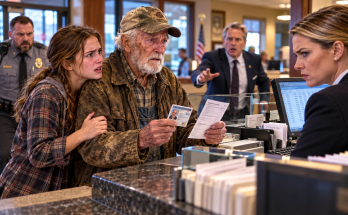
The same man who had accused her of stealing had nearly collapsed when he saw a photograph.
A small Polaroid.
A boy with a blue ribbon.
My father standing behind him.
Something about the contrast made me uneasy.
I didn't know what to do with it.
Mom moved carefully beside me.
Her walker made a familiar sound against the ground.
I stayed close enough to help without touching her.
That was an improvement.
Earlier, I'd wanted to guide every step.
Now I was trying to let her decide.
We had finished the shopping together.
Not quickly.
Not comfortably.
But we'd finished.
Mom had chosen her apples.
We had collected the milk.
And I'd stayed beside her instead of leaving her alone again.
I knew that last part wasn't entirely reasonable.
The danger hadn't come from the dairy aisle.
It had come from a man who made an accusation before asking a question.
Still, I hadn't wanted to leave her.
Not after hearing her beg someone to release her arm.
I wasn't ready to pretend that sound had stopped frightening me.
Mom paused.
I stopped immediately.
"Do you need something?"
She looked at me.
"I need you to stop asking that every time I pause."
I laughed despite myself.
"Fair enough."
She smiled.
Then she looked down at her walker.
Her expression became quieter.
I could see the tiredness in her face.
She had been standing longer than she'd intended.
And she'd endured something no one should have to endure.
I wanted to take every discomfort away.
But I couldn't.
That was one of the hardest things about watching her grow older.
I could carry the bags.
I could accompany her.
I could reach things she couldn't.
But I couldn't stop time.
I couldn't bring Dad back.
And I couldn't make what happened in the fruit section disappear.
Mom looked toward me.
"You're thinking too much."
"I know."
"You always did."
I looked at her.
"Wonder where I learned that."
She gave a faint smile.
Then we continued.
I thought about Dad again.
The photograph had brought him into the store as suddenly as if he'd walked around the corner.
That was how it had felt.
I had seen the plaid shirt.
The familiar shoulders.
The hand resting on Derek's shoulder.
And for one brief moment, I'd forgotten that he was gone.
Then the loss returned.
Sharp.
Unexpected.
I hated how easily grief could still surprise me.
Mom had lived with that absence every day.
I had known she missed him.
But I wondered how often she looked at photographs like the one she'd shown Derek.
How often she remembered moments I hadn't been part of.
How many times she had wanted to tell Dad something and remembered she couldn't.
I looked at her purse.
The Polaroid was inside.
She had placed it there after Derek finished looking.
The same purse she'd brought into the store.
The same place the photograph had been before she recognized his name.
I couldn't stop wondering why she'd been carrying it.
She'd said she'd kept it a long time.
That much was obvious.
The worn corners showed it.
But there was a difference between keeping a photograph and carrying it with you.
I'd wanted to ask about that.
I'd asked too much already.
Mom had promised we'd talk at home.
I intended to respect that.
I wasn't very good at waiting.
But I could learn.
We made our way toward the car.
I carried the groceries.
Mom concentrated on walking.
Neither of us said much.
There was something comforting about the quiet.
Not because everything was all right.
Because we weren't trying to force it to be.
I remembered how the guard had spoken to her.
He'd been so certain.
Certain she'd stolen something.
Certain her age was part of a trick.
Certain the camera proved him right.
I wondered whether he'd ever been that certain about someone else.
I had no way of knowing.
I didn't want to invent a history of cruelty for him.
What I'd seen was bad enough.
I didn't need to imagine more.
And I didn't want the fact that my parents had known him to make me overlook the harm he'd done.
He had been wrong.
Completely wrong.
The photograph hadn't made him wrong.
He'd been wrong before he recognized it.
That mattered to me.
I hoped it mattered to him.
Mom stopped beside the car.
I helped her settle herself.
She didn't object.
That was another thing I was learning.
There was a difference between offering help and insisting upon it.
I could ask.
She could answer.
We could manage the rest together.
After I put the groceries away, I got into the driver's seat.
For a moment, neither of us moved.
Mom looked straight ahead.
I looked at my hands.
They were still tense.
I loosened my grip.
Then I asked the question I'd been holding back since we left the fruit section.
"Are you really all right?"
She turned toward me.
Her expression softened.
"I'm tired."
I nodded.
"Of course."
"And I'm upset."
I looked at her.
She had said it plainly.
No attempt to make me feel better.
No insistence that nothing had happened.
Just the truth.
I felt relieved.
Then ashamed of the relief.
I had wanted her to admit she was hurt so I could stop wondering.
That wasn't entirely fair to her.
"I'm sorry he treated you that way."
She looked down at her wrist.
"So am I."
The answer surprised me.
I had expected her to say Derek hadn't meant it.
Or that he was sorry now.
Or that people made mistakes.
Instead, she acknowledged what had happened.
I appreciated that more than I could explain.
She rested her hands in her lap.
I watched her fingers.
Those hands had spent decades writing lessons.
Correcting papers.
Holding books.
Comforting children.
They had also held the old photograph.
And earlier that morning, one had been trapped in a stranger's grip.
I swallowed.
"Mom, you didn't deserve any of that."
She looked at me.
"I know."
Two words.
Steady.
Certain.
I felt something inside me settle.
She hadn't lost her understanding of herself.
Derek had frightened her.
He had embarrassed her.
But he hadn't convinced her she was guilty.
I looked away.
For a moment, I couldn't speak.
Mom waited.
Then she said something that sounded almost like an instruction from one of her old classrooms.
"Don't let one bad moment become the whole day."
I thought about that.
I wasn't sure I could obey.
The morning had changed the way I looked at the supermarket.
At security guards.
At my own ability to protect her.
But I understood what she meant.
She didn't want the accusation to erase the rest of our time together.
I looked at the grocery bags.
The apples were there.
So was the milk.
We had accomplished what we'd set out to do.
That shouldn't have felt important.
But it did.
Mom followed my eyes.
"You see? We managed."
I smiled faintly.
"Eventually."
She gave a small laugh.
Then grew quiet.
I thought about the photograph again.
And the little boy.
Derek Mullins.
He had recognized her only after she'd shown him the picture.
But she'd recognized the possibility of him before he approached.
That difference stayed with me.
She had looked at him and wondered whether he was someone she remembered.
He had looked at her and decided she was a thief.
Two people watching each other.
Two completely different assumptions.
I knew which one I respected.
I started to speak.
Then stopped.
Mom noticed.
"Go on."
I hesitated.
"I still don't understand why seeing that photograph upset him so much."
She looked at her purse.
For several seconds, she didn't answer.
I wondered if I'd pushed too soon.
Then she turned back toward me.
"He remembered."
I nodded.
"I know."
She looked thoughtful.
"Sometimes that's a great deal."
I waited for more.
Nothing came.
I could tell she wasn't refusing to speak out of anger.
She was tired.
And whatever the picture meant to her, it wasn't something she could explain between one breath and the next.
I let the silence remain.
She'd promised we'd talk.
I trusted her.
I started the car.
As we left the supermarket behind, I glanced toward the building.
I imagined Derek still somewhere inside.
Perhaps working.
Perhaps standing alone for a moment.
Perhaps looking toward the fruit section where everything had changed.
I didn't know.
I couldn't know.
But I hoped he'd remember what Mom had told him.
Not simply the scar or the ribbon.
The part about his behavior.
The part he'd needed to hear.
He had hurt someone.
He had misjudged her.
And he should never have needed a childhood photograph to understand she deserved kindness.
I turned my attention back to the road.
Mom sat quietly beside me.
The grocery bags were in the car.
Her walker was with us.
The Polaroid remained in her purse.
For the first time that morning, no one was demanding anything from her.
No one was grabbing her.
No one was watching her as though she owed them proof of her innocence.
She could simply sit.
And I could simply drive her home.
I hadn't realized how much I needed that ordinary moment until it came.