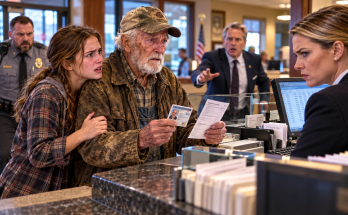
At seven minutes past eight on November 6, Grandpa received a telephone call from Sarah Bennett telling him not to sign anything, surrender any original documents, or discuss the disputed collateral arrangement with anyone outside the legal team. She had learned that Prairie Development Holdings intended to present its claims at a meeting with bank representatives later that morning. Grant Holloway's attorneys were describing the proposed enforcement as an ordinary commercial matter. Sarah believed they were hoping to separate the financial dispute from the evidence of impersonation and fraud.
Grandpa was standing at the kitchen sink when she called, washing a small amount of mud from his hands. He had already been outside checking the cattle and had returned for breakfast. He listened carefully, then asked whether the bank was prepared to reject any unauthorized transfer of his shares. Sarah said Tom had confirmed that no transfer would occur without lawful authority and that further protective measures were being pursued. Grandpa dried his hands, glanced at Grandma Ruth's photograph on the sideboard, and said he wanted to attend the meeting.
Sarah explained that the proceedings involved several parties and that he might not be admitted to every discussion. Grandpa answered that he understood the difference between observing a process and interfering with it. But the property at issue was his, and he had no intention of remaining at home while strangers debated whether a forged signature could substitute for his consent. Sarah agreed to arrange his presence where appropriate.
Mom had laid out his dark suit the previous evening. Grandpa ignored it and chose a clean white shirt, his brown jacket, and the same boots he had worn to court. He inspected the right heel, where an old repair remained visible, then polished the leather with a rag. When I asked whether he wanted something newer, he said the boots had carried him through enough difficult mornings to manage one more. He put Grandma's small brass key in his pocket, though the documents it opened were already secured with Sarah.
We reached Prairie State shortly before ten. The bank's parking lot was crowded with vehicles belonging to attorneys, accountants, and board members. A few customers entered through the front doors, unaware that a dispute affecting the institution's leadership was unfolding behind the glass partitions. Rick stood near the entrance. When he saw Grandpa, he straightened and opened the door without waiting to be asked.
Inside, the lobby looked almost exactly as it had on the morning of the confrontation. The gray carpet was clean, the coffee machine hummed quietly, and the teller windows were occupied. Kayla's station remained closed. Grandpa paused for a moment near the place where Rick had approached him. His eyes moved toward Tom's office, then returned to the guard. He thanked Rick for holding the door. Rick replied that he was glad to see him again, and there was nothing rehearsed in his voice.
Sarah met us beside the reception desk. She carried a narrow briefcase and had the concentrated expression I had come to associate with important decisions. She explained that a meeting was taking place in the bank's boardroom with independent counsel, representatives of Prairie Development Holdings, and members of the institution's governance team. The disputed collateral claims would be addressed first. Grandpa would be permitted to make a statement concerning his ownership and lack of consent, after which counsel would handle the legal arguments.
We entered a room at the rear of the building where a long wooden table occupied most of the floor. Tom sat near the head, accompanied by Denise Porter and two directors I recognized from community events. Across from them sat Grant's attorney and another man carrying a thick portfolio. Grant himself was absent. Vivian Cross was not present either. The empty chairs where I expected to see them made the meeting feel more formal, not less.
The attorney representing Prairie Development Holdings began by presenting a schedule of outstanding obligations. He described Doyle Implement's failure to satisfy restructuring conditions and argued that his client was entitled to enforce contractual remedies. His tone remained measured, and he did not refer to the criminal investigation unless Sarah required him to. He seemed determined to keep the dispute inside the narrow language of contracts, guarantees, and deadlines.
Sarah interrupted when he referred to Grandpa's shares as pledged collateral. She stated that Earl Doyle disputed both the signature and the purported telephone authorization, that the relevant records were under investigation, and that no valid consent had been established. The attorney responded that the documents had been processed through ordinary banking procedures. Sarah placed the original shareholder restrictions and the authentic family collateral agreement on the table. Ordinary procedures, she answered, did not make an unauthorized transaction legitimate.
Grandpa listened from the chair beside me. He had no legal training, but the argument concerned facts he understood. The shares belonged to him. He had refused to pledge them. Someone had used his name anyway. When the attorney suggested that Wade had acted with apparent family authority, Grandpa leaned forward and asked whether he could speak. Sarah nodded.
He said he had trusted his son to help sort mail and household records after his wife's death. He had not authorized him to borrow against the farm or bank shares. He had never approved the December loan package, and he had never spoken during the verification call played for investigators. He understood the value of his assets and had deliberately refused to risk them for the dealership. His voice was quiet enough that everyone leaned toward him.
The opposing attorney asked whether Grandpa was aware of the dealership's financial difficulties. Grandpa said he knew Wade had struggled, but he had not been given accurate accounts. The attorney then asked whether Grandpa had previously helped guarantee business loans. He answered yes, and explained that those obligations had been released years earlier. Sarah produced the release records and the later agreement requiring fresh written consent for any additional support.
One of the bank directors asked Grandpa whether he had ever intended to transfer voting control over his shares to Wade. He replied that he had considered ordinary estate planning, but never the arrangement described in the disputed memorandum. He had retained the shares because he believed Prairie State remained important to the town. He did not intend to place their voting rights under the influence of someone whose business interests conflicted with the bank's responsibilities.
Tom sat without speaking while Grandpa answered. I could see how painful the meeting was for him. The bank had once celebrated Earl's courage. Now its board was reviewing documents produced through its own systems that attempted to take advantage of the same man. When Grandpa finished, Tom thanked him and asked Denise to present the authentication findings.
Denise described the December telephone recording, the access logs, and the internal checklist falsely marked complete. She explained that investigators had found no independent confirmation of Grandpa's consent. The questioned signature differed from verified samples, though the final forensic report remained pending. She also identified the shareholder restriction omitted from the collateral file. The bank had no basis to process a transfer under the disputed documents while those defects remained unresolved.
Grant's attorney argued that the investigation had not produced final findings and that his client's contractual rights should not be disregarded merely because allegations had been made. Sarah agreed that allegations alone were not proof. Then she pointed out that Prairie Development Holdings was the party seeking to rely on disputed authorization. Until lawful authority could be established, the burden could not simply be shifted onto Grandpa to accept an attempted transfer he had never approved.
The board's independent counsel confirmed that the bank would not recognize any change to Earl's shares based on the documents presented. Existing restrictions would remain, and disputed claims would be resolved through the proper legal process. Prairie Development Holdings retained the ability to pursue legitimate remedies against assets lawfully pledged by Doyle Implement, but the bank would not treat Grandpa's farm or shares as available collateral merely because a private agreement listed them.
For the first time that morning, Grandpa's shoulders lowered. The decision did not return the missing savings, and it did not solve the dealership's debts. But a boundary had held. Someone had tried to convert forged documents into authority, and the institution had refused to complete the process.
The meeting might have ended there if Denise had not received a message from the bank's independent forensic team. She read it, asked permission to step outside, and returned several minutes later carrying a single printed page. Her expression had changed. She handed the page to Tom, who examined it before passing it to the board's counsel.
The forensic team had identified an internal memorandum prepared after the October bank confrontation. Its title referred to contingency enforcement and shareholder influence. The file's revision history showed that Grant's department had continued preparing documents intended to support control over Grandpa's shares even after the account was restricted and the guardianship petition challenged. A later revision included instructions to proceed quickly before independent legal review could invalidate the existing authorizations.
Sarah read the page carefully. She asked whether the original digital file and its history had been preserved. Denise confirmed that they had. The document did not, by itself, establish that every proposed action was unlawful. But it made the timing of the attempted enforcement impossible to dismiss as an innocent misunderstanding. Grant's associates had continued moving forward after the authenticity of the authorizations became contested.
The bank's counsel announced that the new record would be referred to investigators and included in the independent review. The representative of Prairie Development Holdings requested a brief recess to consult his client. He left the room with the attorney, their portfolio still open on the table. Nobody tried to stop them. The dispute had not been resolved in a courtroom, but the bank had made clear that it would not cooperate in converting questionable paperwork into control over a shareholder's assets.
Grandpa stood and walked toward the window. I followed him. Outside, traffic moved along the street, and a delivery truck stopped at the bakery opposite the bank. Grandpa watched the driver carry a stack of crates inside. He told me that ordinary work was still happening everywhere, and that he was grateful for it. For weeks, his life had been consumed by people who treated paper as more important than what it represented. Seeing someone deliver bread reminded him that most people were simply trying to do their jobs.
When the meeting resumed, the representative of Prairie Development Holdings said his client would reserve all lawful rights while reviewing the additional evidence. He did not withdraw every claim, but he no longer pressed for immediate recognition of the disputed share pledge. Sarah insisted that the bank's refusal remain documented. The directors agreed. The meeting ended without any transfer of Grandpa's shares or recognition of authority over his property.
As we prepared to leave, Tom asked Grandpa to remain for a private conversation. Sarah agreed, and Mom joined us. Tom looked tired, but he seemed relieved that the bank had taken a clear position. He thanked Grandpa for speaking with such restraint. Grandpa answered that restraint was easier when people finally listened. Then he asked what would happen to the customers whose accounts and loans had been affected.
Tom said the independent review continued. The bank was preparing a process for identifying unauthorized transactions, correcting records, and considering reimbursement where appropriate. He could not promise that every disputed claim would be resolved quickly, but he intended to make the institution's failures visible rather than hide them. Grandpa told him that was the only way to regain trust.
Before we reached the lobby, Tom's telephone rang. He listened for nearly a minute, then asked the caller to repeat the information. His face became grave. When he ended the call, he told us Deputy Ruiz had contacted the bank. Investigators had taken further steps involving records and individuals connected to Prairie Development Holdings. Tom had been asked to preserve additional communications and make certain employees remained available for interviews.
We walked outside into cold sunlight. Grandpa stopped beside the truck and asked Sarah whether the November deadline had passed without his assets being taken. She said the disputed transfer had not occurred and that the bank had formally refused to recognize the claimed authority. The broader financial proceedings remained open, but the immediate attempt had failed.
Grandpa looked toward the bank's entrance. He had arrived there weeks earlier needing two thousand dollars for a tractor part and had been treated as a possible criminal. Now he had stood before its directors and required them to confront evidence that people entrusted with authority had attempted to misuse it. The change was profound, but it did not feel like triumph.
On the way home, Mom received a call from Daniel Mercer, Wade's attorney. Wade had learned about the bank's decision and wanted to know whether his father's property was safe. Mom told Daniel that Sarah would provide whatever information was appropriate through counsel. Grandpa listened, then asked her to add one sentence.
He wanted Wade to understand that the farm was protected not because his father had rescued him again, but because the documents claiming control over it had been challenged and found insufficient. The difference mattered.
When we reached the farmhouse, the light was fading across the last unharvested rows. Grandpa stood beside the porch and watched the field for several minutes. Then he went inside, removed his jacket, and called the neighbor who had agreed to help finish the harvest. He still had work to do.
That evening, Deputy Ruiz called Sarah with confirmation that investigators were pursuing formal action against people suspected of participating in the unauthorized transfers and forged records. The details were not yet ready for public release. Grandpa asked only whether Wade was cooperating truthfully. Ruiz said the evidence he provided had been useful, but his own conduct remained under review.
After the call, Grandpa took Grandma's photograph from the sideboard. He sat with it in his hands while the house settled around him. The deadline had passed. The farm and shares remained his. Yet the money was still missing, Walter Price had not been repaid, and Wade's future was uncertain.
Grandpa told me that preventing someone from taking another thing was not the same as repairing what had already been broken. Tomorrow, he said, they would have to begin the harder work.