The restructuring report arrived two days before the November 6 deadline. Sarah Bennett brought it to the farmhouse in a thick binder, accompanied by a financial adviser named Martin Hale. Grandpa had been working since dawn, trying to finish the last accessible rows before another spell of rain. He came in with mud on his boots and chaff caught in his shirt collar. When he saw the binder on the table, he washed his hands, poured coffee for everyone, and sat down without asking for a summary. He wanted to examine the figures himself.
Martin was a former commercial lender who now assisted troubled businesses and creditors with independent reviews. He spoke plainly, which Grandpa appreciated. Doyle Implement's obligations were substantially larger than Wade had admitted. Some debts were ordinary business liabilities. Others arose from transactions involving inflated inventory values, repeated refinancing, and payments routed through companies connected to Grant Holloway. The November deadline related to a financing arrangement that could trigger defaults and enforcement actions against assets legitimately pledged by the dealership.
Martin emphasized that the report was preliminary. Certain records had not yet been obtained, and disputed documents could change the final accounting. But the overall picture was clear. The dealership could not meet its obligations through normal operations. Several creditors had legitimate claims, employees were owed wages, and customers had paid deposits for equipment that had not been delivered. Any orderly resolution would require identifying which assets actually belonged to the business and which had been included in financing schedules without proper authority.
Grandpa turned immediately to the sections concerning employees and customer deposits. Martin estimated that twenty-three people depended directly on the dealership for wages. Some had already begun looking for work elsewhere. Several customers were waiting for tractors, attachments, or replacement equipment that had been promised months earlier. Their deposits had been used in ordinary business operations rather than kept separately, leaving insufficient cash to satisfy every order.
The information visibly troubled Grandpa. He knew many of those customers. Some had worked beside him in neighboring fields; others were younger farmers trying to establish themselves. A failed equipment order could delay planting or harvesting and create losses far beyond the original deposit. Grandpa understood that kind of risk intimately. But he also knew he could not repair the damage simply by writing checks from his remaining savings.
Sarah explained that the adviser was exploring an orderly process through which legitimate assets could be sold or operations transferred under proper oversight. Such an arrangement might preserve jobs, deliver available equipment, and distribute proceeds according to lawful priorities. It would not guarantee full recovery for everyone. It would, however, reduce the damage caused by a sudden collapse or a scramble among creditors.
Grandpa asked whether Wade would remain in control. Martin said that would depend on the legal structure and the decisions of the relevant parties, but the current evidence made independent management essential. Wade's participation in questionable transactions meant he could not be relied upon to provide an uncontested accounting. His cooperation might help identify assets and records, but oversight had to come from people without a personal interest in concealing losses.
Mom asked about Grant's claims. Martin explained that Prairie Development Holdings asserted rights under several financing agreements. Some appeared to concern legitimate dealership assets, while others depended on disputed authorizations. The claims involving Grandpa's farm and bank shares were being challenged. No valid transfer of those assets had been established. Sarah was pursuing protective relief to prevent anyone from acting on questionable documents while their authenticity and legal effect were examined.
Grandpa studied the figures for nearly an hour. He asked Martin to explain the differences between inventory value, liquidation value, and the amounts lenders had advanced against equipment. He wanted to know why certain machines appeared twice in financing schedules and how the adviser planned to identify genuine ownership. Martin answered each question, occasionally opening supporting documents. By the end of the discussion, Grandpa understood the financial condition more clearly than Wade had ever explained it to him.
He said the dealership had been living on borrowed time for years. Martin agreed. The business's reported strength depended increasingly on refinancing and accounting entries rather than profitable sales. Grant's arrangements may have postponed recognition of losses, but they had not created the cash needed to repay genuine obligations. When the flow of new funds slowed, the weakness became impossible to hide.
Sarah then presented a document she had received that morning. It was a notice from counsel representing Prairie Development Holdings, asserting that certain security interests would become enforceable if the restructuring conditions were not satisfied by November 6. The notice included references to Grandpa's bank shares and the disputed December authorization. Sarah had already responded, rejecting any claim based on unauthorized documents and demanding preservation of all related evidence.
Grandpa read the notice twice. He asked whether Grant's company could sell or transfer the shares before the dispute was resolved. Sarah said the shares remained protected by restrictions and legal safeguards, and she was seeking further court orders as necessary. But a determined claimant might still attempt procedural maneuvers or send instructions based on documents that appeared valid on their face. That was why the bank's transfer records needed to be examined carefully.
Tom Callahan joined us by telephone. He confirmed that Prairie State had received inquiries concerning the shares but had not processed any transfer. The bank's governance and transfer personnel had been instructed to verify all instructions directly with Grandpa and his counsel. Tom also said investigators were reviewing whether someone had created additional documents using Earl's identity. He wanted the bank to be certain no overlooked authorization could be used to interfere with the shares.
Grandpa asked Tom whether he remembered the day the board first issued him the shares after the 1985 crisis. Tom laughed softly and said he remembered it clearly. Grandpa had insisted on reading every page of the agreement and asked questions until the bank's attorney looked exhausted. He wanted to know whether accepting the shares created obligations he did not understand. Tom said the thoroughness had impressed him even then.
The memory suggested something important. Grandpa had never treated the shares casually. He had kept the original documentation, retained notices of changes, and discussed major decisions with Tom or independent advisers. Sarah asked whether he still possessed the first shareholder agreement and subsequent amendments. Grandpa believed they were in a metal file box upstairs, along with old tax records and correspondence from the bank.
I retrieved the box from the spare bedroom closet. It was heavy, painted green, and dented near one corner. Grandma had labeled its compartments with strips of masking tape. The shareholder records occupied a thick folder beneath several decades of tax returns. Sarah examined the documents while Grandpa explained the history of the investment.
The original agreement contained restrictions on certain transfers and procedures for confirming ownership changes. Later amendments modified some requirements but preserved formal verification provisions. Sarah compared the language with the disputed December authorization. She noticed that the document Grant's department relied upon described the shares as freely pledgeable under a simplified process, without mentioning a shareholder restriction that remained in effect.
Tom asked her to read the relevant clause aloud. When she did, he became quiet. He said the bank's transfer department should have recognized the restriction immediately. A valid pledge might require additional approvals or procedures beyond an ordinary signed instruction. If Grant had relied on an incomplete or misleading description, his plan could have been defective from the beginning.
Sarah said the clause did not eliminate every possible dispute, but it provided another substantial basis to challenge the attempted use of Grandpa's shares. The original documents established a chain of ownership and restrictions that could not simply be ignored. Grandpa looked at the green file box and smiled faintly. Grandma had insisted for years that he keep important papers even after the bank moved most records into electronic systems. Once again, her caution had proved valuable.
Martin returned the discussion to the November deadline. He said the immediate priority was preventing disputed assets from being treated as available while legitimate creditors worked toward an orderly resolution. He proposed a meeting among independent representatives of the relevant lenders, suppliers, and the dealership's advisers. Grandpa could participate through Sarah where his rights were affected, but he would not be required to guarantee anyone else's debts.
Grandpa agreed. He wanted employees and customers considered, but he refused to allow his farm or shares to become the price of obtaining a temporary settlement. That boundary was firm. He said he had spent too many years working the land to place it behind another promise that things would improve next season. Martin nodded and said any credible restructuring needed to begin with accurate information, not another unsupported pledge.
Later that afternoon, Deputy Ruiz called with news from the investigation. The technical review of the threatening photograph had found evidence connecting the file's movement to Vivian Cross's access to Grant's department. The digital trail included a transfer to an external device associated with her consulting work. Investigators were still establishing who sent the message from the prepaid number, but the evidence supported a closer examination of her role in obtaining the image.
Ruiz also confirmed that the forged medical letter had been created from an electronic template found among documents associated with Prairie Development Holdings. The file history suggested it was prepared after Dr. Mehta retired. Its metadata and related communications were being evaluated to determine who authored and approved it. Grandpa listened with a grim expression. Each new finding made it harder to believe the false statements had arisen from confusion or carelessness.
Mom asked whether charges had been filed. Ruiz said the investigation remained active and that decisions about charges would be made by the appropriate authorities after reviewing the evidence. He could not promise a timeline or outcome. Wade's cooperation continued, but investigators were checking his account against records rather than accepting it at face value. Grandpa thanked him and said he wanted the process to be thorough.
That evening, Wade's attorney contacted Sarah. Wade had provided another document, this one concerning the movement of funds from Heartland Ag Solutions to Prairie Development Holdings. The records suggested that some money taken from Grandpa's account had been used to pay fees and obligations benefiting Grant's company, not merely to support Doyle Implement. Wade claimed he had not understood the full extent of those payments when they occurred.
Sarah said the distinction could be important in determining responsibility and recovering assets. If funds had been diverted for improper personal or corporate benefits, investigators could pursue those trails through the relevant accounts and transactions. But the money might have been spent, transferred onward, or mixed with other funds. Recovery would depend on what remained traceable and legally reachable.
Grandpa asked whether Wade had retained any benefit personally. Sarah said the investigation was still determining that. Wade's business had received financial support, and that benefit could be significant even if he did not use the money for personal purchases. Grandpa nodded. He had stopped looking for a version of the story in which Wade's intentions made the consequences harmless.
The next morning, November 5, brought a hard frost. The pasture grass shone white, and the windows of the pickup were edged with ice. Grandpa rose before dawn and went outside to check the equipment. I found him beside the combine, rubbing warmth into his hands. He said he wanted to finish the remaining field before the weather changed again. I reminded him about the meetings scheduled that day. He answered that he knew, but he needed an hour doing something he could understand without a lawyer.
We worked until midmorning. The harvest was nearly complete, and the grain cart filled steadily. Grandpa drove with care, stopping whenever a warning light appeared or the machine sounded different. I watched him through the cab window and thought about how much of his life had been reduced to arguments over documents. Here, among the rows, he was still the man who knew every acre and every mechanical sound.
At eleven, Sarah called. A representative of Prairie Development Holdings had sent another notice asserting that Grant's company would proceed with enforcement after the deadline. The notice referred to the disputed collateral package and warned of further legal action. Sarah had responded by seeking immediate protective measures and notifying the relevant parties that the claimed authority was contested and supported by evidence of suspected fraud.
Grandpa asked whether the notice had been signed by Grant personally. Sarah said it came through counsel. Grant remained on administrative leave from Prairie State and was represented separately. The use of attorneys did not make the claims valid, but it meant the dispute was entering a more formal stage. Sarah was prepared to challenge any attempt to interfere with Grandpa's property.
Later that afternoon, Tom called with a finding from the bank's transfer department. The disputed share-pledge file contained an internal checklist. One item required confirmation from the shareholder or an authorized representative. The checklist had been marked complete, but the supporting record was missing from the approved archive. Investigators had located a working copy in Grant's department.
The working copy contained a notation indicating that Earl's approval had been verified through the December telephone call—the same recording in which someone impersonated him. There was no independent confirmation. The supposed authorization rested on a voice that wasn't Grandpa's and a signature he denied making. The bank had not completed a transfer, but the internal file had been prepared to support one.
Sarah said the discovery was significant. It showed that the questionable telephone verification was not merely an isolated attempt to approve a loan. It had been used as support for a broader claim over Grandpa's shares. The same false identity evidence appeared in multiple parts of the scheme. If investigators established that it was deliberately fabricated, several associated documents could be challenged together.
Grandpa asked Tom whether he recognized the voice on the recording. Tom said it resembled Wade's, but he would not claim certainty. Formal comparison and corroborating evidence were being pursued. Grandpa accepted that answer. He had learned to value caution, even when his heart wanted a simpler conclusion.
That evening, Sarah arrived with copies of the protective filings. She explained the steps being taken to prevent unauthorized action before the deadline and to preserve the disputed assets. Grandpa reviewed the documents carefully, asked several questions, and signed where necessary. His signature was slow but firm, ending with the familiar upward stroke.
After Sarah left, Mom prepared supper. Grandpa sat at the table with Grandma's photograph beside his plate. He seemed tired beyond anything the harvest had caused. I asked whether he wanted to rest. He said he would soon. Then he asked me to bring the old newspaper clipping from 1985.
He placed it beside the shareholder agreement and looked at the younger version of himself standing in the crowded bank lobby. He said that forty-one years earlier, he had asked people to trust an institution because he believed its survival mattered to the town. Now he was asking that same institution to prove it could protect people from those who misused its authority.
Mom sat beside him. She said Tom was trying. Grandpa agreed. But he reminded us that trust was not restored by friendship or apologies alone. It required evidence that the harmful conduct had stopped and that the people responsible would be held accountable.
At a little after nine, Tom called again. The bank's transfer department had found an additional unsigned instruction prepared for execution after the November deadline. It would have directed changes affecting the voting rights attached to Grandpa's shares if the disputed collateral arrangement were treated as enforceable. The instruction had never been completed, but its existence suggested that someone had expected to gain control quickly.
Sarah joined the call. She asked Tom to preserve the document and confirm that no action would be taken without proper legal authority. Tom agreed. He also said the bank's independent review team had notified the board and relevant authorities of the finding. The matter was no longer simply an internal lending dispute. It involved the attempted use of a shareholder's identity and rights through questionable records.
Grandpa listened, then asked one final question. He wanted to know whether the instruction had been created before or after the bank confrontation. Tom checked the date. It had been prepared the day after Grandpa's visit, when Grant and Vivian already knew that Earl had discovered the missing money and Tom had begun investigating.
The timing changed the meaning of the document. The plan had not ended when it was exposed. Someone had continued preparing to use the disputed authorization even after Grandpa challenged it and the bank restricted his account.
Grandpa looked toward the dark fields beyond the window. He said that tomorrow's deadline would tell us whether the people behind the scheme were willing to abandon their claims or intended to fight for property they had no right to take.
He put the newspaper clipping back into its folder, closed the green file box, and asked me to lock the study.
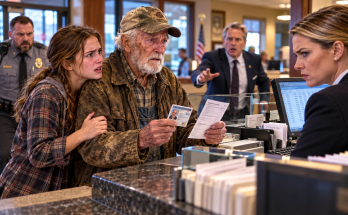
For the first time since the teller called security, Grandpa was not waiting to see whether someone would recognize him. His identity, his choices, and his ownership were documented. The question now was whether the people who had tried to erase those facts would accept the evidence—or force a wider confrontation.