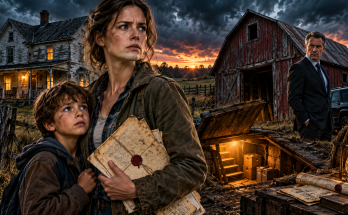
The courthouse was crowded when Hannah arrived for the evidentiary hearing. She recognized farmers, reporters, local officials, and several people she had seen at the planning commission. Caldwell's attorneys occupied one side of the room with boxes of organized exhibits. Dana Brooks stood at the opposite table, checking the order of her witnesses while Paul arranged the certified records. Hannah sat behind them, the seven-dollar deed tucked inside her notebook. She had brought it for herself rather than as evidence. Its worn edges reminded her that she had become the owner before she knew anything about the documents now being debated.
The judge began by defining the questions before the court. The hearing concerned Caldwell's claimed access rights over parts of Mercer Farm, the authority under which certain instruments had been executed, and whether Samuel's later conduct affected the company's position. It would not determine responsibility for the quarry contamination or decide every dispute between the parties. Hannah listened carefully. She wanted a complete resolution, but Dana had taught her to respect the boundaries of each proceeding. A decision was more likely to endure if it rested on questions the evidence could actually answer.
Caldwell's attorney presented the early agreement bearing Rebecca's genuine signature. He emphasized that the document authorized surveys and certain preliminary activities and that related correspondence demonstrated ongoing negotiations. He also introduced receipts showing Samuel had accepted payments for access work. The argument was orderly and plausible when heard without the other records. Hannah understood why Dana had prepared so extensively. A stranger reading only those pages might reasonably believe the Mercer family had agreed to something broader than Rebecca later claimed.
Dana began her questioning with the differences between the original agreement and the later versions. She placed the documents side by side, directing attention to altered definitions of access, infrastructure, and duration. The revisions did not merely correct spelling or change dates. They expanded the activities Caldwell might argue were permitted. A document examiner explained which versions could be reliably dated and identified differences in the attachment histories. She avoided making claims beyond her examination. The judge asked several questions about how the documents had been circulated and recorded.
Mark testified next. He entered the courtroom in a dark jacket, carrying no visible papers. Hannah watched him take the oath and sit beneath the overhead lights. Dana asked about his employment, marriage to Rebecca, and role in preparing the agreements. He answered slowly, confirming that he had explained the original permission as limited survey access. When shown the later documents, he acknowledged that he did not fully disclose the expanded language to Rebecca. The admission was consistent with his deposition, but hearing it in open court gave Hannah an unexpected sense of finality.
Caldwell's attorney questioned Mark about his reasons for returning to Cedar Ridge after years of absence. Mark admitted that he feared legal consequences and had preserved records partly to protect himself. He acknowledged his history of dishonesty and the fact that he had changed his name. The attorney suggested that Mark now had reason to shift blame toward Caldwell. Mark answered that his testimony implicated him as well. He had no expectation of escaping scrutiny simply because he cooperated. Hannah noticed that he did not look toward her for approval.
The most important exchange concerned the supplemental access instrument. Dana asked whether Rebecca had signed a document authorizing Mark to grant permanent infrastructure rights on her behalf. Mark answered that she had not. He recalled preparing paperwork using an interpretation of their earlier agreement that he now understood was unjustified. When asked whether Rebecca knew the supplemental instrument had been recorded, he said he could not establish that she had received it before her death. He admitted that he should have told her. His voice remained low, but the words were unmistakable.
Hannah felt a sharp pressure behind her eyes. Rebecca had written that she was trying to correct an agreement she never intended to make. For years, those letters had existed in silence beneath the barn. Now the man who misled her was confirming the central facts before a judge. Hannah did not mistake the admission for a complete repair of what happened. Her mother was dead, and their family had spent decades apart. But the courtroom had finally given Rebecca's account a place where it could be examined rather than dismissed as bitterness.
Paul testified about Samuel's records and his own representation of the estate. He acknowledged that he had not known the full extent of the underground archive. He explained how Samuel maintained the property taxes, preserved the deed and conservation obligations, and disputed Caldwell's attempts to interpret temporary permissions as broader rights. Dana introduced Samuel's acknowledged objection letter. The document distinguished payments for survey access from consent to permanent infrastructure. Its receipt stamp became important because it established that Caldwell's office had received an express objection during the years it now characterized as acceptance.
Caldwell's attorney challenged whether the receipt stamp proved the letter reached the people responsible for project decisions. Paul could not identify every employee who handled it. Dana did not argue that the stamp established universal knowledge. She asked the court to consider what it did establish: Samuel communicated an objection through a channel Caldwell used for related correspondence. The company might disagree with his interpretation, but the record did not support the claim that he had remained silent while accepting broader rights without question.
Victor Caldwell was called to explain the historical negotiations. He walked to the witness chair with a composed expression, his hands resting lightly against the rail as he took the oath. Dana questioned him about his responsibilities during the early transactions. Victor acknowledged supervising regional development and reviewing major property arrangements. He described Samuel as a landowner who negotiated aggressively and often rejected proposals that might have benefited him financially. Hannah watched him carefully. Victor's account was not wholly false. Samuel had resisted the project. The question was whether that resistance had been respected.
When shown Rebecca's original agreement, Victor confirmed that he knew it authorized limited preliminary access. He said later documents were intended to formalize rights discussed during negotiations. Dana asked who had confirmed Rebecca's consent to those broader rights. Victor referred to Mark's representations and the company's legal review. He could not identify a separate written authorization signed by Rebecca. Dana then showed him Samuel's objection letter. Victor acknowledged that the company received it, though he said he did not remember personally reviewing that particular copy.
Dana asked whether Caldwell had continued relying on the supplemental instrument after receiving Samuel's objections. Victor said the company believed its interpretation remained valid. He emphasized that property agreements often generated disagreements and that a recorded instrument could not be disregarded simply because one party later objected. Dana agreed that objections alone did not determine enforceability. She then asked whether the company had obtained independent confirmation that Rebecca authorized Mark to execute the broader arrangement. Victor replied that he relied on the documentation available at the time.
Hannah listened with growing frustration. Victor had spent years defending arrangements whose authorization remained uncertain, yet he continued presenting the dispute as an ordinary difference of interpretation. She understood why the judge needed evidence rather than outrage. What mattered was whether the documents established valid rights under the applicable law. Rebecca's intentions were relevant, but they could not replace the legal requirements governing agreements and recorded interests. Hannah rested her hand on the notebook containing her deed and waited for Dana's final questions.
The Cedar Valley Land Trust provided testimony concerning the preservation agreement. Its representative explained that the restrictions remained attached to the property and required review of certain activities affecting protected features. The agreement did not automatically invalidate every possible utility project, but Caldwell's proposed corridor could not be evaluated without considering those obligations. An independent surveyor identified the protected meadow and drainage channel on the recorded maps. The testimony established that the land's limitations were part of its legal history, not conditions Hannah invented after inheriting it.
During a recess, Hannah walked outside with Dana. The afternoon air was cold, and dry leaves moved across the courthouse steps. Hannah asked whether Rebecca's intentions would finally matter. Dana said they already did, but that the court must connect those intentions to the actual documents and legal standards. She explained that the original limited agreement might remain valid in some respects even if the supplemental instrument failed. Hannah nodded. She did not need the court to erase every survey or payment that had ever occurred. She needed it to distinguish what Rebecca and Samuel actually permitted from the rights Caldwell later claimed.
The hearing resumed with closing arguments. Caldwell's counsel emphasized continuity in the recorded documents, the company's reliance on historic arrangements, and Samuel's acceptance of certain payments. Dana argued that the company could not transform limited access into permanent infrastructure rights through an instrument executed without demonstrated authority. She pointed to Mark's sworn admissions, the missing written authorization, Samuel's timely objection, and the conservation restrictions. Her argument was firm but restrained. She asked the court to rule on the established record rather than punish Caldwell for unrelated environmental allegations.
The judge took the matter under advisement. Hannah felt the disappointment immediately. She had spent months preparing for a decision, and now she would have to wait again. Dana explained that a written ruling was appropriate given the complexity of the documents and legal questions. The judge wanted time to examine the exhibits and relevant law. Hannah understood, but understanding did not make the uncertainty easier. She had become skilled at waiting for evidence, results, and hearings. She was less skilled at living comfortably while the answers remained beyond her control.
On the courthouse steps, reporters asked whether she believed the hearing had gone well. Hannah said the evidence had been presented and that she would respect the court's process. One reporter asked whether she intended to sell if Caldwell made another offer. She answered that she had no plans to sell under the terms previously proposed. The exchange was brief. Hannah had learned that public statements could become more permanent than the circumstances that produced them. She wanted to leave herself room to make responsible decisions without appearing uncertain about the principles guiding them.
Back at Mercer Farm, Tom had helped Eli repair the chicken coop's latch. Hannah found them testing the door repeatedly to make sure it closed securely. Eli wanted to know whether the judge had said they could keep the farm. Hannah told him the decision had not been issued yet. His disappointment was immediate. He asked how many more adults had to examine the papers before somebody could decide. Hannah almost laughed. It was a fair question, and she had no simple answer. She helped him close the coop, then asked whether the birds Clara planned to give them would appreciate his work.
That night, Hannah returned to the underground room. She had developed a routine for entering safely, documenting each visit, and preserving the records. The chamber no longer frightened her as it had the first time. Its shelves and labels had become familiar, almost comforting. She opened Samuel's correspondence file and found another letter written shortly before his final illness. He had addressed it to Hannah but never mailed it. The envelope bore her name and an old address from the years when she had lived with relatives outside Kansas City.
The letter was different from the formal instructions that accompanied the deed. Samuel did not discuss Caldwell, groundwater, or the hidden archive in much detail. Instead, he described driving past the house where Hannah lived when she was seventeen, parking across the street, and remaining there until dusk without approaching. He wrote that he had imagined introducing himself but feared she would hate him for what happened to Rebecca. Hannah sat at the desk and read the passage several times. Her grandfather had been close enough to knock on her door, yet chose to leave without speaking.
Samuel admitted that he had confused avoiding rejection with protecting Hannah from danger. He wrote that he could no longer justify the decision by blaming Mark, Caldwell, or the unresolved property dispute. He had been afraid of facing a granddaughter who might reasonably ask where he had been. Hannah felt tears gather as she read. The honesty came too late to give her a childhood with him. Yet it mattered that he recognized the difference between protecting someone and protecting himself from difficult consequences.
Near the end, Samuel wrote about Rebecca. He described her as stubborn, intelligent, and capable of defending people she loved even when she was frightened. He said he had failed to recognize those qualities while she was alive because he was too occupied with proving himself right. He hoped Hannah would remember her mother as a person who made mistakes and tried to correct them, not merely as a woman caught in a dispute. Hannah folded the letter carefully. She had spent months investigating the circumstances surrounding Rebecca's death. The letter reminded her to preserve the life that came before it.
The following morning, Dana called with information about the anonymous warning. Investigators reviewing Caldwell's internal files had found a scanned copy of the photograph showing Samuel and Mark outside the farmhouse. It appeared in a folder concerning historical communications with Mark, accompanied by notes indicating that a copy had been provided during an unsuccessful attempt to reopen discussions. The discovery explained how someone connected to Caldwell could have obtained the image without accessing Samuel's blue folder. It did not prove who mailed the anonymous letter, but it narrowed the possible sources.
Hannah asked whether the original warning painted on the barn might also have come from someone connected to Caldwell. Dana said there was no direct evidence establishing that. The paint had been applied before Hannah took possession, and several people might have had reasons to resent the Mercer family or dispute the property's ownership. The anonymous letter was more specific because it referred to the underground room after its discovery. Dana reminded Hannah that both matters should remain documented, but neither should be attributed to a particular person without reliable evidence.
Several days later, the judge issued the written ruling. Hannah was at the hardware store when Dana called and asked her to step somewhere private. The court had concluded that Caldwell failed to establish enforceable permanent infrastructure and water-access rights under the disputed supplemental instrument. The ruling relied on the lack of demonstrated authorization, the document history, and evidence that the broader interpretation had been challenged. It did not erase every limited survey permission ever granted, nor did it resolve all environmental questions. But the permanent rights Caldwell had attempted to enforce were rejected.
Hannah sat on a stool behind the store counter, listening while Dana explained the decision. The court also recognized that the recorded preservation agreement remained applicable and that any future development affecting the protected areas would require appropriate review. Caldwell could seek appellate review, and the ruling did not prevent lawful negotiations for new rights. Nevertheless, the company could no longer proceed as though the disputed supplemental instrument automatically authorized its proposed infrastructure. Hannah pressed a hand against her mouth. For the first time since Evan approached her, a central part of the property's future had been determined in her favor.
Tom found her sitting quietly several minutes after the call ended. He asked whether something was wrong. Hannah looked up and told him the court had ruled that Caldwell did not possess the permanent access rights it claimed. Tom set down the invoice in his hand and pulled out the chair beside her. He did not cheer or offer a grand speech. He simply asked whether she wanted a cup of coffee. Hannah laughed, surprised by the sound, and said yes. After months of formal testimony and careful documents, the moment felt appropriately small.
That evening, she told Eli the court had rejected the company's claim to the permanent rights it wanted over the farm. She explained that other issues remained, but the decision strengthened their ability to control what happened on their land. Eli listened, then asked whether he could finally draw the garden in permanent ink on his farm plan. Hannah looked at the carefully labeled orchard, chicken coop, and repaired farmhouse. She told him he could. He opened his pencil case immediately and began tracing the paths he hoped to build.
Later, Hannah stood at the barn doors, looking at the fading words painted across them. NOTHING HERE IS YOURS. She thought of the clerk's warning, the laughter, Evan's first offer, and Samuel's final letter. The message had once made her feel unwelcome on land she barely understood. Now the court had rejected the broad claim that threatened her control of it. She still needed to learn who had sent the anonymous photograph, and the groundwater problem remained unresolved. But she no longer had to defend her right to the farm solely with hope. She had a deed, a court ruling, and records that could be examined by anyone authorized to see them.