PART 3
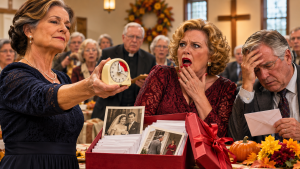
It was a picture of Myles and me on our wedding day, thirty-eight years earlier. I was wearing a simple white dress, and he had that thick brown hair he used to comb backward with too much water.
Underneath the photograph was a little handwritten card.
Trudy picked it up.
Her lips moved as she read it.
“Thirty-eight years of marriage,” she read aloud.
I smiled.
“That’s right.”
She looked inside the box again.
There were thirty-eight small envelopes, each numbered from one to thirty-eight.
“What is all this?” she asked.
“Memories,” I said. “A little history lesson, if you will.”
The people around us leaned closer.
I pulled out the first envelope and opened it.
“Number one. Our first apartment. Two rooms, one broken heater, and a mattress we bought secondhand. Myles worked two jobs that year because he wanted to save enough money for a proper home.”
I looked at my husband.
He was staring at the box now.
“Number five,” I continued. “The year I had surgery. Myles slept in that uncomfortable hospital chair for six nights. He brought me flowers every morning, even though I told him I didn’t need them.”
A few women smiled.
I opened another.
“Number twelve. The year his mother died. He couldn’t sleep for weeks. I held him every night because he didn’t know what to do with all that grief.”
Myles lowered his eyes.
I wasn’t trying to embarrass him.
Not yet.
I reached for envelope number twenty-one.
“Number twenty-one. The year I lost my job at the restaurant. We were behind on our bills, and I picked up extra shifts wherever I could. I remember Myles telling me that we were a team and that we would get through anything as long as we didn’t turn against each other.”
The room had grown quieter.
Trudy looked uncomfortable.
I closed the envelope and placed it back inside.
“Thirty-eight years, Trudy. Thirty-eight years of ordinary mornings, hard winters, unpaid bills, family funerals, birthdays, disappointments, and little victories. That’s what a marriage is. It’s not just a man sitting beside you at a church supper.”
Then I reached into the box and pulled out the last envelope.
It was number thirty-eight.
Inside was a printed photograph.
Not a wedding picture.
Not an anniversary picture.
It was a photograph of Myles standing on Trudy’s porch, holding his toolbox.
Behind him, Trudy was standing in her doorway, wearing that same red lipstick.
Myles went completely still.
I placed the photograph on the table.
“Now, this one is from last Tuesday.”
Trudy’s face changed.
“Claudette, I don’t understand.”
“Oh, I think you do.”
I reached into the box again and removed a small folder.
Inside were copies of several messages.
I hadn’t needed to hire a detective. I hadn’t followed anyone around town. I hadn’t even needed to ask my neighbors.
Myles had made the mistake of leaving his phone on the kitchen counter one evening.
A message had appeared while I was washing dishes.
I hadn’t gone looking for trouble.
Trouble had practically introduced itself.
The first message was from Trudy.
I miss you already. Can’t wait until Thanksgiving. You know what I want.
The second was from Myles.
Soon, sweetheart. I just need to get things settled at home.
And then there was another.
Claudette is starting to suspect something. Be patient.
I could hear somebody at the next table take a sharp breath.
Myles finally spoke.
“Claudette, what the hell is this?”
I looked at him.
“That’s an interesting question coming from the man who told me to lighten up.”
He stood halfway out of his chair.
“Those messages don’t mean what you think.”
“Then perhaps you’d like to explain them.”
He looked at Trudy.
She looked at him.
For the first time since September, neither of them seemed to know what to say.
I turned back to the box.
“There are a few more things.”
I took out a small notebook.
It was an old spiral notebook I’d bought at the grocery store.
On every page, I’d written down a date, an amount, and what Myles had told me he was doing.
September 17: Two hours at Trudy’s house fixing her kitchen sink.
September 24: One hundred and twenty dollars for a new porch light, supposedly paid out of our joint account.
October 1: A trip to the hardware store.
October 8: Dinner at a restaurant in town. Myles told me he was helping his brother.
October 15: Another trip to Trudy’s.
And there were more.
I looked at the pastor.
“Pastor James, I hope you’ll forgive me for bringing personal matters into the supper. But I thought it was important that everyone understand why this present is so special.”
Pastor James cleared his throat.
“Claudette, perhaps you and Myles should discuss this privately.”
“You’re right, Pastor. We should have. I tried. Several times.”
I looked at Myles.
“Remember when I asked you why you were spending every Tuesday at her house?”
He said nothing.
“Remember what you told me?”
He rubbed his forehead.
“You said she was lonely. You said helping a widow was the Christian thing to do.”
I paused.
“Well, I found out something interesting. Being a good Christian doesn’t mean you get to make a fool of your wife.”
Nobody laughed.
Nobody even moved.
Trudy suddenly pushed her chair backward.
“This is humiliating,” she snapped.
I nodded.
“I agree. It must be.”
She looked at me with angry eyes.
“You don’t know what happened between us.”
I studied her for a moment.
“You’re right. I don’t know everything. But I know what you said to me at that potluck. I know how you looked at my husband. And I know you told him you’d have him by Thanksgiving.”
She opened her mouth.
I raised one hand.
“Please don’t tell me you were joking. You had three months to stop joking.”
Then I reached into the box one last time.
There was something wrapped in white tissue paper.
Trudy looked at it suspiciously.
“What now?”
I lifted it out.
It was a small, inexpensive kitchen timer.
The kind with a little bell that rings when the minutes are up.
I placed it in her hands.
“Here. I thought you might need this.”
She stared at it.
“For what?”
I smiled.
“To remind you that your time is up.”
A few people made a sound that was somewhere between a gasp and a laugh.
I wasn’t proud of that line.
But I wasn’t sorry either.
Then I turned toward Myles.
“And there’s something for you, too.”
I reached into my purse and handed him a plain white envelope.
He didn’t take it immediately.
“What is this?”
“Something you should read.”
He finally pulled it from my hand.
Inside was a printed document.
His face went pale as he read the first paragraph.
“What did you do?”
“I spoke to an attorney.”
He looked up sharply.
“You what?”
“I spoke to an attorney. I also spoke to the bank about our joint accounts, and I arranged for a separate account for my own income.”
“Claudette, you can’t just do that!”
“Actually, I can.”
He looked around the room as though he expected someone to rescue him.
But nobody moved.
I continued.
“I also found out that you’ve been using money from our joint account to pay for things at Trudy’s house. The attorney advised me to keep records of everything and to stop allowing money to disappear without an explanation.”
Myles lowered his voice.
“Can we please go home?”
I looked at him.
“Of course. But I’m not leaving with you.”
His expression changed.
“What?”
“I’m going to my sister’s tonight.”
He stared at me.
“You’re leaving me over this?”
I took a slow breath.
“No, Myles. I’m leaving because of what you did after I gave you thirty-eight years of my life. I’m leaving because you watched another woman disrespect me and decided to enjoy it. I’m leaving because every time I asked you to remember that I was your wife, you made me feel like I was the problem.”
My voice shook a little.
I hated that.
I had promised myself I wouldn’t cry.
But some tears are not signs of weakness.
Sometimes they’re just the last little bit of love leaving a place where it no longer belongs.
I looked at Trudy.
“And you know what, Trudy? I hope you enjoy the man you’ve been fighting so hard to win.”
She looked down at her hands.
For once, she had nothing clever to say.
I picked up my purse.
Then I looked around the fellowship hall.
“I’m sorry to everyone who came here expecting turkey and pie. I promise I won’t make this a habit.”
A few people chuckled nervously.
Pastor James stood.
“Claudette, would you like me to walk you to your car?”
“Thank you, Pastor. I’d appreciate that.”
I walked away from the table without looking back.
But before I reached the door, I heard Myles call my name.
“Claudette!”
I stopped.
Not because I wanted to turn around.
Because thirty-eight years is a long time, and even when you’re walking away, your heart sometimes needs a moment to catch up.
I turned slightly.
He was standing beside the table, holding that envelope.
For the first time in months, he looked genuinely afraid.
“Please,” he said. “Don’t do this.”
I looked at him for a long moment.
Then I said something I wish I’d learned twenty years earlier.
“Don’t ask me to protect a marriage you stopped protecting yourself.”
And I walked out.
The November air was cold.
My sister was waiting in her car, just as we’d planned.
She rolled down the window.
“Well?”
I opened the passenger door and climbed inside.
“Did she open the present?”
My sister grinned.
“Claudette, I could hear the whole thing from the parking lot.”
I started laughing.
Then I started crying.
Then I laughed again.
My sister reached over and squeezed my hand.
“Come on, girl. Let’s get you some pie.”
I looked through the windshield at the church.
Through the windows, I could see people moving around the tables.
I couldn’t see Myles.
And for the first time in thirty-eight years, I didn’t feel responsible for finding him.
The next morning, my phone rang at 7:15.
It was Myles.
I watched it ring three times before answering.
“Claudette.”
His voice sounded rough.
“Morning, Myles.”
“Where are you?”
“At my sister’s.”
“I figured that much. Are you coming home?”
I looked out the window.
My sister lived in a little house with a wooden porch and two enormous maple trees in the front yard.
A squirrel was trying to steal something from her bird feeder.
It was a peaceful morning.
“I don’t know,” I said.
He sighed.
“Look, I made a mistake.”
I waited.
“I didn’t mean for things to get this far.”
“How far did you mean for them to get?”
He didn’t answer.
“Did you intend to leave me, Myles?”
“No.”
“Did you intend to start a relationship with Trudy?”
Silence.
“Did you tell her you were going to be with her by Thanksgiving?”
Another silence.
I closed my eyes.
“Then what exactly was the plan?”
He finally spoke.
“She made me feel wanted, Claudette.”
I almost laughed.
Not because it was funny.
Because it was so painfully familiar.
“And what did I make you feel?”
“You know that’s not fair.”
“Tell me, Myles.”
He exhaled.
“You’ve been busy with your own things. The house, your sister, your church friends. We don’t do much together anymore.”
I stared at the squirrel.
For thirty-eight years, I had cooked his meals, washed his clothes, remembered his appointments, celebrated his birthdays, and sat beside him through every difficult season of his life.
And now he was telling me that I hadn’t done enough.
“Did you ever ask me to spend more time with you?” I asked.
He didn’t answer.
“Did you ever tell me you were lonely?”
Nothing.
“Did you ever try to fix the sink I asked you about for four years?”
He made a frustrated sound.
“Claudette, we’re talking about something else.”
“No, Myles. We’re talking about the same thing. You wanted somebody to make you feel special, but you didn’t want to put in the work of being a husband.”
He went quiet.
Then he said, “I love you.”
That was the hardest part.
Because I believed him.
I believed that somewhere beneath his selfishness and foolishness, there was still a man who loved me in the only way he knew how.
But love without respect had become a very lonely place to live.
“I loved you, too,” I said.
“Past tense?”
I swallowed.
“I don’t know what tense we’re in anymore.”
He started crying.
I’d heard that man cry only twice in our marriage.
Once when his father died.
And once when we lost our first pregnancy.
I wanted to comfort him.
I wanted to tell him everything would be all right.
But I didn’t.
Instead, I said, “We need some time apart.”
Then I ended the call.
Three days later, my sister brought me a cup of coffee and sat across from me at her kitchen table.
“There’s something you should know.”
I looked up.
“What?”
“Trudy came to church yesterday.”
I shrugged.
“That’s her church, too.”
“She didn’t stay for the service.”
“What happened?”
My sister took a sip of coffee.
“She left before the sermon. Apparently, Myles didn’t show up either.”
I said nothing.
“People are talking, Claudette.”
I sighed.
“I didn’t want people talking.”
“Well, honey, you didn’t start this. They did.”
She reached into her purse and took out her phone.
“There’s more.”
She showed me a message from one of our church friends.
Apparently, Trudy had been telling people that Myles had promised to marry her after he settled things with me.
I stared at the screen.
My stomach tightened.
“Did he really promise her that?”
My sister shrugged.
“I don’t know. But there’s something else. Apparently, she told someone she was expecting him to move into her house before Christmas.”
I put my coffee down.
I had thought the whole thing was about flirting.
A little attention.
Some excitement for a lonely widow.
But this was beginning to sound like something much bigger.
I looked at my sister.
“Do you think he was planning to leave?”
She held my eyes.
“I think you should stop worrying about what he was planning and start protecting yourself from what he might have already done.”
That afternoon, I called my attorney.
And what I learned during that conversation changed everything.
Because when the attorney reviewed the bank statements I’d brought him, he noticed something I had completely overlooked.
There were several withdrawals I hadn’t made.
They weren’t huge amounts.
Fifty dollars here.
A hundred and twenty there.
Two hundred at a time.
But the dates matched the days Myles had been visiting Trudy.
And there was one transaction that made the attorney stop turning the pages.
A payment for $4,800.
It had been transferred from our joint savings account just two weeks earlier.
I stared at the statement.
“What is that?”
My attorney adjusted his glasses.
“That’s what we need to find out, Claudette.”
I felt cold.
“Can you tell where it went?”
He turned the paper around.
At the bottom was the name of the recipient.
It wasn’t Trudy.
It wasn’t a hardware store.
It wasn’t a restaurant.
It was a company I had never heard of.
I read the name twice.
Then I looked at him.
“Why would Myles send money to a company like that?”
My attorney leaned back.
“That’s a good question.”
He tapped the page.
“And I think you should ask your husband.”
I drove back to my sister’s house with that statement sitting on the passenger seat.
I didn’t call Myles.
I didn’t send him a message.
I simply sat in the driveway for several minutes, staring at the paper.
Then my phone rang.
It was an unfamiliar number.
I answered.
“Hello?”
A woman’s voice came through.
“Is this Claudette?”
“Yes.”
“My name is Denise. I’m Trudy’s daughter.”
I sat up straight.
“Hello, Denise.”
She sounded nervous.
“I know this might be uncomfortable, but I need to ask you something about Myles.”
My heart began beating faster.
“What about him?”
There was a pause.
Then she said something I never expected to hear.
“Did your husband tell you he was planning to move into my mother’s house?”
I gripped the steering wheel.
“No.”
“Then you need to know what he’s been telling her.”
I looked down at the bank statement.
“What exactly has he been telling her?”
Denise took a shaky breath.
“He told my mother that you two were already separated. He said you had agreed to sell your house, divide the money, and let him start a new life.”
I couldn’t speak.
“And, Claudette?”
“Yes?”
“My mother has already given him something.”
My throat tightened.
“What did she give him?”
“Money.”
“How much?”
Denise hesitated.
Then she answered.
“Twenty thousand dollars.”
For a moment, I couldn’t hear anything except the sound of my own breathing.
Twenty thousand dollars.
My husband had taken money from our joint savings account.
And apparently, the woman who had been bringing him pies every Sunday had given him money, too.
I finally managed to ask, “Why would she give him that much?”
Denise’s voice became even quieter.
“Because he told her he needed it to get away from you.”
I closed my eyes.
Thirty-eight years.
Thirty-eight years of believing I knew the man sleeping beside me.
Then Denise said one more thing.
“There’s something else, Claudette. My mother doesn’t know I’m calling you, but I found a document in her kitchen drawer. It has your husband’s signature on it.”
“What kind of document?”
“I don’t know all the details. But it looks like an agreement about your house.”
My fingers went numb.
“Our house?”
“Yes.”
I looked toward my sister’s front door.
She was standing there now, watching me through the window.
“Denise,” I said slowly, “can you send me a photograph of that document?”
“I can. But there’s something you should understand first.”
“What?”
“My mother thinks Myles is going to marry her. She believes he has already arranged everything.”
I stared at the bank statement again.
Then Denise whispered:
“And I don’t think she knows what he actually plans to do with that money.”
PART 4
I sat in my sister’s driveway for another five minutes after Denise hung up.
Twenty thousand dollars.
A document about my house.
And a husband who apparently had been promising two different women two different futures.
I had spent thirty-eight years believing that if you built a life with someone, you knew the person you were building it with.
I was beginning to understand that sometimes the person you marry and the person who betrays you are the same person.
My sister opened the passenger door.
“Claudette, honey, what’s wrong?”
I handed her the bank statement.
She read it, and her expression changed.
“That no-good man.”
“There’s more.”
I told her about Denise and the document.
My sister sat down beside me.
“You’re not going back there alone.”
“I wasn’t planning to.”
“Good. Because we’re going to find out exactly what he’s been doing.”
That evening, Denise sent me the photograph.
It was a document with Myles’s signature at the bottom.
The heading read:
PROPOSED PROPERTY TRANSFER AGREEMENT.
I enlarged the photograph.
My eyes moved slowly down the page.
According to the document, Myles had agreed to transfer his interest in our home to a company in exchange for a financial arrangement.
The company was the same one that had received the $4,800 from our joint savings account.
I read the document again.
Then I noticed something that made my stomach turn.
The address of the property was ours.
The home where I had raised our children.
The home where we had celebrated thirty-eight Christmases.
The home where I had waited for Myles to come back from work, cooked his favorite meals, and spent countless evenings planning our retirement.
He had been making arrangements involving our house without my knowledge.
I called my attorney immediately.
He asked me to send him the photograph.
After reviewing it, he told me something important.
“Claudette, this document alone does not establish that your home has been legally transferred. There are questions about its validity, and we need to check the property records. Do not sign anything. Do not agree to anything verbally. And don’t confront him until we understand the situation.”
I thanked him.
Then I sat at the kitchen table until midnight.
I wasn’t crying anymore.
I was angry.
Not the kind of anger that makes you throw dishes or scream at somebody.
It was the quiet kind.
The kind that makes you finally see things clearly.
The next morning, Myles called.
I answered because I wanted to hear what he would say.
“Claudette, we need to talk.”
“About what?”
“About coming home.”
I looked at the photograph of the document on my phone.
“Why?”
He sighed.
“Because this has gone far enough. People are asking questions. The church is talking. I don’t want everybody knowing our business.”
I almost laughed.
“Interesting. You didn’t seem concerned about people knowing our business when you were taking Trudy’s pies in the parking lot.”
“Can we please stop talking about Trudy?”
“Of course. We can talk about the $4,800 instead.”
Silence.
It lasted long enough for me to hear him take a breath.
“What $4,800?”
I closed my eyes.
There it was.
The first lie.
“The transfer from our savings account.”
“Oh, that.”
“Yes. That.”
“It was an investment.”
“With whom?”
“Someone I know.”
“Who?”
He became irritated.
“Claudette, I don’t have to explain every little thing I do.”
I looked at the ceiling.
“Actually, when you take money from our joint savings account and use it for an investment involving our house, I think you do.”
The silence returned.
Then he said something I will never forget.
“Trudy was supposed to help me get everything organized.”
I felt my stomach tighten.
“So Trudy knew about the house?”
“She didn’t understand everything.”
“Did you tell her we were getting divorced?”
He didn’t answer.
“Did you tell her I agreed to sell our home?”
“Claudette, I was trying to figure things out.”
“Without telling me?”
“I didn’t want another argument.”
I took a deep breath.
“Myles, I am going to ask you one question. I want you to answer honestly.”
“Fine.”
“Were you planning to leave me?”
He didn’t answer immediately.
Then he said, “I thought maybe it was time for something different.”
I stared at the wall.
Something different.
Thirty-eight years had become something different.
I didn’t shout.
I didn’t cry.
I simply said, “Then you should have had the courage to tell me before making promises to another woman.”
He started speaking, but I ended the call.
For once, I didn’t need the last word.
I needed the truth.
And I was finally getting it.
Two days later, Denise called again.
Her voice sounded different.
Less nervous.
More upset.
“Claudette, I need to tell you what happened.”
I sat down.
“Go ahead.”
“My mother has been asking Myles about the money she gave him.”
“And?”
“He told her he couldn’t return it yet.”
I rubbed my forehead.
“Did she ask what he used it for?”
“Yes. He said he was paying legal expenses and preparing to buy a smaller house.”
I almost dropped the phone.
“Buy a house?”
“That’s what he told her. He said once everything was settled with you, he would move in with her until they found somewhere permanent.”
I looked at the clock.
“Denise, I need to ask you something. Did your mother actually see the property agreement?”
“Yes. That’s why I’m calling.”
“What do you mean?”
Denise hesitated.
“She showed it to me last night. But there’s a problem.”
“What problem?”
“The document says the company is supposed to receive an interest in your property. My mother thought the company was helping Myles buy a new home.”
I felt a chill run through me.
“Did she know what the company actually did?”
“No. I looked it up. It’s a private investment company. I also found out that the person listed as its representative has been connected to several complaints about questionable property transactions.”
I sat very still.
Then Denise said something that made everything worse.
“My mother gave Myles the $20,000 because he told her he was going to use it as a deposit for their future home. But now we can’t find the money.”
I closed my eyes.
The pieces were beginning to fit together.
Myles had taken money from our joint savings.
He had accepted money from Trudy.
He had apparently promised her a future together.
And he had been making arrangements involving our house.
But I still didn’t know why he needed all that money.
My attorney had told me not to make assumptions.
So I didn’t.
Instead, I asked Denise to preserve every document, message, and receipt her mother had.
Then I called my attorney again.
The following Monday, my attorney arranged a meeting with Myles.
He was asked to bring every document relating to the company, the proposed property agreement, and the money he had received from Trudy.
Myles arrived wearing his favorite blue shirt.
He looked tired.
His hair was messy, and he had dark circles under his eyes.
For a moment, I remembered the young man who had stood beside me at our wedding.
Then I remembered the photograph of him standing on Trudy’s porch.
My attorney began calmly.
“Myles, we’d like to understand the purpose of this proposed agreement.”
Myles shifted in his chair.
“It’s complicated.”
“That’s why we’re here.”
He looked at me.
“Claudette, can we talk privately?”
“No.”
His expression tightened.
My attorney placed the document on the table.
“Did you sign this?”
“Yes.”
“Did Claudette sign it?”
“No.”
“Did you have her permission to use your joint savings to pay the company?”
Myles rubbed his face.
“I thought I could handle it.”
“That wasn’t the question.”
He looked down.
“No.”
My attorney opened another folder.
“Can you explain the $20,000 payment from Trudy?”
Myles froze.
“How do you know about that?”
I answered.
“Because her daughter called me.”
He looked furious.
“Denise had no business getting involved.”
I leaned forward.
“Neither did you, apparently.”
My attorney raised his hand slightly.
“Let’s stay focused.”
He turned another page.
“According to the information we’ve received, you told Trudy that the money was intended to help establish a new home with her. Is that accurate?”
Myles looked at the table.
“I told her we might need money.”
“Did you tell her you were going to marry her?”
He swallowed.
“I might have said we could have a future together.”
I couldn’t believe what I was hearing.
“Myles, you told me you were helping a lonely widow.”
He finally looked at me.
“I was confused.”
“No. You were comfortable. You were comfortable having a wife at home and another woman believing she was about to become your wife.”
He lowered his head.
My attorney continued.
“Where is the $20,000 now?”
Myles hesitated.
Then he gave an answer that changed the direction of the meeting.
“I lost some of it.”
My attorney stopped writing.
“What do you mean?”
Myles explained that the investment company had promised to help him arrange financing using the proposed property agreement.
He had transferred money toward what he believed would be an investment opportunity.
But the company had stopped responding to his calls.
He had also used some of the money for personal expenses.
I stared at him.
“So you didn’t buy a house?”
“No.”
“You didn’t arrange a new home for Trudy?”
“No.”
“You didn’t even have a plan?”
He looked miserable.
“I thought I could make it work.”
I shook my head.
“You were willing to gamble our home and somebody else’s savings because you wanted to feel young again.”
He started crying.
“Claudette, I made a terrible mistake.”
I looked at him.
“Yes, you did.”
But I wasn’t ready to forgive him.
Not that day.
Not even close.
Over the next several weeks, my attorney worked to protect my interests.
He reviewed the property records, the bank transactions, and the proposed agreement.
Fortunately, the document had not transferred ownership of our home.
The company had not acquired any legal interest in the property through that unsigned arrangement.
The bank was also notified of the disputed transactions, and my attorney advised me on the proper steps to protect my finances.
Myles had to answer for the money he had moved.
The $20,000 Trudy had given him became a separate matter between them, and she began seeking legal advice of her own.
As for the investment company, the situation was referred for further investigation.
I didn’t get involved in every detail.
I had spent enough time cleaning up after Myles.
I wasn’t going to spend the rest of my life doing it.
Meanwhile, Trudy stopped attending church for a while.
I heard that she was furious with Myles.
Apparently, when she finally realized he hadn’t arranged a new home for them, she demanded her money back.
He couldn’t give it to her.
She told him she never wanted to see him again.
I didn’t celebrate.
I didn’t feel victorious.
I simply felt tired.
Because the truth was that neither woman had won anything.
Trudy had lost money and the future she thought she was getting.
Myles had lost his marriage.
And I had lost the man I thought I knew.
But I hadn’t lost myself.
That was something.
Three weeks after Thanksgiving, Myles asked to see me.
I agreed to meet him at a small coffee shop near our old neighborhood.
I arrived early and ordered a black coffee.
When he walked in, I barely recognized him.
He looked older.
Not physically, exactly.
There was something different about his face.
He approached my table.
“Hi, Claudette.”
“Hello, Myles.”
He sat down.
For a while, neither of us spoke.
Then he said, “I’ve been thinking about everything.”
I stirred my coffee.
“That’s good.”
“I know I hurt you.”
I looked at him.
“Yes.”
“I don’t expect you to forgive me.”
“That’s probably wise.”
He gave a sad little smile.
Then he reached into his jacket pocket.
“I brought something.”
He placed a small envelope on the table.
I opened it.
Inside was a handwritten letter.
I recognized his handwriting immediately.
It began:
Claudette,
I don’t know how to explain what I did without making excuses. I wanted attention. I wanted to feel important. And when Trudy started making me feel like a young man again, I allowed myself to believe that what I was doing wasn’t hurting anybody.
I was wrong.
You were my wife, my friend, and the person who stood beside me through every difficult year. You deserved honesty, and I gave you lies.
I don’t expect you to come home.
I only want you to know that I am sorry.
I folded the letter.
“Thank you.”
He looked at me.
“Is that all?”
“What else would you like me to say?”
“I don’t know. I thought maybe we could talk about trying again.”
I took a sip of coffee.
“Myles, do you remember our tenth anniversary?”
He nodded slowly.
“You took me to that little Italian restaurant.”
“And you gave me a necklace.”
“I remember.”
“You told me that if we ever reached thirty-eight years together, we’d know we’d done something right.”
He looked down.
“I remember that, too.”
I smiled sadly.
“We did do something right. We built a life. We raised our children. We worked hard. We survived things that would have broken other people.”
He nodded.
“But a marriage isn’t something you can live on forever just because you once did something right.”
His eyes filled with tears.
“I know.”
I reached across the table and placed my hand over his.
For a moment, we were simply two people who had loved each other for a very long time.
Then I gently withdrew my hand.
“I hope you become a better man, Myles.”
He looked at me.
“Does that mean there’s no chance?”
I took a breath.
“It means I need to become a better woman, too. One who doesn’t ignore disrespect just because she’s afraid of being alone.”
He nodded.
I stood up.
He remained seated.
“Take care of yourself, Claudette.”
“You, too.”
And I walked out.
By January, I had moved back into our house.
Not because Myles was coming home.
Because it was my home, too.
My attorney helped me work through the legal and financial matters, and Myles and I eventually began the formal separation process.
We agreed to handle the remaining shared property fairly, with everything properly documented.
I kept my own savings protected.
I also finally got the kitchen sink fixed.
A young plumber came over one Tuesday morning.
He examined the pipes, shook his head, and said, “Ma’am, this has been leaking for a long time.”
I laughed.
“You have no idea.”
He repaired it in less than an hour.
When he left, I stood in the kitchen and turned on the faucet.
No dripping.
No bucket underneath.
No little puddle on the floor.
Just clean water running the way it was supposed to.
I stood there longer than necessary.
Then I laughed.
It was such a small thing.
But it felt like a beginning.
In February, Pastor James called.
“Claudette, we’d love to have you back at the church supper next Sunday.”
I hesitated.
“Are you sure?”
He chuckled.
“Claudette, people have been asking about you. Besides, someone needs to bring that green chile casserole.”
I laughed.
“I’ll bring it.”
When Sunday arrived, I walked into the fellowship hall carrying my casserole dish.
A few people greeted me warmly.
Some hugged me.
Others simply smiled.
I noticed Trudy wasn’t there.
I didn’t ask about her.
I had no interest in making her part of my life anymore.
I sat beside my friend Margaret and helped arrange the food.
A few minutes later, Pastor James approached.
“Claudette, I wanted to tell you something.”
“What is it?”
He smiled.
“That Thanksgiving, I thought you were going to make a terrible scene.”
I laughed.
“So did Myles.”
“But you taught everybody something.”
I raised an eyebrow.
“What did I teach?”
He thought for a moment.
“That kindness doesn’t mean allowing people to walk all over you.”
I looked down at my casserole.
“Well, Pastor, I learned that one the hard way.”
He smiled.
“Sometimes the lessons we learn the hard way are the ones we remember.”
Spring came early that year.
The maple trees outside my house began growing little green leaves, and I started spending my mornings on the porch with a cup of coffee.
I bought myself a new chair.
I planted flowers along the walkway.
I even painted the front door a cheerful blue.
My sister said the house looked happier.
I thought I did, too.
One afternoon, I received a letter from Myles.
It wasn’t an apology this time.
It was a simple update.
He had found a small apartment.
He had started attending counseling.
He was working on paying back the money he owed Trudy and addressing the financial mess he had created.
At the bottom, he wrote:
I hope you’re happy, Claudette. I know I didn’t make it easy for you to find happiness, but I hope you find it anyway.
I folded the letter and placed it in a drawer.
I didn’t hate him.
I didn’t wish him harm.
But I no longer felt responsible for making his life comfortable.
And that was a freedom I hadn’t expected.
On Thanksgiving the following year, I returned to the church fellowship hall.
The tables were decorated with little paper turkeys again.
The coffee urn was steaming.
People were laughing.
And I had brought my green chile casserole.
Pastor James said grace.
Then everybody began passing plates.
I was sitting beside my sister when a new woman approached our table.
She looked to be in her late fifties.
“Excuse me,” she said. “I’m new here. Is this seat taken?”
I smiled.
“Not at all. Come sit with us.”
She introduced herself as Evelyn.
We talked about the weather, the church, and the best places to buy groceries around town.
Then she asked whether I was married.
I smiled.
“No. Not anymore.”
She looked a little embarrassed.
“Oh, I’m sorry.”
“Don’t be. Life doesn’t always turn out the way we planned.”
She nodded.
Then she looked at my casserole.
“Did you make that?”
“I did.”
“Would you mind sharing the recipe?”
I laughed.
“Of course. That’s the kind of sharing I don’t mind.”
My sister nearly choked on her coffee.
I laughed so hard I had tears in my eyes.
And for the first time in a very long time, those tears came from happiness.
A few months later, I ran into Myles at the grocery store.
He was standing near the produce section, holding a bag of apples.
He looked surprised to see me.
“Claudette.”
“Myles.”
We exchanged a few polite words.
He asked how I was doing.
I told him I was well.
He told me he was doing better, too.
Then he looked at me for a moment.
“You look happy.”
I smiled.
“I am.”
He nodded.
“I’m glad.”
I believed he meant it.
Before we went our separate ways, he said something that stayed with me.
“I used to think you were the one who needed to change.”
I waited.
“Now I understand that I was the one who had everything good and didn’t appreciate it.”
I looked at him.
“Well, Myles, I hope you appreciate what you have now.”
He nodded.
Then we said goodbye.
I pushed my cart toward the checkout.
I didn’t look back.
I’m sixty-five now.
I still make coffee every morning.
I still keep my landline.
And I still make that green chile casserole every Thanksgiving.
Sometimes people ask whether I regret the way I handled things at the church supper.
Whether I should have spoken to Myles privately.
Whether giving Trudy that enormous red box was too much.
Maybe it was dramatic.
Maybe I could have handled some things differently.
But I don’t regret standing up for myself.
I don’t regret refusing to compete for my own husband.
And I certainly don’t regret giving Trudy that kitchen timer.
My sister still brings it up every Thanksgiving.
She says she wishes she’d recorded Trudy’s face when she opened the box.
I tell her the best part wasn’t Trudy’s expression.
It was the moment I realized I didn’t have to beg anybody to choose me.
For thirty-eight years, I thought marriage meant holding on no matter what.
Now I understand something different.
Marriage means choosing each other.
Every day.
And when one person stops choosing you, you cannot spend the rest of your life trying to convince them that you’re worth choosing.
You have to choose yourself.
I never got the marriage I thought I would grow old in.
But I got something else.
A peaceful home.
A working kitchen sink.
A porch full of flowers.
A sister who never lets me drink bad coffee.
And a life that belongs to me again.
Last Thanksgiving, I wrapped a little box for myself.
Inside was a beautiful silver bracelet.
Nothing expensive.
Just something I had wanted for years but never bought because I was always saving money for someone else.
I put it on that morning.
Then I looked in the mirror and smiled.
The little card inside the box said:
For Claudette.
Thirty-eight years of giving to others. Now it’s your turn.
And you know what?
I think that was the best present I ever received.
Because at sixty-five, I finally learned that being alone is not the same as being unloved.
Sometimes the greatest love story you can have is the one where you finally learn to love yourself.