“My father told me not to come home for Christmas because he was afraid my Army career would overshadow my stepbrother’s promotion. So I quietly canceled my flight and volunteered for the overnight shift instead.”
“Don’t come home, Leah,” Dad said. “Your Army career might pull attention away from Bryce’s promotion.”
I sat still on the edge of my barracks bed. My dress uniform hung beside me, and my flight confirmation was still open on my phone. I waited for him to laugh and tell me he was joking. He didn’t.
Through the call, I could hear Celeste, my stepmother, moving ornaments around on the tree.
“Tell her it’s nothing personal,” she called.
Bryce laughed. He had always sounded pleased with himself, even when someone else was the subject.
“It’s Christmas,” I said.
“And this year, it’s Bryce’s night,” Dad replied. “Regional Vice President at thirty-one is a major accomplishment.”
He paused, then added, “Your medals, your uniform, your Army career. People tend to make a spectacle of those things.”
“Those things,” I repeated.
“Don’t make this dramatic, Leah. You know how people respond when they see you now. Everyone starts acting as though you’re the real success story in the family. Bryce worked hard for this.”
I almost reminded him that Bryce had lost two major contracts and blamed one failure on his assistant. I nearly mentioned the company newsletters that had used photographs of me during deployment beneath the slogan “Serving Those Who Serve.” But the point of the call was plain enough. Dad wanted the evening to belong to Bryce, and he thought I would interfere just by showing up.
“I understand,” I said.
He went quiet. He never liked that word from me. It sounded formal, and I think he heard the conversation ending before I did.
“Leah, ”
“Merry Christmas, Dad.”
I hung up before he could hear my voice change.
Then I canceled my flight to Virginia. A few minutes later, I contacted my commander and volunteered for overnight duty at Fort Mason’s emergency operations center. A winter storm was moving in, and several people on the roster had families expecting them at home. I didn’t. That was all I said when I offered to take the shift.
Celeste texted first.
“This really is for the best. Please don’t punish your father over it.”
I read it twice, though the words didn’t change. Then Bryce sent, “Try not to invade the North Pole tonight, Captain Spotlight.”
I didn’t answer. I turned my phone face down and finished getting ready for work.
Two weeks before the call, a civilian attorney had contacted me about my late mother’s trust. The details were complicated, and I wasn’t going to sort them out by text message or on Christmas Eve. What I knew was that Mercer Logistics, the company Dad treated as if it were entirely his, had an interest belonging to the trust. Some company checks were still supported by money from that trust.
Bryce’s promotion had put him in the path of a federal audit. I had formally recused myself from it. I was not directing it, helping with it, or using it to settle a family argument. I had enough distance from the process to know that I needed to keep it that way.
That distinction mattered to me, even if it didn’t make the family situation less uncomfortable. I wasn’t looking for a way to hurt Bryce. I also wasn’t going to pretend that the company had no connection to my mother’s trust just because Dad preferred to speak as though it belonged to him outright.
At 1900 hours, I arrived at the emergency operations center with coffee and my uniform in order. My face felt stiff from holding it neutral, so I concentrated on the work in front of me. The storm updates needed attention. People were coordinating, checking information and keeping track of changing conditions. There was no room in the shift for the conversation I’d just had.
The phone buzzed again once I was settled. I didn’t turn it over. When I finally checked it, there were no new messages from my father. I put it away and went back to the screens.
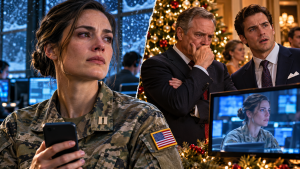
I had not arranged to be on television. I had not asked anyone to film me, and I didn’t know a national news segment was coming. A report about the winter storm included footage from the emergency operations center. I was at my station in uniform, doing my job. The camera caught me in the background while the report showed where people were monitoring the storm.
My family had the television on at Dad’s Christmas party. That was how they saw me.
Later, Celeste called. I stepped away from the main work area before answering.
“Leah,” she said, with none of the earlier softness in her voice. “You’re on the news.”
“I’m at work.”
“We can see that.”
Behind her, I heard voices and the television. Then Dad took the phone.
“You’re at Fort Mason,” he said.
“Yes.”
“You took the shift?”
“I volunteered.”
There was a pause. I could picture him with everyone gathered in the room, the news still playing.
“People are asking why you’re there,” he said.
I was tired enough not to help him out. “You told me not to come home.”
“That isn’t what I meant.”
“It’s what you said.”
“I was trying to keep the night focused on Bryce. You know how these things go when people see you in uniform.”
“Do I?”
He exhaled into the phone. “You could have made it easier.”
“I canceled my flight. I took a shift nobody else wanted. What would have been easier?”
He didn’t answer right away. I could hear the party behind him, but not the words. For the first time that evening, he sounded less certain than he had on the first call.
“I didn’t want Bryce’s promotion to become an Army story,” he said finally.
“It became a story because you told me not to come.”
“Leah, that’s not fair.”
“I didn’t call the news. I didn’t tell them about Bryce. I came to work.”
He started to say something, stopped, and tried again. “You always think I’m choosing him over you.”
I looked back toward the room where my shift was still underway. “You just told me you were choosing his night over having me there.”
“That’s not the same thing.”
“It is to me.”
Celeste came back on the call. “Your father didn’t mean to hurt you. He’s been trying to make the evening go smoothly.”
“Then why did you tell me not to punish him?”
“I thought you’d understand what he was trying to do.”
“I understood the words.”
She didn’t respond. I didn’t fill the silence for her.
Bryce got on the phone after that. I could hear the television in the background again.
“So you’re really working through the storm,” he said.
“Yes.”
“Everyone saw you.”
“I didn’t ask them to.”
“I’m not saying you did.” He sounded irritated, but he lowered his voice. “You know how this looks, though.”
“I know how it looks to you.”
He paused. “Dad wanted one night for me.”
“And I was willing to be there for you. I had a flight.”
“You would’ve had people asking about the Army.”
“Maybe. You could have answered them.”
“That’s not what I wanted tonight.”
There it was, said more honestly than Dad had managed: Bryce didn’t want the attention divided. I wasn’t angry that he wanted his promotion celebrated. I was angry that the family had decided my presence was the problem and expected me to call that generosity.
“I’m not going to argue about it while I’m on duty,” I said.
“So now I’m the bad guy?”
“I didn’t say that.”
“You didn’t have to.”
I let the quiet sit for a moment. Then I told him I had to get back to work and ended the call.
The storm kept the shift busy. I did what I had volunteered to do and stayed where I was needed. The television segment had already passed, but the reactions to it kept arriving in short messages. A relative asked if I was all right. Celeste wrote that the family had not meant to make me feel unwelcome. Dad sent nothing.
The next conversation with him came after Christmas. It wasn’t a dramatic family meeting. He called, and I answered because I wanted to hear whether he could say plainly what he had done.
“I should have handled the invitation differently,” he said.
“You could have invited me.”
“I know.” He sounded frustrated with the word, as if admitting that much were already more than he wanted to give. “I thought it would be simpler if Bryce had the evening to himself.”
“Why did that mean I couldn’t come?”
“Because people pay attention to you when they see the uniform. I didn’t want the whole thing turning into questions about your career.”
“You could have let people ask.”
“I was trying not to take anything away from him.”
“And you took it away from me instead.”
He was quiet. Then he said, “I didn’t think of it that way.”
“I think you did. You just thought I’d accept it.”
He began to object, then stopped. I heard him breathe out.
“I didn’t want you to feel uninvited,” he said.
“You told me not to come.”
“Yes.” He said it without dressing it up. “I did.”
That was not the apology I had wanted before the flight. It was still the first time he had said the plain thing without blaming the uniform, the guests or my reaction.
I told him I wasn’t going to keep rearranging my life around Bryce’s need to be the only person celebrated. If they invited me somewhere, they needed to mean the invitation. I would not be kept away and then asked to pretend it was for my own good.
He said he understood. This time I didn’t try to decide whether he meant it beyond that call. What mattered was what I would do next. I told him I would speak with the attorney about my mother’s trust, and that any discussion of Mercer Logistics would stay separate from my relationship with him and from the audit. I would not intervene in the audit, and I would not let the family turn the trust into an excuse for me to stay silent.
He didn’t like hearing the trust mentioned. “That has nothing to do with Christmas,” he said.
“No,” I replied. “It doesn’t. You brought up my career to keep me away. I’m telling you I won’t pretend the company is yours alone just to make this easier.”
“That’s not what I asked you to do.”
“It’s what you’ve expected me to do.”
He started to answer, then let the point go. We ended the call without settling the family’s history or the company’s future. Those were separate matters, and I would handle the trust through the attorney and keep my recusal intact.
The news footage had not made me a hero, and it had not ruined Bryce’s promotion. It showed me doing the work I had chosen to do after my father told me there was no place for me at his Christmas gathering. My family had seen that much. Dad had finally admitted he told me not to come.
I canceled the flight because he asked me to stay away. I took the shift because other people wanted to be home. After that, I stopped pretending those choices were the same as being included.