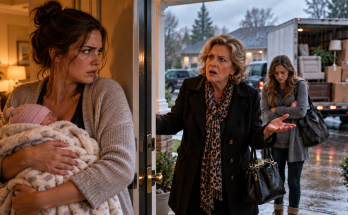
Hannah woke before sunrise to the sound of rain striking the farmhouse roof. A narrow stream of water had found its way through the damaged ceiling above the kitchen, and drops were falling steadily into the enamel pot she had placed beneath the stain. She moved the pot closer to the wall, then checked the sleeping room where Eli lay beneath two blankets. The roof needed repairing before another hard storm arrived. Her savings were still painfully small, and the farm remained entangled in a dispute that might last years. Yet by nine o'clock, she would have to sit before the county planning commission and explain why a proposed industrial corridor should not cross her property.
Dana Brooks arrived shortly after eight, carrying a canvas briefcase and the revised planning documents. Hannah had prepared coffee in the old percolator Tom repaired for her, and the kitchen smelled of damp wood, burnt toast, and fresh grounds. They spread the maps across the dining-room table while Eli finished breakfast. Dana pointed to the northern boundary, where Caldwell's proposed route approached an existing agricultural lane. The corridor appeared narrow on paper, but its accompanying utility specifications contemplated substantial construction, grading, and access for future water infrastructure. Hannah followed the line with her finger and realized how close it came to Samuel's monitoring wells.
“The application calls it a utility improvement,” Hannah said. Dana nodded. “That's how the applicant describes it. Our job is to make sure the commission understands what the improvement could actually involve.” She explained that the proposal remained preliminary and that the county had not authorized construction. Several agencies would need to review environmental and water-related questions before any project could proceed. Hannah was relieved to hear that the process allowed objections, but she understood that an opportunity to object was not the same as a guarantee of protection. Caldwell had engineers, attorneys, and consultants preparing its submissions. She had inherited Samuel's files and was learning to use them.
The preservation agreement complicated matters in ways Hannah had not appreciated when she signed the deed for seven dollars. Samuel had accepted restrictions intended to preserve the farm's agricultural character, maintain certain drainage features, and limit development incompatible with the land's conservation purposes. The agreement did not forbid every improvement or utility installation. It required specific review and, in some circumstances, consent from the organization responsible for enforcing its terms. Dana had contacted that organization, the Cedar Valley Land Trust, and obtained its complete recorded file. Several provisions corresponded directly to the northern fields Caldwell wanted to cross.
Hannah studied a survey attached to the agreement. Samuel had marked the seasonal drainage channel, the old orchard, and a meadow that sloped toward the property's northern boundary. The meadow had never impressed Hannah as valuable farmland. Tall grasses grew through patches of uneven soil, and much of it appeared unsuitable for planting without considerable work. Yet the supporting conservation documents described its importance in slowing runoff and allowing water to enter the ground. Samuel had protected it long before the contamination investigation began. Hannah wondered whether he had understood how significant that choice would become.
Dana explained that the land trust could enforce its recorded rights independently of Hannah's personal wishes. Even if Hannah decided to sell, a buyer could not simply erase the restrictions. Caldwell therefore faced more than the question of persuading an owner to sign a deed. It would need to address existing conservation obligations and demonstrate that any proposed activity complied with applicable requirements. Hannah remembered Evan describing the farm as a burdensome property with little commercial usefulness. She now understood that Samuel had made it difficult to convert the acreage into an unrestricted industrial parcel, regardless of who owned it.
Eli listened while packing his schoolbooks. He asked whether the meadow was the place where he had seen a red fox near the fence. Hannah said it probably was. He wanted to know whether the proposed road would go through the fox's field. She showed him the map, explaining that the route had not been approved and that adults were examining its possible effects. Eli considered the drawing for a moment. “Why can't they put it somewhere else?” he asked. Dana smiled faintly. “That's one of the questions we're asking.” Eli accepted the answer and returned to looking for his missing pencil.
After the school bus departed, Hannah drove into Cedar Ridge with Dana. The county meeting room occupied a low brick building behind the courthouse. Folding chairs had been arranged in rows, and a large map of the proposed development corridor stood beside the commissioners' table. Hannah recognized Ray Donovan near the front and Clara Jenkins farther back. Several local business owners had arrived, along with employees from a nearby manufacturing plant. The room contained people whose hopes and fears did not necessarily align. Hannah reminded herself that opposing one proposal did not require treating everyone who supported development as an enemy.
Evan Caldwell sat beside two engineers and an attorney. His father, Victor, occupied a chair near the wall. Hannah had never seen Victor in person, but recognized him from older photographs in Samuel's archive. His hair was nearly white, and he wore a dark overcoat despite the warmth of the room. He was broader than Evan, with a square face and the stillness of someone accustomed to being listened to. When Hannah entered, Victor looked directly at her. His expression revealed neither surprise nor welcome. Evan glanced toward his father before turning back to the papers in front of him.
The planning commission opened with a review of the application's procedural status. Caldwell's engineer described the proposed corridor as part of a long-term infrastructure improvement intended to support commercial development and strengthen regional utility access. He emphasized potential employment, investment, and transportation efficiency. Several people in the audience nodded as he spoke. Hannah understood why. Cedar Ridge had lost businesses over the years, and reliable jobs were not an abstract benefit to families who struggled to pay rent or keep their farms operating. She had been unemployed recently enough to recognize the appeal without needing anyone to explain it.
When the engineer turned to water infrastructure, Dana requested clarification about the proposed withdrawal and conveyance components. The engineer acknowledged that future phases might involve a substantial water-supply system, although design and permitting details remained unresolved. Dana asked how the proposed corridor accounted for the groundwater investigation near the abandoned quarry. He replied that the company intended to cooperate with applicable environmental requirements. The answer sounded reasonable until Dana asked whether the route had been evaluated against the most recent monitoring results. The engineer admitted that his preliminary assessment predated those findings.
A commissioner asked whether postponing the project would threaten jobs already promised to the community. Evan answered that uncertainty could influence investment decisions, but cautioned against reducing a complex development proposal to one disputed corridor. Hannah watched him closely. He spoke more carefully than he had on her porch, acknowledging that environmental permits and property rights needed to be resolved. She wondered whether the change reflected better advice or a deeper understanding of what Samuel had preserved. Either way, she could not forget that his first approach involved an offer made without disclosing the property's potential value.
Dana introduced the recorded preservation agreement and its supporting surveys. She explained that the northern meadow and drainage features were subject to restrictions that required attention before the county could approve certain uses. The land trust had submitted a letter requesting a full review of the proposal's effects. Caldwell's attorney argued that the restrictions did not necessarily prohibit utility work and that several questions could be resolved through design modifications. Dana agreed that the commission did not need to decide every legal issue that day. She asked only that it avoid approving a route whose compatibility with the recorded protections remained uncertain.
When Hannah's turn came, she stood with her notes in both hands. She had prepared a short statement and practiced reading it aloud beside the woodstove the previous evening. Nevertheless, her mouth felt dry as she approached the microphone. She explained that she had inherited Mercer Farm recently and discovered historical records documenting groundwater concerns near its northern boundary. Independent testing had since confirmed contamination at certain monitoring locations. She did not accuse Caldwell of causing the contamination, because that question remained under investigation. She asked the commission to consider whether approving infrastructure before those questions were resolved might create additional risks.
Someone behind her shifted impatiently when she mentioned the investigation. Hannah continued. She described the preservation agreement, the monitoring wells, and the need for reliable information about groundwater movement. She acknowledged that Cedar Ridge needed employment and that she understood the value of responsible investment. Then she looked toward the commissioners. “I want my son to grow up somewhere people can work and drink safe water,” she said. “I don't believe the county should have to choose between those things without examining the evidence.” She finished before her allotted time expired and returned to her seat.
Ray spoke next. He had brought copies of older property maps showing drainage patterns along the neighboring fields. He explained that heavy rain sometimes sent runoff across the northern meadow before the water disappeared into fractured limestone near the old quarry road. He did not claim expertise in groundwater chemistry. Instead, he described what he had observed during thirty years of farming nearby. Several commissioners asked questions about flooding, and Ray answered without embellishment. Hannah appreciated his restraint. The observations were useful precisely because he did not pretend they proved more than they did.
Clara addressed the commission briefly. She said she had lived near the proposed corridor for over four decades and recently received guidance to use an alternative drinking-water source while her well was assessed. She did not know who was responsible for the problem, but she wanted the testing completed before construction changed the landscape around her home. Her voice trembled slightly when she mentioned her late husband, who had dug their well with help from neighbors. Hannah watched Clara return to her chair and felt the weight of what the investigation meant to people who had trusted the land for most of their lives.
Several business owners then spoke in favor of the project. One described the difficulty of keeping younger workers in Cedar Ridge when employment opportunities remained limited. Another worried that extended delays would persuade investors to build elsewhere. Hannah listened carefully. Their concerns were legitimate, and she had no desire to see the town decline. But she wondered whether Caldwell's representatives had explained the uncertainty surrounding water access as fully to prospective employees as they had explained the benefits. Hope could become another means of pressure when the facts were incomplete.
Victor Caldwell requested permission to address the commission near the end of public comments. He introduced himself as a longtime investor in the region and spoke about projects his family had supported over several decades. His delivery was calm and measured. He said difficult environmental questions deserved proper investigation but warned against allowing unresolved allegations to prevent lawful planning. Hannah noticed that he never mentioned Rebecca, Mark, or the disputed agreements. When one commissioner asked whether the company would support independent groundwater monitoring, Victor replied that Caldwell had cooperated with regulators and would continue doing so.
The commission did not vote on final approval. After questioning the applicant and reviewing the submitted objections, its members agreed to postpone consideration of the contested northern route pending additional information from environmental authorities and the land trust. Caldwell could revise its proposal or provide further supporting material. The decision did not end the project, and it imposed no finding of wrongdoing. Hannah nevertheless felt relief. The county had recognized that the groundwater investigation and recorded conservation restrictions required meaningful examination before the corridor could move forward.
Outside the meeting room, a reporter approached Hannah and asked whether she considered the decision a victory over Caldwell. She answered that it was a decision to obtain more information before making an important commitment. The reporter then asked whether she believed Victor Caldwell had concealed contamination for years. Hannah said investigators were examining historical records and that she would not accuse anyone without sufficient evidence. The questions frustrated her, but she understood why Dana had repeatedly emphasized accuracy. A careless statement might distract from the very records Hannah wanted examined.
Victor passed nearby while the reporter was putting away his recorder. He stopped long enough to tell Hannah that Samuel had been a difficult man who misunderstood the intentions of people trying to improve Cedar Ridge. Hannah looked at him steadily. She could have answered with Rebecca's letters or the transport records, but she resisted. “Then the documents should help everyone understand what happened,” she said. Victor's expression remained controlled. He replied that documents could be interpreted in more than one way, then continued toward his car without waiting for her response.
The encounter stayed with Hannah during the drive home. She wondered what Victor knew about Rebecca's efforts to challenge the access agreements and whether he remembered the telephone call Mark described. The possibility that he had received advance notice of her mother's journey disturbed her. Still, she would not allow that uneasiness to become an accusation about the fatal crash. The police report remained consistent with an accident, and no evidence had established deliberate interference. Whatever wrongdoing the land and transport records eventually revealed, Rebecca deserved a truthful account rather than a more dramatic one invented from grief.
That afternoon, Hannah changed out of her courthouse clothes and returned to work in the orchard. The rain had stopped, leaving the grass wet and the earth soft beneath her boots. Several apple trees needed pruning, but she limited herself to clearing fallen branches and removing debris from the paths. Eli helped after school, carrying smaller sticks into a neat pile. He asked whether the meeting meant the development company could no longer build anything. Hannah explained that the county had delayed a decision while important questions were examined. Eli looked disappointed. “So we still don't know?” he asked. Hannah nodded. “Not yet.”
They worked until the light began to fade. Hannah found the physical labor useful after hours of careful legal language. A broken branch could be lifted, examined, and placed in the appropriate pile. A blocked drainage channel could be cleared. The results were immediate and visible. She wished the same were true of the documents beneath the barn. When Eli became tired, they carried their tools back to the equipment shed. Hannah paused beside Samuel's old pickup and noticed the organized boxes of replacement parts still stacked against the wall. She had intended to finish sorting them weeks earlier.
Tom arrived the following morning to inspect the truck's brakes and discuss what it would require to make the vehicle roadworthy. While he worked, Hannah examined the boxes beneath the workbench. Most contained ordinary supplies, but one held old agricultural survey markers, sections of measuring tape, and several notebooks stained by years of use. She opened a small notebook containing Samuel's handwriting and found repeated references to the northern meadow. The entries described surface-water movement after heavy storms and locations where water disappeared into shallow cracks in the limestone. Several measurements corresponded to points on the preservation survey.
Hannah called Dana and described the notebook. The attorney asked her to preserve it and compare its observations with the more formal records already reviewed by the hydrogeologist. Hannah photographed the pages and identified the locations Samuel had marked. She recognized the meadow, the drainage channel, and a low ridge she had crossed while accompanying investigators. The notebook showed that Samuel observed water movement long before the contamination concerns became serious. It strengthened the explanation for why he had included the meadow in the preservation agreement. He had understood that protecting the surface could matter to what happened underground.
Later that afternoon, Ray arrived carrying an old property file he had found in his barn office. His father had once considered selling a small adjoining parcel to a company associated with Caldwell. The file included a proposed access map, correspondence, and a copy of an early agreement that had never been completed. Ray explained that the negotiations ended when his father objected to language allowing broader use than the initial discussions suggested. Hannah examined the document. Its wording resembled the changes Mark admitted making to Rebecca's agreement. She asked whether Ray would let Dana review the original. He agreed immediately.
Dana compared Ray's file with the copies in Samuel's archive. The similarities did not prove that Rebecca's agreement was invalid, but they revealed a pattern of increasingly broad language appearing in different negotiations. More importantly, Ray's map contained a reference to a supplemental property-access instrument filed after the original Mercer agreement. Dana searched the county records and located the recording information. The supplemental instrument existed, but its attached supporting pages were not included in the digital copy they had previously examined. Hannah watched as Dana requested the complete archived record.
The certified pages arrived the next morning. They contained an acknowledgment of additional rights affecting a portion of Mercer Farm, apparently executed in connection with the disputed access agreement. Rebecca's name appeared in the document history, along with a reference to an authorization Mark had allegedly possessed. Hannah searched Samuel's archive for that authorization but found no matching original. Dana explained that the document's validity would depend on the precise authority granted, the sequence of signatures, and applicable recording requirements. The absence of an original did not settle the question. It made the underlying transaction more important to investigate.
Hannah studied the certified copy beside Rebecca's letters. Her mother had believed she was granting limited permission for surveys. Mark admitted that later language expanded the rights being claimed. Now a supplemental instrument appeared to rely on authority Hannah could not verify. She understood why Dana would not declare it fraudulent from the paperwork alone. Yet the discrepancy was substantial enough to affect Caldwell's current position. Hannah placed the pages in a protective folder and looked toward the barn. Samuel had spent years collecting evidence, but the county's older records were still revealing pieces he might never have seen. She asked Dana to challenge the supplemental instrument's claimed authority in the pending property case.