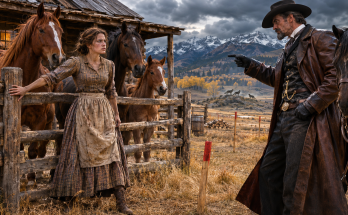
One afternoon, while I was sitting beside Henry's bed, he brought up something we hadn't discussed properly in years.
He had been looking out of the window.
Then he turned toward me.
“Do you remember when I found those horses beneath your cabin?”
I smiled.
“I remember you nearly losing your footing on the stairs.”
He frowned.
“That never happened.”
“It very nearly did.”
“I knew exactly what I was doing.”
“Of course you did.”
He laughed.
The laugh was weaker than it used to be.
But it was unmistakably Henry's.
I watched him settle against the pillow.
Then his expression changed.
“I hadn't believed you.”
I looked at him.
“What do you mean?”
“When I came to inspect the corral.”
He moved his fingers against the blanket.
“You told me the horses were somewhere protected. I thought you'd sent them away.”
I nodded.
“I know.”
“I thought perhaps you'd sold them.”
“I know that too.”
He looked toward the window again.
“I should've asked more questions.”
There was something in his voice that made me put down my cup.
For years, I had considered the matter settled.
Apparently, Henry had continued carrying part of it.
“You recorded what you saw.”
He shook his head.
“I recorded what I thought was there.”
“You weren't supposed to know what I'd hidden.”
He looked at me.
“That was precisely the trouble.”
I remained quiet.
He took a breath.
“I'd told James I'd keep an eye on you.”
I remembered him mentioning that promise after the storm.
He had been ashamed of how little attention he had paid to my circumstances.
I had never blamed him in the way he seemed to blame himself.
Henry had his own work.
His own grief.
His own responsibilities.
And I had spent considerable effort preventing anyone from discovering the shelter.
It wasn't reasonable to expect him to see through a deception I had deliberately maintained.
“Henry.”
He looked at me.
“You came back.”
He didn't answer.
“When the weather allowed you to travel, you came back to the cabin.”
He glanced down.
“And when you saw the horses, you told people what you'd found.”
I reached for his hand.
“That was enough.”
His fingers closed around mine.
They no longer possessed their old strength.
Still, I recognized the gesture.
For a while, we sat without speaking.
The sunlight moved slowly across the wall.
I remembered the schoolhouse.
Henry standing with his hat in his hands.
Richard asking whether he considered himself qualified to judge underground construction.
Henry answering without pretending to possess qualifications he didn't have.
I remembered the four votes against Richard's complaint.
I remembered stepping outside and discovering that I could still go home.
Henry's honesty had mattered that day.
So had Margaret's courage.
I squeezed his hand.
“You've never owed me an apology.”
He looked at me.
Then he smiled.
It was a small smile.
I didn't ask him to say anything else.
Not long afterward, Henry died.
I had known it might happen.
Knowing didn't make the loss easier.
I attended his funeral on the hill overlooking the valley.
The ground was no longer covered with winter snow.
Grass moved gently in the wind.
People from the settlement gathered around the grave.
Many had known Henry longer than I had.
They remembered the tools he had made.
The horses he had shod.
The repairs he had undertaken during terrible weather.
Some remembered his assistance with their shelters.
I listened to them.
I was glad he had been appreciated.
But I kept thinking about the afternoons that nobody else knew much about.
A loaf of bread placed on my kitchen table.
A damaged chisel examined beneath the window light.
Two cups of coffee beside the stove.
The little disagreements that never became serious.
Ordinary things.
That was what I would miss most.
When the funeral ended, I remained on the hill.
James's grave stood nearby.
I walked toward it.
Then I turned and looked back at Henry's resting place.
I had buried my husband when I was still a young woman.
Now I had buried the man who had become my closest friend during the years afterward.
They had loved me differently.
I had loved them differently.
Neither friendship nor marriage needed to be diminished for the other to matter.
I stood between the graves for several minutes.
Then I returned to town.
Henry's forge was quiet.
I opened the door.
The familiar smell reached me immediately.
Coal.
Iron.
Old leather.
His tools were still arranged where he had left them.
His apron hung beside the anvil.
I walked toward it.
Then I touched the leather.
For one foolish second, I expected to hear him behind me.
Something about how I shouldn't stand there looking at things when there was work to do.
The silence that followed was difficult.
I lowered my hand.
Then I prepared the forge.
There was something I wanted to make.
I selected a length of wrought iron.
I heated it.
When it was ready, I brought it to the anvil.
The hammer felt familiar in my hand.
Years earlier, Henry had adjusted the position of my fingers.
He had told me to let the weight assist me.
I remembered his voice as I lifted the tool.
Then I brought it down.
The sound traveled through the forge.
I lifted the hammer again.
And again.
I worked carefully.
I didn't want the piece to be elaborate.
Henry would have disliked anything excessively decorative.
He appreciated usefulness and sound workmanship.
The thing I intended to make needed to reflect that.
A simple iron cross.
As the hours passed, my arms became tired.
I rested when necessary.
Then I continued.
The iron gradually took the shape I wanted.
I examined the finished work.
It wasn't perfect.
I suspected Henry would have pointed out something that could have been improved.
That thought made me smile through my tears.
Near the base, I carved a sentence.
I wanted the words to remember something Henry had done that nobody else would have considered particularly important at the time.
He had knelt inside my cabin.
He had placed his hand against the floor.
And instead of dismissing something he didn't understand, he had paid attention.
That moment had changed my life.
The inscription remembered the man who had felt life moving beneath the ground and recognized what it meant.
When the cross was ready, I carried it to the cemetery.
I installed it beside his grave.
Then I stood back.
The dark iron looked simple against the grass.
That was what I had wanted.
I walked toward James's headstone.
I placed my hand against it.
Then I returned to Henry's cross and rested my fingers against the iron.
“Thank you.”
I wasn't speaking to one man rather than the other.
Both had given me something I had needed.
James had given me years of love and a home.
Henry had given me companionship, knowledge, and friendship during years when I hadn't expected to find those things again.
I remained on the hill until the light began fading.
Then I went home.
The cabin was quiet when I entered.
I placed my coat beside the door.
The table remained where James had built it.
The stove remained where Henry and I had spent so many afternoons talking.
I sat down.
For a moment, the loneliness felt painfully familiar.
Then I noticed the papers waiting beside my father's notebook.
People had requested help.
There were drawings to examine.
Questions to answer.
Things I could still do.
I placed my hand across the notebook.
The grief didn't disappear.
I didn't expect it to.
But I had learned long before that sadness and useful work could exist together.
The following morning, I returned to the ordinary responsibilities of my life.
The animals needed feeding.
The property required attention.
The letters needed answers.
There was comfort in doing those things.
Years passed.
The valley continued changing.
The old sawmill eventually closed.
The roads became better.
New buildings appeared where there had once been very little.
Transportation changed considerably.
When the railroad arrived, the old stagecoach route lost much of its importance.
I thought of the three red stakes.
Of Richard standing on my porch.
Of the folded map with my land surrounded by red ink.
The relay station he had been so eager to control belonged to a world that was gradually passing away.
I wondered whether he ever thought about it.
I hadn't seen him since the afternoon he offered me five hundred dollars for exclusive construction rights.
He never returned to the cabin.
Eventually, he left the valley altogether.
People still spoke of his business affairs occasionally.
He remained wealthy.
That didn't surprise me.
Richard had always been skilled at accumulating money.
I had no particular interest in whether his fortune increased or diminished.
His decisions no longer governed my life.
That was sufficient.
In 1911, while I was purchasing supplies at the general store, I heard that he had died.
The news had come from Tucson.
I was counting change when someone mentioned his name.
For a moment, I stopped moving.
“Richard Whitmore?”
“Yes.”
I looked down at the coins.
He had died far from the valley.
Still wealthy, from what I was told.
I had imagined many things concerning Richard during the weeks when he threatened my property.
I had imagined him discovering that he couldn't take it.
I had imagined the council rejecting his demands.
I had imagined how wonderful it would feel to know he had failed.
Those things had happened.
But standing beside the counter all those years later, I felt no pleasure in hearing that he was dead.
There was no satisfaction.
No sense of a final victory.
I simply counted the remaining change and placed it where it belonged.
Richard had become part of my past a long time earlier.
I carried my purchases home.
Then I fed the animals.
There were things requiring attention that mattered considerably more than the death of a man who had once believed he could purchase everything around him.
As I grew older, people occasionally asked why I had never remarried.
I didn't mind the question when it was asked kindly.
I told them I had never felt the need.
That was the truth.
I hadn't rejected the idea because I believed another marriage would somehow dishonor James.
I simply hadn't wanted one.
The life I had made suited me.
It contained work I enjoyed.
People I cared about.
Memories I valued.
And a degree of independence I hadn't possessed when I was younger.
I never became a wealthy woman.
My cabin remained modest.
I continued making careful decisions about money.
There were things I couldn't afford.
Things I repaired rather than replaced.
Occasionally, I remembered the five hundred dollars Richard had offered me.
I wondered what I might have purchased with it.
Then somebody would bring me a drawing.
Or ask a question.
Or describe a winter their animals had survived.
And I would stop wondering.
I had received something from that decision.
It simply hadn't come in the form Richard understood.
The wooden box beside my belongings gradually filled with letters.
Some had become worn from being opened repeatedly.
Others I had read only a few times.
I kept all the ones that mattered to me.
James's watch remained among them.
The hands had never moved.
I never attempted to repair it.
I didn't need it to tell the time.
It belonged to a particular day.
A particular loss.
My life had continued beyond that day, even when I hadn't believed it could.
By 1921, I was seventy-four years old.
My hands were not as steady as they once had been.
Opening a stubborn jar required considerably more patience.
Walking any distance took longer.
I occasionally sat beside the window simply because I was tired.
Still, I enjoyed looking across the property.
I remembered the woman who had stood barefoot on the porch while Richard explained that she had twenty-one days.
I remembered her coffee tin.
Her fear.
Her determination not to surrender.
Sometimes I wished I could sit beside that younger version of myself.
I wouldn't tell her that everything ahead would be easy.
It wouldn't.
She would experience pain.
She would make mistakes.
She would lose people whose companionship mattered to her.
But I would tell her that the life she thought she was trying to preserve wasn't the only life available to her.
There was another one ahead.
One she could not yet imagine.
And it would begin beneath the very floor on which she was standing.
I opened my father's notebook one afternoon.
The cover was cracked.
The pages had become thin and worn.
His handwriting remained legible.
I turned to the familiar drawing near the back.
Then I smiled.
I had spent much of my life learning from those pages.
I had never stopped being grateful that he had placed them in my hands.
Outside, the wind moved through the valley.
I closed the notebook carefully.
Then I placed it beside the wooden box.
The cabin felt peaceful.
I no longer believed silence meant that something was missing.
Sometimes it meant that everything was where it belonged.