Mama had taught me to distrust the first measurement.
It was a habit she'd developed through years of working with fabric.
A small error could waste material that hadn't been cheap to begin with.
I thought about that as I held my measuring tape against the inside wall of the van.
I marked a possible position for a window.
Then I checked the dimensions again.
The second measurement made me reconsider the mark.
I moved it slightly.
This wasn't a piece of cloth I could replace easily if I made a mistake.
The wall had to remain strong enough to serve its purpose.
It also had to keep rain from entering my future home.
An unnecessary opening in the wrong place would give me another expensive problem.
I put the tape away.
Before cutting any openings, I needed to address the exterior.
That was the part of the van that had made it so easy for other people to dismiss.
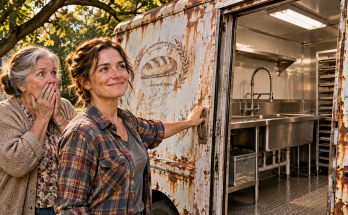
The original white finish had deteriorated badly.
Rust showed around the bottom of the body.
The rear door looked particularly neglected.
Standing beside it after work one afternoon, I tried to imagine what it might look like without all that damage.
I couldn't simply cover everything with paint.
The deteriorated areas needed attention first.
Otherwise, I would be concealing problems rather than repairing them.
I began removing the loose material.
It was slow work.
There wasn't much satisfaction in spending an afternoon on a small section while the rest of the vehicle remained ugly.
I had to remind myself that I wasn't trying to impress anybody.
I was trying to make something last.
Over several afternoons, I worked on the affected surfaces and dealt with three damaged portions of the body.
The back cargo entrance needed special attention.
My plan placed the sleeping area toward the rear, which meant I wouldn't be using that door every day.
The side entrance would become my ordinary way in and out.
I secured the old rear door and sealed it appropriately.
It could then become part of the permanent enclosure around my sleeping area.
That decision made sense on paper.
Completing the work took considerably longer than drawing the line in my notebook.
Mississippi hadn't become particularly cool just because the calendar said autumn.
By the time I arrived at Mama's place, I'd often spent hours working in rooms where the air seemed determined to stay warm.
My arms already felt tired.
My feet hurt.
Then I'd change clothes and stand beside the truck with another task waiting for me.
I'd imagined determination would carry me through every afternoon.
It didn't.
Sometimes I stood looking at the vehicle and realized I had nothing useful left in me that day.
At first, I felt guilty about that.
The truck represented my chance to have something of my own again.
Every unfinished task seemed like another day spent paying for a rented room.
But working when I was too tired to concentrate wasn't going to help.
I could damage materials.
I could overlook an important problem.
I could hurt myself.
Any of those things would set me back much further than an evening of rest.
So there were afternoons when I changed my mind and returned to Cherry Street.
I showered.
I rested.
I went to sleep knowing the rust would still be waiting the following day.
It wasn't a failure.
It was part of making the project sustainable.
When I finally finished preparing the body, I had a different decision to make.
The original white appearance held no particular appeal for me.
It belonged to the van's previous working life.
I chose a dark gray enamel.
It seemed practical, and I liked the way it looked.
The first coat didn't produce the dramatic improvement I'd hoped to see.
There were areas that looked uneven.
From certain angles, I could still recognize the tired appearance of the vehicle underneath.
I knew better than to judge it before completing the work.
After the second coat, I stood back.
The old bakery van looked different enough that I wanted Mama to see it.
I didn't need to call her.
She came out of the house that evening and paused on the steps.
Her eyes traveled from the front of the vehicle toward the back.
“That's quite a change.”
I looked at the gray body.
“Not such an eyesore anymore?”
She smiled.
“I was getting used to having an eyesore.”
I laughed.
She hadn't complained about the truck being in her yard.
But I knew she was pleased to see the improvement.
For the first time, somebody looking at it from outside could recognize that work had been done.
Until then, most of my efforts had involved the sort of mechanical problems that weren't immediately visible.
The new finish was different.
It gave the project a sense of movement.
I opened my expense notebook that evening.
The materials for the body repairs and paint had cost $220.
I recorded the figure.
I didn't round it down or leave anything out to make myself feel better.
The numbers needed to be accurate.
That was the only way I'd know whether I could finish without exhausting my savings.
With the exterior work completed, I returned to the problem of the windows.
I didn't need enormous windows.
There wasn't enough uninterrupted wall space to accommodate them anyway.
I wanted daylight and the ability to let fresh air move through the interior.
I found two casement windows at a resale building supply shop in Jackson.
They measured roughly eighteen inches by twenty-four inches each.
The frames weren't fashionable.
There wasn't anything especially attractive about their appearance in the shop.
But they were in sound condition.
The hinges allowed them to open in a way that suited my limited interior.
And their size worked with the positions I'd been considering.
I purchased them.
Once I had the actual windows in front of me, I could finalize the measurements.
I didn't assume the truck's walls would behave like the walls of a conventional house.
The structure was different.
I needed to make sure the surrounding areas received suitable reinforcement.
I also needed to arrange the installation so water wouldn't find its way around the frames.
I paid particular attention to the sealing.
The last thing I wanted was to spend money repairing moisture-damaged flooring and then create another source of moisture myself.
It took patience to get everything ready.
I occasionally found myself looking at the two windows and wishing somebody could simply put them in while I went back to cleaning hotel rooms.
But I was invested in the result.
I wanted to understand what was being done.
I wanted to know what I'd need to examine in the future if something went wrong.
When both windows were finally in place, I stood inside the cargo compartment and opened them.
Air entered from one side and moved toward the other.
I could feel it against my arms.
I hadn't realized how accustomed I'd become to the enclosed feeling of the original interior.
With the side door open, the van had always received some light.
But that light came mostly from one direction.
Now it reached the walls from different places.
The old sink reflected it.
The white panels seemed brighter.
Even the dimensions of the compartment felt different, although I knew they hadn't changed.
Mama came to the entrance.
She leaned inside.
“That makes a world of difference.”
I looked toward the window nearest her.
“I think so, too.”
She didn't immediately ask about the next task.
She stood there appreciating the improvement with me.
I was grateful for that.
There was still an enormous amount to accomplish, and I knew it.
But I wanted a moment to enjoy what we'd reached.
I could imagine waking up inside that small space and opening a window.
I could imagine sitting near the kitchen counter while air moved through the room.
Eventually, I would have curtains hanging beside the frames.
Nothing expensive.
Just something that made the space feel less industrial.
The window work came to $190.
I recorded that beneath the exterior expenses.
The notebook was becoming more important to me with every stage of the project.
It held evidence of the money I'd spent.
It also held evidence of decisions I'd made for myself.
I was no longer simply calculating how many weeks my savings would cover the room on Cherry Street.
I was deciding what those savings could become.
The damaged floor was next.
I'd marked two affected sections near the side entrance.
The softness I'd discovered bothered me every time I stepped through the doorway.
I wanted to deal with it before building anything over the surrounding area.
The existing material was marine-grade plywood.
Most of it remained in useful condition.
Replacing the entire floor would have meant spending money unnecessarily.
I concentrated on removing the compromised portions.
As I worked, I examined the neighboring material.
I wanted to preserve everything that was still sound without leaving hidden damage behind.
Both sections could be addressed without discarding the rest of the floor.
That was a relief.
I installed suitable replacement material in the affected areas.
Then I protected the repaired portions with an appropriate finish.
When I was done, I stood near the side entrance and examined the result.
Nobody would have mistaken it for a polished living room floor.
I didn't need them to.
I wanted something durable that I could keep clean without worrying about damaging it every time I washed the floor.
The old bakery's drainage arrangement was useful, too.
I'd been thinking about how to incorporate a small washing area.
Having some of the commercial infrastructure already present gave me possibilities that an ordinary empty delivery vehicle wouldn't have offered.
That was something I'd come to appreciate more as the renovation progressed.
The value hidden behind the rusty exterior wasn't something I could remove, sell, and use to purchase a conventional house.
It was material.
Useful material.
The original builders had fitted the vehicle to withstand the demands of a working food business.
I could make some of those features serve an entirely different purpose.
The floor work cost me seventy dollars.
Compared with what I might have spent replacing everything, I considered that a good result.
I wrote the amount down.
Then I looked at the interior drawings I'd made before beginning the bodywork.
Some of my earliest ideas didn't appeal to me anymore.
I'd imagined having a reasonably generous kitchen counter.
But after spending more time inside the truck, I understood how quickly that would consume the available space.
I wasn't somebody who needed room to prepare enormous meals.
Most of my evenings involved cooking something simple for myself.
I could manage with less counter space if the layout was sensible.
The same thing applied to storage.
I'd drawn more cupboards than I actually needed.
My possessions already fitted inside a relatively small rented room.
I didn't need to create enough cabinetry for belongings I didn't own.
Every additional cupboard would reduce the open area where I'd stand, dress, or move between the kitchen and bed.
I revised the drawing.
Then I revised it again.
I considered the placement of the washing area.
I checked the distance between the proposed bed and the kitchen.
I looked at the windows I'd just installed.
It helped to make those decisions while standing inside the actual vehicle instead of imagining the dimensions from a chair in Mama's house.
The limited space no longer seemed quite as intimidating.
It demanded some discipline.
That was all.
One evening, I sat near the doorway with the notebook balanced on my knees.
The gray paint was finished.
The windows opened.
The damaged floor had been repaired.
I could walk through the entrance without feeling those soft sections beneath my feet.
There was still no place to sleep.
Still no functional household water system.
Still a considerable expense waiting before I'd be able to leave Mrs. Broussard's room.
But the basic enclosure was in better condition.
I could begin constructing the actual living area.
I looked down at my drawing of the raised bed.
The storage tubs would go underneath.
The narrow wardrobe would hold my work clothes.
The kitchen would make use of the stainless steel sink.
For the first time, I wasn't looking at a drawing that depended entirely on what might be possible someday.
I was looking at plans for the space around me.
I closed the notebook and carried it inside Mama's house.
The next stage would require lumber.
I knew where the first pieces belonged.