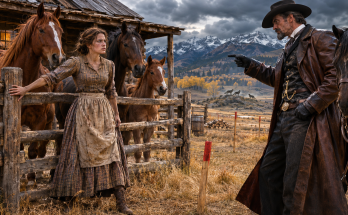
Five hundred dollars was an extraordinary amount of money to me.
I won't pretend otherwise.
When Richard made his offer, I immediately began thinking about everything that needed attention around the property.
The cabin roof required repairs.
Several tools were worn.
The corral needed additional work.
My pantry wasn't nearly as well supplied as I wanted it to be.
And I had never recovered from the habit of worrying about money.
Even after the council hearing, I still counted my coins carefully.
I still thought twice before using extra lamp oil.
Five hundred dollars could have changed all of that.
Richard knew it.
He unfolded the paper and held it toward me.
“You wouldn't be required to finance any construction yourself.”
I looked at him.
“What would I be required to do?”
“Provide the design and the knowledge necessary to reproduce it.”
He tapped the document.
“The commercial rights would belong to me.”
I rested the harness beside my chair.
“And nobody else could build one without your permission?”
“That would be the general arrangement.”
I looked toward the empty corral.
The snow had begun hardening along the fence.
Richard stood patiently.
He seemed confident that the amount he had offered would settle whatever objections I might have.
I imagined walking into Margaret's store without worrying about the price of flour.
I imagined purchasing proper tools instead of repairing things that should have been discarded years earlier.
I imagined having money available if one of the horses became ill.
Those were reasonable desires.
There was nothing wrong with wanting them.
For a moment, I was almost embarrassed by how tempting the offer was.
Then I thought about what Richard intended to purchase.
Not stone.
Not timber.
Not the labor required to excavate another chamber.
Knowledge.
Something my father had given me without asking for payment.
I remembered him sitting with his notebook.
I remembered the coughing that had become increasingly troublesome during his later years.
Thirty years beneath the earth had taken something from his lungs that he could never recover.
Yet he had never regretted teaching me what he knew.
Whenever I asked him a question, he had tried to answer it.
When he gave me the notebook, there had been no agreement attached.
No restriction concerning who else could learn from it.
It had simply become mine to use.
Richard shifted his weight.
“Mrs. Bennett?”
I looked at him.
“Would people have to pay you to use the design?”
He gave a slight smile.
“Naturally. There would be costs associated with providing such a service.”
I thought of Margaret's two dead cows.
The Wilson family's sheep.
The Patterson children whose family had lost its chickens.
I thought of ranchers who had spent everything they could afford constructing shelters that had failed.
Then I imagined Richard deciding which of them could purchase the protection I had discovered.
The thought made my decision easier.
“No.”
His smile disappeared.
“Perhaps you should read the document before answering.”
“I understand what you're offering.”
“Five hundred dollars.”
“Yes.”
He looked at me as though the amount itself required further consideration.
“You could make substantial improvements to this property.”
“I know.”
“You could purchase equipment.”
“I know that too.”
He folded the paper slightly.
“Is the price your objection?”
“No.”
He studied my face.
“Then what is?”
I looked toward the cabin.
“My father taught me these things.”
Richard waited.
“He didn't give me that knowledge so I could prevent other people from using it.”
“You wouldn't be preventing anyone from using it.”
“Not if they could afford your price.”
His expression hardened.
I stood.
“I won't give you exclusive control over the design.”
He considered me for several seconds.
Then he asked what amount would persuade me.
I shook my head.
“There isn't an amount.”
“Everyone has a figure in mind.”
“Not for this.”
I picked up the harness.
“I intend to let other people learn from what I've built.”
Richard folded the paper completely.
He returned it to his coat.
For a moment, neither of us spoke.
I had turned down two hundred dollars from him in October.
Now I had turned down five hundred.
The second decision had been more difficult.
But I felt considerably more certain about it.
Richard looked toward the cabin.
Smoke was rising from the chimney.
He studied the little building as though seeing something unfamiliar.
Then he mounted his horse.
I expected him to leave without saying anything else.
He rode partway toward the path.
Then he stopped.
He didn't turn around.
“You've done more than construct somewhere to keep horses, Mrs. Bennett.”
I remained on the porch.
“You've made the old requirements rather difficult to defend.”
Then he continued down the path.
I watched him disappear.
Richard never visited my cabin again.
I sat back down and returned to the harness.
The damaged leather still needed repairing.
Refusing his offer hadn't changed that.
I smiled a little.
Then I continued working.
By the latter part of February, the snow began retreating.
Water appeared along the edges of the creek.
Small patches of grass emerged.
The valley looked tired.
Buildings carried visible evidence of the winter.
Some fences had collapsed.
Several roofs had been repaired with whatever materials people could obtain.
But the weather was becoming easier to endure.
And people began visiting my property.
The first few approached with considerable hesitation.
They would stop near the corral and look toward the cabin.
Some carried pieces of paper.
Others brought little samples of soil.
They had heard about the underground shelter.
Now they wanted to understand how it worked.
One morning, I was brushing Rusty when a man approached holding his hat.
He stopped a short distance away.
“Mrs. Bennett?”
“Yes?”
“My brother lost six horses during the winter.”
I lowered the brush.
“I'm sorry.”
He nodded.
“He's been talking about your shelter.”
I waited.
“We wondered whether something similar might work on his property.”
I asked him about the land.
He described its position and the surrounding ground as well as he could.
Some of his answers were too uncertain for me to form a useful judgment.
“Bring me a drawing of the property.”
His expression brightened.
“You'd look at it?”
“Certainly.”
He hesitated.
“What would that cost?”
“There's no charge for showing me a drawing.”
He thanked me.
Then he thanked me again.
After he left, I returned to brushing Rusty.
The horse stood patiently.
I thought about how differently that conversation might have gone if I had signed Richard's agreement.
I would have been obliged to send the man elsewhere.
He would have needed to negotiate with somebody who had never carried a bucket of dirt beneath my cabin.
Somebody who viewed the shelter primarily as another source of income.
I was glad I hadn't signed.
More people arrived over the following weeks.
I showed them my drawings.
I explained what my father had taught me.
I described Samuel's corrections.
I made it clear that copying the appearance of my chamber wasn't enough.
Different ground presented different problems.
Water needed to be considered.
So did the surrounding soil and the structural demands of each location.
I refused to tell anyone that an underground shelter would be suitable for every property.
I remembered the eastern wall too clearly.
Sometimes people became impatient when I explained the difficulties.
They wanted a quick answer.
They wanted to know how much digging would be necessary.
How many stones they would need.
How soon the horses could be moved inside.
I understood the desire for certainty.
But I couldn't give it to them without knowing enough about their circumstances.
One thing I repeated whenever necessary was that no animal's safety justified careless construction.
People sometimes looked disappointed.
I preferred disappointing them to encouraging them to build something that might collapse.
Samuel had taught me that.
My own experience had made certain I wouldn't forget it.
Margaret eventually became the first person to ask me to undertake a proper piece of work for her.
Part of the storeroom attached to her general store had failed during the blizzard.
A considerable amount of her inventory had been damaged.
She wanted somewhere more dependable to keep her supplies.
One evening, she invited me to her home.
I brought the notebook.
She had cleared her kitchen table and prepared coffee.
Several sharpened pencils waited beside the cups.
“Well,” she said.
“Let's see what can be done.”
I sat beside her.
We discussed the space she needed and the difficulties presented by her property.
I explained that a storage chamber involved different considerations from keeping horses.
She listened carefully.
Occasionally, she interrupted with another question.
“Would the flour stay dry?”
“If the site is suitable.”
“And the potatoes?”
“We can account for them.”
“What about jars of preserves?”
“Yes, Margaret.”
She looked at the drawings.
“And if I wanted somewhere for extra supplies?”
I laughed.
“How much of the store are you intending to put underground?”
She smiled.
“As much as I can afford.”
We continued working.
The following evening, I returned with revised drawings.
She made more coffee.
We spent several hours examining the details.
When I finished, Margaret pulled her ledger toward herself.
“Now we should decide what I owe you.”
I shook my head.
“You don't owe me anything.”
She looked up.
“Excuse me?”
“You brought me oats when I needed them.”
“That wasn't payment for this.”
“You helped me when Richard was threatening my property.”
She picked up her pencil.
“Emily.”
I stopped speaking.
Margaret began writing.
I watched her hand move across the page.
The ledger reminded me of the afternoon I had asked whether I could pay for supplies after winter.
She had explained that Richard held three hundred dollars of her debt.
She had been unable to offer me credit.
I had walked out carrying damaged rope and discarded buckets instead.
Now she turned the ledger toward me.
I read the new entry.
It provided me with a full year of store credit for reasonable household necessities.
I looked at her.
“Margaret, that's too much.”
She closed the ledger.
“You've done professional work.”
“I wanted to help you.”
“And I want to pay you.”
I started to protest again.
She lifted one hand.
“People pay me for the things I provide. I see no reason they shouldn't pay you for the things you provide.”
I looked down at the drawings.
My eyes became damp.
I didn't know why the gesture affected me so strongly.
Perhaps it was because nobody had ever treated the knowledge my father had given me as something deserving payment.
Not payment for preventing others from using it.
Payment for work I had actually performed.
There was an important difference.
“Thank you.”
Margaret poured more coffee.
“That's better.”
Neither of us mentioned Richard.
Neither of us mentioned the day she had been unable to grant me credit.
There was no need.
We understood what had changed.
That evening, I rode home carrying the notebook beneath my coat.
I felt lighter.
Not because I had become wealthy.
I hadn't.
But somebody had looked at what I knew and treated it as useful work.
I had spent two years thinking of myself principally as James Bennett's widow.
The people around me had often thought of me in the same way.
Now Margaret had given me another way of understanding who I was.
I was somebody who could provide something valuable.
I was somebody whose judgment mattered.
That realization stayed with me.
In the months that followed, Henry began visiting regularly.
Usually, he came about once a month.
Sometimes he brought bread.
Sometimes he carried a piece of metal he wanted me to examine.
When the weather was pleasant, we sat on the porch.
When rain made that uncomfortable, we sat beside the stove.
Our conversations rarely followed any particular direction.
We discussed tools.
We discussed stone.
We discussed the repairs different neighbors were making.
Occasionally, we talked about James.
Henry remembered things I had forgotten.
Little jokes.
Minor disagreements.
The peculiar habits James had developed when working with wood.
Those memories no longer made me cry every time they were mentioned.
Sometimes they simply made me laugh.
One afternoon, Henry arrived carrying a damaged chisel.
He placed it on the kitchen table.
“Tell me what you think happened here.”
I picked it up.
The edge had fractured.
I turned it beneath the window light.
“Too hard, perhaps.”
Henry raised his eyebrows.
“You think I got the temper wrong?”
I pointed toward the damaged edge.
“Look at the way it broke.”
He leaned closer.
Then he picked up the chisel himself.
For a little while, he examined it without speaking.
Eventually, he laughed.
“James used to tell me there wasn't much point arguing with you.”
I smiled.
“He argued with me anyway.”
“He certainly did.”
We both laughed.
Henry set the chisel down.
Then we returned to discussing why it had failed.
That was what I appreciated about him.
He didn't become offended when I questioned something.
He didn't assume that respecting me required agreeing with everything I said.
When he thought I was wrong, he told me.
When I proved otherwise, he accepted it.
I tried to offer him the same courtesy.
Henry had lost his wife years earlier.
I knew something about the emptiness waiting for him when he returned home.
He knew something about mine.
Neither of us attempted to change that by pretending we could replace the people we had buried.
There was no courtship.
No expectation that our friendship ought to become something else.
We simply enjoyed being in one another's company.
One afternoon, Henry suggested I visit his forge.
“You might as well learn to make some of those fittings you keep needing.”
I looked at him.
“You'd trust me with your tools?”
“Some of them.”
I laughed.
He smiled.
“Come when you've got time.”
I agreed.
After he left, I remained on the porch.
The valley was becoming green again.
Water moved steadily through the creek.
Rusty and Belle grazed nearby.
Daisy had grown noticeably since the previous autumn.
I watched her move along the fence.
Then I looked toward the eastern boundary.
The three red survey stakes were visible again.
Their paint had faded.
Once, the sight of them had filled me with dread.
Now they were little more than pieces of wood marking a business plan that hadn't succeeded.
I went inside.
My father's notebook lay on the table.
Beside it were several drawings people had brought me from their own properties.
I sat down and began examining the first one.
There were questions I needed to ask.
There were details that required further consideration.
I sharpened my pencil.
Then I returned to work.
For the first time since James's death, I wasn't making plans merely to preserve what I had left.
I was making plans for something I wanted to do.