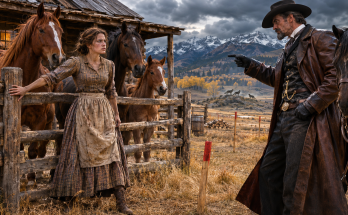
Three days before the weather turned, I rode to Samuel Brooks's cabin.
The journey was colder than I had expected.
I kept my hands tucked close to my body whenever I could.
The wind found its way through my coat.
When I reached Samuel's property, he was sitting outside with a chisel resting across his knee.
He was sharpening it.
He glanced at me when I dismounted.
“What's gone wrong?”
“Nothing.”
He returned to his work.
“Water getting inside?”
“No.”
“Stone moving?”
“Not that I've noticed.”
He stopped sharpening.
“Then what brings you here?”
I removed my father's notebook from beneath my coat.
“I'd like you to inspect the shelter.”
Samuel looked at the notebook.
He didn't take it.
“I thought we were finished with those drawings.”
“We are.”
“Something troubling you about them?”
“Not the drawings.”
I held the notebook against my chest.
“The actual chamber.”
He studied my face.
“You finished it?”
“Yes.”
He put the chisel down.
“And the horses?”
“They've been inside since October twentieth.”
Samuel looked toward the distant hills.
For a while, he said nothing.
I knew he had avoided visiting my property deliberately.
He had spent years working on structures for the army and for men who paid him to solve their problems.
He was old.
He wanted to spend his remaining years without carrying responsibility for another person's construction.
I respected that.
Still, I had made the journey because I needed an answer that only somebody like him could provide.
“I wouldn't ask if it weren't important.”
Samuel picked up the chisel.
He wiped it with a piece of cloth.
“You've been checking the eastern wall?”
“Every day.”
“And the rest?”
“Yes.”
He wrapped the chisel carefully.
“Let me get my coat.”
I released a breath.
He disappeared inside the cabin.
When he returned, he carried a small hammer.
We mounted our horses and rode back toward my property.
Neither of us spoke much.
I was grateful for the silence.
The closer we came to the cabin, the more nervous I became.
It was one thing to examine my work when nobody else was watching.
It was another to invite someone who could recognize every mistake.
Samuel dismounted beside the empty corral.
He looked at the fence.
Then he looked at the cabin.
“Still seems a peculiar place to keep horses.”
I nearly smiled.
“That's rather the point.”
He followed me inside.
I closed the door and put my father's notebook on the table.
Samuel removed his gloves.
He watched while I moved the furniture.
I pulled aside the square of deerskin covering the concealed iron ring.
He leaned forward.
I lifted the wooden panel.
A little warmth rose through the opening.
Samuel looked down.
His eyebrows moved.
He bent closer and examined what he could see of the stone staircase.
Then he removed his coat.
“Bring a light.”
I collected the lantern.
He descended slowly.
I followed.
Rusty noticed us first.
He raised his head and turned toward the staircase.
Belle continued eating.
Daisy looked at Samuel as though she expected him to have brought something interesting.
Samuel barely glanced at the horses.
His attention went immediately toward the stonework.
He walked to the eastern wall.
I stopped a short distance behind him.
That was the place where I had nearly died.
Even after the repairs, I sometimes found myself looking at it longer than the other walls.
Samuel examined the surface.
He pressed his hand against several sections.
Then he crouched.
I stood holding the lantern.
“Higher.”
I lifted it.
He studied one of the joints.
“Did you follow the last drawing?”
“Yes.”
“All the way through?”
“Yes.”
He grunted.
I couldn't tell whether he was satisfied.
He stood and moved toward the curved ceiling.
The hammer came out of his pocket.
I recognized what he intended to do.
My father had explained how experienced men listened to materials as well as looked at them.
Samuel tapped a section of stone.
The sound was clear.
He moved farther along.
Another tap.
Another clear sound.
I tightened my fingers around the lantern handle.
He didn't speak.
I found that particularly difficult.
When a person criticized something, at least you knew what they were thinking.
Samuel simply moved from one part of the chamber to another.
Occasionally, he crouched.
Occasionally, he stood with his head tilted back.
At one point, he examined a section for so long that I became convinced he had discovered a serious problem.
“Is something wrong?”
He held up one finger.
I waited.
Finally, he straightened.
“You altered this from the earlier drawing.”
“After the wall came down.”
“Why?”
I explained my reasoning.
He listened without looking at me.
Then he examined the section again.
“That was sensible.”
I almost thanked him.
But he had already moved away.
He examined the ventilation arrangements.
He considered the concealed entrance.
He looked at the spaces occupied by the horses.
Only then did he spend much time observing the animals themselves.
Rusty approached him.
Samuel rested a hand against the horse's nose.
“You seem content enough.”
Rusty moved closer.
Samuel scratched him briefly.
Then he returned his attention to the chamber.
I followed him around until my arm began aching from holding the lantern.
He eventually indicated that we should go upstairs.
I climbed behind him.
When we reached the cabin, he stood near the table and looked down at the floor.
I closed the entrance.
Then I waited.
He walked to the window.
He looked outside.
I began wondering whether I should make coffee simply to have something to do.
“Samuel?”
He turned.
“Well?”
He rubbed his beard.
“Your father would've had a few complaints.”
My stomach tightened.
“How many?”
“Three, probably.”
I looked toward the notebook.
“And you?”
“Two.”
I stared at him.
He took his coat from the chair.
“Either you've done better than I expected, or my eyes aren't what they used to be.”
There was the faintest smile beneath his beard.
I finally understood.
He wasn't telling me the chamber was about to fall apart.
He was telling me I had built something worthy of his respect.
I sat down.
The relief made my legs feel weak.
Samuel pulled on his coat.
“Nothing built by human hands is perfect.”
“I know.”
“Keep paying attention to it.”
“I will.”
He walked toward the door.
Then he stopped.
“Emily.”
I looked up.
“The stone arches are sound.”
I said nothing.
He looked down at the floor.
“They'll carry what they're meant to carry.”
Those words mattered more to me than any compliment Richard could ever have offered.
Samuel had seen the chamber.
He had inspected it.
He had found imperfections, as any honest man would.
But he believed the structure would endure.
I stood.
“Thank you.”
He nodded.
Then he left.
I watched him ride away through the window.
He never came back to inspect the underground chamber.
There wasn't any need.
He had given me the best of what he knew.
The rest belonged to me.
I sat at the kitchen table and opened my father's notebook.
I traced a finger across one of the old drawings.
I wished he could have met Samuel.
I imagined the two of them discussing some small detail while pretending not to enjoy each other's company.
The thought made me smile.
Then it made me sad.
I closed the notebook.
Outside, the afternoon was becoming colder.
I went to the corral and checked the fencing.
The ground beneath my boots had begun hardening.
I looked toward Richard's property.
I couldn't see his main stable from where I stood, but I knew what it looked like.
People in town had spoken about it often enough.
Thick pine walls.
Expensive fittings.
Heavy doors.
Everything the council expected a livestock shelter to possess.
Richard had the resources to build according to every requirement.
His prized mare, Duchess, occupied the best stall.
I had heard what he had paid for her.
Four hundred dollars.
More than eight times the amount I had possessed when he first came to my door.
She was a beautiful animal.
I had seen her before.
Her coat was carefully maintained, and Richard took considerable pride in her.
He was accustomed to buying the best things available.
He assumed doing so gave him the best protection against difficulty.
I couldn't blame him for wanting his animals sheltered.
I could blame him for trying to use that same concern to remove me from my home.
There was a difference.
I returned inside and checked my remaining provisions.
The oats Margaret had brought stood against the wall.
I had hay.
I had firewood.
I had enough food for myself if I was careful.
I spent part of the evening considering whether there was anything else I should obtain before the roads became difficult.
Richard's petition remained inside my father's notebook.
I hadn't forgotten about it.
Samuel's inspection had strengthened my position.
But I still couldn't show the shelter too soon.
A man like Richard could always argue about what might happen.
I needed the chamber to demonstrate what actually happened.
That would require patience.
And winter.
The morning of November fourteenth began strangely.
I stepped outside and noticed the quiet before I noticed anything else.
The fence posts were empty.
Usually, there were birds moving somewhere near the corral or along the trees.
That morning, I saw none.
By midday, the sky had taken on an unpleasant gray color with a purple cast.
I stood on the porch and watched it.
The wind was changing.
I had lived through enough Montana winters to recognize when bad weather was approaching.
This felt different.
I carried another armful of wood inside.
Then another.
I filled what needed filling and brought everything within easy reach.
The cabin grew darker as the afternoon progressed.
I lit the lamp earlier than usual.
The temperature began falling so quickly that I noticed the change every time I opened the door.
Within six hours, it had dropped forty degrees.
Water left outside froze.
The wind struck the cabin hard enough to make the door difficult to close.
I pressed my shoulder against it until the latch caught.
Then I stood there listening.
I learned later how crowded Margaret's store had become that afternoon.
People had arrived looking for flour, lamp oil, candles, and anything else they feared running out of.
Margaret had worked behind the counter until her fingers scarcely moved properly.
Nobody knew how long the weather would last.
They simply knew it was coming.
At my cabin, I finished carrying the last of the firewood inside.
I placed it where I could reach it without opening the door again.
Then I went downstairs.
Rusty looked up.
Belle remained beside her feed.
Daisy approached me.
The temperature inside the chamber felt remarkably steady.
I stood still for a moment, enjoying the absence of wind.
Outside, the world was becoming increasingly unpleasant.
Down here, the horses barely noticed.
I checked their water.
I replenished their feed.
I walked along the eastern wall and examined the stonework.
Then I looked upward.
Samuel's words returned to me.
I wasn't relying solely on my own hopes anymore.
That mattered.
I stayed until I was satisfied everything was in order.
Upstairs, I closed the entrance and returned the furniture to its place.
Snow had begun striking the windows sideways.
I added wood to the hearth.
The flames rose.
I wrapped a blanket around my shoulders and sat at the table.
My father's notebook lay open in front of me.
I attempted to read.
But the noise outside kept drawing my attention away from the pages.
The wind hit the western wall.
The cabin creaked.
I looked toward the door James had fitted.
I remembered watching him adjust it until it closed properly.
I was grateful for every hour he had spent building the place.
I picked up his broken watch.
For a little while, I held it in my lap.
Then I returned it to the drawer.
There were living things beneath my floor that required my attention.
I didn't have the luxury of becoming lost in memories.
As evening deepened, the snow grew thicker.
I could no longer see the creek.
The corral was becoming difficult to distinguish.
I checked the fire again.
Then I heard something above the wind.
A long, low sound.
I stood very slowly.
I had heard wolves before.
Usually from a considerable distance.
This sound wasn't distant.
Another answered from somewhere farther along the valley.
Then several more voices joined it.
I walked toward the window.
Frost had collected on the inside of the glass.
I wiped a small patch clear with my sleeve.
For several seconds, all I could see was moving snow.
Then a dark animal crossed the empty corral.
Another appeared behind it.
I pressed my fingers against the window frame.
The storm was bad enough.
Now the wolves had come down from the mountains.
I looked toward the floor.
For the first time, the protection I had built would be tested by the very thing Richard had used to threaten me.
I drew the blanket closer around my shoulders.
Then I stayed beside the window and watched.