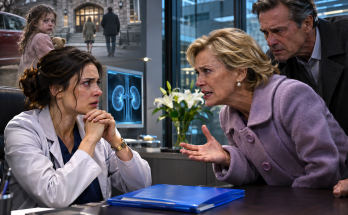
I had spent most of my life thinking about the moment our mother left me.
I hadn't given enough thought to what happened after the red car drove away.
Tori had gone home.
She had probably looked for me.
She might have asked where I was when it was time to sleep.
And somebody had apparently told her that I had decided to leave.
I looked at the woman sitting across from me.
"How did you learn what actually happened?"
"I found out they had taken her to a children's home."
She looked uncomfortable.
"I only learned that last year. I still don't know everything."
I nodded slowly.
"That must have been difficult to hear."
"It was."
She pulled her sleeves over her fingers again.
"I kept thinking about how little she must have been."
I couldn't speak.
Victoria seemed to mistake my silence for the ordinary patience of a physician listening to a patient.
She continued.
"I remember a few things about her. Nothing very clear."
"What do you remember?"
"She used to sing to me."
My chest tightened.
"There was a cartoon we watched sometimes. It had a little bear in it."
I knew the one.
Of course I knew the one.
"I think Annie learned the song from that cartoon," Victoria said. "She sang it at bedtime."
I looked down.
There had been nights when Tori refused to settle.
I remembered singing the same little tune until her breathing became slow and steady.
I had been proud of myself when it worked.
I was her big sister.
I liked being useful to her.
I liked the way she smiled when I sang the first few notes.
I hadn't known that those notes would be among the few things connecting us thirty years later.
Victoria gave a nervous laugh.
"Sometimes I hum it when I'm having dialysis. I don't even know if I remember it correctly."
I stood.
I couldn't think of a reasonable explanation for why I needed to move away from my desk.
I walked toward the window.
Outside, everything looked ordinary.
People were arriving at the hospital.
Others were leaving.
Nobody knew that I was listening to my little sister describe something I had done when we were children.
Behind me, Victoria continued speaking.
"My mother thinks finding Annie could solve the transplant problem."
I kept looking outside.
"What do you think?"
"I think that's a terrible reason to suddenly start looking for her."
I closed my eyes.
She hadn't raised her voice.
There was no dramatic anger in what she said.
Just embarrassment and sadness.
"I don't know what happened to Annie after she left our house. She could be living anywhere."
I turned slightly.
"She might have a husband or children. She might have problems of her own."
Victoria paused.
"I can't imagine showing up after all that time and asking her to have an operation for me."
I swallowed.
"Would you like to meet her?"
"More than anything."
Her answer came immediately.
"But I don't want her to think that I expect something."
I looked at her.
"If you ever find a way to contact her, could you explain that?"
"Explain what, exactly?"
"That I don't want to ask her for a kidney."
She took a breath.
"I'd just like to meet my sister. Even for a few minutes."
Her eyes became wet.
"And I'd like to tell her how sorry I am."
I gripped the edge of the windowsill.
There was so much I wanted to say.
That she hadn't done anything wrong.
That I had never blamed her for being in the car.
That there was a little girl inside my memories who still wanted to make certain she had enough apple to eat.
But none of those things would have made sense without the truth.
I wasn't ready to give her that truth in the middle of a medical appointment.
Not when she had enough uncertainty in her life already.
I turned back toward her.
"I understand."
Victoria wiped beneath one eye.
"Sorry. I didn't come here planning to talk about my childhood."
"That's all right."
She gave me another tired smile.
"You're very easy to talk to."
I sat down.
I managed to finish the appointment.
I made sure we had addressed the medical matters that needed attention.
And when Victoria stood to leave, I had to resist the urge to call her back.
She thanked me.
Then she walked out wearing her oversized sweater.
I sat alone for several minutes.
My sister wanted to find me.
Not because of what I could give her.
She wanted to see my face and tell me she was sorry about something she hadn't done.
I wished our mother could have been there to hear her say it.
A few days later, I saw Gail on television.
By then, she had taken the search for Annie Saunders far beyond the hospital.
She appeared on a national television program.
I recognized the lilac coat before I had properly looked at her face.
She held a tissue in one hand.
Her expression was sad.
The woman on the screen seemed very different from the woman who had complained about the cost of parking in my office.
She spoke softly.
She explained that a daughter had been taken from her life many years earlier.
She suggested that the adoption had happened without her knowing what was going on.
Then she described all the years she had supposedly spent wondering where her little girl had gone.
I stared at the screen.
I waited for her to mention Saint Jude's.
She didn't.
I waited for her to explain the decision she had made because she couldn't afford to keep both children.
She didn't mention that, either.
Instead, she presented herself as a mother who had suffered a terrible loss.
A mother who had somehow been separated from a child she desperately wanted to find.
I watched the recording from the beginning again.
I wanted to be certain I hadn't misunderstood.
Perhaps she had explained her role before the part I remembered.
Perhaps she had admitted bringing me to Saint Jude's.
Perhaps she had acknowledged that she had signed the documents herself.
No.
The second viewing was just as difficult as the first.
I watched it a third time.
Then a fourth.
Each time, I found myself paying attention to different details.
The tissue.
The lilac sleeves.
The careful way she pronounced my name.
The expression she wore when she discussed the daughter she had lost.
That was the version of my mother I had once wanted to believe existed.
A woman who missed me.
A woman who regretted the separation.
A woman who had spent years hoping somebody would bring me home.
If I had seen that television appearance without remembering Saint Jude's, I might have believed her.
But I remembered the grocery bag.
I remembered the apple.
I remembered how plainly she had explained that keeping two children was too expensive.
And I remembered who had walked away.
Nobody had carried me out of her house against her wishes.
She had taken me there herself.
I tried to imagine what Lorraine Miller would think if she saw the interview.
She had been there that day.
She had spoken to my mother.
She had watched me standing beside my belongings while Gail dealt with the paperwork.
I wondered whether the television presenter would have asked different questions if Lorraine had been sitting beside her.
For the first time since my mother entered my office, I felt truly angry.
Not because she wanted to help Victoria.
I could understand a mother becoming desperate when her child's health was failing.
I was angry because she had decided that helping one daughter required rewriting what she had done to the other.
She had already told Victoria that I had run away.
Now she was telling strangers that I had been adopted without her knowledge.
In neither version had she accepted responsibility for leaving me.
She was still arranging the story so that the consequences belonged to someone else.
The following Monday, the laboratory contacted me.
I was at work.
I recognized the nature of the call immediately.
The preliminary results were available.
My blood group was compatible with Victoria's.
The initial crossmatch hadn't detected a reaction that would rule out proceeding with an evaluation.
I listened carefully.
I understood that compatibility at this stage was not the same thing as approval to donate.
There would need to be further testing.
There would need to be a complete assessment of my health and the risks involved.
But the possibility was real.
I thanked the person who had called.
Then I remained at my desk.
I looked at the photograph of Dad.
After that, I looked at the photograph Gail had given me.
There was a way I might be able to help Victoria.
And there was a woman who would probably interpret that possibility as confirmation that she had been right to come looking for me.
I didn't know how I felt about either thing.
I opened the bottom drawer of my desk.
There was a manila folder inside.
I had kept it there for years.
I knew what it contained, and I had found countless reasons not to open it.
It had been about a decade since I had last looked through those particular papers.
I removed the folder and placed it on the desk.
The outside looked ordinary.
It could have contained meeting notes or an old administrative report.
Instead, it held some of the earliest written information about the life I had lived before becoming Annie Kingsley.
I opened it.
The original intake record from Saint Jude's was among the documents.
I read the entries slowly.
There was the record of my arrival.
Information about the belongings I had with me.
Details that had once seemed unimportant to an adult completing paperwork.
To me, they were the remains of an afternoon that had changed everything.
Then I reached the copy of the voluntary surrender form.
I looked at the signature.
Gail P. Saunders.
I recognized it.
The letters were written by the same person who had recently appeared on television claiming she hadn't known what became of her daughter.
I couldn't understand how she had managed to speak those words so convincingly.
The truth was right there.
Not a childhood recollection that could be dismissed as confusion.
Not an accusation made by somebody who resented her.
A document bearing her own name.
I had lived most of my adult life without needing to prove what had happened to me.
Michael and Olivia had never asked me to justify my feelings about Saint Jude's.
They knew that adopting me had given me a different future.
They also understood that the circumstances leading to the adoption had hurt me.
Those two things had always been allowed to exist together.
Now Gail had publicly changed the facts.
And the medical situation involving Victoria meant I couldn't simply close the drawer and go on with my life.
I placed the surrender form beside the photograph.
One showed the child.
The other showed the decision an adult had made about that child.
I thought about my sister sitting in my office, telling me she was sorry.
She had carried guilt for something that wasn't hers.
Our mother had carried an explanation that protected her from her own responsibility.
I didn't want Victoria going into a transplant believing that her sister had abandoned her.
I also didn't want my potential donation to become part of Gail's television story.
There had to be a way to handle both matters properly.
I closed the folder.
I would need help from people who could look at the situation independently.
I would need to separate my professional responsibilities from the personal decisions in front of me.
And when the time came to tell Victoria who I was, I wanted the truth to be available in a form nobody could easily change.
The next evening, however, all those carefully considered questions became less immediate.
Victoria experienced a serious medical emergency.
The moment I learned about her condition, the papers in my drawer stopped being the most important thing in the hospital.
My sister needed medical care.
Everything else could wait.
I went to her room and remained nearby while the team worked to stabilize her.
For most of that night, there was nothing I could do except wait.
I had spent years helping frightened families understand that feeling.
Now I was the person sitting beside a hospital bed, listening to unfamiliar changes in someone I loved.
And just before morning, my sister opened her eyes.