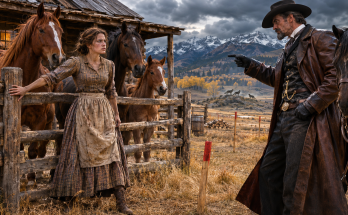
I had never been particularly good at speaking in front of people.
James used to tease me about it.
I could explain something complicated while sitting at our kitchen table, but put six strangers in front of me and I would suddenly forget the simplest words.
Now I was expected to explain an underground livestock shelter before an entire room of people.
And Richard Whitmore would be sitting there.
Waiting for me to make a mistake.
I spent the first morning preparing drawings that someone unfamiliar with underground construction could understand.
My father's notebook contained illustrations that made sense to me because I had grown up listening to him.
The council members hadn't.
I couldn't expect them to understand everything simply because I placed the notebook in front of them.
I needed to explain why the chamber remained standing.
Why the horses could breathe comfortably.
Why the severe weather hadn't affected them in the same way it had affected animals housed above ground.
I sharpened my pencil.
Then I began again.
By midday, the kitchen table was covered with paper.
One drawing showed the cabin.
Another showed the chamber beneath it.
I included the stone arches and the areas occupied by the horses.
I marked the entrance and the ventilation features.
Nothing was particularly beautiful.
But everything had a purpose.
I tried explaining the drawings aloud.
“The surrounding earth provides protection from the weather.”
I stopped.
That sounded too simple.
Richard would immediately ask whether the surrounding earth also presented a danger.
Of course it did.
I couldn't pretend otherwise.
I looked toward the eastern wall on my drawing.
That was where I had nearly lost my life.
I could leave the accident out of my explanation.
Nobody on the council knew exactly what had happened during those first days.
Samuel knew.
I knew.
But if I failed to mention it, I would be concealing something important about the construction.
I sat back in my chair.
Richard had spent months arranging matters so that people would see only the facts convenient to him.
I didn't want to defend myself by doing the same thing.
I made another note.
The original eastern wall had failed during construction.
The design had subsequently been corrected.
Samuel Brooks had examined the revised drawings.
He had later inspected the finished chamber.
I underlined the last sentence.
Then I looked at my hands.
The marks from those early days were still visible.
The skin across my palms had grown rough.
Several places remained discolored.
I turned my hands over.
Perhaps the council members would see those marks.
Perhaps they wouldn't.
Either way, I wasn't going to pretend that building the shelter had been easy.
That afternoon, I went downstairs with a piece of paper.
Rusty approached immediately.
I examined his coat and recorded his condition.
Then I did the same for Belle.
Daisy made the process considerably more difficult by trying to investigate the paper.
“Would you leave that alone?”
She moved closer.
I held the paper above her head.
She looked offended.
I laughed.
It felt good to laugh about something ordinary.
I finished recording what I needed and returned upstairs.
The evidence was simple.
All three horses were healthy.
None had suffered from exposure to the storm.
None had been injured by wolves.
The structure remained intact.
I wished the entire hearing could be settled with those four observations.
But I knew Richard.
He would make the discussion longer than necessary.
He would speak about responsibility.
He would make my lack of money sound like evidence of incompetence.
He would probably mention that I was a woman working without professional qualifications.
I had heard that particular argument in different forms throughout my life.
Usually, people expressed it more politely.
They would tell me certain matters were better left to men with experience.
They would advise me against attempting things I hadn't been formally taught.
Sometimes their advice was reasonable.
Other times, it was merely a way of preventing me from trying.
My father had rarely spoken to me that way.
When I asked questions, he answered them.
When I misunderstood something, he corrected me.
He never seemed concerned that I might learn more than somebody thought appropriate.
I hadn't appreciated how unusual that was until I became older.
I opened his notebook.
The leather cover had begun separating slightly at one corner.
I handled it carefully.
Inside were years of his observations.
Some pages contained little marks beside calculations he had reconsidered.
Others showed drawings that had been changed more than once.
Even my father had made mistakes.
That realization comforted me.
Understanding something didn't mean never being wrong.
It meant recognizing when you were wrong and doing something about it.
I returned to my own drawings.
By evening, I had written a detailed account of the materials I had used.
I included Margaret's discarded equipment.
I included the locally available stone.
I included the changes Samuel had recommended.
Then I tried calculating how much my labor would have cost if somebody else had performed it.
I stopped halfway through.
The figure wasn't important.
Richard had more money than I did.
Nobody disputed that.
The question was whether his money had produced a better shelter.
The storm had already answered.
I gathered the papers and placed them in a neat pile.
Then I opened the notebook to the page containing Daniel's map.
I removed it.
The three survey stakes were represented by little marks along the proposed route.
My property stood between the road and the southern passage.
The red circle was unmistakable.
So was Richard's handwriting.
I laid the map beside the petition requesting the revocation of my homestead.
Together, the documents told a story more clearly than any speech I could give.
I imagined unfolding them before the council.
I imagined Richard having to explain why he had marked my property months earlier.
For a moment, the possibility was terribly tempting.
Then I remembered Daniel's hands tightening around his hat.
I remembered the expression on his face when he discovered the horses.
He had known what reporting them would mean for me.
Now I knew what presenting the map might mean for him.
I folded it once more.
There were things a person shouldn't do, even when doing them might make life easier.
I hoped I wouldn't regret that decision.
The following day, I practiced explaining the shelter again.
I walked through the cabin holding my drawings.
I spoke to James's empty chair.
I spoke toward the kitchen shelves.
At one point, I found myself explaining the ventilation features to Daisy while she ate.
She appeared unimpressed.
“You're a difficult audience.”
She continued chewing.
I returned upstairs feeling slightly ridiculous.
The evening before the hearing, I heard a horse approaching.
I set down my pencil.
Henry Miller knocked a moment later.
When I opened the door, he removed his hat.
“Am I interrupting?”
“Only an argument I've been having with myself.”
He glanced toward the table.
“Who's winning?”
“I'm not certain.”
He smiled.
I invited him inside.
He took off his coat and stood beside the papers.
For a while, he examined them without speaking.
Then he picked up one of the drawings.
“You've put a considerable amount of work into this.”
“I don't want to leave anything unexplained.”
He looked at the other papers.
“Richard will have plenty to say.”
“I know.”
“He'll probably make it sound as complicated as possible.”
“I know that too.”
Henry returned the drawing to the table.
“You needn't answer every objection before he's made it.”
I looked at him.
“If I don't, he might convince them the chamber is unsafe.”
Henry shook his head.
“There's a difference between explaining a thing and proving it.”
I waited.
He glanced toward the floor.
“I've seen those horses.”
“Yes.”
“I've examined the stonework.”
I nodded.
He rested his hand on the back of a chair.
“I intend to tell the council what I found.”
For several seconds, I simply looked at him.
“You're going to speak on my behalf?”
“I'm going to tell them what I observed.”
His answer was immediate.
I understood why he had phrased it that way.
Henry wasn't offering to support every decision I had made because he had known James.
He was offering to give an honest account of the shelter.
That meant more.
“Thank you.”
He looked slightly uncomfortable.
“Don't thank me for doing what I ought to do.”
I poured him a cup of coffee.
We sat at the table.
He looked at my drawings again.
Then he asked about several details he hadn't understood during his inspection.
I explained them.
He listened carefully.
Once or twice, he suggested simpler ways of describing the work.
I made notes beside the drawings.
When we finished, he pushed the papers toward me.
“You know more about that chamber than anybody who'll be sitting in that schoolhouse tomorrow.”
I looked down.
“That won't make Richard listen.”
“No.”
Henry took another drink.
“But Richard isn't the only person who gets a vote.”
I hadn't allowed myself to think much about that.
For years, I had watched people treat Richard's preferences as though they were decisions already made.
Men who borrowed money from him rarely contradicted him in public.
Business owners were careful about offending him.
Even people who disliked him generally kept their opinions to themselves.
It was easy to forget that the council consisted of more than one man.
Henry stood and put on his coat.
“Get some sleep.”
“I'll try.”
He collected his hat.
At the door, he paused.
“James would've been proud of you, Emily.”
I lowered my eyes.
“He might have preferred me to stay above ground.”
Henry smiled.
“Probably.”
Then he left.
I remained beside the door until the sound of his horse faded.
The cabin felt quiet again.
But it didn't feel quite as lonely.
I returned to the table and gathered my papers.
There was nothing more I could usefully add.
I placed the drawings inside my father's notebook.
The survey map remained hidden among the older pages.
Then I checked the horses.
Daisy stretched her neck toward me.
I rubbed her forehead.
“Tomorrow, then.”
Rusty shifted his weight.
Belle continued eating.
They weren't concerned about hearings.
They didn't care how many people supported Richard.
They only needed a safe place to live.
That helped me remember why I was going.
I climbed upstairs.
Before preparing for bed, I opened the bedside drawer.
James's watch lay where I had left it.
I picked it up.
The hands still pointed toward the moment when my old life had ended.
I held it briefly.
Then I returned it to the drawer.
I didn't need to carry it with me tomorrow.
For years, I had believed that keeping everything James had left was the same thing as keeping him close.
I was beginning to understand that some things he had given me couldn't be confiscated or purchased.
His trust had been one of them.
I blew out the lamp.
The following morning, I dressed carefully.
My best dress wasn't particularly fine.
But it was clean.
I examined the cuffs and smoothed the fabric with my hands.
Then I wrapped my father's notebook in a piece of cloth to protect it from the weather.
Outside, the snow reflected the pale morning light.
I fed the horses before leaving.
I checked the chamber.
I made sure everything was in order.
Then I closed the concealed entrance.
For a moment, I rested my hand against the floor.
I remembered lying there after the collapse.
I remembered believing I had reached the end of what I could endure.
That woman would have been astonished to see me preparing to defend the completed shelter.
I straightened.
I put on my coat.
Then I left for town.
When I reached the schoolhouse, I noticed more horses and wagons outside than I had expected.
People had come from surrounding properties.
Some were standing near the entrance.
Others were already inside.
The storm had touched nearly every household in the valley.
They wanted to hear what Richard intended to do about my shelter.
I dismounted and held the notebook against my chest.
Through the window, I could see him standing near the front of the room.
His coat was dark.
His boots were polished.
He looked perfectly prepared.
I took a breath.
Then I opened the schoolhouse door.