I still had the same job when winter arrived.
The same uniforms.
The same twenty-minute drive along Highway 61.
There hadn't been any change in the motor lodge that reflected what had happened in my personal life.
I reported for work and took care of the rooms assigned to me.
Some days, I was grateful for the familiarity of it.
I knew what was expected.
I understood the work.
I could begin a shift without having to make difficult decisions about every little thing.
That hadn't always been true of my afternoons during the renovation.
I'd spent plenty of time facing problems I hadn't encountered before.
Now most of my working day involved tasks I'd performed countless times.
I removed the used bedding.
I collected towels.
I cleaned the bathrooms.
I made sure the finished rooms met the manager's requirements.
The laminated card explaining how the towels should be folded hadn't changed, either.
I followed it as usual.
There was nothing especially interesting about watching me work.
I wasn't doing something that attracted much attention.
Most people who occupied the rooms probably didn't think about the person who'd prepared them.
I understood that.
They'd paid for somewhere clean and comfortable to spend the night.
My responsibility was to help provide it.
I'd become particularly aware of the importance of that comfort during my own search for somewhere to live.
A clean bathroom mattered.
Fresh bedding mattered.
Somewhere to put your belongings mattered.
When a person was tired, those things could make a considerable difference.
I knew what it felt like to arrive somewhere carrying everything you needed in a few containers.
I knew what it meant to depend on a room that belonged to somebody else.
That experience hadn't made me resent the people whose rooms I cleaned.
If anything, it had made me more aware of the usefulness of my work.
There was dignity in doing something properly even if nobody saw how much effort it required.
I could finish a room, look around, and know I'd done what was expected of me.
Then I moved on to the next one.
Fourteen rooms.
That number had become a familiar measure of my day.
During the autumn, it had also become a measure of what I could afford.
Whenever I looked at an expensive piece of equipment, I considered how many working hours stood behind the money I'd be spending.
A radiator.
A window.
A water tank.
Each purchase represented time I'd already given to the lodge.
That had made me careful.
I couldn't look at a price without thinking about what earning that amount involved.
Now I was beginning to experience the benefit of that care.
I wasn't returning home to another large receipt.
There were no additional panels waiting to be installed.
No unfinished section of flooring.
No need to visit a building materials shop simply because I couldn't complete the next stage without something else.
The major expenses were behind me.
I could begin keeping more of what I earned.
That didn't happen in a particularly dramatic way.
There wasn't a morning when I woke up and discovered that my financial concerns had disappeared.
I simply noticed that the money I earned wasn't being consumed as quickly as it had been.
The absence of the monthly room payment made a difference.
Three hundred and ninety dollars.
I'd become accustomed to setting that amount aside for Cherry Street.
When money was limited, a regular payment occupied more than a line in a budget.
It occupied part of your attention.
I used to think about it well before it was due.
I wanted to make sure I wouldn't be caught short.
I'd never blamed Mrs. Broussard for charging me.
She'd given me somewhere to live when I needed it.
But I was glad I no longer had to arrange my finances around that payment.
The change allowed me to consider my savings differently.
During the renovation, I'd watched them diminish in exchange for materials and equipment.
I could justify the spending.
I knew where the money had gone.
Nevertheless, watching that balance decrease had made me nervous.
I'd entered the project with $5,200.
That was a significant amount for somebody in my position.
It hadn't been given to me.
I'd accumulated it gradually through work and careful spending.
I knew how easily something unexpected could consume money a person had taken months to save.
That was why Mama's questions had bothered me at first.
Not because they were unreasonable.
Because they were questions I was already asking myself.
What would happen if the vehicle needed more work than I'd expected?
What would happen if the equipment cost too much?
What would I do if I'd spent most of my savings and still couldn't move in?
Those possibilities had been real.
I'd needed to acknowledge them before deciding how far to proceed.
Fortunately, the commercial interior had given me enough to work with that I could complete the project without exhausting everything.
Now I intended to protect what remained.
I wanted to increase it.
There was a quiet satisfaction in knowing another day at the lodge could help me do that.
I wasn't working toward the next construction purchase anymore.
I was working toward a little more security.
That felt good.
It didn't make me enjoy every moment of the shift.
There were still bathrooms I wished somebody had left in better condition.
There were still wet towels that seemed unnecessarily heavy.
My feet still hurt on busy days.
The work remained physical.
I didn't expect gratitude for my circumstances to make me immune to ordinary tiredness.
When I'd finished, I was usually ready to leave.
I looked forward to the drive home.
The Hyundai was as familiar to me as the route itself.
It hadn't been replaced during the renovation.
There wasn't a newer car waiting for me because I'd managed to reduce my housing expenses.
I had no intention of treating every improvement in my circumstances as a reason to purchase something else.
The car continued serving its purpose.
I needed to look after it.
That included paying attention to the rear tire that still required air from time to time.
I'd have preferred not to deal with that little inconvenience.
But it belonged to my life just as surely as the van's water tanks and batteries did.
I couldn't ignore ordinary maintenance simply because I'd completed something larger.
I accepted that.
Driving along Highway 61, I sometimes thought about how different my priorities had become.
When I first began living on Cherry Street, my thoughts had often returned to what I'd lost or what I no longer had.
That was understandable.
Divorce brought changes that extended well beyond the end of a relationship.
There were belongings to arrange.
Expenses to reconsider.
Decisions about where to remain and how to support yourself.
Even familiar routines could suddenly feel unfamiliar.
I'd left Natchez knowing that my life wouldn't look the way it had before.
What I hadn't known was what it would look like afterward.
For a while, that uncertainty had been difficult to bear.
Now I could drive toward Port Gibson knowing exactly what waited for me.
I didn't have to imagine a different future before finding comfort in the present.
I already had somewhere comfortable to return to.
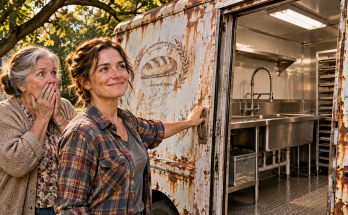
When I arrived at Mama's property, I could see the van beneath the pecan tree.
The gray paint looked particularly ordinary against the surroundings.
I liked that about it.
It didn't announce how much work had gone into the interior.
It didn't need to.
The things I valued about it weren't necessarily visible from the driveway.
Someone looking at the vehicle might notice the small windows.
They might see the newly finished exterior.
They wouldn't immediately understand the usefulness of the commercial floor or the position of the old preparation sink.
They wouldn't know how carefully I'd considered the space beneath the bed.
They wouldn't know what the blue fabric had meant to Mama when she finally saw it covering the mattress.
Those were things a person discovered inside.
I opened the side door and stepped through.
The temperature was comfortable.
The cupboard concealed my belongings.
The counter was clear.
I could leave the working day behind without finding another day's labor waiting for me.
That was still one of my favorite things about the finished home.
Sometimes I was tired enough that I wanted to sit down before doing anything else.
I allowed myself to do that.
I'd spent enough of the autumn pushing through one task after another.
There was no reason to continue treating every afternoon as though I were facing a deadline.
I sat on the bed.
The dark blue covering felt familiar beneath my hand.
One of the cushions rested near the window.
I'd never thought I particularly needed it.
Yet I often found myself adjusting it behind me when I wanted to sit comfortably.
Mama had been right to make those two little pillows.
They'd become part of my ordinary life.
That made me smile.
I rested for a while before preparing something to eat.
The refrigerator didn't contain much, but it held enough.
I could make a meal without going anywhere else.
That mattered on an afternoon when my feet were tired and I had no desire to leave again.
I opened the cupboard beneath the counter and retrieved the things I needed.
There wasn't an unnecessary collection of kitchen equipment to search through.
I knew where everything was.
I prepared supper using the space I'd built.
The modest dimensions no longer required much thought.
My movements had adjusted to them.
I could turn from the counter to the sink.
I could reach the refrigerator.
I could put away what I wasn't using.
The arrangement made sense for one person.
I was that person.
There was no reason to wish for a larger kitchen simply because other people preferred one.
I had enough room to do what I needed.
That had become increasingly important to me.
The ability to recognize when something was sufficient.
Before the renovation, I might have looked at a small room and concentrated mainly on what wouldn't fit inside it.
Now I looked at the same dimensions differently.
What would I actually use?
What would make my daily routine easier?
What could I reasonably afford to maintain?
Those questions had helped me make decisions throughout the project.
They continued helping me afterward.
I didn't want to fill every shelf merely because it was available.
I didn't want to bring something home and discover I needed to rearrange half the cupboard to accommodate it.
Empty space had a usefulness of its own.
So did money I hadn't spent.
I was learning to appreciate both.
After supper, I washed the dishes in the old bakery sink.
I wiped the counter.
I returned the utensils to their storage place.
There was something pleasant about finishing those little tasks without feeling that they represented another demand on my limited energy.
They were manageable.
My home was manageable.
That had been one of the things I'd wanted most.
I hadn't needed a grand place to demonstrate that my life was improving.
I needed somewhere that didn't make my circumstances more difficult.
Somewhere I could afford to keep.
Somewhere I could enjoy without worrying constantly about the cost.
There were trade-offs.
The limited water supply required attention.
The equipment needed monitoring and maintenance.
The van occupied Mama's land, which meant my arrangement depended in part on her willingness to share it.
I never forgot that.
But those requirements were ones I could understand and manage.
They weren't hidden obligations that would suddenly reveal themselves after I'd committed to something beyond my means.
I'd considered them during the project.
I continued considering them now.
That gave me confidence.
Not the confidence of believing nothing could ever go wrong.
The confidence of knowing I'd taken reasonable steps to prepare for the things that might.
I reached toward the window latch after finishing in the kitchen.
The evening air was pleasant enough to let in briefly.
I opened the window and watched the curtain move.
The breeze came from the direction of Bayou Pierre.
It reached the counter and moved across the little room.
I sat beside it for a while.
I thought about the working day I'd completed.
Another fourteen rooms.
Another day's earnings.
There had been a time when I would have used those earnings to purchase another part of my home.
Now they could help provide for the future.
That was a change worth appreciating.
I didn't need to calculate it every evening.
I didn't need to open the notebook and remind myself of every expense.
I could simply continue the routine I'd established.
Work.
Careful spending.
Ordinary living.
I looked toward the cupboard containing my uniforms.
Tomorrow, I'd put another one on and return to the lodge.
There wasn't anything discouraging about that prospect.
I'd never expected my home to eliminate the need to earn a living.
I'd expected it to make earning that living feel more worthwhile.
And it had.
I closed the window when the air became cooler.
Then I sat on the bed with nothing particularly demanding my attention.
For a woman who'd spent months trying to make every available dollar solve a problem, that was a remarkably pleasant way to end the day.