The notebook stayed in its drawer for longer stretches as the weeks passed.
I no longer reached for it whenever I entered the van.
That was a change I hadn't deliberately made.
It simply happened as the interior became familiar.
There were fewer things I needed to remember.
The measurements had served their purpose.
The expenses had been recorded.
The drawings belonged to a stage of the project that was finished.
Sometimes I thought about how often I'd carried that notebook into Mama's house.
I'd sit at her dining table while she worked with fabric.
I'd turn the pages and check what I'd written.
I'd estimate how much the remaining work might cost.
I was always trying to make sure that the home I wanted remained within my reach.
Now it surrounded me.
There was something reassuring about being able to leave the notebook alone.
It meant I trusted the arrangement enough to live in it without continually examining the decisions that had brought me there.
The van wasn't perfect.
I hadn't expected it to be.
It was small.
It required attention in ways a conventional house might not.
There were things I couldn't do conveniently inside it.
But I'd never needed it to accommodate every possible activity.
I'd needed it to accommodate my life.
And my life was fairly simple.
I went to work.
I returned home.
I prepared food.
I washed.
I slept.
Those ordinary requirements had once seemed quite difficult to arrange affordably.
Now I could meet them within ninety-eight square feet.
I found that increasingly satisfying.
One evening, I stood in the middle of the interior and looked toward the front bulkhead.
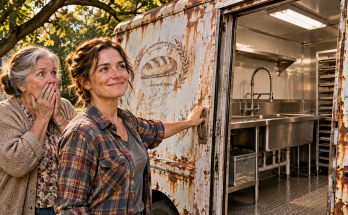
The stainless steel sink was clean.
The wooden counter beside it held very little.
I remembered examining that area before building the cabinets.
I'd considered different arrangements.
Some would have required moving the sink.
Others would have left me with less useful space elsewhere.
Eventually, I'd decided that the people who originally installed the sink had given me something worth keeping exactly where it was.
That had saved money.
It had also allowed me to build the rest of the kitchen around something substantial.
I was pleased with that decision every time I used it.
The sink wasn't attractive in the way some newly purchased household fixtures might have been.
But I wasn't interested in replacing a perfectly useful object for the sake of appearance.
I'd spent too many hours earning money to throw it away like that.
I ran some water into the sink while preparing to wash the dishes.
The metal caught the light.
It looked remarkably similar to the way it had looked when the van still belonged to its previous life.
Most of the surrounding interior had changed.
The sink hadn't needed to.
I liked that.
Someone had chosen it years earlier because it suited a working bakery.
I'd kept it because it suited my little kitchen.
There was nothing mysterious about the connection between those two uses.
It was simply a well-made thing continuing to serve a purpose.
That was the unexpected value I'd found inside the vehicle.
It wasn't something hidden in a secret compartment.
It hadn't been concealed deliberately.
The people who'd ignored the van probably hadn't considered the interior valuable in relation to the work the vehicle needed.
I could understand their reasoning.
Looking at the deteriorated exterior, there had been plenty of reasons to question the purchase.
Even Clarence, who understood trucks, had identified several things that needed attention almost immediately.
The old tires.
The radiator.
The brakes.
There had been legitimate expenses waiting behind that twenty-dollar price.
I hadn't avoided them.
I'd paid for them.
The opportunity had come from recognizing that the commercial interior could save me enough elsewhere to make those expenses reasonable.
That was the important distinction.
The van's price had attracted my attention.
What was inside had made me willing to attempt the renovation.
Neither fact would have been sufficient by itself.
I finished washing the dishes.
Then I returned them beneath the counter.
The storage area closed neatly.
There wasn't much room for things I didn't use.
That didn't trouble me.
I'd already spent six months living with a relatively small collection of belongings.
I knew what I needed regularly.
Most of it was already inside the van.
There had been no reason to buy new furniture simply because my circumstances had changed.
The raised platform accommodated the containers I already possessed.
The cupboard held the clothes I'd been wearing.
The little kitchen had room for the utensils I'd brought from Cherry Street.
I'd provided those things with a better arrangement rather than replacing them.
That was enough to make them feel different.
I opened the clothing cupboard and checked what I needed for the following day.
The shirts were hanging neatly.
There was something about seeing them that still brought Mama's Saturday visit to mind.
She'd sat on my bed, holding her coffee, and mentioned the three wire hangers from the rented room.
I hadn't expected her to remember them.
They'd seemed like such a small detail.
But mothers noticed things their children didn't necessarily realize they were noticing.
She'd seen those hangers above my plastic tubs.
She'd understood what that arrangement represented.
Then she'd watched me spend months working toward something better.
When she saw the cupboard in its finished condition, she'd recognized a change that had nothing to do with the attractiveness of the gray paint.
Her daughter had somewhere decent to put her clothes.
That mattered.
I found myself thinking about her practical questions from the beginning of the project.
She hadn't asked whether the finished van would impress anybody.
She'd asked where I intended to sleep.
Where I intended to wash.
Where I would put my work shirts.
Those had been the things that concerned her.
I'd been excited about the possibilities of the vehicle.
She'd been thinking about my daily comfort.
Looking at the finished cupboard, I was grateful for both approaches.
I'd needed the enthusiasm to begin.
I'd needed the practical questions to make sure I finished something suitable.
I closed the curtain.
Mama's work concealed the little collection of clothing.
The fabric fell into place.
I touched its edge.
It still looked as good as it had when she fitted it.
I thought about the care she'd taken with the sewing.
She'd wanted the coverings to withstand daily use.
That was exactly what they were doing.
I hadn't needed to ask her to make adjustments after moving in.
The measurements had been right.
The fabric suited its purpose.
The same was true of the window curtains.
I could open them easily.
The lining kept out the light when I wanted to sleep.
The hems held their shape.
Nothing about those curtains would have surprised Mama.
She understood how to make useful things.
What surprised me was how much pleasure I took in them.
They made the interior feel comfortable without occupying much space.
They also reminded me that somebody had cared enough to spend evenings making something specifically for me.
That wasn't a feeling I wanted to take for granted.
I looked toward the small pillows.
They'd become familiar enough that I hardly thought about their origin most days.
But sometimes I remembered the pieces of leftover material spread across Mama's dining table.
She'd looked at those scraps and decided there was enough for something additional.
I hadn't asked for the pillows.
I'd been concentrating on necessary expenses.
Mama had understood that a place could be functional without yet feeling welcoming.
She'd given my home something beyond the things it absolutely required.
I was glad she'd done that.
There had been a period when I thought I could manage without practically everything except the essentials.
Money was limited.
My living arrangements were uncertain.
I didn't want to purchase things that might become inconvenient when I eventually moved.
That had been a reasonable attitude at the time.
But I didn't need to carry it into every part of my future.
A person could be careful with money and still appreciate something pleasant.
Especially something made from material already available.
I sat beside the pillows.
The blue canvas beneath me was comfortable and practical.
I could imagine Mama examining its seams.
She'd probably notice details in the finished coverings that I'd never consider.
I was content simply to enjoy what she'd made.
Outside, a pecan landed somewhere near the van.
The sound was softer than when one struck the roof.
I looked toward the nearest window.
It was beginning to become dark outside.
The pecan tree had become such a familiar part of my surroundings that I sometimes forgot I'd originally appreciated it mainly for the shade it offered while I worked.
During the warmer autumn afternoons, that shade had made the exterior work more comfortable.
I'd been grateful for it while removing loose material and preparing the body for paint.
Now the same tree helped define the place where I lived.
Its sounds belonged to my nights.
Its branches stood above the roof.
I could see the yard around it whenever I opened the side door.
Mama's house was nearby.
That proximity was another thing I appreciated more as I settled into my routine.
I had my own space.
She had hers.
I could invite her inside for coffee, and she could return to her house afterward.
Neither of us needed to pretend my independence required me to live a considerable distance away from her.
I'd found an arrangement that allowed me to remain responsible for my own everyday life while accepting her generosity.
That suited me.
I was glad Mama hadn't interpreted my desire for my own home as a desire to separate myself from her.
She'd understood that I wanted somewhere to feel settled.
She'd helped me achieve that in a very practical way.
The ground beneath the van belonged to her.
That fact mattered.
I never wanted my satisfaction with the project to make me forget it.
My name might have been associated with the vehicle, but owning the vehicle hadn't provided somewhere to keep it.
Mama had made that part possible.
I thought about what the renovation might have cost if I'd needed to pay for somewhere to park it throughout those three months.
I didn't try to calculate a figure.
There wasn't any reason to introduce an imaginary expense into my notebook.
I simply recognized how fortunate I'd been to have that arrangement.
It was one of the reasons the project had worked within my circumstances.
Clarence's assistance was another.
I hadn't needed to purchase every tool required to address the mechanical work.
He'd shared the things he had.
More importantly, he'd shared his knowledge.
He'd helped me distinguish between work I could undertake and work that required more experience.
That was something I was particularly grateful for.
Trying to save money through ignorance could become very expensive.
I'd understood enough about the limits of my abilities to accept help.
The result was better because I'd done that.
I hadn't needed to prove anything to Clarence.
He hadn't expected me to.
He'd simply helped me deal with the vehicle in front of us.
I liked the straightforward nature of that kindness.
The project had contained plenty of it.
Mama bringing a sandwich.
Clarence offering his driveway.
A useful piece of equipment available through a business clearing surplus stock.
Two sound windows waiting in a resale shop.
Those things had fit together because I'd taken the opportunity to make use of them.
I hadn't known in advance that every stage would work out as well as it did.
There was no guarantee attached to the twenty-dollar purchase.
I was aware of that every time I thought about how fortunate I'd been.
The finished home hadn't been inevitable.
It had depended on decisions.
On the condition of materials.
On what I could afford.
On the assistance available to me.
And on my willingness to continue when the work became tedious.
I didn't want to make the story more dramatic than that.
There wasn't any need.
The reality was enough for me.
I had somewhere to live that I'd made possible through ordinary effort and some very important kindness.
That was a considerable achievement in my circumstances.
I got up from the bed and reached for my notebook.
I didn't intend to study every expense again.
I simply wanted to look at the first page.
The original twenty-dollar entry was still there.
I smiled when I saw it.
I'd once thought that figure might become the most interesting thing about the entire project.
People generally noticed a surprisingly low price.
It was easy to understand why.
But I found myself more interested now in the everyday things the finished home allowed me to do.
I could make coffee.
I could prepare supper.
I could wash my work clothes and put them away.
I could rest in a comfortable bed.
I could invite Mama inside and offer her a drink.
None of those things was particularly unusual.
That was precisely what I'd wanted.
I'd wanted the uncertainty of the months following my divorce to give way to ordinary living.
The old bakery van had given me a chance to accomplish that.
I closed the notebook and returned it to the drawer.
There was no need to leave it on the counter.
I looked at the room around me.
I liked that nothing immediately demanded my attention.
The curtains were ready to be closed whenever I wanted.
My dishes had been washed.
The floor was clear.
I could sit down or prepare for bed.
I chose to begin getting ready for the night.
I didn't have to work the following morning.
The thought of waking without needing to hurry along Highway 61 pleased me.
I would have time for coffee.
Time to open the side door if the weather was pleasant.
Time to sit without thinking about the rooms waiting at the lodge.
There had been plenty of mornings during the renovation when a day away from work meant additional hours spent on the vehicle.
Now a day away from work could simply be a day away from work.
I was looking forward to discovering how that felt.
I turned off the lights and settled beneath the blanket.
The pillows Mama had made rested nearby.
Outside, the yard was quiet.
The notebook remained inside its drawer.
Tomorrow, I wouldn't need to purchase anything for the renovation.
I wouldn't need to measure another section of wall.
I wouldn't need to prepare another drawing.
I could wake up and enjoy the little home exactly as it was.