There was something I'd been wrong about when I first began putting my life back together.
I'd thought being independent meant needing very little from anybody else.
I hadn't expressed it quite that way.
But looking back, I recognized the feeling.
After my divorce, I'd wanted to establish that I could manage my own affairs.
I could earn money.
I could make decisions.
I could find somewhere to live without expecting somebody else to arrange everything for me.
There was nothing wrong with wanting those things.
The trouble came when I began treating assistance as though accepting it meant I'd accomplished less.
Living in the van helped me recognize how unreasonable that was.
I could sit inside my finished home and identify contributions from other people almost everywhere I looked.
The curtains were the most obvious example.
Mama had made those.
The dark blue mattress covering and the little pillows were hers, too.
But her involvement had begun long before she brought the fabric outside.
The land beneath the vehicle belonged to her.
So did the tree that sheltered it.
She'd allowed me to work there throughout the renovation without making me feel that my presence was inconvenient.
That had given me somewhere to attempt a project I couldn't have undertaken in the rented room.
I'd needed space.
I'd needed time.
I'd needed somewhere the van could remain while I decided what to do with it.
Mama had provided those things.
There wasn't an expense in my notebook that could adequately represent them.
I thought about the evenings when she'd appeared beside the vehicle with something to eat.
I'd usually been concentrating on whatever task occupied me at the time.
Sometimes I'd been frustrated.
Sometimes I'd simply been tired enough that preparing food felt like another obligation.
Then Mama would arrive with a sandwich and cold sweet tea.
She never made those occasions particularly dramatic.
She didn't stand in the doorway explaining how much she was doing for me.
She simply brought the food.
I'd take a break and eat.
Then I'd return to my work.
At the time, those interruptions had seemed like small acts of kindness.
Now I understood that they had helped me continue.
There were days when I might otherwise have become too exhausted to accomplish anything useful.
I'd been doing physical work at the lodge before arriving at the van.
My body needed food and rest whether my plans allowed for them or not.
Mama had understood that better than I had some afternoons.
Her practical concerns had mattered, too.
I remembered telling her where I intended to sleep.
I'd pointed toward the rear of my drawing.
She'd immediately asked about my clothes.
Then about somewhere to wash.
She hadn't been impressed simply because I'd worked out where to place a mattress.
She'd been thinking about the entire life that would have to fit inside the vehicle.
That included things I hadn't yet considered properly.
I was glad she'd asked those questions.
The finished cupboard reflected her advice.
So did the little washing area.
Even my decision to remain on Cherry Street until the van was suitable for living had been influenced by the promise I'd made to her.
She hadn't wanted me moving in prematurely.
I hadn't wanted to give her another reason to worry.
We'd both understood that my eagerness to leave the rented room couldn't determine whether the project was ready.
There had been practical requirements.
The condition of the equipment mattered.
The arrangements for using the vehicle on her property mattered.
I couldn't simply put a mattress inside and declare myself settled.
Mama's concern had helped me remember that whenever I became impatient.
I was grateful for it.
Her help hadn't taken away my ability to make my own decisions.
It had made some of those decisions better.
Clarence had done something similar.
He'd looked at the mechanical condition of the van without becoming distracted by what I wanted the interior to become.
The radiator required attention whether I intended to travel or remain parked.
The brakes needed dealing with.
The old tires needed replacing.
He hadn't been interested in making those requirements sound less serious just because I'd purchased the vehicle cheaply.
I'd needed someone willing to be practical.
Clarence had been exactly that.
His experience was something I couldn't purchase by obtaining a few tools.
He'd spent years working with trucks.
He knew how to recognize problems I might not have noticed.
I'd accepted his assistance and participated in the work I could reasonably handle.
There hadn't been any humiliation in that.
I understood it now.
A person could be responsible for a project without possessing every skill required to complete it.
There was no point risking a poor result merely to demonstrate that I hadn't needed help.
I'd paid four hundred and eighty dollars for the mechanical work.
That figure was in the notebook.
It represented the parts and expenses associated with getting the van into better condition.
But it didn't fully represent the value of having someone experienced beside me.
Clarence's willingness to share his knowledge had mattered.
So had the use of his driveway and tools.
I'd benefited from things he'd already accumulated over the course of his working life.
I couldn't pretend otherwise.
And I didn't want to.
That was something I liked about the finished home.
I didn't need to pretend that every useful thing inside it had originated with me.
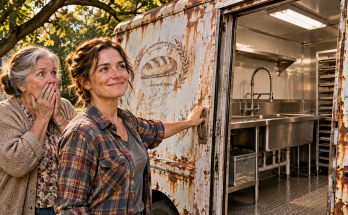
The entire project had begun because somebody else had built a commercial food preparation space.
The insulated walls had been there before I purchased the vehicle.
The durable flooring had been there.
The stainless steel sink.
The existing ventilation and electrical infrastructure.
Those things belonged to the van's previous life.
I hadn't created them.
I'd recognized their usefulness.
Then I'd made decisions about how to preserve and adapt them.
That was the opportunity I'd been fortunate enough to discover.
Standing beside that sink one evening, I thought about how much more difficult everything would have been if I'd purchased an ordinary empty delivery truck.
There would have been more material to obtain.
More work to accomplish.
More money to spend before I could even begin addressing the things that made the space comfortable.
Instead, the old bakery had left behind a foundation.
It hadn't been a complete solution.
There were areas of damaged flooring.
There were exterior problems.
The equipment required assessment and adaptation.
The vehicle needed mechanical repairs.
I'd had plenty to do.
But I hadn't been starting with nothing.
That distinction had probably made the project possible within the amount I'd saved.
I looked at the white interior panels.
They'd never struck me as particularly decorative.
They were practical surfaces intended for a working environment.
I'd chosen to preserve them because they remained useful.
Now they provided a light background for the curtains Mama had made.
The commercial character of the walls didn't bother me.
If anything, I liked seeing evidence of what the van had once been.
The same was true of the floor.
Most of the original plywood remained beneath my feet.
I'd replaced the two damaged sections near the entrance and protected the repaired areas.
I hadn't covered everything with some expensive material merely to make it resemble the floor of a conventional house.
It was already suited to the way I intended to live.
I could keep it clean.
I could maintain it without worrying about a delicate finish.
That was enough.
I'd learned to appreciate the word enough throughout the renovation.
Enough storage for my clothes.
Enough room to prepare supper.
Enough electricity for the things I regularly used.
Enough water to manage my daily requirements carefully.
I'd spent a considerable amount of time deciding what enough meant in relation to my life.
The available space had encouraged those decisions.
The money I'd saved had made them necessary.
I couldn't have purchased everything that appealed to me.
Even if I'd had considerably more money, there wouldn't have been room for it all.
I was glad I'd learned to distinguish between something useful and something merely available.
The resale windows were a good example.
I hadn't bought the most attractive windows I could find.
I'd purchased two that were in suitable condition and fitted the dimensions I needed.
They opened.
They admitted daylight.
They allowed fresh air to move through the room.
Those were the qualities that mattered.
Now, when I opened them after work, I didn't wish I'd chosen something more expensive.
I enjoyed what they did.
The old sink was another example.
There were probably more attractive sinks available in building supply shops.
Some might have looked better beside a newly constructed kitchen counter.
But replacing the stainless steel one would have meant spending money to remove something that already served my needs.
That wouldn't have made sense.
I was grateful I'd recognized it.
Looking around the van, I could see a whole collection of decisions like that.
Some had saved money.
Some had saved space.
Others had allowed me to benefit from something that was already there.
Together, they'd given me a home I could reasonably afford.
I hadn't discovered a way to avoid paying for everything.
I'd discovered a way to make better use of what I could obtain.
There was a considerable difference.
Occasionally, I thought about the condition of the van before the exterior repairs.
The faded white finish.
The rust along the lower sections.
The neglected rear door.
I could understand why people might have looked at it and decided it wasn't worth their attention.
There was certainly plenty wrong with it.
The mechanical repairs alone had cost twenty-four times what I'd paid for the vehicle.
And those were only the first expenses.
I didn't consider everybody who'd ignored the van foolish.
They might not have had any use for it.
They might not have had somewhere to keep it.
They might have understood how much work it required and decided that the effort wasn't worthwhile for them.
Those would have been reasonable decisions.
What made the vehicle valuable to me was the particular situation I was in.
I needed a small, affordable place to live.
I had some savings.
I had a mother willing to provide somewhere for the vehicle to remain.
I had enough time outside my working hours to make progress gradually.
I also had access to assistance when I encountered things I couldn't handle appropriately myself.
Without those circumstances, my twenty-dollar purchase might not have made nearly as much sense.
I understood that.
I didn't think of it as a solution that would work for everybody.
It had worked for me.
That was sufficient.
One thing I never wanted to do was describe the whole experience as though something mysterious had happened.
I'd been fortunate to recognize a useful opportunity.
But the opportunity hadn't assembled the cabinets.
It hadn't repaired the flooring.
It hadn't paid for the solar equipment.
There had been hours of work behind every improvement I now enjoyed.
There had been difficulties that didn't make interesting conversation afterward.
Stubborn fasteners.
Measurements that required checking again.
Materials that needed additional preparation.
A hundred small decisions that nobody would particularly notice once the job was finished.
Those things had been part of the experience.
I was glad I'd persevered through them.
But I was equally glad I'd allowed myself to stop working on the afternoons when I was too exhausted.
I'd come to understand that determination didn't require ignoring my own limitations.
Sometimes the sensible thing had been to return to Mrs. Broussard's house and get some rest.
The van had always been there when I came back.
I'd completed the work without needing every single day to be productive.
That was another thing the project had taught me.
A person could make progress without punishing herself whenever she needed a break.
I'd been rather slow to learn that.
Now, after a difficult shift at the lodge, I could sit on my bed without feeling that I ought to be constructing something.
I could read the figures in my notebook if I wanted.
Or I could leave the drawer closed.
I could prepare supper and wash the dishes.
I could open a window.
I could listen to the familiar sound of the pecans.
There was no need to turn those ordinary activities into anything more significant than they were.
They were the things I'd been trying to make possible.
I thought about Mama again.
She'd been sitting on the bed when she'd mentioned the wire hangers on Cherry Street.
That little observation had stayed with me.
She hadn't asked how many people might admire the finished vehicle.
She hadn't asked whether anybody else thought the renovation was impressive.
She'd noticed that her daughter had somewhere decent to hang her clothes.
That was what mattered to her.
I reached toward the cupboard curtain and moved it aside.
My work shirts were waiting for me.
The arrangement was exactly what we'd discussed while standing over my original drawing.
A proper hanging rail.
Shelves for the folded garments.
A covering that fitted the opening.
There was nothing particularly remarkable about it.
But Mama's question at the beginning had helped make it possible.
I closed the curtain again.
Then I looked toward the little pillows on the bed.
Those hadn't appeared in the original drawing.
They were there because Mama had decided the room deserved something pleasant.
I was grateful she'd made that decision, too.
The following evenings passed quietly.
I continued working at the lodge.
I continued paying attention to the ordinary expenses of living.
I watched my savings begin to recover.
There was no dramatic change in my income.
I simply had fewer demands on it.
That gave me some room to breathe financially.
I intended to protect that room.
I didn't want to begin accumulating unnecessary things merely because the renovation expenses had stopped.
I already knew how little I needed for a comfortable evening.
And I knew how much work those unnecessary purchases might represent.
The notebook remained in the drawer.
The first entry still said twenty dollars.
Sometimes I smiled when I thought about it.
But I didn't think that figure told the most important part of the story anymore.
It explained how I'd acquired the vehicle.
It didn't explain how the vehicle had become a home.
For that, I'd need to look at everything that followed.
The parts Clarence helped me deal with.
The space Mama provided.
The money I'd earned.
The afternoons I'd spent working.
The practical things I'd preserved from the bakery's old commercial interior.
And the blue fabric that had waited nearly two years for somebody to find a use for it.
All of those things belonged together.
I sat beside the window one evening with the curtain drawn back.
The breeze lifted its lower edge.
I reached out and settled the material with my hand.
Mama's stitching was neat.
The hem held its shape.
I remembered her examining that same edge at the dining table.
At the time, the window covering had been unfinished.
The van hadn't yet become my everyday home.
Now the fabric moved gently beside me while I rested after work.
I couldn't imagine the interior without it.
I couldn't imagine the project without Mama or Clarence, either.
I'd wanted to establish a life I could manage for myself.
I'd done that.
Accepting their kindness hadn't made that achievement any smaller.
It had helped make the achievement possible.
I let go of the curtain.
The breeze moved it again.
Then I turned toward the kitchen and began preparing something to eat.