I couldn't afford to make another expensive mistake.
That was what worried me most.
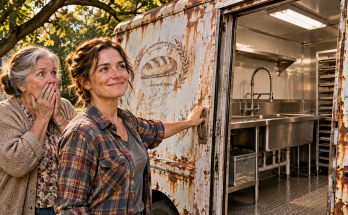
I'd paid twenty dollars for an old bakery van, but twenty dollars wasn't going to turn it into somewhere a woman could live.
I understood that much.
Sitting with my notebook open, I drew four lines that represented the walls of the cargo compartment.
There wasn't much space between those lines.
Ninety-eight square feet.
Everything I needed would have to fit inside them.
Mama leaned over my shoulder.
She studied my drawing without saying anything for a while.
Then she pointed at the back.
“Is that supposed to be your bedroom?”
“That's where I'm putting the bed.”
She moved her finger toward the opposite end.
“What about everything else?”
I explained that I could raise the mattress off the floor and use the space underneath it.
My plastic storage tubs would slide beneath the platform.
I wouldn't need an ordinary dresser.
There might be enough room along one wall for a narrow cupboard.
Mama listened carefully.
She wasn't somebody who could look at a drawing and pretend it answered questions that hadn't been considered.
She had a few more.
“Where will your uniforms go?”
“In the cupboard.”
“You can't keep those shirts folded all the time.”
“I'll put a rail in there.”
She nodded.
Then she asked about washing.
I turned toward the old commercial sink.
The stainless steel was one of the things that had made me reconsider what that ugly vehicle was worth.
There was already a substantial sink inside.
The surrounding walls had been made for commercial food preparation rather than ordinary deliveries.
There was insulation, flooring designed to withstand hard use, and equipment that had once served a working bakery.
From outside, you wouldn't have expected any of it.
That was the strange part.
The body looked as though somebody should have hauled it away years earlier.
Yet standing inside, I could recognize things that would have cost me a considerable amount to purchase separately.
I had something to work with.
Not a finished home.
Something to work with.
I needed to keep that distinction clear in my mind.
Buying an unwanted vehicle and making it look pretty wouldn't solve my problems.
I needed water that was safe to use.
I needed somewhere for used water to go.
The electricity had to be dependable, and the interior needed proper ventilation.
I couldn't spend a Mississippi winter wrapped in every blanket I owned because I hadn't thought about heating.
There were practical questions about keeping the vehicle on Mama's land, too.
I'd bought the truck.
I hadn't bought anywhere to put it.
“Would you mind if I worked on it here?” I asked.
Mama looked toward the backyard.
Her pecan tree provided enough shade to make the area reasonably comfortable.
She considered it for a moment.
“I don't mind you fixing it up back there.”
I waited.
“But I won't have you spending the night in something that isn't ready for you.”
I understood why she said that.
Since my divorce, she'd watched me make adjustments I hadn't expected to be making at this point in my life.
I'd left Natchez.
I'd rented a room on Cherry Street.
I'd learned how quickly money could disappear when I was paying for somewhere temporary to stay.
Mama didn't want my desire to get out of that situation to push me into something worse.
“I won't move in before it's ready,” I promised.
She looked at me again.
“Make sure you mean that.”
I did.
The room at Mrs. Broussard's house wasn't the future I'd imagined for myself, but it was clean and reasonably affordable.
I wasn't desperate enough to abandon it for an unsafe vehicle.
I'd spent enough nights worrying about what the following month might bring.
The last thing I wanted was a different set of worries waiting beside my bed.
Before I could start thinking seriously about curtains or kitchen cabinets, I needed somebody who understood trucks.
Mama knew just the person.
Clarence lived nearby and had spent his working years driving them.
Retirement hadn't taken away his knowledge of engines, brakes, or the other things that kept heavy vehicles moving safely.
He looked over my purchase with considerably less excitement than I felt.
That was useful.
I needed somebody who could see problems without being distracted by my plans.
He walked around the vehicle.
He examined the tires.
Then he looked under the hood.
I told him what I'd noticed so far.
He listened without interrupting.
When he finished looking, he stepped away from the engine compartment.
“You'll be needing tires.”
I glanced down.
I'd already suspected that.
He mentioned the radiator next.
That didn't surprise me, either.
The engine had roughly 112,000 miles on it.
It would start, which was encouraging, but starting an engine wasn't proof that everything attached to it was working correctly.
Clarence explained that the cooling system needed attention.
The brakes required work, too.
I tried not to let my disappointment show.
Every problem meant another receipt.
Every receipt meant taking something out of the money I'd managed to put aside.
Clarence wanted to understand what I intended to do with the van once it was running properly.
I explained that it would spend most of its time beneath Mama's pecan tree.
I wasn't planning a long trip.
I hadn't purchased it because I wanted to travel.
I wanted a place to come home to after work.
Still, there might be occasions when the vehicle needed to move.
I didn't want those occasions to become emergencies simply because I'd neglected something important.
Clarence offered to let me use his driveway and some of his tools.
I appreciated that more than I knew how to express.
Tools weren't something I could justify purchasing indiscriminately.
Neither was professional assistance for every little task I encountered.
There were things I could learn to handle.
There were other things I had no business attempting without somebody experienced nearby.
I was old enough to understand the difference.
Over the next several days, I began collecting the parts we needed.
I found a suitable radiator through a salvage source.
There were replacement hoses to obtain, along with filters and brake parts.
The tires took some consideration.
Saving money wouldn't accomplish much if I bought tires that weren't suitable for the weight of the vehicle.
I eventually obtained four secondhand commercial tires with the proper load capacity.
They weren't new.
They were a considerable improvement over what had been there when I purchased the van.
Clarence helped me assess what needed doing.
I worked where I could.
When something was beyond my abilities, I didn't pretend otherwise.
That was another adjustment for me.
After my divorce, I'd become rather determined to demonstrate that I could take care of myself.
There was nothing wrong with that determination until it started making me reluctant to accept sensible help.
I couldn't rebuild a life by refusing every kindness offered to me.
Clarence wasn't asking me to surrender control of my project.
He was helping me make sure my twenty-dollar purchase didn't become a twenty-dollar disaster.
When the mechanical work was finished, I sat down with my notebook.
Four hundred and eighty dollars.
That was the cost of getting the old vehicle into better mechanical condition.
I wrote it beneath the original purchase price.
Twenty dollars for the van.
Four hundred and eighty for the repairs.
Five hundred dollars altogether.
I looked at those two entries for quite a while.
Anybody hearing that I'd bought a van for twenty dollars might imagine I'd somehow escaped the ordinary costs of owning one.
The notebook told a more accurate story.
I'd already spent five hundred dollars, and I hadn't built so much as a shelf.
Still, I had something better than I'd had before.
I knew more about the condition of the vehicle.
I knew which mechanical problems we'd addressed.
And I felt considerably more comfortable about having it in Mama's yard.
That seemed worth the money.
It also meant I needed to be careful about everything that came next.
My paychecks hadn't increased because I'd acquired a project.
Every morning, I still drove to the motor lodge.
Fourteen rooms waited for me there.
Beds needed stripping.
Bathrooms needed cleaning.
Trash cans needed emptying.
There were towels that seemed to weigh twice as much when they were wet.
I worked through each room knowing that the money I'd earn from those hours had somewhere important to go.
It wasn't a glamorous way to finance a home.
It was the way available to me.
After work, I'd drive to Mama's house and change into clothes I didn't mind ruining.
Some days, I had enough energy to work until I could no longer see properly.
Other days, the simplest task seemed determined to defeat me.
An old fastener could refuse to move for what felt like forever.
A piece of damaged metal could look manageable until I examined the area around it.
Then the job became larger.
I was learning not to measure progress solely by what I could see at the end of an afternoon.
Sometimes discovering a problem was the only useful thing I'd accomplished.
That mattered, too.
Mama often appeared with something to eat.
A sandwich.
A glass of cold tea.
She knew I could become so occupied with what I was doing that I'd postpone eating until I felt miserable.
“Your truck will still be here after supper,” she'd remind me.
She was right.
The van wasn't going anywhere.
I didn't have to finish it in a single evening.
One afternoon, I sat inside examining the white wall panels and the floor.
The condition of that commercial interior continued to impress me.
Considering how neglected the outside appeared, there was a surprising amount worth preserving.
I moved toward the side doorway.
Something beneath my feet didn't feel quite right.
I pressed the area again.
There was a softness that wasn't present elsewhere.
I examined the surrounding floor before making a mark beside the affected section.
I wouldn't know how extensive the damage was until I investigated it properly.
The following afternoon, I found another place that needed attention.
For a moment, I wondered how many more problems would reveal themselves as I worked.
Then I reminded myself what I'd purchased.
An old bakery truck.
Not something fresh from a dealership.
I couldn't reasonably expect perfection.
What mattered was whether the rest of that durable floor could be saved.
From what I could determine, there was still plenty of solid material.
That was encouraging.
I began estimating the cost of dealing with the damaged sections.
Then I turned my attention toward the outside bodywork, windows, interior framing, electricity, and water.
My pencil moved down the page.
Each new figure made the small purchase price look less significant.
When I added everything together, I was looking at several thousand dollars.
I'd known that was possible.
Seeing the figures written together felt different.
Mama found me sitting on her back steps that evening.
She sat down beside me.
I showed her what I'd calculated.
She took her time reading the page.
“You're going to be putting quite a bit into this.”
“Looks that way.”
She knew how long it had taken me to save that money.
I'd started with $5,200.
That represented countless mornings getting out of bed before I wanted to.
It represented the work I did while other people were traveling, visiting relatives, or enjoying time away from their own responsibilities.
Mama didn't want me to forget that.
“What if these numbers aren't enough?” she asked.
I looked at the van beneath the tree.
I'd asked myself the same question.
There wasn't anybody who could guarantee that my estimates would turn out exactly right.
Another problem could appear beneath the floor.
Something I'd hoped to preserve might need replacing.
I needed to leave myself room for that possibility.
“I'll do what I can afford as I go.”
“And keep some money back?”
“Yes.”
I wouldn't spend every dollar trying to convince myself that the purchase had been a brilliant decision.
If the project became more expensive than I could reasonably manage, I'd have to reconsider some things.
I could keep working at the lodge.
I could continue renting my room while the van remained unfinished.
There wasn't any benefit in making my situation more precarious by rushing.
Mama handed the notebook back.
I turned to a fresh page.
Instead of drawing furniture, I began identifying what had to be functional before I could consider living inside.
The bed wasn't enough.
The cabinets weren't enough.
I needed a complete, practical space that wouldn't leave me dependent on one improvised arrangement after another.
Once I'd written down those requirements, I felt better.
The problems hadn't disappeared.
I'd simply given them an order.
I carried the notebook back across the yard.
Inside the van, the daylight was already beginning to fade.
I stood beside one of the white panels and considered where a window could go.
I'd spent enough time in that cargo compartment to know how much difference a little natural light would make.
I took out my measuring tape.
There would be plenty to do before I could install anything.
But for the first time, I had a proper starting point.