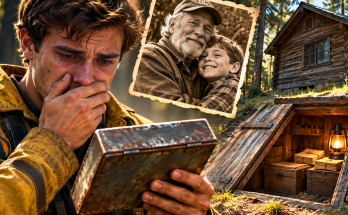
The storm reached Argentum Ridge before I had finished my evening meal.
I heard the wind first.
It moved across the high ground with a deep, steady sound.
Then it struck the rocks above my shelter.
The noise changed as the gusts passed through the narrow draw.
I sat beside the stove and listened.
I knew that sound.
I had heard it from our old cabin many times.
There had been nights when Elias and I lay awake while the walls creaked and snow pressed against the windows.
He would rise to check the fire.
I would listen for any change in the roof.
Now there was no wooden roof above me.
There was granite.
I reminded myself of that while I checked the door.
The frame held firmly in the stone wall.
I had packed the surrounding gaps as carefully as possible.
Still, I could feel a little cold air near the entrance.
I adjusted what I could.
Then I returned to the stove.
By the time I finished eating, snow had begun driving into the draw.
It did not fall gently.
The wind carried it almost sideways.
I opened the door only far enough to look outside.
The passage beyond was filling with white movement.
I could barely see the rocks that concealed the entrance.
I shut the door quickly.
The cold followed me inside.
I stood still for a moment, feeling it against my face.
Then I checked the thermometer.
The temperature inside was much warmer than outside.
But that was before the storm had reached its full strength.
I added another piece of pine.
The flames rose.
The stovepipe carried the smoke upward as it should.
I watched the fire through the stove opening.
I had never depended on a machine I assembled myself quite so completely.
If the stove failed, I would have a serious problem.
If the chimney became blocked, the danger could be immediate.
And if the door or front wall gave way, I would have little protection from the wind.
I knew all of that.
I also knew that worrying would not improve the shelter.
Checking it might.
So I checked.
The joints around the pipe.
The stonework near the door.
The small window opening.
The places where the front wall met the natural rock.
Everything remained in position.
I sat down.
For a while, I tried reading one of Elias's books.
I turned the same page three times.
My attention kept returning to the wind.
Eventually, I put the book aside.
There was no use pretending I was not concerned.
I was frightened.
Not helpless.
Not panicked.
But frightened.
I had worked twenty-eight days to create a place I believed would protect me.
Now the mountain was testing that belief.
I had no one to consult.
No one to tell me whether the wall was thick enough or whether the chimney would remain clear.
Elias had left the calculations.
I had supplied the labor.
The result was sitting around me.
There was nothing more I could do but manage it properly.
During the night, the temperature fell.
I kept the thermometer near the door where I could check it.
The air outside reached twenty degrees below zero.
Then it became colder.
I remembered the first winter Elias and I spent in the original cabin.
We had underestimated how quickly an exposed wooden house could lose heat.
The stove consumed more wood than we expected.
We had taken turns rising during the night to feed it.
By morning, frost sometimes formed along the inside edges of the windows.
I thought about that experience while sitting beneath the granite shelf.
The comparison was not exact.
The new chamber was smaller.
Its walls were thicker.
Its roof was a great mass of rock rather than timber exposed to the open air.
But the principle was the same.
Heat entered from the stove.
Heat escaped into the surroundings.
My survival depended on how quickly that happened.
I began taking readings at regular intervals.
The air near the stove was warm.
Farther away, it was cooler.
But the temperature did not plunge when I allowed the flames to settle.
That encouraged me.
I placed my palm against the rear wall.
It was warmer than it had been days earlier.
Not hot.
Not even especially comfortable.
But the bitter cold I remembered from the morning I discovered the chamber had diminished.
The stone had begun storing heat.
I could feel the difference with my own hand.
I wrote down the observation.
Then I fed the stove again.
By morning, snow had collected heavily outside.
I could tell because the passage admitted less light.
The wind had not stopped.
It seemed stronger.
I listened to the repeated movement of snow against the rocks.
Sometimes the sound was like coarse sand being thrown against stone.
Sometimes it was almost silent.
The temperature outside continued falling.
Eventually, it reached thirty degrees below zero.
I stared at the thermometer.
I knew what that meant.
A person exposed to such cold without shelter could lose the ability to help herself very quickly.
Even a short trip outside could become dangerous.
I looked toward the door.
The passage beyond was no longer a safe place to wander.
I stayed inside.
That was the decision.
Simple.
Necessary.
I kept the fire burning and made careful use of the woodpile.
I could not waste fuel in a place where I might remain trapped for days.
I had stacked the wood along the back wall before the storm.
At the time, it seemed like a good reserve.
Now I counted the pieces differently.
Every log represented a period of warmth.
Every wasted piece shortened the time I could remain comfortable if the storm continued.
I remembered Elias making calculations beside the hearth.
He had once explained that people often judged a fire by how large its flames appeared.
That was not always a useful measure.
What mattered was how much heat remained in the living space.
I began understanding that lesson more clearly.
I did not need the stove to roar.
I needed it to provide steady warmth.
The chamber helped.
Its enclosed shape reduced the amount of air I had to heat.
The granite held some of the warmth the stove produced.
The wall protected me from direct wind.
I was seeing the principles Elias had recorded become practical facts.
The second day of the storm was worse.
Snow covered the entrance passage almost entirely.
The light that normally entered around the doorway faded.
I opened the door cautiously and found a mass of packed snow beyond it.
The drift was deep.
It had formed against the low bank I built from the soil excavated inside the chamber.
That bank had served as a windbreak.
Now it had become part of a barrier of snow.
I closed the door.
For a moment, I felt trapped.
Then I stood with my hand against the oak and considered what was happening.
The snow was blocking the wind.
It was also filling the gaps around the stonework.
The same snow that prevented me from leaving was protecting the chamber from the full force of the storm.
I had seen that before in the mountains.
Snow could be dangerous.
But a sufficiently deep layer could also reduce heat loss.
Elias had explained that when we discussed the way snow covered roots and small animals through winter.
I had listened then.
Now I was living inside the lesson.
I returned to the stove.
The air temperature remained above forty-five degrees Fahrenheit.
Outside, it was thirty below zero.
I checked the reading again.
The difference was so large that I briefly doubted the thermometer.
But my hands were not numb.
My breath was not turning into clouds inside the room.
The water I kept near the stove had not frozen.
I could sit comfortably with my blanket around my shoulders.
I knew the instruments were telling the truth.
The chamber was working.
That realization did not arrive all at once.
I had been waiting for some dramatic moment when I would understand whether the shelter was successful.
Instead, I found myself going about ordinary tasks during weather that would have made those tasks miserable in the old cabin.
I cooked beans.
I mended a worn place in one of my garments.
I cleaned the cooking pot.
I checked the lamp.
I recorded the temperature.
Then I sat beside the fire and read.
The wind continued outside.
But I was no longer listening to it every moment.
That was when I began to feel secure.
Not because the storm had weakened.
It had not.
But because the room around me was doing what I had built it to do.
The granite held warmth.
The door remained shut.
The stove carried smoke away.
And the snow surrounding the entrance reduced the wind that reached the wall.
I put down Elias's book.
For a moment, I looked around the chamber.
I remembered crawling through the little opening for the first time.
The place had smelled of dry stone.
Its floor had been uneven.
There had been no way to stand near the entrance without bending.
I had looked at the bare rock and imagined a home.
Now I was sitting inside that home.
The work had cost me most of my money.
It had left scars on my hands.
It had taken every useful thing I could spare from the cabin Elias built.
But I had been right to try.
That was what I finally allowed myself to believe.
The third night brought no improvement in the weather.
The wind continued.
Snow pressed more tightly against the hidden entrance.
I did not try to clear it.
There would be time for that after the storm.
For now, remaining inside was safer.
I checked my food.
I had enough.
I checked the wood.
I had enough for the immediate need.
I checked the stove.
It was functioning properly.
Those three observations allowed me to settle.
There was nothing else to solve that night.
I made coffee.
I sat near the granite wall and opened Elias's journal.
I found the entry describing the hidden formation.
I read the measurements again.
The dimensions were familiar now.
I no longer needed his drawing to understand where each wall stood.
I had lived with those stones.
I had dug beneath them.
I had carried granite into place around the entrance.
Yet I still found comfort in seeing his handwriting.
He had been thinking about the same questions I now faced.
How much protection could a natural formation provide?
Where would the sunlight reach?
How would the surrounding rock respond to changing temperatures?
What could make the space suitable for living?
He had not lived long enough to see the answer.
I touched the edge of the page.
"I wish you could see it," I whispered.
The stove gave a small metallic sound as the iron changed temperature.
I looked up.
Then I returned to the journal.
I was not asking him to answer.
I simply missed him.
I missed his careful explanations.
I missed the way he checked the weather without appearing worried.
And I missed having another person in the room.
A warm room did not remove loneliness.
It only made loneliness something I could survive.
The storm lasted three days and three nights.
During that time, I continued recording the temperatures.
I also measured how much fuel I used.
For the first week of severe heating, my consumption worked out to approximately a quarter cord of wood.
That was important.
It meant my existing supply could last if I maintained the same careful routine.
I knew I would have to replenish it whenever the weather allowed.
But I was not burning through wood at the frightening rate I had known in the old cabin.
The shelter was conserving heat.
And that conservation was allowing me to conserve strength.
I did not have to spend every waking hour collecting enough fuel to replace what the stove consumed.
I could rest.
I could repair clothing.
I could prepare food.
I could think beyond the next fire.
During a lull, I examined the snow blocking the entrance.
I did not try to venture far.
The storm remained dangerous.
But I could see how deeply the drift had settled around the rockfall.
It was approximately six feet in places.
Anyone looking from outside would see only an ordinary accumulation of snow.
They would not see the oak door.
They would not see the thick stone wall.
And they would never guess a woman was sitting beside a stove beneath the granite.
I returned inside and shut the door.
The thought stayed with me.
Sterling Consolidated believed the land was theirs.
They believed my right to live there had ended with Elias's employment.
They believed a notice and a deadline were enough to remove me.
But the mountain held a space they had never bothered to notice.
Elias had found it because he looked carefully.
I had made it habitable because I refused to surrender the only place I knew.
That did not give me legal ownership.
I understood the difference.
But it gave me shelter while the company believed the matter settled.
When the wind finally weakened, I sat quietly beside the stove.
For three days, the storm had made the world outside almost impossible to inhabit.
Inside, my temperature had remained above forty-five degrees.
The result was written in my notebook.
It was written in the amount of wood remaining against the wall.
It was written in the food I had cooked and the sleep I had managed.
I had not merely endured the blizzard.
I had remained warm enough to live normally through much of it.
That mattered.
I closed the journal.
Then I checked the stove once more.
I no longer needed to convince myself that the shelter might work.
I had proof.