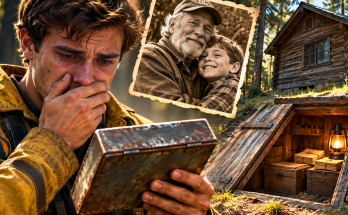
The first morning after the deadline, I woke before sunrise and listened.
No horses.
No voices.
No sound of boots moving through the snow outside.
Only the faint movement of air around the rocks and the soft noise of the fire inside my stove.
December fifteenth had passed.
The Sterling Consolidated Mining Company had not come to remove me.
I knew better than to mistake their absence for mercy.
They had given me thirty days to leave, and I suspected they believed the threat alone had been enough.
Perhaps someone in their office had already marked the matter finished.
Perhaps Mr. Finch had reported that the widow would go quietly.
I wondered what he would have said if he could have seen where I was sitting.
I was beneath Argentum Ridge, inside a chamber concealed by fallen granite.
The same oak door that once separated my bedroom from our living room stood between me and the winter air.
Elias's stove burned a few feet away.
And his leather-covered journal rested beside my lamp.
Everything around me had been made possible by something he noticed two years earlier.
I wanted to be grateful.
I was grateful.
But gratitude did not make my hands stop hurting.
I looked down at my palms.
The cuts from moving stone had begun to close, but the skin was still rough and tender.
My shoulders felt stiff.
My knees ached when I stood.
I had spent nearly a month forcing my body to complete work that should have taken several strong men.
Now I needed that same body to survive the winter.
There would be no long rest.
The chamber was enclosed, but it was not ready for months of living.
My firewood supply was too small.
My food needed to be organized.
And the cold stone around me had not yet absorbed enough warmth to make the shelter comfortable without a steady fire.
I rose from my blankets and put another piece of pine into the stove.
The fire brightened.
I held my hands toward it.
Then I checked the stovepipe.
I had done that repeatedly since lighting the first fire on December fourteenth.
I did not completely trust anything that had been assembled under such desperate conditions.
The pipe rose through the granite ceiling, passed through the opening I had made, and carried smoke toward the rocks above.
I watched for any sign that smoke was escaping into the chamber.
There was none.
The stove continued drawing properly.
That small fact mattered more to me than almost anything else.
I had seen what poor ventilation could do in mountain cabins.
Heat was useful only when the fire did not poison the person depending on it.
I opened the oak door.
Cold air pressed against my face.
The difference between the air outside and the chamber inside was already noticeable.
I stepped into the narrow passage behind the boulders.
Above the draw, the morning sky was clear.
The sun had not yet reached the entrance.
I stood for a moment looking toward the direction of the original cabin.
It was still there.
A house built from logs that Elias and I had worked to raise.
A house with a stone fireplace, a pine table, and the marks of six years of living.
But I did not go there immediately.
The upper cabin had become a place I visited for necessary things.
My shelter beneath the rock was where I now slept.
That change was harder to accept than I expected.
I had told myself that the company could take the structure but not the memories.
Yet memories were attached to objects.
The sound of the bedroom door closing.
The warmth of the fireplace.
The uneven leg of our kitchen table.
I had removed the bedroom door with my own hands.
Now, whenever I looked at it inside the mountain, I remembered the empty doorway it had left behind.
I returned inside and opened Elias's journal.
I had begun using the margins of its pages to record my own observations.
At first, writing there felt like trespassing.
His handwriting was precise.
Mine became crooked when my fingers were stiff.
He recorded geological measurements.
I recorded the amount of wood I burned and whether the stove kept the chamber warm.
But I understood that I was continuing the same work.
We were both trying to understand how the mountain behaved.
I checked the temperature near the entrance.
Then I made another reading closer to the stove.
There was a difference.
The chamber had not warmed evenly.
The deeper granite still felt cold when I touched it.
I remembered Elias explaining that thick stone changed temperature slowly.
It was one reason the formation might protect me.
It was also a reason I had to be patient.
A fire could warm the air quickly.
Warming the surrounding rock would take longer.
I wrote down the readings.
Then I made breakfast.
A little flour.
Some salt pork.
Coffee prepared carefully enough that I could make the supply last.
I had bought one hundred pounds of flour, fifty pounds of beans, twenty pounds of salt pork, and ten pounds of lard.
Those quantities had looked enormous when Mr. Abernathy loaded them into my wagon.
Inside the chamber, they looked less impressive.
Winter in the high country could last far longer than anyone wanted.
Snow might block the road for weeks.
I could not assume I would reach Prospect whenever I needed something.
I took out the sheet of paper on which I had calculated my resources.
Then I began again.
I estimated how much food I could eat each day.
I considered how long the flour would last.
How often I could use the salt pork.
How much fuel I needed to cook beans.
The numbers did not promise comfort.
They promised a chance.
That was enough.
I arranged the provisions along the driest part of the chamber.
The sacks needed to remain away from the entrance.
Snow could enter when I opened the door.
Meltwater might cause trouble if it reached the food.
I placed the smaller supplies where I could find them in the dark.
I kept the lamp near Elias's journal.
The tools stood along the back wall.
The Winchester rifle remained within reach.
I did not expect anyone to visit.
But I was a woman alone on land the company claimed.
I preferred to be prepared.
The next task was firewood.
I had used much of my strength building the shelter.
Now I needed to spend more strength feeding it.
There was deadfall pine in the wooded country near the draw.
Some of it had dried enough to burn well.
Other pieces were less suitable.
I had learned from Elias that damp wood could waste heat and fill a chimney with trouble.
I took the handsaw and went outside.
Jericho waited near the sheltered place where I had secured him.
I checked him before beginning work.
He was old, but his appetite remained good.
I rubbed his neck and examined his footing.
He had helped me move the stones that formed my wall.
He had helped transport the oak door.
He had carried pieces of the stove over ground I could barely cross myself.
Without him, the shelter might never have been completed.
"Still working, old fellow," I said.
He moved one ear toward me.
That was his usual answer.
I began cutting dead pine into lengths that would fit inside the stove.
The sawing was slow.
The wood resisted in places.
My shoulders protested almost immediately.
But the work felt different from digging frozen earth.
Each piece I cut had an obvious purpose.
I could carry it inside.
Stack it.
Count it.
And know it might keep me warm on a night when the temperature fell far below zero.
I worked until the light began to weaken.
Then I hauled the wood into the chamber.
I stacked it along the back wall, keeping enough space for air and movement.
The pile looked small.
I stood staring at it.
I knew how much wood an ordinary cabin could consume during a severe winter.
Our old cabin needed constant attention when the wind was strong.
The heat escaped through the roof, the walls, and every small opening around the windows.
This chamber was supposed to behave differently.
But I had not yet seen it endure a true blizzard.
I could only trust the principles Elias had written down.
And trust my own observations.
The following day, I gathered more wood.
The day after that, I continued.
My hands gradually recovered from the worst of the construction work.
My back did not hurt quite as sharply each morning.
The routine began to establish itself.
Wake.
Check the fire.
Record the temperature.
Eat.
Gather wood while daylight allowed.
Return before the cold deepened.
Tend the stove.
Prepare food.
Read by lamplight.
Sleep.
It was not an exciting existence.
I did not want excitement.
Excitement in winter often meant something had gone wrong.
During those first two weeks, the sky remained mostly clear.
The air was cold but manageable.
That weather gave me time I badly needed.
I knew it would not last.
Every evening, I checked the sky before closing the door.
I watched the clouds near the high peaks.
I noticed the direction of the wind.
I remembered Elias describing the way a storm could gather beyond the ridge long before the first snow reached our cabin.
He had taught me to treat the weather as something to observe rather than something to fear blindly.
I was beginning to understand how valuable that lesson had become.
One afternoon, I walked back toward the original cabin.
The trail was quiet.
There were no fresh tracks that belonged to anyone else.
I opened the door and stepped inside.
The room smelled of cold wood.
Without a fire, the cabin seemed smaller.
The hearth was dark.
The place where the stove had stood was empty.
The doorway to our bedroom had no door.
I felt an unexpected shame.
I had taken apart a home Elias built.
The company had not yet touched it.
I had done the damage myself.
I stood there for several minutes before admitting the truth.
I had removed those things because I wanted to live.
Elias would have understood.
He had never cared more about a building than about the person inside it.
He had spent years studying stone because he believed understanding the land could make human life safer.
I walked to the kitchen table.
The eviction notice still lay where I had left it.
The paper was no longer perfectly flat.
Its folds had softened.
I picked it up.
Thirty days.
Fifty dollars.
A release of further claims.
I read the words again.
They had not changed.
Neither had my opinion of them.
I set the notice down.
Then I looked around for anything useful I had overlooked.
There were still household items I could carry to the shelter.
I selected only what I needed.
I did not empty the cabin.
The furniture that remained made it appear recently occupied.
That seemed wise.
If someone from Sterling came to inspect the place, I wanted no sign pointing toward the hidden chamber.
I carried my things outside.
Then I went behind the cabin to Elias's grave.
The ground was hard.
A thin layer of snow covered the south-facing slope.
I stood beside the place where I had buried him.
I had dug that grave six months earlier.
At the time, I thought the worst thing that could happen on our mountain had already happened.
I knew now that grief did not prevent further hardship.
It simply made hardship lonelier.
I looked toward the ridge.
"I found your place," I said quietly.
There was no answer.
I had not expected one.
But I wanted to tell him.
I wanted him to know that the drawing he made in October of 1886 had become the reason I might survive the winter of 1888.
I returned to the hidden shelter before dark.
I closed the oak door.
Then I sat beside the stove with his journal in my lap.
I had begun to notice something encouraging.
The granite wall no longer felt quite as cold as it had when I first moved inside.
Near the stove, it was warmer to the touch.
The heat was beginning to settle into the stone.
It happened slowly.
There was no sudden change.
But the difference was real.
I checked the thermometer.
Then I compared the reading with the one I had taken earlier.
The chamber was holding warmth after the flames diminished.
I made another note in the margin.
I was learning to measure success by small changes.
A stone wall that held.
A door that closed.
A chimney that drew.
A chamber that remained warmer than the air outside.
I did not know how the company intended to handle my absence.
I did not know whether anyone in Prospect believed I had left.
I did not even know whether my supplies would last until spring.
But I had one thing I had not possessed when Finch stood at my door.
A place where I could continue living without asking anyone's permission.
For several nights, that knowledge allowed me to sleep.
Then the weather began to change.
On December twenty-seventh, I stepped outside and found the sky covered by a heavy sheet of gray cloud.
The high peaks had disappeared.
The wind had shifted.
It carried a colder, sharper force than anything I had felt during the previous two weeks.
I checked the thermometer.
Then I looked toward the narrow passage that led to my door.
I knew the shelter was about to face the kind of weather Elias had designed it to withstand.
I carried in the last pieces of wood I could gather safely.
I closed the door.
And I prepared to remain inside.