The children had been standing in the cold for too long.
I knew it.
Samuel knew it.
And every time I looked at their faces, I understood that another minute spent arguing with myself was a minute they could not afford.
I looked toward the northern sky.
The clouds had thickened.
The wind moved across the open land without anything to soften it.
I had lived on that prairie long enough to understand what such weather meant.
Winter did not care whether a family had enough money.
It did not care whether a widow was exhausted.
It did not care whether a grave was unfinished.
The cold simply came.
And people had to find a way to survive it.
I had tried.
For six days, I had tried.
But effort alone had not been enough.
I looked down at Danny.
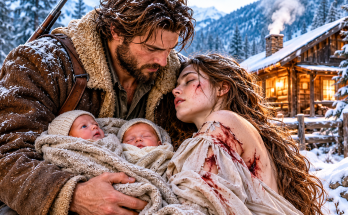
His small body remained tucked inside my coat.
I kept one hand around him and the other beneath the fabric, trying to shield him.
I remembered the moment I had seen the blue color around his lips.
That image would remain with me.
I knew it.
I had been so determined to bury Thomas that I had nearly forgotten the danger standing behind me.
My baby had needed help.
And I had been holding a shovel.
The thought made me feel sick.
I did not want to forgive myself too easily.
But I also knew that shame would not warm him.
I had to act.
I looked toward Samuel.
He was standing near the grave, waiting.
I had already agreed to accept his shelter.
Yet I found myself hesitating again.
I was afraid of leaving the familiar yard.
I was afraid of trusting someone new.
I was afraid of being wrong.
But most of all, I was afraid that my children would pay for another decision made by an adult who promised to know what was best.
Thomas had done that often.
He decided to spend money.
We went without.
He decided to drink.
We lived with his anger.
He decided to sell the milk cow.
The children lost something they needed.
He made choices.
We paid for them.
I did not want to become another person who decided things without considering what those decisions would mean for the children.
So I looked at each of them.
Will stood closest to me.
His cheeks were pale.
His hands were red.
But he was still watching Samuel.
Jake stood beside him.
He seemed tired enough that even turning his head required effort.
Maggie held Sarah's hand.
The girls leaned together.
Danny stirred faintly against my chest.
Five children.
Five lives.
They had done nothing to deserve the hardships Thomas left us.
And they would be the ones who suffered most if I let fear keep us standing in that yard.
I looked at Will.
“Are you cold?”
He glanced toward Jake.
“I'm all right.”
I knew that answer.
I had used it myself.
I looked at him again.
“I'm not asking whether you can manage.”
He hesitated.
Then nodded.
“Yes, Mama.”
I felt a strange relief.
He had told me the truth.
“Thank you.”
He looked surprised.
I wanted him to understand that honesty was not something to be punished.
I turned toward Jake.
“And you?”
He rubbed his nose.
“My feet hurt.”
I nodded.
“I know, sweetheart.”
He looked toward my torn boot.
“Yours too?”
“Yes.”
He seemed almost comforted by the answer.
Perhaps it helped him to know that I was not standing there untouched by the cold.
I had spent years pretending I could endure everything.
The children may have begun believing I did not feel pain the way they did.
I wanted them to understand that adults could be tired.
That adults could need help.
That a mother could admit she did not have every answer.
I turned toward Maggie and Sarah.
The girls had moved closer together.
“Tell me how you're feeling.”
Maggie looked at me carefully.
“Cold.”
Sarah nodded.
“And tired.”
I reached toward them.
“Thank you for telling me.”
Sarah frowned slightly.
I wondered whether she thought I was behaving strangely.
Perhaps I was.
Thomas had rarely thanked the children for telling him what they needed.
More often, he treated their needs as complaints.
I had learned to keep the peace by asking them to stay quiet.
Now I was trying to undo that habit.
One sentence at a time.
It felt awkward.
But I meant every word.
I looked at the house again.
The children knew every room.
They knew where to find their things.
They knew which places were warmest when we could keep the stove going.
They also knew which corners were safest when Thomas was angry.
I remembered Will once stepping around that loose floorboard near the bedroom.
He had done it without thinking.
He knew exactly where to place his foot.
I had watched him.
And I had felt something terrible.
A child should not have to learn the quietest path through his own home.
But that was what our house had become.
A place where footsteps mattered.
A place where voices had to be measured.
A place where a father's mood could decide whether the evening was peaceful or frightening.
I wanted something different.
I did not know whether Samuel's house would give us that.
But I knew our old life had not.
I looked toward the grave.
Thomas lay beneath the canvas.
He had once promised that our children would never know hunger.
I remembered those words.
I had believed them.
So had he, perhaps.
At the beginning.
But promises made by a young man did not feed children years later.
The crops failed.
The debts grew.
The whiskey took its share.
Then Thomas sold the milk cow.
That was the moment I stopped believing he understood what the children needed.
I remembered discovering she was gone.
The place where she belonged had been empty.
I had stared at it, trying to understand.
The milk cow was part of our survival.
Thomas had turned her into money.
Then he had spent half of that money in town.
I had been furious.
But I had also been frightened.
I knew what could happen if I confronted him.
So I carried the anger quietly.
I thought of the children.
I thought of the food that money could have bought.
I thought of the coming winter.
And I wondered how much more we could lose.
Now Thomas was dead.
And the cow was still gone.
That was one of the cruelest things about his death.
The danger he brought into the house had ended.
But the damage remained.
The debts did not disappear.
The hunger did not disappear.
The cold did not disappear.
The children's fear did not disappear.
I had hoped death would close the door on all of it.
Instead, I was discovering how much work remained.
I looked toward Samuel again.
He was not the answer to every problem.
I knew that.
I refused to imagine him as some perfect rescuer.
He was a man I had met only that afternoon.
A stranger with a scar.
A ranch eight miles north.
A wagon.
A team.
Tools strong enough to break frozen earth.
And a warm house.
Those were the things he had offered.
Nothing more.
But they were things we desperately needed.
I thought of the way he had asked what I wanted done.
That question remained with me.
Thomas rarely asked what I wanted.
He asked what I had cooked.
What I had spent.
What I had finished.
Why the children were noisy.
Why I looked tired.
But what did I want?
That question had almost disappeared from my life.
Samuel had asked it beside a grave.
And I had answered without thinking.
I wanted my husband buried.
That had been the truth.
But it was not the whole truth.
I wanted my children safe.
I wanted them fed.
I wanted them warm.
I wanted them to stop being afraid.
I wanted a life that did not revolve around avoiding a man's anger.
I wanted to wake up in the morning and believe the day might be ordinary.
I wanted Will to put away the knife.
I wanted Jake to speak without apologizing.
I wanted Maggie and Sarah to stop watching the doorway whenever a man's voice grew loud.
I wanted Danny to grow up without learning the habits his brothers and sisters had already learned.
I wanted so many things.
And for years, I had been ashamed of wanting any of them.
Now I stood in the snow, admitting them to myself.
I looked toward Samuel.
He had not asked me to explain my marriage.
He had not demanded to know why Will was so suspicious.
He had not questioned the children's silence.
I wondered whether he recognized fear when he saw it.
Perhaps he did.
Perhaps his own loss had taught him to notice things others missed.
But I would not pretend to know.
I looked at the scar on his face.
Then at his hands.
They were steady.
He had spoken gently.
He had accepted my conditions.
That was enough for the moment.
I did not need to understand his whole life before accepting the help he offered.
I needed to protect my children.
I needed to make a decision based on what was happening in front of me.
Not only on what Thomas had taught me to fear.
I turned toward Will.
“Listen to me.”
He looked up.
“We're going to let Mr. Brennan help us.”
He nodded.
I looked at the knife.
“And I need you to understand something.”
He waited.
“Keeping everyone safe is my responsibility.”
His face tightened.
“I can help.”
“I know you can.”
I touched his shoulder.
“But you don't have to carry it all.”
He looked toward Jake.
Then the girls.
Then Danny.
I could tell he was not ready to believe me.
That was all right.
I had not expected one conversation to undo years of fear.
I only wanted to begin.
I looked at the other children.
“We're staying together.”
Sarah stepped closer.
“All of us?”
“All of us.”
Maggie reached for Jake's hand.
Will moved near my side.
Danny stirred beneath my coat.
For a moment, we stood in a small circle near the unfinished grave.
The cold remained.
The problems remained.
But the children were together.
And I was finally making a decision based on what they needed rather than what Thomas would have allowed.
I looked toward Samuel.
“I'm ready to accept your help.”
He nodded.
There was no celebration in his face.
No sense that he had won something.
He simply accepted my decision.
And I understood that the next thing we needed was not another promise.
It was action.