The auditorium was nearly full when the ceremony began.
I sat near the front.
From my seat, I could see several rows of military personnel.
There were officers in dress uniforms.
Enlisted service members seated beside their families.
Veterans whose medals reflected years of service.
And people who had come simply because someone they loved was being recognized.
I liked that part of these events.
The families.
The quiet pride.
The way people looked toward the stage when a familiar name was announced.
Military service affected more than the person wearing the uniform.
I knew that better than most.
Olivia had spent much of her childhood learning what my assignments required.
She had experienced my absences.
She had celebrated important days without me.
She had learned to understand responsibilities that were difficult for a young child to accept.
And through all of it, she had remained the most important person in my life.
I hoped she knew that.
I believed she did.
But I also knew there were things I could never fully give back.
A birthday missed.
A graduation ceremony attended only through a telephone call.
A holiday when I was too far away to come home.
Those memories stayed with me.
I wondered whether Olivia was thinking about them as she sat somewhere in the audience.
She had asked to attend.
She had wanted to see this part of my life.
And I was glad she had come.
I looked across the rows but didn't immediately find her.
The auditorium was busy.
People were settling into their seats.
The ceremony was about to begin.
I decided I would look for her afterward.
There would be time.
The master of ceremonies welcomed everyone.
The opening remarks were formal.
Names were introduced.
The purpose of the gathering was explained.
Then the awards began.
I listened as the achievements of different service members were recognized.
Some had shown exceptional leadership.
Others had demonstrated integrity under difficult circumstances.
Others had contributed important work to their commands.
Each recognition represented effort.
Time.
Responsibility.
Often sacrifice.
I watched the recipients approach the stage.
Some looked comfortable.
Others seemed almost embarrassed by the attention.
I understood both reactions.
Not everyone who performed excellent work enjoyed being recognized publicly.
Some of the people I respected most had been happiest when their teams succeeded and nobody needed to mention their names.
That kind of leadership was easy to overlook.
But it mattered.
I thought about the young soldier whose letter Olivia had found.
He had thanked me for treating him as an individual.
The memory returned so clearly that I could almost see the folded paper in my hands.
I had kept it for years because it reminded me that small acts of consideration could matter deeply to someone else.
A leader might forget a conversation.
The person who needed that conversation might remember it for the rest of their life.
I had learned to be careful about that.
I didn't always succeed.
I was human.
There were days when I was tired.
Days when I was impatient.
Days when I had more work than I wanted to admit.
But I tried to remember that the person standing in front of me deserved attention.
Not because of rank.
Because they were a person.
The awards continued.
Families applauded.
People smiled.
Some recipients returned to their seats with expressions that reminded me of how much recognition could mean after years of difficult work.
I felt grateful to be there.
Then the master of ceremonies approached the microphone again.
He introduced me.
My name was announced.
General Victoria Hayes.
I stood.
The audience applauded.
I walked toward the podium.
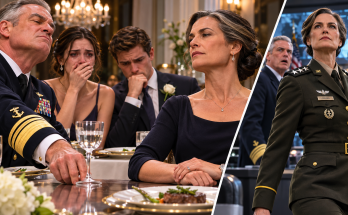
For a moment, I thought about the last time Richard had seen me enter a formal military room.
He had been seated at a conference table.
He had watched me walk toward the chair reserved for the presiding officer.
He had recognized the woman he insulted.
And he had realized how badly he had misjudged me.
That moment had embarrassed him.
But it had never been the moment I wanted to remember.
I preferred this one.
An auditorium filled with people being honored for service.
Families watching proudly.
Young officers listening.
People from different branches gathered for a common purpose.
I rested my hands on the podium.
Then I looked at the audience.
"Good morning."
The room settled.
I thanked those attending.
Then I began speaking about the years I had spent in the Army.
More than three decades.
I had served with people whose lives were very different from mine.
Some came from families with money.
Others had grown up facing difficulties I could only partly understand.
Some had parents, spouses, children, and relatives waiting for them at home.
Others returned from assignments without anyone waiting at the door.
Their circumstances varied.
Their experiences varied.
Their opportunities before joining the military had not been the same.
But none of those differences determined whether they deserved dignity.
I looked across the audience.
"I've learned that the person standing in front of us is never fully explained by the circumstances we can see."
Several people were listening closely.
I continued.
"A uniform tells us something about someone's service. It doesn't tell us everything about their life."
I thought about Richard.
About the assumptions he had made when he saw my simple dress.
He had believed he understood my worth before he understood anything meaningful about me.
I didn't mention him.
I didn't need to.
The lesson belonged to everyone.
Including me.
I continued.
"Some of the finest people I've served with came from homes where very little was easy."
I paused.
"Others grew up with opportunities many people never receive."
I looked toward the younger officers.
"Those differences didn't decide who could become a good leader."
I let the words settle.
"Character did."
The room remained quiet.
I spoke about responsibility.
About listening.
About treating people fairly even when they lacked the authority to challenge a decision.
I reminded the audience that leadership wasn't an opportunity to make other people feel small.
It was a responsibility to help them perform at their best.
I had seen the difference.
I had worked with officers who believed fear was the easiest way to obtain obedience.
Sometimes they got obedience.
But they rarely earned trust.
People became careful around them.
They avoided bringing bad news.
They tried to guess what the officer wanted to hear.
And problems grew because nobody felt safe speaking honestly.
I had also worked with leaders who listened.
People who could give a difficult order without humiliating anyone.
People who accepted responsibility when something went wrong.
People who treated junior personnel with the same seriousness they gave senior commanders.
Those were the leaders I remembered with respect.
Those were the examples I wanted younger officers to follow.
I looked at the audience.
"Authority should make us more responsible for our conduct, not less."
I paused.
"If we need someone to feel worthless before we can feel important, we've misunderstood what leadership is."
I could see a few people nod.
I continued.
"A person's value isn't determined by their money."
Another pause.
"Or their family circumstances."
I thought of Olivia.
Of the dinner.
Of the way Richard had judged my life as a single mother.
I kept my voice steady.
"Or the title written before their name."
The auditorium was still.
I wanted the people listening to understand that this wasn't an abstract idea.
It affected everyday choices.
The way an officer spoke to someone cleaning an office.
The attention given to a junior soldier who raised a concern.
The courtesy shown to a civilian employee.
The respect offered to someone who had no influence over promotions or assignments.
Those moments mattered.
They revealed what a person believed about authority.
I told the audience to treat the person responsible for cleaning their workspace with dignity.
I told them to listen when a junior service member brought forward a concern.
I reminded them that the person with the least power in a room was often the person most affected by the conduct of those above them.
I wanted those words to be remembered.
Not because they were impressive.
Because they were practical.
Any officer could apply them.
Any leader could choose to listen.
Any person could decide not to humiliate someone simply because they believed there would be no consequences.
I thought about how different Friday's dinner might have been if Richard had understood that.
He could have asked me about my life.
He could have welcomed me as Olivia's mother.
He could have treated the evening as an opportunity to know the family his son hoped to join.
Instead, he had chosen judgment.
And that choice had helped destroy the future our children had planned.
I didn't say any of that aloud.
The ceremony wasn't about my family.
It was about recognizing service.
But the lesson was the same.
Respect couldn't depend on whether someone could benefit us.
It had to be part of how we treated people.
I continued speaking.
I told the younger officers that they would eventually face moments when their decisions affected people who couldn't easily challenge them.
In those moments, their character would matter more than their confidence.
It would matter whether they listened.
Whether they remained fair.
Whether they could admit a mistake.
Whether they remembered that authority was entrusted to them for a purpose.
I looked toward the front rows.
"Don't confuse being obeyed with being respected."
The room was quiet.
"People may follow an instruction because they must."
I paused.
"But the trust they place in you has to be earned."
I thought about my own career.
The mistakes I had made.
The lessons I had learned.
The people who had trusted me with responsibilities I sometimes found overwhelming.
I knew I had not been a perfect leader.
No one was.
But I had tried to recognize when I was wrong.
I had tried to remember that my rank didn't make my feelings more important than anyone else's.
And I had tried to carry those principles home.
I hoped Olivia had seen them.
Not always perfectly.
But often enough to understand what I believed.
I looked across the room again.
"One day, every one of us will stop wearing the uniform."
I let that thought remain for a moment.
"Our positions will pass to other people."
I glanced toward the older veterans.
"Some of the people here already know what that feels like."
A few smiled.
I continued.
"But the way we've treated others won't disappear when our assignments end."
I thought about the soldier's letter.
The folded paper in the wooden box.
His gratitude for being treated as more than another name on a list.
That memory had remained with me for years.
It had taught me something more valuable than another title.
I wanted the audience to understand.
"People will remember whether you made them feel capable."
I paused.
"Whether you listened when they needed help."
Another pause.
"And whether you treated them with dignity when you had the authority to do otherwise."
I looked toward the young officers again.
"That is the kind of leadership worth carrying forward."
I finished my remarks.
For a moment, the room was still.
Then the applause began.
It grew across the auditorium.
I stepped back from the podium.
I had spoken at many ceremonies.
I was accustomed to applause.
But that morning, I felt something different.
I wasn't thinking about my rank.
I wasn't thinking about how the audience would describe my speech.
I was thinking about Olivia.
I hoped she had heard what I wanted her to hear.
I hoped she understood that the values I had tried to teach her weren't simply advice given by a worried mother after a painful dinner.
They were principles I had spent my career learning to live by.
As I returned toward my seat, I saw her.
She was standing near the aisle.
Her eyes were bright.
For a moment, I thought she might be crying.
Then she smiled.
She moved her lips without making a sound.
I understood the words.
She was proud of me.
I smiled back.
There were people applauding around us.
There were officers waiting for the ceremony to continue.
There were responsibilities I would return to when the event was over.
But for that moment, none of them seemed as important as my daughter's expression.
She had been hurt deeply two months earlier.
She had lost a future she wanted.
She had spent weeks learning how to move forward.
Now she was standing in an auditorium, watching her mother speak about the importance of human dignity.
And she looked proud.
Not because I had three stars.
Not because a Navy captain had discovered I outranked him.
Because she understood what I believed those stars should represent.
I took my seat.
The ceremony continued.
More people were recognized.
Families applauded.
The auditorium returned to the purpose that had brought everyone together.
I remained attentive.
But the image of Olivia near the aisle stayed with me.
I remembered her as a little girl.
I remembered the graduation I had missed.
I remembered the call I made from overseas.
I remembered the young woman crying in my car after Friday's dinner.
And now I remembered her standing in that auditorium.
Smiling.
Proud.
Beginning to believe in herself again.
I had worked thirty years to earn the responsibility represented by my uniform.
But seeing that expression on my daughter's face made me understand something I had known for a long time.
The greatest recognition I could receive wasn't always the kind announced from a podium.
Sometimes it was the quiet approval of someone whose life had been shaped by my choices.
And on that Saturday morning, my daughter gave me that gift.