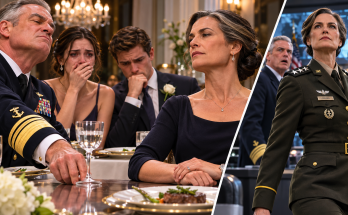
Two months after that Friday dinner, I received an invitation that made me think about everything Olivia and I had been through.
It was for a military leadership recognition ceremony at Fort Meade.
I had attended many events like it during my career.
Some were formal occasions with senior commanders.
Others were smaller gatherings where the people being recognized were surrounded by their families.
I had always valued those ceremonies.
Not because I enjoyed standing in front of an audience.
Not because I needed another occasion to wear my dress uniform.
I valued them because they gave us an opportunity to acknowledge people whose work deserved attention.
People who had served with integrity.
People who had accepted difficult responsibilities.
People who had demonstrated leadership without making themselves the center of everything.
That last quality had become especially important to me.
I looked over the invitation at my desk.
The ceremony would recognize officers and enlisted personnel from several branches of the military.
I had been asked to deliver a short address.
The event was scheduled for Saturday morning.
I checked my calendar.
There was no conflict.
I accepted.
Then I placed the invitation beside the documents I had been reviewing.
For a while, I returned to work.
But later that afternoon, I found myself thinking about the speech.
Leadership.
Integrity.
Service.
Those were familiar words.
I had heard them throughout my career.
I had used them myself.
But I knew how easily familiar words could become meaningless if the person speaking them didn't live by them.
Richard Whitmore had reminded me of that.
On Friday evening, he had spoken with the confidence of a man who believed his rank made him important.
He had expected me to accept his judgment.
He had treated my family situation as something inferior to his own.
Then he discovered I was a lieutenant general.
His entire manner changed.
At first, he had seemed frightened by the professional implications.
Later, he began to acknowledge that his treatment of me had been wrong regardless of my position.
I hoped that understanding would last.
But it wasn't my responsibility to make sure it did.
I had my own standards to uphold.
And I had a daughter who was learning to build a future different from the one she had planned.
By then, Olivia had been living with the canceled engagement for several weeks.
She had returned Ethan's belongings.
She had dealt with the remaining wedding arrangements.
She had thrown herself back into her career as a financial analyst.
I could see that she was recovering.
Slowly.
Not perfectly.
But genuinely.
Some days, she talked easily about work.
Other days, she became quiet when something reminded her of Ethan.
I didn't ask her to pretend those memories had stopped hurting.
She had loved him.
Three years didn't disappear because one difficult week revealed problems she could no longer ignore.
There had been good moments.
She remembered them.
I knew she did.
But she was no longer using those memories to explain away the choices that had hurt her.
That was the change I noticed most.
She had stopped asking whether Ethan might eventually become the husband she needed.
She had begun asking what kind of life she wanted for herself.
I thought that was healthier.
And I was proud of her for reaching that point without allowing me to make the decision for her.
That evening, I told Olivia about the invitation.
We were sitting together at home.
She had come by after work.
The conversation had been ordinary until I mentioned the ceremony.
"I've been asked to speak at Fort Meade on Saturday."
She looked up.
"Another meeting?"
"No. A recognition ceremony."
She smiled.
"What are they recognizing?"
"Leadership, service, and professional conduct."
She looked interested.
"Are you getting an award?"
I laughed softly.
"No, sweetheart. I'm giving the address."
She leaned back.
"That sounds important."
"It is important to the people being recognized."
She thought for a moment.
Then she asked whether she could attend.
I looked at her.
"Of course."
Her face brightened.
I hadn't expected her to be quite so eager.
For years, I had kept much of my professional life separate from our family life.
She knew I served the government.
She knew I traveled.
She knew there were things connected to my work I couldn't always discuss.
But she hadn't understood the level of responsibility I carried.
Now she was curious.
Ever since the morning she discovered my rank, she had been asking more questions.
Not intrusive questions.
Not questions about matters I couldn't explain.
She wanted to understand the life I had lived beyond the walls of our home.
I was glad.
There was something comforting about no longer feeling that the two parts of my life had to remain completely separate.
Olivia looked at me again.
"Could I bring someone?"
"Certainly."
She smiled.
"I have a friend I'd like you to meet."
I raised my eyebrows.
"Oh?"
She laughed.
"Don't start, Mom."
I smiled.
"I haven't said anything."
"You're making that face."
"What face?"
"The one where you're curious but pretending you're not."
I laughed.
She had known me long enough to recognize it.
I didn't press her.
She had asked to bring a friend.
That was enough.
I wanted her to feel comfortable attending.
I wanted her to see the people I worked with.
And I wanted her to understand that my rank was only one part of what happened during a military ceremony.
There would be families.
Officers.
Enlisted personnel.
People being thanked for work that often went unnoticed outside their units.
The event wasn't about me.
I hoped she would see that too.
After Olivia left, I returned to the invitation.
I read the description of the ceremony again.
The words were familiar.
Integrity.
Leadership.
Service.
I thought about the wooden box Olivia had found in my closet.
The photographs.
The medals.
The commendations.
And especially the letter from the young soldier who had written to thank me for treating him as a person.
That letter had remained with me longer than many official documents.
It had reminded me that people remembered how they were treated.
Not only what orders they received.
Not only what assignments they completed.
They remembered whether someone had listened when they needed help.
They remembered whether a superior officer had made them feel capable or insignificant.
They remembered whether authority had been used carefully.
I wanted those ideas reflected in my speech.
Not because of Richard.
Because they were the principles I believed in.
I began making notes.
I didn't want the address to sound complicated.
The people in the auditorium didn't need an elaborate explanation of leadership theory.
They understood responsibility.
Many had lived through difficult assignments.
Some had spent years learning to lead others.
They deserved words that were clear.
Honest.
Useful.
I thought about the different people I had commanded.
Some came from comfortable families.
Others had grown up with very little.
Some had large families waiting at home.
Others returned from assignments to empty houses.
Some carried responsibilities that nobody around them fully understood.
But when they put on the uniform, they were all entitled to be treated with dignity.
Their backgrounds didn't determine whether they deserved respect.
Their financial circumstances didn't determine whether they were worth listening to.
And their rank didn't determine their value as human beings.
That was the message I wanted to deliver.
I wrote a few sentences.
Then I crossed out words that sounded too formal.
I had never liked speeches that seemed designed to impress the person giving them.
I wanted people to understand what I meant.
I wanted them to take something useful away from the ceremony.
And I wanted the young officers in attendance to remember that the authority they might hold one day would come with obligations.
Not privileges to humiliate people.
Obligations.
I thought about the wineglass Richard had pushed toward me.
I could still picture it moving across the table.
Such a small gesture.
Yet it had revealed how he saw me.
He believed I was someone who could be ordered around because he had decided my circumstances placed me beneath him.
He had made that judgment without knowing anything about my professional life.
When he discovered my rank, he became embarrassed.
But the problem had never been the difference between our positions.
The problem was the belief that one person's worth could be measured that way.
I didn't want to mention the dinner in my speech.
That would have been inappropriate.
The ceremony was meant to honor people who had demonstrated good leadership.
It was not a place to settle a family disagreement.
But I could speak about the principles the incident had brought into sharper focus.
I could remind the audience that a uniform was a symbol of service.
I could talk about dignity.
I could explain why genuine authority required humility.
Those were professional lessons.
They belonged in that room.
Over the following days, I continued preparing.
My regular work remained demanding.
There were reports.
Meetings.
Decisions requiring attention.
I didn't spend every hour thinking about the ceremony.
But when I had time, I returned to the address.
I read it aloud.
I removed anything that sounded unnecessarily grand.
I wanted the words to feel like something I would say to a young officer sitting across from me.
Someone beginning a career.
Someone still learning what responsibility meant.
I remembered how I had thought about success when I was younger.
I had wanted to work hard.
I had wanted to earn promotions.
I had wanted to prove that I could handle difficult assignments.
Those ambitions weren't wrong.
But they were incomplete.
I had learned that the people working beside you mattered as much as the position you held.
Perhaps more.
Because one day the position would belong to someone else.
The people you had affected would still remember you.
That was why the soldier's letter mattered.
And that was why I kept returning to it in my thoughts.
I wondered whether Olivia had understood just how much that letter meant to me.
She had read it carefully.
She had asked questions.
She had recognized that the soldier remembered kindness rather than rank.
I was grateful for that.
Her understanding had arrived at a difficult moment in her life.
But perhaps it would help her recognize good character in the future.
I hoped so.
As Saturday approached, Olivia seemed increasingly interested in attending.
She asked what the ceremony would be like.
I explained that several branches would be represented.
There would be awards.
There would be remarks from the people responsible for the event.
And there would be families in the audience.
She asked whether I would be nervous.
I smiled.
"Not particularly."
She laughed.
"Of course you wouldn't be."
I looked at her.
"I've spoken to groups before."
"I know, Mom."
She paused.
"I'm still getting used to knowing what you actually do."
That made me laugh.
I understood.
For years, she had imagined me working in a government office.
That wasn't entirely wrong.
I did work in offices.
But she hadn't known how many people depended on the decisions made there.
She hadn't known the rank I carried.
She hadn't known how many responsibilities were connected to my assignments.
Now she was discovering those things one piece at a time.
I didn't mind her surprise.
I had created much of it by keeping my work private.
What mattered was that she was interested.
And that she wasn't allowing the revelation to change our relationship.
At home, I was still her mother.
I still worried whether she was eating properly.
I still listened when she wanted to talk.
I still remembered the little girl who once tried to bake a birthday cake and confused salt with sugar.
Those memories mattered more to me than the formal ceremonies.
They belonged to us.
The night before the event, I checked my uniform.
Everything was ready.
The three stars rested where they belonged.
I looked at them for a moment.
I had worn them at the meeting where Richard first recognized me.
I would wear them again on Saturday.
But the circumstances were completely different.
Monday's briefing had been about readiness and professional responsibilities.
Saturday's ceremony would be about recognizing people who had demonstrated service and integrity.
I preferred thinking about the latter.
There was something hopeful about honoring good conduct.
It reminded younger service members that leadership could be measured by more than position.
It gave families an opportunity to see their loved ones recognized.
And it allowed people who had worked quietly to know that their efforts mattered.
I placed my notes beside the invitation.
Then I thought about Olivia.
She had once planned to marry a man who couldn't challenge his father's disrespect.
Now she was preparing to attend a ceremony where I would speak about the responsibilities of leadership.
I hoped she would enjoy it.
I hoped she would feel proud.
Not because I outranked Richard.
Not because I could stand at a podium while others listened.
Because she would see that the values I had tried to teach her at home were the same values I believed should guide my work.
That mattered to me.
I didn't want to be one person in uniform and another person without it.
I had known officers who struggled with that distinction.
They were disciplined in public but careless with those closest to them.
They demanded respect at work but forgot to give it at home.
I had never wanted to become that kind of leader.
I knew I wasn't perfect.
I had made mistakes.
I had missed important moments in Olivia's childhood.
I had sometimes been exhausted when she needed more of my attention.
But I had tried to remain the same person.
The same woman who believed people mattered before titles.
And after them.
On Saturday morning, I arrived at Fort Meade early.
The auditorium was already being prepared.
Military personnel were gathering.
Families were arriving.
Officers greeted one another.
The room had the quiet energy of an event that meant something to the people attending.
I made my way toward the front.
Several officers greeted me by rank.
I returned their greetings.
Then I looked across the auditorium.
I saw young soldiers sitting near their parents.
I saw spouses talking quietly.
I saw veterans wearing decorations earned many years earlier.
It reminded me why I had accepted the invitation.
These were the people whose service deserved recognition.
I took my place near the podium.
Then I noticed a familiar Navy uniform near the back of the room.
Richard Whitmore.
He was standing among the attendees.
For a moment, our eyes met.
He gave a respectful nod.
I returned it.
Nothing more.
There was no reason for either of us to revisit Friday's dinner.
Not here.
Not during an event meant to recognize the good work of others.
I turned my attention back toward the stage.
The ceremony was about to begin.
And I was ready to speak about the kind of leadership I believed every uniform should represent.