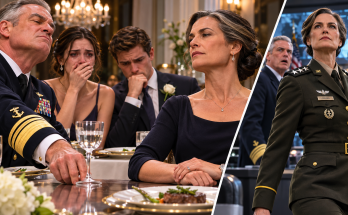
The ceremony ended with people standing to congratulate the honorees.
Families moved through the auditorium.
Officers spoke with one another.
Some of the recipients were surrounded by relatives taking photographs.
Others were talking quietly with colleagues.
The atmosphere was warm.
There was a sense of relief that comes when a formal event has gone well.
I remained near the front for a while.
Several officers approached.
They thanked me for the address.
Some wanted to discuss the leadership themes I had mentioned.
Others simply offered polite greetings before returning to their families.
I appreciated their words.
But I was looking forward to finding Olivia.
I had seen her standing near the aisle after my speech.
Her expression had stayed with me.
I wanted to speak with her.
I wanted to ask whether she had enjoyed the ceremony.
And I wanted to meet the friend she had brought.
But first, there were people waiting to speak with me.
I had learned not to rush those conversations.
A formal event might be an ordinary part of my schedule.
For someone receiving recognition, it could be one of the most meaningful days of their career.
I wanted to give those moments the attention they deserved.
I spoke with several officers.
I congratulated people whose work had been recognized.
I listened as one person described how much the event meant to the family members who had attended.
Then I noticed Richard Whitmore approaching.
He was still wearing his Navy uniform.
He moved carefully through the people standing nearby.
When he reached me, he stopped.
"General Hayes?"
I turned.
"Captain Whitmore."
He stood straight.
His expression was serious.
But it was different from the expression I had seen after Monday's briefing two months earlier.
Back then, he had looked frightened.
He had discovered that the woman he insulted was senior to him.
He seemed deeply concerned about the consequences.
Now he appeared uncomfortable for another reason.
He seemed to be thinking carefully about what he wanted to say.
"May I speak with you for a moment?"
I looked at him.
"Go ahead."
He glanced toward the podium.
Then he looked back at me.
"I listened to your remarks."
I nodded.
"Thank you for attending."
He took a breath.
For a moment, he seemed uncertain where to begin.
I waited.
There was no need to make the conversation harder.
But there was also no reason to supply his words for him.
He had approached me.
He knew what he wanted to discuss.
Finally, he spoke.
He said the speech had made him think about his own approach to leadership.
He had spent many years in the Navy.
He had worked hard for his position.
And somewhere along the way, he had begun believing that rank itself should command respect.
He looked down briefly.
"I think I confused my authority with my value."
I studied him.
That was different from what he had said at Fort Meade.
During our first private conversation, he had apologized because he didn't know who I was.
He had been shaken by the discovery of my rank.
His concern had centered on having offended someone who held greater authority.
Now he was talking about the belief behind his behavior.
I listened.
Richard continued.
He told me he had spent time considering what happened at dinner.
At first, he had been embarrassed because he had insulted someone senior to him.
That was how he had understood the problem.
He feared the professional implications.
He worried about his reputation.
He wanted to make sure his career would not be damaged.
I remembered.
He had asked me about those things.
More than once.
I had answered him.
His professional future would be determined through the proper process.
I wasn't going to use my position against him.
But I had also told him that his behavior would have been unacceptable regardless of my profession.
Now he seemed to have returned to that question.
He looked directly at me.
"The mistake wasn't that I failed to recognize your rank."
I remained silent.
"It was that I thought I could speak to someone that way in the first place."
I nodded slowly.
"That's an important difference, Captain."
He looked relieved that I understood what he meant.
But I didn't want him to think one sentence settled everything.
He had caused real hurt.
My daughter had ended her engagement.
His own son had been forced to face the consequences of choosing silence.
And his wife had gone to Olivia's apartment trying to preserve a wedding that was no longer right for either of them.
One apology couldn't undo all of that.
Richard seemed to understand.
He didn't ask me to excuse him.
He didn't ask whether I could change Olivia's mind.
He continued speaking about his own behavior.
He admitted that he had believed people should show him respect because of his rank.
He had grown comfortable with being obeyed.
He had sometimes forgotten that the people around him had their own dignity.
And he had carried that attitude into his home.
I thought about the dinner.
The way he had spoken from the head of the table.
The way everyone seemed to adjust to his moods.
The way Ethan had remained silent while his father insulted me.
Richard's admission didn't surprise me.
But hearing him say it himself mattered.
He had begun to recognize something I couldn't force him to see.
The problem wasn't simply one rude comment.
It was a way of thinking.
A belief that authority made other people less important.
I had seen versions of that belief during my career.
Sometimes it appeared in obvious ways.
A senior officer speaking harshly to someone who couldn't answer back.
A leader dismissing concerns because the person raising them held a lower rank.
Someone treating civilian employees as though their work made them less worthy of consideration.
Other times, it appeared in smaller habits.
Interrupting people.
Ignoring questions.
Assuming that disagreement was disrespect.
Those things could become normal if no one challenged them.
And once they became normal, they could damage an entire organization.
I had always believed that leadership required constant attention to those habits.
Richard was beginning to understand why.
He told me he had spoken with his leadership about improving his approach.
He had attended development sessions.
He had requested feedback from supervisors.
Colonel Brooks had mentioned some of those things weeks earlier.
I had not asked for details.
I had considered Richard's professional development his responsibility.
Now he was telling me directly.
I listened.
He didn't present the sessions as proof that everything was fixed.
He didn't ask for praise.
He simply explained that he had begun trying to change.
"I know I can't make Friday disappear," he said.
I nodded.
"No, Captain. You can't."
He looked down.
"But I don't want to keep behaving like that."
I considered his words.
They sounded sincere.
Still, sincerity wasn't something I could measure in one conversation.
Change would have to appear in his daily conduct.
In the way he treated people.
In the way he responded when someone challenged him.
In the way he behaved when there was no senior officer watching.
I told him so.
"An apology means more when your behavior begins to match it."
He nodded.
"I understand."
I hoped he did.
I wanted to believe people could learn.
I had spent much of my career helping others develop into better leaders.
If I believed one failure permanently defined a person, I would have been unable to do that work fairly.
People made mistakes.
Some mistakes were serious.
Some caused lasting harm.
But responsibility also meant recognizing the possibility of change.
Not pretending the harm hadn't happened.
Not demanding forgiveness.
Simply accepting that a person could choose to act differently in the future.
Richard appeared to be trying.
I could acknowledge that without erasing what happened.
He glanced toward the people moving through the auditorium.
Then he looked back at me.
"There is something else I should have said."
I waited.
He spoke about Olivia.
He admitted that his behavior at dinner had placed her in a painful position.
She had come hoping to join his family.
Instead, she had watched him disrespect her mother.
And she had been forced to see how Ethan responded.
Richard's voice became quieter.
"I treated your daughter badly too."
I looked at him.
He continued.
"Not only because I insulted you."
He paused.
"Because I made her feel she had to accept it if she wanted to belong in our family."
That was closer to the truth.
I thought about Olivia standing beside me after Richard's visit to our house.
She had told him Ethan was responsible for his own silence.
She had refused to let Richard excuse his son.
Now Richard seemed to understand that his behavior had affected both of them.
I nodded.
"She was deeply hurt."
He looked down.
"I know."
I considered whether to say more.
There were things I wanted him to understand.
But Olivia's feelings belonged to her.
I didn't want to speak as though I could decide what she would forgive.
Or whether she wanted any further contact with him.
He had already apologized to me.
Now he seemed to want to acknowledge his responsibility toward her.
Richard looked across the auditorium.
"Is Olivia here today?"
I followed his gaze.
I could see her standing several feet away.
She was watching us.
I didn't know how much of the conversation she had heard.
But she seemed to understand what was happening.
"Yes," I said.
Richard hesitated.
"Would she be willing to hear an apology from me?"
I looked at him.
I understood why he asked.
He was trying to address the person who had been hurt.
That was reasonable.
But I wasn't going to decide for my daughter.
Not now.
Not after everything she had done to reclaim her own voice.
I turned slightly toward Olivia.
She was still watching us.
Then I looked back at Richard.
"That's something Olivia will have to decide."
He nodded.
I continued.
"I won't answer for her."
Richard accepted that.
There was no argument.
No attempt to persuade me.
He simply looked toward my daughter.
I wondered what she would do.
Two months earlier, she had sat at his dining table waiting for Ethan to defend me.
Then she had listened while Richard apologized at our house.
Later, she had ended her engagement and faced Patricia's request to reconsider.
Now she was standing in a military auditorium.
She had heard me speak about dignity.
She had watched officers and enlisted personnel receive recognition.
And the man who had caused so much pain wanted to apologize directly to her.
I knew she might refuse.
She had every right.
She might listen.
She might thank him without forgiving everything.
She might decide she didn't want to discuss the past at all.
Whatever she chose, I would respect it.
Richard took a small step toward her.
Then he stopped.
He looked back at me.
"Thank you for hearing me, General."
I nodded.
"Captain."
There was nothing else I needed to say.
I had listened.
I had acknowledged his effort to understand.
And I had reminded him that change required action.
The rest belonged to him.
He turned toward Olivia.
I watched him approach.
For a moment, I remembered the gift bag he had carried into my living room.
He had wanted to make amends.
But he had still been concerned about his position.
Now he carried nothing.
No gift.
No request for professional reassurance.
No attempt to convince me that the incident had been misunderstood.
He was simply going to speak to the young woman whose life had been changed by his conduct.
I hoped he would do it honestly.
I hoped he would listen if she had something to say.
And I hoped he wouldn't confuse her willingness to hear an apology with an obligation to restore what had been lost.
I stood where I was.
Olivia saw him coming.
She didn't move away.
She looked at him calmly.
Richard stopped in front of her.
He addressed her by name.
And I watched my daughter prepare to answer a man she no longer needed to impress.