The envelope arrived on a Friday afternoon.
I remember that much clearly.
I was at my office.
The day had been ordinary.
There were client documents to review.
There were questions to answer.
There was work waiting for me.
Nothing about the afternoon suggested that my past was about to appear on my desk.
Then I noticed the envelope.
There was no return address.
I looked at it for a moment.
I had learned to be cautious with unexpected mail.
After the Harrington investigation, I didn't assume that every envelope contained something harmless.
I remembered Charles standing outside my house.
The stranger beside him had been holding a thick envelope.
I never learned what was inside it.
But the memory had stayed with me.
Now I had another envelope in front of me.
This one was simple.
There was nothing about it that explained who had sent it.
I opened it.
Inside was a photograph.
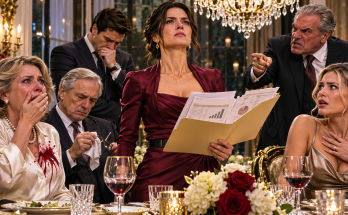
I recognized the room before I fully understood the picture.
Charles's dining room.
The chandelier.
The table.
The formal setting I had tried so hard to tolerate for years.
Then I saw my mother.
She was looking down.
My father was beside her.
He was cleaning his glasses.
And I was standing behind them.
My face was turned toward Daniel.
I stopped breathing for a moment.
Someone had taken the picture immediately after the wine was thrown.
I hadn't known anyone had captured that moment.
I had lived it.
I had remembered it.
I had replayed it more times than I wanted to admit.
But seeing it printed on paper was different.
There was my mother's white blouse.
There was the evidence of what had happened.
There was Dad with his glasses.
And there I was.
Standing close enough to help.
Looking toward the man who should have been standing beside me.
I placed the photograph on the desk.
For a while, I couldn't take my eyes off it.
I remembered the sound of the dining room.
The movement around the table.
The way Madison acted as though she could humiliate my parents without consequences.
The way Charles tried to control what happened afterward.
The way Daniel looked away.
All of it came back.
Not as a distant story.
As something I could still feel.
I remembered the tightness in my chest.
I remembered wondering how many more times I would allow that family to make my parents feel unwelcome.
I remembered the phone in my hand.
The five-minute timer.
I remembered making a decision that frightened me.
I was no longer going to keep the peace by sacrificing the dignity of people who had done nothing wrong.
The photograph showed the moment before so much changed.
Before I opened the financial folder.
Before Charles learned that outside professionals were involved.
Before I told Daniel I had already consulted a divorce attorney.
Before the deleted accounting records.
Before Grant Ellison called.
Before the $1.85 million transfer raised questions about my husband.
Before the federal investigation revealed the scale of the transactions.
Before I took off my wedding ring.
Before the divorce papers.
And before I opened this office.
I stared at my father's face.
The photograph had caught him looking down at his glasses.
It was the image I had carried in my mind for so long.
At first, I had remembered it with shame.
I had believed it represented my failure to protect him.
Later, after our conversation in his backyard, I began to understand it differently.
Dad had been humiliated.
But he hadn't surrendered his dignity.
He had stayed calm.
He had stood beside me.
And when Charles threatened him, he had walked away without asking permission.
Now I could see that moment on paper.
It still hurt.
But it didn't mean what it once had.
I looked at Mom.
She was looking down.
I wished the photograph had been taken on a happier night.
I wished it showed her laughing.
I wished it showed Dad smiling beside her.
I wished I had a picture of that dinner where everyone behaved decently.
But that wasn't what happened.
And pretending otherwise had never helped us.
For years, I had tried to create a version of the Harrington family that didn't exist.
I had told myself they were difficult but loving.
Proud but generous.
Demanding but loyal.
I had believed that if I kept showing patience, eventually the good parts would become stronger than the cruelty.
The photograph didn't allow that story.
It showed what happened when Madison decided my parents were beneath her.
It showed what happened when Charles's family treated respect as something they could grant or withhold.
And it showed what happened when Daniel remained silent.
I wondered who had taken the picture.
Then I turned it over.
There was handwriting on the back.
Only a few words.
They said I had made the right decision by leaving.
I stared at the writing.
I knew it.
Daniel.
I recognized his handwriting.
I had seen it for eight years.
On ordinary notes.
On documents.
On the small things people leave for each other when they share a home.
I hadn't expected to see it again like this.
For a moment, I looked at the back of the photograph without moving.
There was no long letter.
No explanation.
No request for forgiveness.
No suggestion that I should call him.
Just those words.
An acknowledgment.
I turned the photograph over again.
There I was looking toward Daniel.
That detail hurt more now that I knew who had sent it.
At the time, I had looked at him because I expected him to act.
I wanted him to defend my parents.
I wanted him to say that Madison had gone too far.
I wanted him to tell Charles that his family's behavior was unacceptable.
I wanted to see the man I married choose to stand beside me.
But he hadn't.
He had looked down.
I had carried that moment into our final conversations.
At my lawyer's office, Daniel eventually admitted he had been wrong.
He said he should have asked more questions about his father's company.
He said he should have spoken up.
He acknowledged that protecting his family had cost him our marriage.
I believed his regret.
But believing it didn't change my decision.
Now he had sent a photograph of the night everything came apart.
He wasn't asking me to return.
He wasn't trying to argue about who was right.
He seemed to be acknowledging what I had lived through.
I sat down.
I didn't feel angry.
I didn't feel the urge to call him.
I didn't even feel surprised that he remembered the dinner.
Of course he remembered.
How could he not?
The anniversary dinner had changed both our lives.
It had led to the end of our marriage.
It had exposed financial questions that Harrington Group could no longer ignore.
It had forced Daniel to confront the consequences of his silence.
And it had given me the courage to stop waiting for things that never changed.
I looked at the handwriting again.
He believed I had been right to leave.
I had wanted to hear that from him during the last years of our marriage.
Not because I needed permission.
Because I had wanted him to understand why I was hurting.
I had wanted him to recognize that asking me to endure his family's behavior wasn't fair.
I had wanted him to see that loyalty didn't mean remaining silent while someone insulted people I loved.
Now he seemed to understand.
And I no longer needed him to.
That was a strange feeling.
For so long, I had measured the success of our conversations by whether Daniel finally understood me.
If he understood, perhaps he would change.
If he changed, perhaps the marriage would improve.
If the marriage improved, perhaps I wouldn't have to face the possibility of leaving.
I had built years of hope around that sequence.
But the marriage had ended.
I had opened my own firm.
I had begun living without Charles's approval.
And I had learned that Daniel's understanding, while meaningful, wasn't necessary for me to move forward.
I could appreciate the photograph without treating it as an invitation.
I could accept the message without responding.
I could remember the good parts of our marriage without deciding to rebuild it.
The envelope stayed on my desk for a while.
I returned to my work.
Then I looked at the photograph again.
I noticed how different my face looked.
Not because I had changed physically.
Because I knew what I had been feeling.
I was frightened.
I was angry.
I was exhausted.
I was finally close to doing something I had spent years avoiding.
I had been asking myself whether my marriage could survive if I stopped being the person who made every conflict easier.
The photograph caught me before I fully knew the answer.
I thought about the woman I was now.
A woman with a small office.
Three employees.
Clients who valued her work.
Parents who loved her without conditions.
A woman who no longer wore a wedding ring.
A woman who could hear the Harrington name without feeling obligated to defend it.
I wondered what that younger version of me would have thought if she could see this office.
Would she have been frightened?
Probably.
Would she have believed she could be happy after leaving Daniel?
I'm not sure.
At the time, I thought divorce would mean losing the life I had spent eight years building.
I hadn't understood that some things needed to end before other things could begin.
I picked up the photograph.
My mother was still looking down.
Dad was still cleaning his glasses.
I was still looking toward Daniel.
The image couldn't change.
That was important.
I couldn't go back and make Madison kinder.
I couldn't make Charles respect my parents.
I couldn't force Daniel to stand beside me.
And I couldn't undo the years I spent trying to protect a family that had never fully accepted me.
But I could decide what the photograph meant to me now.
I didn't have to keep looking at it as proof of failure.
I didn't have to destroy it to prove I had moved on.
I didn't have to display it where I would see it every day.
I could simply accept that the night happened.
That it mattered.
And that I had survived what came afterward.
I opened a drawer.
Then I placed the photograph inside.
I didn't tear it.
I didn't throw it away.
I didn't send it back.
I closed the drawer.
That was all.
For years, I had treated painful memories as problems that needed solutions.
I wanted apologies.
Explanations.
Proof that people understood what they had done.
I wanted the past to become something different before I could feel better about it.
But the past didn't change.
What changed was the amount of power I allowed it to have over my life.
Daniel's message didn't reopen our marriage.
It didn't create another chance.
It didn't ask me to forgive him again.
It simply acknowledged something I already knew.
I had been right to walk away.
I sat at my desk.
The office was quiet.
The curtains Mom had helped choose were in place.
Dad's bookshelves still leaned.
There were client documents waiting.
There were ordinary responsibilities that belonged to me.
And there was no Charles Harrington telling me what I was allowed to think.
I looked at the closed drawer.
The photograph was still there.
The dinner was still part of my history.
Daniel was still someone I had once loved.
But none of those things required me to stop living.
I returned to my work.
For the first time, the memory of that dining room felt like something behind me instead of something I was still trapped inside.
I didn't know then that I would see Daniel again.
I didn't know what our next conversation would sound like.
But I knew something I hadn't known when we married.
A relationship could end without every feeling disappearing.
And a memory could remain without becoming a reason to return.