I looked at Carol's name in Ruth's handwriting.
Then Jeanette's.
I had spent forty years hearing those names spoken inside the farmhouse.
Sometimes with affection.
Sometimes with worry.
Sometimes with the tired patience only a mother could have.
Now they were written at the top of a letter Ruth had prepared before she died.
I wondered how difficult it had been for her.
She loved her daughters.
I had never doubted that.
She remembered their birthdays.
She listened when they complained.
She gave them beautiful things.
She defended them when their behavior hurt other people.
And yet she had apparently reached a point where she believed they might challenge her final decisions.
I looked at Margaret.
“She really wanted them to hear this?”
Margaret nodded.
“Only if they questioned the estate arrangements.”
I glanced toward Daniel.
He was looking at the notebook.
His expression was serious.
I wondered what it felt like for him.
These were his sisters.
His mother.
His family.
And now he was sitting beside me while an attorney explained that Ruth had prepared a letter in case his sisters tried to overturn her wishes.
I felt sorry for him.
But I also remembered how often I had been the person asked to understand everyone else.
I couldn't make this easier by pretending nothing had happened.
Carol and Jeanette had already taken formal steps.
They had raised questions about Ruth's decisions.
That was the situation.
I looked down at the letter.
“May I read it?”
Margaret nodded.
“Of course.”
I unfolded the pages carefully.
The handwriting was familiar.
Ruth had written slowly.
I could see the uneven places.
But the words were clear.
She began by addressing her daughters with affection.
Not anger.
Not bitterness.
She acknowledged that they might be upset about the way she had arranged her estate.
She understood they had expected a different outcome.
I swallowed.
I could almost hear her voice.
Ruth had always spoken plainly.
If something displeased her, she didn't spend much time decorating the truth.
But she rarely raised her voice.
She preferred a few firm words.
I continued reading.
She knew Carol and Jeanette believed her property should be divided among her biological children.
She understood why they thought that way.
But she wanted them to understand something else.
The property had belonged to her.
The decisions were hers.
And she had the right to decide how the things she earned and preserved would be used.
I looked up from the page.
For years, I had heard Carol talk about the farmhouse as though she already owned it.
Jeanette had spoken about selling parcels of land.
Both women discussed what would happen after Ruth died.
But Ruth had still been alive.
She had still been living in that house.
She had still been looking out at the apple tree.
She had still been making jam in the kitchen.
I wondered how painful those conversations must have been for her.
I remembered one afternoon when Carol argued about selling the property.
Ruth had been sitting near the window.
She listened.
Then she said no.
Carol had continued explaining why selling would be sensible.
Ruth repeated herself.
“No.”
I had admired her stubbornness.
Now I understood there was more behind it.
She had fought to keep that farm in 1985.
My father had helped her.
She had spent decades maintaining it.
And her daughters were treating it as an asset waiting to be divided.
I looked down at the letter.
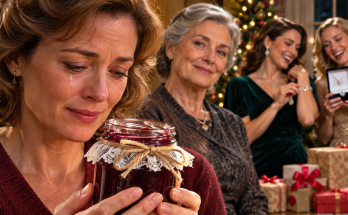
Ruth explained the Christmas presents.
I felt my throat tighten.
She wrote that Carol and Jeanette had always enjoyed jewelry.
They liked beautiful things.
They valued the feeling of receiving something expensive.
So she gave them jewelry.
But I appreciated homemade preserves.
I treated the jars carefully.
I kept them.
I never acted as though they were disappointing gifts.
So Ruth continued giving me jam.
I smiled through my tears.
It was such a simple explanation.
And such a painful one.
For forty years, we had all been looking at the same Christmas scene.
Carol and Jeanette saw proof that their mother valued them more.
I saw proof that I mattered less.
Ruth saw three women receiving gifts she believed suited them.
But she also saw something else.
She saw how her daughters behaved.
She saw their laughter.
She saw my silence.
And she understood more than any of us realized.
I kept reading.
Ruth wrote that she had never expected her daughters to show affection in exchange for expensive presents.
She hadn't wanted to buy their love.
She had wanted to make them happy.
But she had become troubled by how much importance they placed on what they received.
I thought about their visits.
How often they arrived talking about things they wanted.
How often they asked about the property.
How rarely they seemed interested in whether Ruth had eaten or slept well.
I had tried not to judge them.
They were busy.
They had lives.
But Ruth had noticed the difference.
She wrote about the times I came when she needed help.
The quiet visits.
The meals.
The afternoons when I stayed after everyone else left.
I felt embarrassed reading it.
Not because I regretted helping.
Because I had never wanted Ruth to keep a list of what I did.
I had never considered those things accomplishments.
They were ordinary acts of care.
But Ruth described them as important.
I remembered the kitchen after Christmas dinner.
The plates stacked beside the sink.
The damp towel in my hands.
Ruth standing beside me.
I remembered how she always told me to go home.
How I always insisted I was nearly finished.
I had never realized those evenings meant so much to her.
The letter continued.
She remembered the times I sat beside her when she was frightened.
I thought about her operation.
The hospital.
The way she tried to hide her worry.
I had stayed with her because I didn't want her alone.
I had assumed any daughter would have done the same.
But Ruth's words suggested she had often felt alone even while surrounded by family.
I wiped my face.
Daniel squeezed my hand.
I continued.
Ruth wrote about the anniversary of Arthur's death.
I stopped.
I remembered those days.
Every year, I thought about how difficult that date must be for her.
Arthur had been gone for many years.
But Ruth never forgot him.
I usually called.
Sometimes I asked whether she wanted company.
Sometimes she said no.
Sometimes she said yes.
When she wanted me there, I went.
We didn't always talk about Arthur.
Sometimes we drank tea.
Sometimes she told me a memory.
Sometimes we sat quietly.
I never made a big occasion of it.
I knew she didn't want that.
She only wanted someone to remember.
Now I read that Ruth had noticed those calls.
She compared them with the conversations she often had with Carol and Jeanette.
Her daughters asked about the property.
They wanted to know what would happen to the land.
They discussed money.
I called to ask whether she needed something to eat.
I covered my mouth.
I didn't feel proud.
I felt heartbroken.
Ruth had loved her daughters so deeply.
She had spent years hoping they would understand what she needed.
A visit.
A telephone call.
A little attention.
Not because she was helpless.
Because she was their mother.
I read the next portion slowly.
Ruth made clear that she loved all three of us.
Carol.
Jeanette.
And me.
She wasn't trying to erase her daughters.
She wasn't trying to punish them for disappointing her.
But she believed love and inheritance were separate matters.
She could love her children while making different financial decisions.
She could recognize my years of care without denying their place in her life.
I looked at Margaret.
“She didn't want them to think she stopped loving them.”
Margaret nodded.
“That is how I understand her words.”
I looked back at the letter.
Ruth wanted her daughters to respect her choices.
And if they couldn't accept those choices, she asked them not to turn their anger against me.
I stopped reading.
I stared at the sentence.
She had known.
She had understood exactly what Carol and Jeanette might do.
She had imagined them standing in my house.
Questioning me.
Accusing me.
Demanding to know how much money she left.
And she had tried to protect me from that.
I thought about the living room.
Carol's expensive coat.
Jeanette's crossed arms.
The fortieth jar on the coffee table.
I could still hear Carol asking how much money was involved.
I could still hear Jeanette accusing me of breaking the family apart.
I had stood there feeling as though I needed to defend myself.
But Ruth had already written the defense.
Not because I had demanded one.
Because she knew her daughters.
I folded the letter carefully.
Then I unfolded it again.
I wanted to read the final portion once more.
Ruth had expressed disappointment without cruelty.
She had acknowledged love without surrendering her decisions.
She had told her daughters the truth as she understood it.
I admired that.
I wished I had been able to do the same earlier in life.
For years, I had avoided difficult conversations.
I had told myself that silence was the kindest choice.
But Ruth's letter showed me something different.
A person could speak firmly without being unkind.
A person could refuse a demand without rejecting the person making it.
And a mother could love her children while telling them they were wrong.
I looked toward Daniel.
He was wiping his eyes.
I hadn't seen him cry much since Ruth's funeral.
He was a quiet man.
When grief came, he usually withdrew.
But the letter had reached him.
I touched his arm.
He looked at me.
“She loved them,” he said.
I nodded.
“I know.”
He looked down.
“She really did.”
“I know.”
For a moment, I thought he might say more.
But he couldn't.
I understood.
Ruth had not only left a message for Carol and Jeanette.
She had left Daniel with a difficult truth about his sisters.
He had spent years trying to keep everyone happy.
Now he had to accept that his mother had seen things he preferred not to confront.
I looked at Margaret.
“What happens to the letter?”
She explained that Ruth had directed how it should be used if her daughters challenged the estate.
The necessary legal steps would be handled properly.
The document would remain part of the record.
I nodded.
I didn't want to deliver it myself.
I didn't want to stand in front of Carol and Jeanette reading their mother's disappointment aloud.
That would turn something painful into a confrontation.
Ruth hadn't asked me to punish them.
She had asked me to respect her wishes.
I could do that.
I looked at the notebook again.
The blue cover.
The worn edges.
The pages filled with dates and memories.
I thought about how carefully Ruth had recorded her life.
Not just the money.
Not just the farm.
The things that mattered to her.
A woman staying to wash dishes.
A telephone call after an operation.
A repaired porch railing.
An anniversary remembered.
Forty jars of jam.
I had never considered those things important enough to write down.
Ruth had.
And because she had, I was finally beginning to understand what she valued.
I placed my hand on the notebook.
Margaret watched quietly.
Then she asked whether I wanted to take it home.
I nodded.
“Yes.”
I couldn't imagine leaving it behind.
It had been part of Ruth's life for decades.
Now she wanted me to have it.
I closed the cover gently.
I felt the roughness near the spine.
It wasn't an expensive object.
Carol and Jeanette might not have looked twice at it if they hadn't suspected it contained information about money.
But I knew what was inside.
My father's kindness.
Ruth's struggle to keep the farm.
Her memories of me.
Her disappointment in her daughters.
And her final explanation.
I held it against my chest.
For forty years, I had kept empty jars because I couldn't bear to throw away something Ruth made.
Now I had a book filled with evidence that she had been keeping pieces of our relationship, too.
I looked at Daniel.
He gave me a small smile.
I smiled back.
I was still grieving.
The family was still divided.
And the legal questions hadn't disappeared.
But I finally understood why Ruth wanted me to read the blue notebook.
She wasn't asking me to count what she had given me.
She was asking me to see what we had shared.