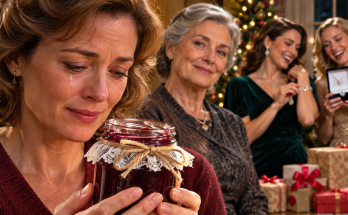
By our twentieth Christmas together, I had stopped expecting anything different.
Ruth would give me plum jam.
I would thank her.
And the jar would eventually join the others.
It was a simple routine.
So simple that nobody thought it deserved much attention.
Except me.
I couldn't explain why I kept the empty jars.
I had plenty of ordinary reasons to throw them away.
They took up space.
They collected dust.
Some of the lids became difficult to clean.
And as the years passed, finding somewhere to store them became a small problem.
But I never threw away a single one.
The original jar had stood beside our wedding photograph for years.
Then a second appeared.
Then a third.
Eventually, I moved them to the basement.
We had an old shelf near the laundry area.
It wasn't fancy.
The wood had marks from things that had once been stored there.
But it was dry and wide enough for my collection.
I arranged the jars in rows.
One beside another.
Each represented another Christmas spent with Ruth.
At first, I remembered which jar belonged to which year.
Then I began numbering the lids.
I thought it would help me keep them in order.
I liked knowing where everything belonged.
That may sound silly.
They were empty jam jars.
But I could stand in front of that shelf and remember family dinners, laughter, difficult conversations, and the sound of Ruth moving around her kitchen.
The jars held those memories for me.
Even after the jam was gone.
I never removed the lids completely when I cleaned the jars.
I simply washed the glass, rinsed around the top, and let everything dry.
It was the way I had always done it.
I never thought about what might be beneath the metal.
Why would I?
They were preserve jars.
Nothing more.
When Ruth needed surgery in 2005, I visited her regularly.
I remembered how much she disliked asking for help.
If I called ahead, she would tell me not to trouble myself.
If I arrived anyway, she would act as though she had expected me.
She never made a fuss.
That was her way.
One afternoon, I brought groceries.
I put the bags on her kitchen counter.
She looked through them.
“You brought too much.”
“You can use it.”
“I could have gone myself.”
“I know.”
She examined the vegetables.
Then she looked at me.
“Have you eaten?”
I shook my head.
She immediately started preparing something.
I tried to stop her.
“Ruth, please sit down. I'll take care of it.”
She waved me away.
“I can manage my own kitchen.”
I let her.
There were some arguments that weren't worth having.
I had learned that after twenty years.
Later, while we sat together, she asked about Daniel.
I told her he was fine.
She nodded.
Then she asked whether I still made use of the jam.
I smiled.
“Every jar.”
She looked pleased.
I assumed she was happy that I enjoyed her cooking.
I didn't see anything else in the question.
Now I wonder whether she was checking.
Whether she wanted to know what happened to the jars.
Whether she was quietly making certain that her plan was still working.
But at the time, all I heard was an older woman asking whether her homemade preserves were being appreciated.
And I was happy to reassure her.
By 2015, Ruth was moving more slowly.
The farmhouse needed repairs.
A porch railing had become loose.
I noticed it during one visit.
It moved when I touched it.
I told Ruth.
She dismissed it.
“It's been that way for a while.”
“That doesn't make it safe.”
“I've managed.”
I didn't argue.
I found a way to secure it.
She watched me work.
When I finished, she tested the railing.
Then she gave a small nod.
“That should hold.”
I laughed.
“I'm glad it meets your standards.”
She smiled.
It wasn't a big moment.
We didn't speak of it again.
But I remember how she stood on that porch after I finished.
Her hand rested on the railing.
She looked toward the red barn and the old apple tree.
That farmhouse had been the center of her life.
She had raised her children there.
She had worked through difficult years there.
And no matter how often Carol and Jeanette complained that the property should be sold, Ruth refused.
I heard those conversations many times.
Carol believed the land could bring in a great deal of money.
Jeanette thought it should be divided into smaller pieces.
Both women had opinions about what their mother should do.
Ruth would listen.
Then she would give the same answer.
“No.”
Sometimes Carol became impatient.
“Mom, you can't keep everything forever.”
Ruth would look at her.
“It's my property.”
Jeanette would try a softer approach.
“You could live somewhere much easier to manage.”
Ruth didn't change her mind.
She loved that land.
She knew every part of it.
And she had no intention of letting her daughters make decisions for her while she was still capable of making them herself.
I understood that.
I didn't always agree with how much work she insisted on doing.
But I understood why the house mattered.
I never asked her for money from the property.
I never suggested she should leave me anything.
I didn't consider it mine.
It was her home.
That was enough.
At Christmas that year, Ruth gave me another jar.
Thirty years.
Carol made a familiar remark.
Jeanette laughed.
And I smiled the way I always did.
I was fifty-four years old by then.
You would think I had grown too old to care about someone laughing at a Christmas gift.
But sometimes the things that hurt us are embarrassingly small.
A glance.
A joke.
The sound of two people sharing something that leaves you standing outside.
I felt it.
Then I put the feeling away.
I didn't want Daniel caught in another uncomfortable family situation.
He had spent years trying to keep peace between his mother and his sisters.
I had watched him go quiet whenever Carol became forceful.
I knew he loved them.
I knew he hated arguments.
And I didn't want to make him choose sides over a jar of jam.
So I said nothing.
Thirty-one jars followed thirty.
Then thirty-two.
The shelf slowly filled.
I cleaned it when I cleaned the basement.
I straightened the lids.
I wiped away the dust.
And every December, another jar arrived.
Ruth became more frail as the years passed.
Her movements slowed.
Her handwriting changed.
She sometimes needed more help than she wanted to admit.
But she still remembered my Christmas present.
She never forgot the jam.
Sometimes I thought it would have been easier for her to stop making it.
She was getting old.
Preparing preserves took effort.
But she insisted.
I offered to help her make it once.
She refused.
“That one's mine to do.”
I smiled.
“All right.”
I didn't question her.
There were things Ruth felt strongly about, and I had learned not to push.
But I remember thinking that her stubbornness was becoming difficult to understand.
Why would she go through so much work for something everyone treated like a joke?
I could have bought jam at the grocery store.
She knew that.
I knew that.
Still, every Christmas, there it was.
A glass jar.
Purple preserves.
A cloth-covered lid.
One more quiet thank-you from me.
In the final years of her life, Ruth spent more time dealing with health problems.
She was ninety-one when she died.
I had known her for four decades.
I had spent more of my adult life with her in it than without her.
That realization struck me after her death.
For so many years, I had thought of Ruth as Daniel's mother.
The woman whose approval I had once been afraid of losing.
The woman who gave me jam while her daughters received jewelry.
But grief made those old descriptions seem inadequate.
I missed her voice.
I missed her stubborn expressions.
I missed the way she insisted that she didn't need help and then quietly accepted it.
I missed sitting in her kitchen after everyone else had left.
And I missed the farmhouse.
The white porch.
The red barn.
The apple tree.
All of it.
Carol and Jeanette became heavily involved in sorting through Ruth's possessions.
They had strong opinions about what should be kept.
They also seemed determined to settle matters quickly.
I stayed out of their way.
I didn't want another disagreement.
Ruth was gone.
No amount of money or property could change that.
I had no interest in fighting over what she had left behind.
The last Christmas gift Ruth had arranged for me was the fortieth jar.
I remember holding it after her death.
It looked so much like all the others.
The familiar glass.
The dark jam.
The lid she had prepared so carefully.
For a long time, I couldn't bring myself to open it.
The thought of using the last jar made something inside me tighten.
There would never be another.
No next December.
No Ruth reaching across the room.
No familiar smile while everyone waited to see what I had received.
I put the jar beside the others.
Number forty.
Then I stood there looking at the shelf.
Forty years of Christmas presents.
Forty jars.
I felt ridiculous for crying over them.
They were only containers.
But I knew I would never receive another.
Eventually, I decided I couldn't leave the last jar untouched forever.
Ruth had made it to be used.
That was what I believed.
I brought it into the kitchen.
I placed it on the table.
For several minutes, I just looked at it.
Then I began opening it.
I was thinking about Ruth.
About the first Christmas.
About the secondhand dress I had worn.
About Carol's laughter.
I wasn't thinking about money.
I wasn't thinking about inheritance.
And I wasn't thinking about a secret.
But as I handled the final jar, I noticed something I had never paid attention to before.
There was more beneath the lid than I expected.
Something had been fitted carefully against the metal.
I stopped.
I turned the lid in my hands.
Then I reached for it again.
For the first time in forty years, I began examining the part of Ruth's gift I had always ignored.
And I realized that I had never truly looked inside the lids at all.