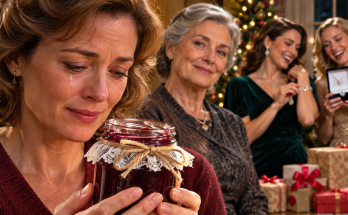
I used to believe my mother-in-law liked me less than her daughters.
I never said that out loud.
Not to my husband.
Not to my friends.
And certainly not to Ruth.
But for forty Christmases, I had watched the same little scene play out in her living room.
Carol would open something expensive.
Jeanette would unwrap something beautiful.
And I would receive a jar of homemade plum jam.
Every year.
Without fail.
I would smile, hold the glass jar in both hands, and tell Ruth how much I appreciated it.
Then I would bring it home and place it on a kitchen shelf.
I told myself that presents didn't matter.
I believed that, too.
At least I tried.
But after enough years, even a person who expected very little could begin wondering why she was always given the smallest thing.
My name is Linda Haddon.
I married Daniel Haddon in 1985, when I was twenty-four years old.
Daniel was kind, quiet, and uncomfortable whenever anyone in his family argued.
That last part mattered more than I understood when I married him.
His mother, Ruth, lived in an old farmhouse surrounded by land that had belonged to the family for years.
She made preserves in her kitchen.
She raised vegetables.
She kept herself busy with work that never seemed to end.
She was not a woman who wasted anything.
A cracked bowl could still hold fruit.
A worn towel could still clean a counter.
And an empty glass jar could be washed and used again.
I admired that about her.
I had grown up without much money myself.
My father, Thomas Bennett, worked as a mechanic.
He came home with dark grease beneath his fingernails and the kind of tiredness that made him sit quietly before supper.
He always made sure I had enough.
But there was rarely money left for luxuries.
By the time I married Daniel, my father had already been gone for five years.
I missed him terribly.
I missed having someone who could look at me across a room and know when I felt out of place.
And I felt out of place often during those first months with the Haddon family.
Carol, Daniel's older sister, was thirty-one.
She was married and lived in a house that looked as though everything inside had been chosen to impress somebody.
Jeanette was twenty-eight.
She was engaged and dressed carefully, even for ordinary family dinners.
I was twenty-four, newly married, and still learning how to feel comfortable around people who seemed to have more than I did.
I remember the first Christmas after our wedding.
December 1985.
I had chosen a secondhand dress because I couldn't justify buying something new for one family dinner.
I checked the seams before leaving home.
I brushed away a loose thread.
Then I asked Daniel whether I looked all right.
He smiled.
“Linda, you look lovely.”
I wanted to believe him.
When we arrived at Ruth's farmhouse, the living room was already filled with people.
Carol was talking about her house.
Jeanette was discussing preparations for her wedding.
Ruth moved between the kitchen and dining room, making sure everyone had enough food.
I offered to help.
She handed me a dish and asked me to set it on the table.
It was such a small thing.
But I remember feeling relieved.
At least I had something useful to do with my hands.
After dinner, we gathered around the Christmas tree.
Carol received jewelry.
Jeanette received jewelry, too.
Both women examined their presents carefully, holding them where the light could catch the metal.
Then Ruth reached beneath the tree.
She brought out a small package wrapped in ordinary paper.
“Linda, this one's yours.”
I thanked her before I even opened it.
Inside was a glass jar filled with deep purple plum jam.
A piece of cloth covered the lid.
Ruth had tied it neatly.
I held it carefully.
“Did you make this yourself?”
She nodded.
“From the plums I put up this season.”
I smiled.
“Thank you. I'll enjoy it.”
Carol laughed.
I glanced toward her.
She was holding her new jewelry against her wrist.
“Mom, you really gave Linda jam?”
Ruth looked at her.
“That's what I made.”
Jeanette smiled in a way that made me feel younger than I was.
“Well, at least she'll have something for breakfast.”
They laughed again.
I laughed a little, too.
That is the part I still dislike remembering.
I joined in because I didn't want anyone to think I was upset.
Daniel moved closer to me.
He didn't say anything.
Neither did Ruth.
I carried my jam home that evening.
When Daniel and I reached our kitchen, I put the jar on the shelf beside our wedding photograph.
The photograph had been taken only a few months earlier.
We looked so young.
Daniel was smiling straight at the camera.
I was leaning toward him, looking happier than I had ever expected to be.
I placed the jam beside it because the jar felt important to me.
Someone had made something with her own hands and given it to me.
That was how I chose to see it.
And for a while, that was enough.
I didn't open the jar immediately.
I wanted to save it.
Daniel noticed after several days.
“Are you going to eat that?”
“Eventually.”
He looked toward the shelf.
“Mom makes more every year.”
“I know.”
“Then why are you keeping it there?”
I touched the glass.
“It's the first thing she ever made just for me.”
Daniel smiled.
He didn't tease me.
He simply put his arm around my waist.
I had no idea that he later mentioned that conversation to his mother.
I had no reason to think it would matter.
Eventually, I opened the jar.
The jam was thick and sweet.
I spread it on bread in the mornings.
When it was empty, I washed the glass and returned it to the shelf.
I didn't want to throw away the first Christmas gift Ruth had given me.
That became a habit.
The next Christmas, Carol opened another expensive present.
Jeanette received something equally beautiful.
I received another jar.
Plum jam again.
The same dark color.
The same careful wrapping.
I thanked Ruth.
Carol made another joke.
I smiled.
And when we returned home, I placed the second jar beside the first.
I never stopped to ask myself why I was keeping them.
I liked looking at them.
They reminded me that I belonged to a family larger than the one I had grown up with.
Even if I sometimes felt like the least important person in it.
The years continued.
Ruth got older.
Daniel and I settled into our marriage.
Carol and Jeanette built lives of their own.
And Christmas followed the same familiar pattern.
Some years, Carol received gold.
Other years, Jeanette received pearls or another lovely piece of jewelry.
I watched them admire their presents.
Then Ruth would hand me my jar.
I always knew what was inside before removing the paper.
Sometimes Carol laughed before I had even finished opening it.
“Don't tell me. Plum jam again?”
Jeanette would smile.
“Mom certainly knows what Linda likes.”
The room would fill with laughter.
I would look down at the glass.
I would say thank you.
That was my part.
I had become very good at it.
I never asked Ruth why she bought expensive gifts for her daughters while giving me preserves.
I was not her daughter.
I told myself that was the answer.
Carol and Jeanette had grown up in that house.
They had known Ruth all their lives.
I had married into the family.
I shouldn't expect the same treatment.
Looking back, I wish I had been less willing to accept that explanation.
Not because I wanted jewelry.
I didn't.
But because I had allowed myself to believe that being treated differently meant I mattered less.
The truth was that I loved Ruth.
That never changed.
I visited her when Daniel was working.
I stayed after family meals to help clear the table.
I washed dishes while Carol and Jeanette gathered their coats.
Sometimes Ruth and I worked beside each other without speaking very much.
She would dry a plate.
I would put it away.
She would ask whether Daniel was doing well.
I would ask whether she needed anything.
Those were ordinary conversations.
Nothing dramatic happened.
There were no great speeches.
No emotional declarations.
Just a kitchen, a drying towel, and two women finishing the work after everyone else had gone.
I came to enjoy those quiet moments.
Ruth was easier to talk to when her daughters weren't there.
She could be stubborn.
She could be particular.
And she rarely explained herself unless she absolutely had to.
But she noticed things.
If I was tired, she would tell me to sit.
If I arrived without eating, she would put food in front of me.
If I offered to bring groceries, she would insist she needed nothing.
Then she would give me a short list.
I began to understand how to care for her without making her feel dependent.
That mattered as she grew older.
There were years when her daughters seemed too occupied to visit.
Carol had her own household.
Jeanette had responsibilities and plans.
They talked about appointments, purchases, and things that needed attention.
Ruth listened.
Then she went back to her work.
I tried not to judge them.
They were her daughters.
Their relationship with her had begun long before I arrived.
I didn't know everything that had happened between them.
But I knew what I saw.
I saw Ruth sitting alone after a difficult medical appointment.
I saw her trying to carry groceries when she should have been resting.
I saw her pretend not to mind when someone forgot to call.
And sometimes I saw her face change when the telephone rang.
She always hoped it might be one of her girls.
I noticed.
I didn't make speeches about it.
I simply visited when I could.
In 1995, ten years after I married Daniel, I stayed behind after Christmas dinner to clean the kitchen.
The others had already left.
Ruth stood beside the sink.
She watched me rinse the last plate.
“You don't have to do all that.”
“I know.”
“Then go home and rest.”
“I'm almost finished.”
She gave me a look.
I smiled at her.
She shook her head and began drying.
I remember that evening because it felt comfortable.
I had stopped being nervous around her.
I no longer worried about saying the wrong thing.
She was simply Ruth.
And I was Linda.
But when I went home, I carried another jar of plum jam.
I placed it beside the others.
Ten jars.
Ten Christmases.
Not a single piece of jewelry.
I told myself I didn't care.
Most of the time, I really didn't.
But every December, when Carol and Jeanette started comparing their gifts, the old feeling returned.
I would smile.
Then I would remember how little it seemed to take for everyone to laugh at me.
And I would feel ashamed for allowing it to hurt.
I never knew that Ruth had been watching those moments, too.
I never knew that she remembered the laughter long after everyone had gone home.
And I certainly never imagined that the jars I lined up so carefully would one day make me question everything I believed about my place in that family.