Part 1
At forty-five years old, Helen Carter had learned that losing everything didn’t happen all at once.
It happened one bill at a time. One unanswered telephone call. One apology from somebody who had promised to help. One night when the rent was due and the checking account showed seventeen dollars.
But nothing hurt quite like watching her twelve-year-old daughter shiver on a bus station bench at two in the morning.
“Mom?”
Helen turned toward the small voice beside her.
Sophie was curled against her shoulder, wearing a faded purple sweatshirt beneath a jacket that had become too thin for the October weather. Her brown hair was tangled from three days without a proper shower.
“Are we going to sleep here again?”
Helen looked at the fluorescent lights buzzing overhead.
“Just for a little while, sweetheart.”
Sophie nodded.
She didn’t complain anymore.
That was what frightened Helen most.
Seven months earlier, Sophie had been a cheerful sixth grader with a bedroom full of drawings, a small desk beside the window, and a laptop she had saved for by helping neighbors with their dogs.
Now that laptop was gone.
So was their apartment.
So was the used Chevrolet Helen had driven for nine years.
And three weeks earlier, they had lost the last place they could call home.
Helen pulled her daughter closer.
“We’re going to figure something out.”
Sophie rested her head against her mother’s shoulder.
“I know.”
Two little words.
Spoken with more faith than Helen deserved.
Across the waiting room, a vending machine hummed beside a row of empty plastic chairs. A janitor pushed a mop along the tiled floor. Somewhere outside, a diesel engine groaned to life.
Helen closed her eyes.
She could still remember the telephone call that had begun everything.
Her mother, Margaret, had been seventy-one and stubborn enough to argue with the doctor about the weather.
“Helen, honey, I need you to come over.”
“What’s wrong, Mom?”
“They found something on my pancreas.”
By the following afternoon, Helen was sitting across from an oncologist who spoke gently and avoided making promises.
Stage-four pancreatic cancer.
Six months, perhaps eight.
Treatment might buy some time.
It wouldn’t change the ending.
Helen had gone home that evening and called her older brother, Richard.
“I can’t manage this alone,” she told him. “Mom needs somebody with her almost constantly.”
Richard sighed.
“Helen, you know I’ve got responsibilities.”
“So do I.”
“Linda just started her new position. The boys have their sports. I can’t simply leave everything.”
“I’m not asking you to leave everything.”
“Then what are you asking?”
Helen stared at the telephone.
“For you to help your mother.”
There was a long silence.
“I’ll send what I can.”
He sent two hundred dollars.
Once.
Helen took unpaid leave from her job as a nursing assistant at a rehabilitation center outside Asheville, North Carolina.
She expected to be gone six weeks.
Maybe eight.
She had worked in healthcare for nearly twenty years. She knew how to help somebody into a wheelchair, change bedding without causing pain, and remain calm when a frightened patient couldn’t catch her breath.
But she had never been prepared to watch her own mother die.
Margaret needed medication that insurance didn’t fully cover. She needed special equipment, transportation to appointments, and eventually a caregiver whenever Helen had to leave the house.
The savings disappeared first.
Then the credit cards reached their limits.
Helen sold her car when the payments became impossible.
She sold the small diamond earrings her late husband had given her on their tenth anniversary.
And finally, on a rainy Thursday afternoon, she sold Sophie’s laptop.
The man behind the pawnshop counter offered seventy-five dollars.
Helen stared at him.
“It works perfectly.”
“Seventy-five.”
She had stood outside afterward with the money folded in her palm, crying so hard she couldn’t make herself walk.
When she told Sophie, the girl merely shrugged.
“It’s okay, Mom. I can use the computers at school.”
Helen knew her daughter cried that night.
She heard it through the wall.
Margaret survived seven months.
Seven months of medicine cups, hospital visits, sleepless nights, and whispered prayers.
She died on a Wednesday morning while Helen held her hand.
Her last words were barely audible.
“You always were my good girl.”
Helen kissed her forehead.
“I love you, Mom.”
The funeral cost more than she could afford.
Her landlord was patient for a while.
Then his patience ended.
The final notice gave Helen seven days.
Her old position at the rehabilitation center had been filled. Every application she submitted received the same polite answer.
They would keep her information on file.
Richard wouldn’t answer his telephone.
When he finally returned one message, his voice sounded irritated.
“Helen, you can’t keep expecting me to solve your problems.”
“She was your mother too.”
“And I have a family to support.”
“So do I.”
“Then you need to start acting like it.”
He hung up.
Helen never forgot that conversation.
On the seventh day, she and Sophie packed two backpacks and a suitcase with a broken wheel.
They left behind the kitchen table where Sophie had learned her multiplication tables.
The bedroom doorframe marked with pencil lines showing how tall she had grown.
The little blue ceramic bird Margaret had given Helen when she turned thirty.
Helen stood on the sidewalk holding their belongings while the landlord changed the lock.
Sophie looked back only once.
Then she took her mother’s hand.
For three weeks, they survived wherever they could.
Public libraries when it rained.
Church meal programs when they were open.
A shelter on two nights when a bed became available.
Gas station bathrooms where Helen washed their clothes in the sink.
Bus station benches where she slept with one arm around Sophie and the other wrapped through the straps of their backpacks.
She had forty-three dollars left.
And she was beginning to understand that being a good person offered no protection against becoming invisible.
That was when she remembered the brass key.
It had been twenty-five years since her grandmother placed it in her hands.
Grandma Rose Carter had been a small woman with silver hair, strong hands, and a habit of smelling faintly of lavender soap.
She lived most of her life in the mountains of western North Carolina, where her family had owned timberland since before the Great Depression.
When Helen was twenty, Grandma Rose called her to the bedside.
She was dying.
“Helen, there’s something I want you to keep.”
She placed a waterproof cloth pouch in her granddaughter’s hands.
Inside were three things.
A heavy brass key.
A folded map drawn by hand.
And a sealed envelope.
“What is this, Grandma?”
“Something for a hard day.”
Helen smiled sadly.
“I don’t understand.”
Rose squeezed her fingers.
“One day, sweetheart, you may find yourself with nowhere left to go. When that day comes, take this key and follow the map.”
“To where?”
“The old mountain house.”
Helen remembered hearing about the property.
Her brother Richard had visited it once with their father and later declared it a worthless, rotting cabin.
“Grandma, that place is falling apart.”
Rose looked at her for a long moment.
“People sometimes call a thing worthless because they don’t know what’s inside it.”
Then her expression turned serious.
“Promise me you won’t open that letter until you truly need it.”
Helen promised.
For twenty-five years, the pouch traveled with her through apartments, marriage, motherhood, grief, and financial troubles.
Sometimes she forgot it existed.
But she never threw it away.
Now, sitting in a nearly empty bus station with her sleeping daughter against her shoulder, Helen reached into the bottom of her backpack.
Her fingers touched the old waterproof cloth.
She pulled it out.
The brass key felt cold and unexpectedly heavy.
She unfolded the map.
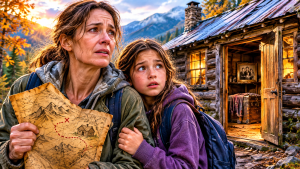
There were crooked mountain roads, a creek crossing, and a little square marked with the words Rose’s House.
Finally, with trembling hands, she opened the envelope.
The letter began:
My dearest Helen,
If you are reading this, then the world has hurt you badly enough that you have nowhere else to turn.
I am sorry I cannot be there to hold you.
But I made certain I could still help you.
The mountain house is not what your family believes it to be.
I kept it safe. I protected it from people who would never understand why.
Go there with your child.
The key will open the door.
And when you have finally found your way inside, remember that being kind does not mean allowing others to destroy you.
The house is yours, my darling.
It always was.
Love, Grandma Rose.
Helen read the letter three times.
Tears fell onto the yellowed paper.
Beside her, Sophie stirred.
“Mom? Why are you crying?”
Helen wiped her cheeks.
She held up the brass key.
“Because I think I finally know where we’re going.”
“Where?”
Helen swallowed.
“To your great-grandmother’s house in the mountains.”
Sophie frowned.
“The broken-down one Uncle Richard said nobody could live in?”
“Yes.”
“What if it’s gone?”
Helen looked at the faded map.
Then at her daughter’s exhausted face.
“I don’t know, sweetheart.”
She folded the letter carefully.
“But we’re going to find out.”
And six hours later, with almost every dollar she had left spent on bus tickets, Helen and Sophie headed toward the mountains.
Neither of them knew what was waiting beyond that old road.
Or why Grandma Rose had gone to so much trouble to keep a forgotten house hidden from her own family.
Part 2
The bus left Asheville shortly after sunrise.
Helen sat beside Sophie near the back, holding both backpacks between her knees.
Outside the windows, town streets gave way to small farms, wooden fences, churchyards, and wooded hills.
The mountains rose beyond them, their slopes covered in red and gold autumn leaves.
Sophie pressed her forehead against the glass.
“It’s pretty out here.”
Helen smiled.
“Your great-grandmother loved these mountains.”
“Did you come here when you were little?”
“Every summer.”
“What was it like?”
Helen looked toward the ridgeline.
She remembered a wooden porch overlooking the valley.
Blackberries growing beside a creek.
Grandma Rose calling everyone inside when biscuits came out of the oven.
And a narrow trail that led to a meadow where wildflowers bloomed every June.
“Quiet,” she said. “The kind of quiet that makes you feel safe.”
Sophie considered that.
“I’d like that kind of quiet.”
Helen reached over and squeezed her hand.
“So would I.”
Their first bus took them to the little mountain community of Pine Hollow.
There was one gas station, a white clapboard church, a hardware store, and a general store with a weathered wooden sign.
HARRISON’S GENERAL MERCHANDISE — EST. 1962.
Helen remembered it vaguely.
The porch had sagged a little more over the years, but the old bell still hung above the door.
They went inside.
The air smelled of cedar shavings, coffee, leather, and dried apples.
Behind the counter stood an elderly man with white hair and deep lines around his eyes.
He looked at Helen as she gathered a cheap flashlight, batteries, crackers, and two bottles of water.
“How far are you headed?” he asked.
“Up toward the old logging road.”
His hands stopped moving.
“Which road?”
“The one past Mile Marker Thirty-Seven.”
The man looked at her more closely.
“Not much up there anymore.”
Helen reached into her backpack for the map.
“I’m trying to find this place.”
The old man leaned forward.
Then he went completely still.
He touched the paper with one finger.
“Where did you get this?”
“My grandmother.”
“What was her name?”
“Rose Carter.”
The old man slowly took off his glasses.
For several seconds, he said nothing.
Then he pulled out a stool and sat down.
“Well, I’ll be.”
Helen felt a sudden uneasiness.
“Did you know her?”
“Know her?”
He gave a soft, astonished laugh.
“Ma’am, your grandmother bought supplies from me for nearly forty years.”
He held out his hand.
“Calvin Harrison.”
Helen shook it.
“I’m Helen. Her granddaughter.”
His expression changed.
“The little girl with the brown braids?”
Helen nodded.
Calvin looked toward Sophie.
“And now you’ve brought your own.”
Something glistened in his eyes.
“Your grandmother said you would come.”
Helen stared at him.
“What?”
Calvin turned toward a cabinet behind the counter.
He unlocked a drawer and removed a faded envelope.
“She left this with me twenty-three years ago.”
He placed it on the counter.
“Made me swear I’d give it to a woman who came asking about the old house. Said she’d have a child with her.”
Helen’s mouth went dry.
Inside was a photograph.
Grandma Rose stood on the porch of a large log house, smiling broadly.
The roof was sound.
The windows were clean.
A brass key hung from her raised hand.
Helen turned the picture over.
In Grandma Rose’s familiar handwriting were eight words.
She will come when she needs it most.
Helen covered her mouth.
Calvin watched quietly.
“She knew,” Helen whispered.
“She hoped,” Calvin said. “There’s a difference.”
He studied her worn clothes and Sophie’s tired face.
“Looks like you’ve had a rough go of it.”
Helen lowered her eyes.
“We’ve been through some things.”
Calvin didn’t ask for details.
Instead, he placed their purchases into a paper bag.
“How much do I owe you?” Helen asked.
“Nothing.”
“I can’t take them for free.”
“You aren’t.”
He reached below the counter and showed her a small brown ledger.
On one page, written in careful blue ink, was Grandma Rose’s name.
Beside it was a deposit entered more than two decades earlier.
“She left money for supplies. Told me if her girl ever showed up, I should make sure she got what she needed.”
Helen felt tears rising again.
“She planned all this?”
Calvin smiled sadly.
“Rose was a determined woman. Once she decided somebody mattered, there wasn’t much that could stop her.”
He added a loaf of bread, canned beans, peanut butter, and two apples.
Then he gave Helen directions.
“Catch the afternoon shuttle to Mile Marker Thirty-Seven. You’ll see an old logging road on the left. Walk about three miles until you reach the creek. The house sits above it.”
“Can we drive up?”
“Not in anything you’re likely to find around here.”
He glanced at her shoes.
“And that walk won’t be easy.”
Helen thanked him.
As they headed toward the door, Calvin called after her.
“One more thing.”
She turned.
“Your brother came asking about that land years ago.”
Helen went still.
“Richard?”
“That’s right. Took one look at the chains on the porch and said it wasn’t worth the trouble.”
Calvin paused.
“But Rose never believed a thing was worthless just because somebody couldn’t see its value.”
The little shuttle dropped them beside an empty mountain road after three that afternoon.
The driver looked at Helen doubtfully.
“Lady, there’s nothing back there but woods.”
“We’re meeting family,” Helen said.
He shrugged and drove away.
The sound of the engine disappeared around the bend.
For the first time all day, there was no human noise.
Only wind moving through pine trees.
A distant crow.
And the faint sound of running water.
Sophie looked down the overgrown road.
“We have to walk all that way?”
Helen adjusted her backpack.
“I’m afraid so.”
“Okay.”
They began walking.
The old logging road was nearly swallowed by the forest.
Young trees grew through deep ruts.
Branches caught at their sleeves.
Fallen leaves concealed loose stones and twisted roots.
Helen’s feet were already blistered from weeks of walking around town.
After the first mile, each step sent pain through her heels.
Sophie noticed.
“Mom, you’re limping.”
“Just a little sore.”
“You always say that.”
Helen gave a tired laugh.
“I suppose I do.”
They stopped beside a fallen tree and shared an apple.
Sophie offered her the larger half.
Helen pushed it back.
“You need it.”
“So do you.”
They looked at each other.
For a moment, Helen saw how much her daughter had changed.
A year ago, Sophie would have worried about missing her favorite television show.
Now she worried whether her mother had eaten enough.
Helen took a bite.
“There. Happy?”
“Very.”
They continued climbing.
The sun sank toward the western ridges.
Shadows stretched across the trail.
Helen began wondering whether she had made a terrible mistake.
What if Richard had been right?
What if the house had collapsed long ago?
What if Grandma Rose had been mistaken about how long it would survive?
There was no money left for a motel.
No car to return to town.
No one waiting to help them.
Then Sophie stopped.
“Mom.”
Helen looked up.
Through the trees, beyond a clearing, stood a house.
Not a small, broken cabin.
A substantial two-story log home with a broad covered porch, a tall stone chimney, and a steep roof built to carry mountain snow.
Helen stared.
The lower windows were covered with thick wooden boards.
Heavy chains crossed the front door.
Tall grass surrounded the foundation.
Vines climbed one wall.
But the roof was straight.
The chimney stood firm.
And the porch, though weathered, looked solid.
Sophie whispered, “It’s huge.”
Helen approached slowly.
The old porch steps held beneath her weight.
Three heavy padlocks secured the chains.
She removed the brass key from her pocket.
Her fingers shook as she inserted it into the first lock.
It turned.
The lock opened.
The second opened too.
The third resisted, its mechanism stiff with rust.
Helen twisted carefully.
For one terrible second, she thought the key might break.
Then something inside gave way.
The lock clicked open.
The chains fell against the porch with a dull metallic crash.
Helen pulled away the wooden crossbars.
Splinters pierced her hands.
Sophie helped stack the boards against the railing.
At last, they stood before the front door.
Its iron handle was shaped like a pine branch.
Helen inserted the key.
It fit perfectly.
The heavy lock turned with a deep, stubborn sound.
She looked at Sophie.
“Ready?”
The girl nodded.
Helen pushed.
The door moved inward.
A breath of cold, dry air swept across their faces.
The flashlight beam revealed furniture covered in white sheets.
A stone fireplace.
An enormous oak table.
Shelves of dishes.
A rocking chair beside the hearth.
Everything was covered in dust.
But nothing appeared broken.
Nothing smelled rotten.
The room was dry.
The walls were solid.
The house had not been abandoned carelessly.
It had been closed deliberately.
Preserved.
Waiting.
Sophie stepped inside.
“Mom?”
Helen could barely answer.
“Yeah, honey?”
“I think Grandma Rose really did leave us a home.”
Helen sank onto the nearest chair.
She pressed both hands against her face.
For the first time in three weeks, she cried without trying to hide it.
Not because the danger had ended.
It hadn’t.
Winter was coming.
They had almost no money.
And she still didn’t know how they would survive.
But they had found a roof.
A door that locked.
And a place where Sophie might finally sleep without being afraid.
That evening, as the mountain darkness gathered outside, Helen found a bundle of firewood beneath a canvas cover.
There were candles in the pantry.
Matches sealed in a glass jar.
A wood-burning stove with a heavy iron door.
It took several tries to start the fire.
On the second attempt, Helen burned her thumb.
She muttered something that made Sophie laugh.
It was the first real laugh Helen had heard from her daughter in weeks.
They ate canned soup warmed on the stove.
They washed their faces with bottled water.
Upstairs, they found three bedrooms with mattresses wrapped in protective covers and folded quilts stored in cedar chests.
Sophie chose the smallest room because its window faced the creek.
Helen spread a quilt over her.
The girl snuggled into the pillow.
“Mom?”
“Yes?”
“I forgot what a real bed felt like.”
Helen sat on the edge of the mattress.
Her throat tightened.
“Then you enjoy every minute of this one.”
Sophie reached for her hand.
“Do you think Grandma Rose knew we’d come?”
Helen looked toward the old quilt, stitched with tiny blue stars.
“I think she loved us enough to hope we’d find our way.”
She kissed Sophie’s forehead.
And when the girl finally fell asleep, Helen stood at the bedroom door for a long time.
Downstairs, the fire crackled softly.
Outside, the creek continued running through the darkness.
The old house had opened its doors.
But Helen still didn’t understand why her grandmother had protected it so fiercely.
Part 3
Morning arrived with sunlight pouring through the cracks around the boarded windows.
Helen woke in an unfamiliar bed.
For a moment, she reached automatically for the backpack she had been using as a pillow.
Her hand found a soft cotton pillowcase instead.
She lay still.
The ceiling above her was made of dark wooden beams.
A quilt rested over her legs.
Through the walls came the faint, steady murmur of a mountain creek.
She closed her eyes again.
They were inside.
They were warm.
And no one was telling them to leave.
Downstairs, she discovered Sophie standing in front of the stove, staring at a pot.
“What are you doing?”
“Trying to make breakfast.”
“And?”
Sophie looked offended.
“The stove doesn’t like me.”
Helen laughed.
“Woodstoves can be stubborn.”
Together they coaxed a flame from dry kindling and boiled water for oatmeal.
The honey in the pantry had crystallized, but it softened when Helen warmed the jar near the stove.
They ate at the enormous oak table.
Sophie asked if they could paint her room light blue someday.
Helen looked at the unfinished wood walls.
“Someday,” she promised.
But as they ate, she began making a mental inventory.
Food.
Water.
Heat.
Money.
Transportation.
School.
Medical care.
The house might have solved one enormous problem, but it hadn’t solved the rest.
After breakfast, she searched the outbuildings.
Behind the house stood a woodshed filled with carefully stacked logs.
A hand pump rose beside a stone-lined well.
Helen worked the iron handle until brown water sputtered from the spout.
She pumped again.
And again.
Eventually the water ran clear.
She filled a bucket and carried it to the porch.
They would still need to test and treat it before drinking, but it was a beginning.
Beyond the well, an old garden lay beneath weeds.
There were apple trees, a collapsed chicken run, and a small barn with a sagging door.
Helen walked through the property slowly.
She recognized pieces of it from childhood.
The creek bend where Grandma Rose used to catch trout.
The broad stone where they had eaten sandwiches after berry picking.
The giant oak beside the path.
Rose had always told her that the trees remembered more than people did.
Helen touched its bark.
“I came back, Grandma,” she whispered.
By midday, a motor sounded on the trail.
Helen stiffened.
An old green pickup emerged from the trees.
Calvin Harrison climbed out carrying a cardboard box.
“Thought you ladies could use some things that haven’t been sitting in a cupboard for twenty-five years.”
Inside were fresh bread, eggs, milk, apples, coffee, potatoes, and a small first-aid kit.
“Mr. Harrison, I don’t know how to thank you.”
“Calvin, please.”
He glanced around the clearing.
“Looks like you got the place opened.”
“Barely.”
“Rose built this house to last.”
He walked through the main room, examining the fireplace and stove.
“Before you use that chimney much more, we ought to get it cleaned and inspected.”
Helen looked down.
“I can’t pay anybody.”
Calvin waved a hand.
“Didn’t ask you to.”
He showed her where the old chimney tools were stored, then arranged for a local chimney sweep to come the following day.
He also helped secure the loose window boards and identify several repairs that would have to be made before winter.
They worked side by side until afternoon.
Calvin wasn’t the sort of man who talked constantly.
When Helen made a mistake, he showed her how to correct it.
When she did something well, he nodded.
He treated her as a capable adult, not a charity case.
That alone felt like a gift.
Before leaving, he leaned against the pickup.
“People around here remember your grandmother.”
Helen smiled faintly.
“She seems to have left quite an impression.”
“She helped folks who had nowhere else to turn.”
He glanced toward the house.
“Never made a production out of it either.”
Over the following days, Helen discovered how much truth those words contained.
On Tuesday, a basket appeared on the porch.
Inside were jars of apple butter and blackberry preserves.
On Wednesday, somebody left a bundle of dry kindling.
On Thursday, a folded wool shawl appeared on the rocking chair with a note.
Rose helped me when my husband died. Figured it was my turn.
It was signed Martha.
Helen held the note for a long time.
She had spent months feeling as though the world had no place for her.
Now strangers were leaving things on her porch.
Not because she demanded help.
Not because she had earned some special privilege.
But because decades earlier, Grandma Rose had been kind to people who remembered.
Sophie noticed too.
“It’s like she’s still looking after us.”
Helen folded the shawl over the back of the rocking chair.
“In a way, I suppose she is.”
They settled into a routine.
Mornings began with sweeping ashes, carrying water, preparing breakfast, and opening the windows to fresh air when weather allowed.
Afternoons were spent repairing what they could.
Helen patched loose boards.
She cleaned the pantry and discarded old food that could no longer be trusted.
She counted the remaining safe supplies and made careful lists.
Sophie helped wash dishes, organize books, and clear weeds from the garden.
They discovered an old sewing machine.
A cabinet filled with wool blankets.
A shelf of books on gardening, carpentry, local history, and cooking.
And a small wooden box containing photographs of Grandma Rose as a young woman.
In one picture, Rose stood beside a tall man wearing work clothes.
In another, she sat on the porch holding a little girl.
Helen recognized herself.
She was maybe five years old.
Grandma Rose had one arm around her shoulders.
Helen stared at the photograph until her vision blurred.
Sophie peered over her arm.
“That’s you?”
“That’s me.”
“You look just like I did when I was little.”
Helen smiled.
“You’re much prettier.”
Sophie rolled her eyes.
“Mom.”
They laughed.
For a few precious days, the house felt like an answer to every prayer Helen had whispered.
Then the storm came.
It struck on a Thursday night.
The weather changed in less than an hour.
Clouds rolled over the ridge, swallowing the stars.
Wind tore through the trees.
Cold rain hammered the roof so violently that Sophie came downstairs carrying her blanket.
“Mom, I’m scared.”
Helen wrapped an arm around her.
“This house has stood through worse.”
She wanted to believe it.
The windows rattled.
The chimney moaned.
A large branch crashed somewhere outside.
Then a sharp crack echoed through the main room.
One of the partially repaired window frames had blown inward.
Rain swept across the floor.
The lamp on the table tipped.
Helen caught it before it fell.
“Stay away from the window!” she shouted.
She pulled Sophie toward the staircase.
The cold wind pushed so hard through the opening that the fire in the stove flickered.
Helen grabbed one of the old wooden shutters.
It was heavy.
Water made it slippery.
She dragged it to the broken window and tried to position it against the frame.
The wind knocked it from her hands.
She tried again.
Her fingers were numb.
Rain soaked her clothes.
Sophie appeared with the toolbox.
“I found the hammer!”
Helen took it.
“Good girl. Now go upstairs.”
“Mom—”
“Please.”
Sophie obeyed.
Helen braced the shutter with her shoulder.
With trembling hands, she drove screws into the frame using the tools Calvin had found.
The first slipped.
The second held.
The third bit into solid timber.
At last, the shutter stayed in place.
Helen stepped backward, soaked and exhausted.
Her palms were scraped.
Her shoulders ached.
But the house was secure.
Then she heard Sophie coughing upstairs.
Helen hurried to her daughter’s bedroom.
Sophie sat beneath the quilt, shivering.
“Mom, I feel terrible.”
Helen touched her forehead.
Hot.
Too hot.
She found the thermometer in the new first-aid kit.
One hundred and three degrees.
Her daughter had a high fever.
Helen’s stomach turned.
The road outside was flooded.
The nearest clinic was miles away.
She had no vehicle.
And the storm had made the mountain trail nearly impassable.
She tried calling Calvin using the old cellphone he had helped her charge, but reception failed.
She attempted an emergency call.
It wouldn’t connect.
Helen sat beside the bed, fighting panic.
She had spent years caring for sick people.
She knew the importance of fluids, careful monitoring, and medical attention when dangerous symptoms appeared.
But knowing what to do was not the same as having the means to do it.
She offered Sophie small sips of water.
She used the fever medicine Calvin had brought, following the label.
She watched for breathing problems, confusion, and signs of dehydration.
And she kept trying the telephone.
“Mom?”
Helen leaned closer.
“I’m here.”
Sophie reached for her hand.
“Don’t let them take our house.”
Helen felt her heart break.
Even sick and frightened, her daughter was thinking about losing another home.
“Nobody’s taking it tonight,” Helen whispered.
“Promise?”
Helen held her daughter’s hand.
“I promise I’ll do everything I can to keep us safe.”
The hours crawled.
At three in the morning, Sophie’s temperature remained high.
Helen put on her coat and stepped onto the porch, trying again to find a signal.
Wind lashed her face.
Rain ran down her neck.
She raised the telephone toward the dark trees.
One bar appeared.
She called Calvin.
He answered on the fourth ring.
“Helen?”
“Calvin, Sophie is sick. High fever. I need help.”
His voice changed immediately.
“Is she breathing all right?”
“Yes, but she’s getting weaker.”
“I’ll call the county emergency dispatcher. They’ll know the upper logging road. You stay with her.”
Forty minutes later, Helen heard an engine beyond the clearing.
Calvin’s truck appeared through the rain, followed by an emergency vehicle equipped for rough mountain roads.
Two paramedics climbed the porch steps.
Helen nearly collapsed with relief.
They assessed Sophie and transported her to the nearest hospital.
Calvin drove Helen behind them.
The doctor diagnosed a serious respiratory infection requiring treatment and observation.
By morning, Sophie was resting in a hospital bed with her fever beginning to fall.
Helen sat beside her, still wearing the damp clothes from the storm.
Calvin brought her coffee.
“You did right calling.”
Helen looked down at her scraped hands.
“I nearly waited too long.”
“But you called.”
He sat beside her.
“Listen, Helen. You don’t have to do every hard thing alone.”
She stared at him.
For years, she had believed that loving someone meant carrying every burden herself.
Now she wasn’t so sure.
Three days later, Sophie was well enough to return home.
Calvin brought them back up the mountain.
When they reached the clearing, Sophie looked at the house.
The repaired shutters were still holding.
Smoke rose from the chimney.
Helen had never seen anything so beautiful.
That night, after Sophie fell asleep, Helen walked upstairs to the one room she had not yet searched.
Grandma Rose’s old bedroom.
The door stood at the end of the hallway.
Helen opened it.
A narrow iron bed.
An old wardrobe.
A dressing table.
A small wooden jewelry box.
Everything was neat and strangely untouched.
She approached the jewelry box.
It was made of polished maple, carved with tiny flowers and leaves.
Inside, resting on faded blue velvet, lay a little silver key.
Helen picked it up.
Then she noticed something unusual about the far wall.
The wardrobe didn’t sit flush against it.
Behind the wardrobe was the edge of a narrow wooden door.
A door she had never seen before.
Helen moved the wardrobe just enough to uncover the handle.
She pulled.
The door opened inward.
Her flashlight revealed a concealed room.
Wooden crates lined the walls.
Canvas-wrapped bundles stood in carefully arranged stacks.
Metal boxes occupied a heavy shelf.
And at the far end, beneath a covered window, stood an old steel safe.
Helen remained motionless.
Grandma Rose had preserved more than a house.
She had hidden an entire room from the family.
And Helen was beginning to understand that the most important part of her grandmother’s promise had not yet been revealed.
Part 4
Helen didn’t sleep much that night.
The hidden room remained in her thoughts.
The old wooden crates.
The carefully wrapped packages.
The steel safe.
She wanted to open everything immediately.
But years of caring for patients had taught her that fear and excitement could make a person careless.
So she locked Grandma Rose’s bedroom, placed the little silver key in her pocket, and went downstairs to check on Sophie.
Her daughter was sitting beside the fireplace with a sketchbook.
“Mom, you look like you found a ghost.”
Helen gave a tired smile.
“Maybe I found something Grandma wanted me to see.”
“What?”
“I’m not sure yet.”
Sophie set down her pencil.
“Is it bad?”
Helen considered the question.
“I don’t think so.”
Then she sat beside her.
“But whatever it is, we’re going to be careful.”
The following morning, Helen returned to the concealed room.
She removed the covering from the nearest crate.
Inside, surrounded by protective padding, sat a delicate porcelain tea service decorated with small blue flowers.
Each cup carried a tiny gold emblem.
The next crate contained old silver candlesticks, serving trays, and jewelry boxes.
The canvas bundles held framed paintings.
Mountain landscapes.
Portraits of women in nineteenth-century dresses.
An enormous oil painting of a farmhouse beside a river.
Helen recognized the style of some pieces from books she’d seen at the public library.
These weren’t ordinary decorations.
They appeared old, beautifully made, and potentially valuable.
Other boxes held leather-bound books, collections of coins, old letters, and carefully preserved documents.
Helen opened one folder.
There were property records dating back generations.
Tax receipts.
Copies of deeds.
Survey maps.
Bank statements.
And a packet bearing her full name.
Helen Marie Carter.
She stared at it.
The handwriting on the label belonged to Grandma Rose.
Helen opened the folder.
Inside were papers that seemed to indicate that the mountain property had been placed in her name long ago.
But the legal language was complicated.
Some pages were originals.
Others were copies.
There were trusts, recorded deeds, and references to accounts she didn’t recognize.
She didn’t understand enough to know what any of it meant.
What she did understand was that Grandma Rose had deliberately prepared these records for her.
And she had kept them somewhere Richard would never think to look.
Helen carried the folder downstairs.
Calvin arrived that afternoon to help repair the woodshed door.
When he saw the documents, his expression changed.
“Where did you find these?”
“In a hidden room.”
He leaned back slowly.
“Well, I’ll be.”
“Did you know?”
“I knew Rose kept family things tucked away. Didn’t know she had a whole room for them.”
Helen spread the papers across the table.
“Calvin, what if this property isn’t mine?”
He examined the top page without touching it.
“You need a lawyer for that.”
“I can’t afford one.”
“There’s a legal aid office in the county. I can help you get an appointment.”
Helen looked away.
“I hate asking.”
Calvin set down his coffee.
“You know what Rose told me once?”
Helen shook her head.
“She said pride is a fine thing until it stops you from accepting a hand someone freely offers.”
He nodded toward the papers.
“You’ve spent enough years holding everybody else up.”
Before Helen could respond, Sophie’s voice came from the doorway.
“Mom, somebody’s coming.”
A dark SUV appeared at the edge of the clearing.
Helen stepped outside.
Richard climbed out.
He wore a pressed jacket, polished boots, and the same irritated expression Helen remembered from their last telephone call.
For several seconds, neither spoke.
Then he looked at the house.
“Well.”
Helen folded her arms.
“Hello, Richard.”
He walked slowly toward the porch, examining the open windows and repaired shutters.
“Didn’t expect to find you here.”
“How did you know?”
“People talk. Somebody mentioned a woman and a girl had moved onto Grandma’s old property.”
His gaze moved toward Calvin’s pickup.
“Looks like you’ve made friends.”
Calvin nodded politely.
“Richard.”
“Calvin.”
No warmth passed between them.
Richard returned his attention to Helen.
“Why didn’t you tell me you were coming up here?”
Helen felt a familiar tightening in her chest.
The old instinct to apologize rose before she could stop it.
Then she remembered Sophie sleeping on a bus station bench.
“You weren’t answering my calls.”
Richard shifted his weight.
“I had things going on.”
“So did we.”
He looked away.
“Look, I know things have been difficult.”
Helen said nothing.
“I heard about the apartment.”
“You heard?”
“Helen, don’t start.”
She stared at him.
“Your niece spent three weeks sleeping in public places.”
Richard’s expression hardened.
“I didn’t know it was that bad.”
“I told you we were desperate.”
“You told me you needed money. That’s different.”
Helen felt anger rise.
She had swallowed disappointment for months.
She had defended him to their mother.
Explained his absence.
Made excuses for the way he never visited.
Now he stood on the porch of the only shelter she had left, acting as though her suffering were a misunderstanding.
“What do you want, Richard?”
His eyes moved toward the front door.
“To discuss the property.”
Helen stood straighter.
“What about it?”
“Grandma’s cabin was part of the family estate.”
“She left it to me.”
“That’s not what I remember.”
“You said it was worthless.”
“Things change.”
He glanced toward the hills.
“Land values up here have been rising. There’s a resort development near the highway.”
Helen understood.
“That’s why you’re here.”
Richard frowned.
“What?”
“You didn’t come because you were worried about Sophie.”
“That isn’t fair.”
“You didn’t come because you wanted to see whether we were safe.”
“Now hold on—”
“You came because somebody told you this land might be worth money.”
Richard’s jaw tightened.
“You always make everything personal.”
Helen looked at him for a long moment.
“It is personal.”
He took one step toward her.
“Listen carefully. If you plan to stay here, we need to figure out who owns what. You can’t just move onto family property and claim everything belongs to you.”
Helen felt fear return.
Not because she believed Richard.
Because she knew what a determined person with money could do.
He could hire attorneys.
Challenge records.
Create delays.
Force her to spend money she didn’t have.
Richard glanced through the doorway.
“Maybe we should sit down inside.”
Helen moved in front of him.
“No.”
He blinked.
“What?”
“We can talk here.”
“You’re not letting me inside?”
“Not today.”
The words surprised her.
She had spent most of her life saying yes.
Yes, she would work the extra shift.
Yes, she would drive across town.
Yes, she would take care of it.
Yes, she would lend money she couldn’t spare.
This was the first time she could remember refusing Richard without offering an explanation.
He gave a short, humorless laugh.
“You’ve changed.”
Helen thought of the weeks on the street.
The cold benches.
The sleepless nights.
Her daughter asking whether they would lose another home.
“Yes,” she said quietly. “I have.”
Richard’s face darkened.
“You’d better have those documents in order.”
He returned to his SUV.
Before getting inside, he looked back.
“This isn’t finished.”
Then he drove away.
Helen remained standing until the sound of the engine faded.
Her knees felt weak.
Calvin approached.
“You all right?”
She looked at the road.
“I don’t know.”
He studied her for a moment.
“Your grandmother was smart about business. Don’t let him frighten you into giving away something she meant you to have.”
Helen nodded.
But she knew the problem was larger now.
The house was no longer simply a place to hide.
It had become something her brother wanted.
And she needed to know exactly what Grandma Rose had left her.
That afternoon, Helen called the county legal aid office.
They helped her arrange a consultation with a local attorney named Diane Mitchell, who agreed to review the documents and refer her to a property specialist if necessary.
Helen brought copies to their appointment.
Diane was a serious woman in her late fifties who listened carefully and didn’t interrupt.
After an hour, she looked up from the paperwork.
“Mrs. Carter, these appear to be significant records.”
Helen gripped her hands together.
“Does that mean the house is mine?”
“It means there’s evidence your grandmother took formal steps to transfer and protect this property. But I need to verify the recorded documents and check the current title.”
“Can my brother take it?”
“Not simply because he says it belongs to him.”
Helen exhaled.
Diane continued.
“You should also be careful with the other items you’ve found. Don’t sell, move, or advertise anything until we establish what it is and who legally owns it.”
Helen nodded.
Then Diane paused over an old folder.
“Your grandmother also appears to have arranged a trust.”
“A trust?”
“Possibly containing financial assets as well as the property. We’ll need to investigate.”
Helen stared at her.
She thought of the steel safe.
The silver key.
And Grandma Rose’s promise.
I made certain I could still help you.
Back at the house, Helen waited until Sophie was asleep before returning to the hidden room.
The steel safe stood against the far wall.
She brushed dust from its surface.
Then she took out the silver key.
It slid into the lock.
For a moment, she hesitated.
Whatever Grandma Rose had left inside had been waiting for twenty-five years.
Helen turned the key.
The mechanism clicked.
The heavy door opened.
Inside lay a waterproof packet.
On top was a sealed envelope.
Her name was written across it.
For my sweet Helen, when the time has finally come.
She sat on the wooden floor.
Her hands trembled.
And she broke the seal.
Part 5
The letter inside the safe was eight pages long.
Helen recognized every curve of Grandma Rose’s handwriting.
The same careful letters that once appeared on birthday cards and handwritten recipes.
But this letter was different.
It had been written by a woman who knew she was preparing for something her granddaughter couldn’t yet imagine.
My darling Helen,
If you have found this room, then you have survived the journey I hoped you would never need to make.
I wish I could see your face right now.
Perhaps you are frightened. Perhaps confused. Perhaps wondering why I kept so much from the family.
There is a reason.
And before you read another word, I want you to know something.
None of this was an accident.
Helen felt the room tilt around her.
She continued reading.
Grandma Rose explained that much of the collection had belonged to earlier generations of their family.
Her own grandmother, Eleanor, had come from a prosperous family that owned farmland, timberland, and a collection of valuable artwork and antiques.
Over decades, marriages, deaths, financial difficulties, and family disputes had scattered much of that wealth.
But Eleanor had protected several pieces.
Paintings.
Silver.
Porcelain.
Jewelry.
Letters.
Historical documents.
And, most importantly, ownership records that could establish how the remaining assets had passed through the family.
Rose had inherited what remained.
She could have sold it.
She could have divided the proceeds among relatives.
But she had watched her family closely.
She had seen how some people valued money more than loyalty.
How promises disappeared when someone became inconvenient.
How the kindest members of the family were expected to make every sacrifice.
And she had watched Helen grow into a woman who apologized even when other people hurt her.
You remind me so much of myself, Rose wrote.
When I was young, I believed love meant giving until there was nothing left.
I was wrong.
Love sometimes requires sacrifice, yes.
But it must never require you to disappear.
I could see that you were in danger of giving away your whole life to people who would never give you theirs.
Helen wiped her eyes.
The next paragraphs described Rose’s preparations.
She had placed the mountain house and surrounding land into a carefully structured ownership arrangement.
She had worked with an attorney to ensure Helen would become the designated beneficiary.
She had preserved the collection and organized its records.
She had also established a trust intended to provide security when Helen eventually needed it.
The packet contained copies of those documents, instructions for contacting the trustee, and records identifying the paintings, jewelry, and other valuable items.
But the letter wasn’t finished.
I did not keep these things because I wanted you to be wealthy.
Money has never been the most important thing in our family, though some of our relatives have spent their lives believing otherwise.
I kept them because I wanted you to have a place where nobody could frighten you into leaving.
A place where your child could sleep.
A place where you would never have to beg someone to treat you with dignity.
I wanted you to know that you mattered long before you could prove yourself useful to anybody.
Helen stopped reading.
Her shoulders began to shake.
For months, she had believed she had failed.
Failed to save her mother.
Failed to keep her job.
Failed to provide her daughter with a home.
Now, through words written decades earlier, Grandma Rose was telling her something she had almost forgotten.
Her worth had never depended on how much she could give.
She read the final paragraph.
I know there may come a day when others try to convince you that you do not deserve what I have left.
Do not believe them.
You have earned love simply by being who you are.
Keep the house.
Protect your daughter.
And when your life becomes peaceful again, help someone else find a way home.
That will be the finest way you could ever honor me.
With all my love,
Grandma Rose.
Helen folded the letter against her chest.
Then she began to cry.
Not the quiet tears she had shed at the bus station.
Not the exhausted crying that came after another rejection.
These were the tears of a woman finally realizing that someone had seen her suffering before it happened and tried to protect her.
She sat among the old paintings and wooden crates until long after midnight.
The following morning, she called Diane Mitchell.
Together, they began the careful process of verifying the documents.
The county records confirmed that the deed to the house and approximately one hundred acres of surrounding woodland had been transferred into the trust decades earlier.
Helen was the named beneficiary.
The legal structure did not eliminate every possible challenge, but the paperwork was valid, properly recorded, and supported by extensive documentation.
Richard’s claim that the land automatically belonged to all the family members had no basis in the records.
The financial documents were equally important.
The trust contained investments and assets that had grown over the years under professional management.
The collection in the hidden room required specialists to evaluate, but preliminary assessments suggested that several paintings and antique pieces were exceptionally valuable.
Helen could scarcely understand the numbers.
For three weeks, she had been counting coins to buy a loaf of bread.
Now she was sitting across from an attorney discussing assets that might support her and Sophie for the rest of their lives.
She didn’t feel triumphant.
Not yet.
She felt stunned.
And strangely frightened.
“What do I do now?” she asked Diane.
The attorney closed the folder.
“First, we make certain your housing and finances are secure. Then we deal with the property and the collection properly.”
Helen nodded.
“And my brother?”
“If he contacts you about the property, refer him to me.”
That evening, Richard returned.
His SUV climbed the road as darkness settled across the clearing.
Helen saw the headlights from the kitchen window.
Sophie was upstairs drawing.
Calvin had gone home.
Helen stood alone on the porch as her brother approached.
“We need to talk,” he said.
Helen folded her hands.
“All right.”
“I’ve been looking into the property.”
“So have I.”
Richard frowned.
“I spoke with somebody who says land up here can be worth a great deal.”
Helen said nothing.
“I think we ought to discuss a fair arrangement.”
“A fair arrangement for whom?”
“For the family.”
Helen looked at him.
“Richard, where were you when Mom was dying?”
His face changed.
“What does that have to do with—”
“Where were you when I sold my car?”
“Helen—”
“Where were you when Sophie and I lost our apartment?”
He looked away.
“You know things were complicated.”
“They were.”
Her voice remained calm.
“They were complicated for me too.”
Richard shifted uneasily.
“You always act like I did nothing.”
“You sent two hundred dollars.”
“I had bills.”
“So did I.”
She took a slow breath.
“I don’t want to spend the rest of my life arguing about what you should have done.”
“Then let’s settle this.”
“It is settled.”
Helen brought out a folder.
She didn’t hand him the originals.
Only copies of the relevant recorded documents that her attorney had approved for disclosure.
“Grandma Rose transferred the property into a trust. I’m the beneficiary. The deed and trust records have been verified.”
Richard stared.
“No.”
“Yes.”
He took the papers.
Read the first page.
Then the second.
His expression changed slowly.
Confusion.
Disbelief.
Then anger.
“She couldn’t do that.”
“She did.”
“That’s family land.”
“It was hers to transfer.”
Richard looked toward the house.
“She always liked you better.”
Helen felt the old wound open.
But she didn’t allow it to control her.
“She loved us both, Richard.”
“Then why leave it to you?”
Helen studied her brother.
For one moment, she wanted to tell him everything.
Every sleepless night.
Every humiliation.
Every time she had made excuses for his absence.
But Grandma Rose’s last lesson came back to her.
Kindness didn’t require surrender.
And strength didn’t require cruelty.
“I can’t answer for Grandma,” Helen said. “But I can tell you what I intend to do.”
Richard looked at her.
“This is Sophie’s home now. It’s my home. And I’m not giving it away.”
He stared at the papers.
“I could challenge it.”
“You have that right. My attorney can speak with yours.”
Silence stretched between them.
The wind moved through the tall pines.
At last, Richard lowered his eyes.
“You really won’t let me inside?”
Helen shook her head.
“Not tonight.”
Something in his expression softened for an instant.
Not enough to become an apology.
Not enough to erase the past.
But enough to reveal a tired man who had spent too many years convincing himself that responsibility belonged to somebody else.
He folded the papers.
Then turned toward his SUV.
“Helen.”
She waited.
He hesitated.
“I didn’t know it got that bad.”
She looked at him quietly.
“You could have asked.”
He had no answer.
Helen watched him walk away.
Before he reached the vehicle, she called after him.
“Drive carefully. The lower road gets dangerous after dark.”
He paused.
Then nodded.
The SUV disappeared down the trail.
Helen remained on the porch for several minutes.
She felt no urge to celebrate.
No desire to punish him.
Only relief.
She had finally said no.
And the world had not ended.
Behind her, the screen door creaked.
Sophie stood on the top step wearing her pajamas.
“Was that Uncle Richard?”
“Yes.”
“Is he going to take our house?”
“No, sweetheart.”
Sophie studied her face.
“Did you yell at him?”
“No.”
“Did you let him tell you what to do?”
Helen smiled.
“No.”
Sophie thought about that.
Then she stepped forward and hugged her.
“I think Grandma Rose would be proud of you.”
Helen held her daughter close.
“I hope so.”
The following months brought changes that once would have seemed impossible.
With legal guidance and access to the trust’s funds, Helen arranged for necessary repairs.
The roof was inspected.
The chimney was cleaned and repaired.
The damaged windows were replaced.
A reliable heating system was installed.
The well water was tested, and proper filtration equipment was added.
Calvin’s grandson, a licensed electrician, helped coordinate a small solar installation with battery storage.
For the first time, Sophie could turn on a light without searching for matches.
Helen bought her a warm winter coat, new shoes, school supplies, and a laptop to replace the one she had sold.
Sophie hugged the box when Helen brought it home.
“Mom, you didn’t have to.”
Helen knelt beside her.
“Yes, I did.”
The girl shook her head.
“I mean, I was okay without it.”
“I know.”
Helen brushed a strand of hair from her face.
“You’ve been okay without a lot of things you should never have had to give up.”
Sophie wrapped her arms around her mother’s neck.
Helen registered her daughter at the local school in Pine Hollow.
On the first morning, Sophie stood beside the front entrance looking nervous.
“What if nobody likes me?”
Helen adjusted her backpack strap.
“Then they haven’t gotten to know you yet.”
By the end of the week, Sophie had made a friend named Emma.
By the end of the month, she had joined the school art club and begun bringing home drawings of mountains, creeks, and the old farmhouse.
Helen had never seen her so happy.
Meanwhile, the specialists continued examining Grandma Rose’s collection.
Several paintings proved to be important examples of regional American art.
Some antique pieces had come from well-documented family estates.
Not everything was worth a fortune.
But the collection as a whole was valuable enough to provide substantial financial security.
Helen chose not to sell it all.
She kept the family portraits.
The old silver tea service.
The handwritten letters.
And the paintings Grandma Rose had loved most.
A few selected pieces were professionally sold, while others were placed on loan to regional museums.
Helen also asked the attorney to help establish a charitable foundation.
She named it the Rose Carter Family Relief Fund.
Its purpose was simple.
Emergency housing assistance for women and children facing homelessness after caregiving, medical crises, or sudden family hardship.
The first family they helped was a widow with two young boys who had lost her apartment after months of caring for her dying husband.
Helen met her at a community center.
The woman kept apologizing.
“I don’t know how I’ll ever pay you back.”
Helen took her hand.
“You don’t have to.”
The woman began crying.
Helen squeezed her fingers.
“Someday, when you’re standing on your feet again, help somebody else if you can.”
The foundation also provided small grants for emergency transportation, utility deposits, and temporary lodging.
Helen insisted that the program remain practical.
She knew exactly what it meant to have no car.
To need medication but lack the money for a prescription.
To be turned away from a shelter because every bed was full.
She didn’t want sympathy to be the only thing a desperate mother received.
She wanted help that arrived before the situation became unbearable.
As winter passed, Helen began sleeping through the night.
She no longer woke whenever a car approached the property.
She no longer counted every dollar before entering a grocery store.
And she no longer apologized for needing rest.
One evening in early spring, she returned to Grandma Rose’s bedroom to organize the remaining family papers.
At the bottom of an old trunk, she discovered a bundle of letters tied with blue ribbon.
Beneath them sat a small carved jewelry box.
Inside was a silver necklace.
At its center rested a deep blue sapphire surrounded by tiny diamonds.
A handwritten note lay beneath it.
For the women who come after me.
May they inherit courage without inheriting our sorrow.
Helen held the necklace against her palm.
The stone caught the afternoon light.
She thought about Grandma Rose.
About her own mother.
About the women who had worked and sacrificed before her.
And about Sophie, who was downstairs laughing with a friend.
Helen fastened the necklace around her neck.
Then she looked in the mirror.
The lines around her eyes were still there.
Her hair still carried strands of gray.
Her hands still bore the marks of hard work.
But the frightened, exhausted woman from the bus station seemed very far away.
For the first time in years, Helen recognized herself.
Not as somebody’s caretaker.
Not as Richard’s younger sister.
Not as a woman who had failed to hold her life together.
But as a person who deserved a life of her own.
When summer finally arrived, the mountain clearing bloomed.
Helen and Sophie planted tomatoes, beans, potatoes, and flowers beside the porch.
The apple trees produced fruit.
Birds gathered near the creek.
Calvin visited often, sometimes bringing tools, sometimes fresh vegetables, and sometimes nothing more than a good story.
Martha, the woman who had left the wool shawl, became a close friend.
Helen began hosting Sunday suppers for the neighbors who had helped her when she first arrived.
She never forgot a single act of kindness.
One warm July evening, Helen sat in Grandma Rose’s old rocking chair.
Sophie sat on the porch steps with her sketchbook.
Fireflies floated above the grass.
The creek whispered beyond the trees.
“Mom?”
Helen looked up.
“Yes, sweetheart?”
“What are you going to do when I grow up?”
Helen smiled.
“I suppose I’ll sit right here and wait for you to visit.”
“What if I move far away?”
“Then I’ll write you letters.”
“What if I get too busy?”
Helen gave her a playful look.
“Then I’ll remind you that your mother knows how to use a telephone.”
Sophie laughed.
Then she became serious.
“I think I want to help people when I grow up.”
Helen tilted her head.
“What kind of people?”
“People like we were.”
Helen grew quiet.
Sophie continued.
“People who don’t have anywhere to go. People nobody listens to.”
She looked out toward the trees.
“Grandma Rose helped us even though she wasn’t here anymore.”
Helen nodded.
“She did.”
“I want to do something like that.”
Helen leaned forward.
“You don’t have to wait until you’re grown to be kind.”
“I know. But I mean something big.”
“Then maybe someday you’ll help run the foundation.”
Sophie’s face brightened.
“Really?”
“If that’s what you want.”
She thought for a moment.
Then she looked back toward the house.
“Mom, can I tell you something?”
“Of course.”
“I don’t think the paintings were the important part.”
Helen smiled.
“No?”
“Or the money.”
“Then what was?”
Sophie looked at her mother.
“Grandma Rose knew someone might need help one day. And instead of waiting for somebody else to do something, she made sure there would be a place for us.”
Helen felt her throat tighten.
Sophie looked toward the old brass key resting on the porch table.
“She couldn’t stop bad things from happening to us.”
“No,” Helen whispered.
“But she made sure the bad things wouldn’t be the end of our story.”
Helen reached for her daughter’s hand.
The two sat together as the sky turned pink behind the mountains.
After a while, Sophie leaned against her mother’s knee.
“Do you think she knows we’re here?”
Helen looked at the house.
At the warm light glowing through the windows.
At the garden growing where weeds had stood.
At the rocking chair that had waited twenty-five years to hold somebody again.
“I don’t know, sweetheart.”
She squeezed Sophie’s hand.
“But I think she’d be very happy.”
The fireflies rose through the grass like tiny lanterns.
The old house stood quiet and strong beneath the summer stars.
And Helen reached into her pocket, where she still carried Grandma Rose’s brass key.
She didn’t need it to unlock the front door anymore.
Every lock had been opened.
Every room had been explored.
But she kept it because it reminded her of something money could never replace.
There had been a night when she believed her life was over.
A night when her daughter shivered beside her on a bus station bench.
A night when the world seemed to have forgotten them both.
And yet, through twenty-five years of silence, one woman had left behind a promise.
A house in the mountains.
A map.
A key.
And a kind of love that had waited patiently until it was needed most.
Helen looked toward Sophie, now drawing the last fireflies of the evening.
One day, she would give her daughter that key.
And with it, the story of a grandmother who had understood that the greatest inheritance wasn’t wealth, land, or jewelry.
It was the knowledge that someone had loved you enough to prepare a safe place before you knew you would need one.
Inside the house, the old grandfather clock struck nine.
Helen rose from the rocking chair.
“Come on, sweetheart. Time for bed.”
Sophie gathered her pencils.
“Mom?”
“Yes?”
“I’m glad we came here.”
Helen looked once more at the dark mountains, the little garden, and the warm light in the windows.
Then she smiled.
“So am I, baby.”
They went inside together.
And for the first time in many years, Helen Carter closed the front door without wondering where she and her daughter would sleep tomorrow.