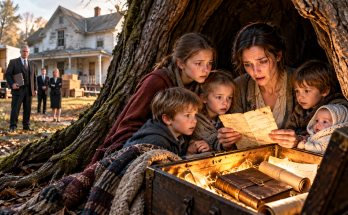
The handwritten note was the hardest thing in the safe for me to look at.
Not the financial records.
Not the sealed folders.
Not even the flash drive.
The note.
A single piece of paper carrying Dad's writing.
I had lifted it when I first opened the safe.
Then I had stopped.
Samuel needed to be present before the contents were handled.
Those were Dad's instructions.
So I had placed it back carefully.
Now it remained there while the investigators continued their examination.
I could see the signature.
That was enough to make my chest ache.
I wondered what Dad had been feeling when he wrote it.
Was he tired?
Angry?
Disappointed?
Had he been afraid that Julian would destroy the documents?
Had he worried that I would surrender the key under pressure?
I didn't know.
And I wasn't going to pretend I did.
But I knew he had written the note for a reason.
He wanted his instructions preserved.
He wanted the evidence protected.
And he wanted the truth handled in front of the right people.
That was why I couldn't rush.
Julian seemed to have forgotten about the note for a while.
He had been concentrating on the financial records.
Every question about authorization made him more defensive.
Every reference to transactions made before Dad's death seemed to irritate him.
He continued insisting that his father had helped him.
Samuel continued asking whether that help included the specific withdrawals being examined.
The conversation moved slowly.
It wasn't the kind of dramatic confrontation Julian seemed to expect.
Nobody shouted that he was guilty.
Nobody demanded a confession.
Nobody announced a punishment.
The investigators examined documents.
Samuel asked questions.
Julian answered, avoided, or complained.
And the process continued.
I found myself appreciating its slowness.
Earlier, I had wanted everything finished.
I wanted to leave the house.
Change my clothes.
Wash my face.
Sit somewhere alone and grieve.
But I understood now that rushing would only create more uncertainty.
Dad had already spent months dealing with questions about his accounts.
He had preserved the records because he wanted them examined properly.
I would not undo his care simply because I was exhausted.
I looked at the bloodstained handkerchief beside me.
It had become stiff.
The cloth no longer folded neatly.
I thought about how casually Julian had struck me.
One moment I was standing beside Dad's coffin.
The next I was tasting blood.
He had been angry because I wouldn't give him the key.
That was the whole reason.
Not because I had threatened him.
Not because I had taken anything.
Because I refused to surrender something Dad had trusted me to protect.
I wondered what would have happened if I had given in.
The question made my stomach tighten.
Julian would have had the key.
He might have opened the safe without Samuel.
He might have handled the documents before the investigators arrived.
He could have claimed the contents were different.
He could have accused me anyway.
I couldn't know exactly what he would have done.
But I knew Dad had wanted the safe opened with witnesses.
And I knew Julian had tried to prevent me from following that instruction.
That was enough.
I didn't need to imagine worse things to understand why I had been right to refuse.
Samuel looked toward me.
He asked whether I wanted some water.
I nodded.
My mouth had become dry.
The swelling made swallowing uncomfortable.
I hadn't noticed how thirsty I was until he asked.
I was embarrassed by how grateful I felt.
Such a small kindness.
Someone noticing that I needed something ordinary.
Water.
A chair.
A moment without being accused.
I had spent so long providing those things for Dad that receiving them felt strange.
I took a careful sip.
My lip stung.
I held the water in my mouth for a moment before swallowing.
Then I set it down.
I looked toward Julian.
He was speaking to Serena quietly.
His expression was tense.
She seemed upset too.
I couldn't hear their conversation.
And I decided I didn't need to.
For years, I had tried to read every expression in the room whenever Julian was angry.
Was he becoming more upset?
Would he shout?
Could I change the subject before things became worse?
I had treated his moods like weather I needed to predict.
That afternoon, I stopped trying.
His feelings belonged to him.
His choices belonged to him.
And whatever he said to Serena was not something I needed to manage.
The realization felt almost unfamiliar.
I could let people have private conversations without assuming I was responsible for what happened next.
Samuel returned to the safe.
The investigators had been comparing the account records.
They were discussing the information carefully.
I understood that they still needed to complete their review.
Dad had left six folders.
Only part of the material had been examined in front of us.
The flash drive remained untouched.
The handwritten note had not been read aloud.
There was still work to do.
I watched Samuel check the arrangement of the documents.
He was precise.
Dad had chosen him for a reason.
I remembered how calm Samuel had sounded when he entered the study.
He hadn't been intimidated by Julian.
He hadn't treated the relatives' expectations as evidence.
And when he saw my injury, he asked whether I wanted medical care and police involvement.
He had separated the two problems immediately.
The assault.
The financial records.
Neither excused the other.
That mattered.
I had spent years allowing family disagreements to become tangled.
If Julian behaved badly, someone would bring up his struggles.
If Dad became angry, someone would remind him Julian was his son.
If I complained, someone would tell me I should be more understanding.
By the end, nobody could remember what had actually happened.
Everything became feelings.
Opinions.
Old grievances.
Samuel wasn't allowing that.
Julian had struck me.
That matter could be reported.
Dad's accounts contained suspicious transactions.
Those records could be examined.
I had been appointed executor.
That responsibility could be carried out according to Dad's wishes.
Each issue had its own facts.
They didn't disappear because someone preferred a different conversation.
I thought about how much trouble our family might have avoided if we had learned that earlier.
Not every disagreement needed to become a judgment about who loved whom.
Not every boundary was rejection.
Not every question was an accusation.
Sometimes a person simply needed to answer what had been asked.
Samuel turned toward Julian again.
He asked whether there was anything specific my brother wanted to clarify about the records under discussion.
Julian hesitated.
Then he repeated that Dad had intended to provide for him.
I felt a deep tiredness.
He was still saying the same thing.
He had not offered a specific authorization.
He had not explained the transactions.
He had not addressed the difference between receiving help and taking money.
He simply returned to what he believed he deserved.
I wondered whether he understood how that sounded to the rest of us.
At the beginning of the afternoon, he had spoken about a fortune.
Now he was speaking about permission.
But the underlying belief had not changed.
Dad's money should have been his.
That was what he kept coming back to.
And I was beginning to understand why Dad had stopped trying to settle the matter through family conversations alone.
You cannot reach an agreement with someone who treats every question as an insult.
You cannot establish facts with someone who keeps changing the subject.
And you cannot protect important documents by trusting a person who has already shown he will use force to get the key.
I looked toward the note again.
Dad had understood.
I wished he hadn't been right.
That thought came with such force that I had to look away.
I wanted a different brother.
Not a perfect one.
Just someone who could stand beside me after our father's death and remember that we had both lost him.
Someone who could ask how I was doing.
Someone who could admit when he was wrong.
Someone who could care more about Dad's final wishes than about claiming his belongings.
I had wanted that for so long.
Even at the church, some part of me had hoped we could share our grief.
Then Julian hit me.
And the hope changed.
It didn't disappear completely.
I don't think feelings work that neatly.
But it became smaller.
Less convincing.
Something I could no longer allow to make decisions for me.
I could still love the brother I remembered.
I could still grieve the relationship I wished we had.
But I could not pretend his actions were harmless.
And I could not sacrifice Dad's instructions to avoid making him angry.
Raymond moved toward my chair.
I noticed him before he spoke.
For a moment, I braced myself.
I expected another lecture about how a family should handle its affairs.
Another reminder that Julian was Dad's son.
Another suggestion that I should be less difficult.
But Raymond didn't say any of those things.
He looked at my lip.
Then at the handkerchief.
His face tightened.
I waited.
He seemed to be searching for words.
Finally, he asked whether I was all right.
It was such a simple question.
I almost didn't know how to answer.
I had been hurt.
I was grieving.
I was sitting in Dad's study while investigators examined evidence against my brother.
Of course I wasn't all right.
But I understood what Raymond was asking.
He was acknowledging my injury.
For the first time since he challenged me at the church, he was looking at me as someone who had been hurt rather than someone holding a key he thought she shouldn't have.
I nodded slightly.
"I'll be all right."
He looked uncomfortable.
He seemed about to say something more.
Then he stopped.
I didn't press him.
I wasn't ready to offer forgiveness he hadn't asked for.
And I wasn't interested in pretending his earlier words hadn't hurt.
But I appreciated the question.
It was more than I had expected.
Raymond moved away.
I watched him return to the other relatives.
I wondered whether Dad would have been pleased that his brother was beginning to see the situation differently.
Perhaps.
But I couldn't know.
And I was tired of imagining what Dad might say about every decision.
He had left instructions.
I needed to follow them.
Beyond that, I had to begin making choices for myself.
That was frightening.
For so long, caring for Dad had organized my days.
There was always something to do.
A bill.
A prescription.
A conversation with the hospital.
A night beside his bed.
Now the tasks were changing.
The estate needed handling.
The financial records needed examining.
The family needed to hear facts they might not like.
And I needed to decide what kind of relationship I could have with Julian after what happened.
That last responsibility was mine alone.
Dad couldn't make that decision for me.
Samuel couldn't.
The investigators couldn't.
The police couldn't.
They could deal with the actions and evidence before them.
But I would have to decide whether I could ever feel safe around my brother again.
I looked toward him.
He was standing beside Serena.
His shoulders were tense.
His expression was guarded.
He wasn't looking at me.
He had not apologized.
I didn't know whether he ever would.
I had spent so much of my life waiting for him to become more reasonable.
I couldn't keep arranging my future around that possibility.
The thought made me sad.
But it also gave me a strange sense of relief.
I didn't have to decide everything that day.
I didn't have to promise reconciliation.
I didn't have to announce that our relationship was over.
I could simply acknowledge what had happened and refuse to excuse it.
That was enough for the moment.
Samuel moved closer to the safe.
He looked at Dad's note.
Then at the remaining documents.
He was preparing to continue the examination.
I watched his hands.
Careful.
Deliberate.
Respectful of what Dad had left.
I thought again about the final lesson Dad had tried to give me.
Patience wasn't waiting forever for someone to treat you properly.
It wasn't accepting abuse because you shared a family name.
And it wasn't avoiding the truth because the truth might hurt someone.
Patience meant allowing the right process to work.
It meant keeping a promise even when pressure made surrender seem easier.
It meant not confusing immediate relief with doing what was right.
I had followed that lesson at the funeral.
I had followed it when I opened the safe.
I had followed it while Samuel examined the records.
And now I understood that the same lesson applied to what came afterward.
I didn't need Julian to admit everything before I could protect myself.
I didn't need Raymond to apologize before I could honor Dad.
I didn't need Serena to approve of my decisions.
I needed to remain honest.
I needed to preserve the evidence.
I needed to tell the police what happened.
And I needed to let the people responsible for examining Dad's accounts complete their work.
I looked toward the open safe.
The folders remained the center of the investigation.
The flash drive was still there.
Dad's note waited beside them.
The key rested in my hand.
It was small.
Warm from being held.
I turned it over once.
Then I placed it carefully beside me.
I no longer felt the urge to hide it beneath my collar.
I had protected it when protecting it mattered most.
The safe was open.
The witnesses were present.
The records were being examined.
And the family could no longer claim there had been nothing to question.
That was enough progress for one terrible afternoon.
Samuel turned toward the investigators.
They resumed their careful review.
I stayed in my chair.
I didn't interrupt.
I didn't explain away Julian's behavior.
And I didn't reach for the handkerchief when my brother began speaking again.
For once, I let his words belong entirely to him.
Source: shadowtnue.com