The child specialist did not react when Rick said Thomas Harlow’s name. She simply kept her hands folded on the table and let several quiet seconds pass.
“What does Grandpa Tom look like?”
Rick described gray hair, a heavy face, and a black truck with chrome steps.
Detective Ramirez stood beside me behind the one-way glass. Her expression barely changed, but she wrote continuously.
The specialist asked, “Had you seen him earlier at the party?”
Rick shook his head.
“So how did you know it was Grandpa Tom?”
“Because he came to our house sometimes. And Brent calls him Dad.”
“What happened when he arrived?”
Rick stared at the small wooden puzzle on the table.
“Mom got out first.”
“And Brent?”
“He got out too.”
“What did they do?”
“They talked by the truck.”
“Could you hear them?”
“Not all of it.”
“Tell me only what you remember hearing.”
Rick pressed one thumb into his opposite palm.
“Mom said, ‘No.’”
My throat tightened.
“What happened after that?”
“Grandpa Tom yelled.”
“What did he say?”
“I don’t know. Then Brent hit the car.”
“With what?”
“His hand.”
The specialist nodded.
“Was Noah awake?”
“He was crying.”
“Why?”
“Because everybody was yelling.”
“And then Grandpa Tom gave Brent something?”
Rick nodded.
“Can you describe it?”
“Small.”
“How small?”
Rick held his hands about eight inches apart.
“Was it a box?”
“No.”
“A bag?”
“Maybe.”
“What color?”
“Brown.”
Ramirez looked at me.
I understood the same thing she did.
Brown could mean almost anything.
Paper bag. Envelope. Cloth pouch. Wallet.
The specialist continued carefully.
“What did Brent do with it?”
“He put it under his shirt.”
“Where?”
Rick touched the front of his stomach.
“Then what?”
“Grandpa Tom told Mom that thing about Dad finding out.”
The words hit harder hearing them a second time.
“If Craig ever finds out about tonight, all of you are finished.”
“What did your mom say?”
“She said, ‘This isn’t about Craig.’”
My pulse jumped.
“What did Grandpa Tom say?”
Rick closed his eyes.
“I don’t remember.”
“Did anybody get back into the Mercedes?”
“Brent did.”
“Where?”
“Driver side.”
“And your mom?”
“Passenger.”
There it was.
The switch.
Not because Laura suddenly became incapable of driving.
Not because Brent became safer.
Because Thomas Harlow had arrived.
“What happened to the black truck?”
“It left first.”
“Which direction?”
Rick pointed right.
“And the Mercedes?”
“We went after it.”
“Did you follow the truck?”
“For a little bit.”
“How long?”
“I don’t know.”
“Did you stop again?”
“No.”
“What happened before the crash?”
Rick’s breathing changed.
“Brent was mad.”
“What was he doing?”
“Driving fast.”
“Was he still holding the brown thing?”
“No.”
“Do you know where it went?”
Rick hesitated.
Then he said, “Mom had it.”
I felt Ramirez shift beside me.
The specialist asked, “What did your mom do with it?”
“She opened it.”
“What was inside?”
Rick’s face pinched with effort.
“I couldn’t see.”
“Did she say anything?”
“Yes.”
“What?”
Rick looked toward the mirror.
“She said, ‘You brought that here with the boys in the car?’”
The room behind the glass seemed to contract.
Ramirez’s pen stopped again.
The specialist did not.
“What did Brent say?”
“He said, ‘Give it back.’”
“Did your mom?”
“No.”
“What happened next?”
“They yelled more.”
“And then?”
“Brent tried to grab it.”
I stopped breathing.
“The car moved.”
Rick’s voice became smaller.
“Like sideways.”
“Was Brent looking at the road?”
“No.”
“Where was he looking?”
“At Mom.”
“And then you hit the mailbox?”
Rick nodded.
The pieces rearranged themselves in my head.
Brent drunk.
Laura driving away from the party.
Thomas Harlow summoned to a roadside meeting.
A brown package passed to Brent.
Laura opening it.
An argument.
Brent taking over the wheel.
Then, while speeding, reaching toward Laura for whatever Thomas had given him.
The Mercedes veering.
The crash.
That did not absolve anyone.
It made the entire situation worse.
The specialist asked Rick whether he had ever seen the brown item afterward.
“No.”
“Did your mom still have it after the crash?”
“I think.”
“What makes you think that?”
“She kept something inside her coat.”
The interview lasted another twenty minutes, but Rick remembered little else.
When it ended, I waited in the hallway while the specialist walked him to another room where Denise had brought Noah coloring books and crackers.
Ramirez stayed behind.
“What was in the package?”
“I don’t know.”
“You have an idea.”
She looked at me.
“Having an idea isn’t the same as having evidence.”
“What kind of thing makes Thomas Harlow tell them I can never know?”
“Maybe the warning wasn’t about the package.”
“It happened immediately after he handed it over.”
“Which matters.”
I lowered my voice.
“Drugs?”
“Possible.”
“Cash?”
“Possible.”
“A gun?”
“Possible.”
That answer made my stomach turn.
“My children were sitting ten feet away.”
“I know.”
“If you think there was a weapon—”
“I said possible.”
She shut her notebook.
“We need Thomas’s phone records and vehicle data. We need to know why he was called and what he was doing on that road at one-thirty in the morning.”
“Can you search his house?”
“Not because an eight-year-old saw him holding a brown package.”
“What about Brent’s house?”
“We already searched the lake property.”
“And found nothing.”
“We found several things.”
Her phrasing caught me.
“What things?”
“I can’t discuss everything.”
“Ramirez.”
“Craig.”
We had reached that familiar wall.
She stepped closer.
“You want certainty immediately because uncertainty is what your children lived inside after the crash.”
I hated how accurately she said it.
“But if we move faster than the evidence, people like Thomas Harlow survive investigations. They have money, attorneys, and years of experience making messy things look clean.”
“So what do I do?”
“Keep your children safe.”
“And wait.”
“Yes.”
I hated that too.
Outside, Denise was leaning against the courthouse wall while Noah tried to balance crackers on Chompy’s head.
Rick came out looking exhausted.
I put a hand on his shoulder.
“You did good.”
He flinched.
I immediately removed it.
“I’m sorry.”
“No. It’s okay.”
He looked up at me.
“Is Grandpa Tom in trouble?”
“I don’t know.”
“Mom says he helps everybody.”
Denise glanced at me.
Rick continued.
“Like if people need money or have problems, he makes it go away.”
That sounded less like generosity than power.
“What kind of problems?”
Rick shrugged.
“Brent says nobody says no to Grandpa Tom.”
I filed the sentence away.
That evening, the mechanic’s lien notice went out.
Denise had prepared it exactly.
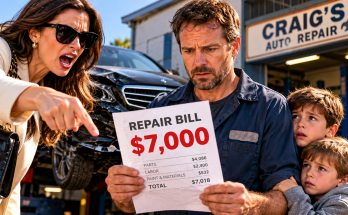
Seven thousand eighteen dollars.
Parts and labor.
Authorization documented through Laura’s messages.
Payment due.
The process felt absurd beside everything else happening, but Denise insisted the civil dispute mattered.
“Why?”
“Because refusing to pursue the bill lets them argue you never expected payment.”
“I don’t care about the argument.”
“A judge might.”
So I signed.
The following morning, Harlow Automotive Group’s attorney sent a response.
Not Brent’s personal lawyer.
Corporate counsel.
The company denied any obligation.
More interestingly, it demanded that I preserve all records concerning the Mercedes, including photographs, invoices, diagnostic logs, removed components, and communications.
I showed the letter to Denise.
She read it twice.
“They want discovery.”
“Why?”
“To find out what police have.”
“Can they?”
“Not through you.”
She folded the letter.
“Thomas is nervous.”
“You think he sent this?”
“I think a corporate attorney doesn’t care about seven thousand dollars unless someone with authority tells him to.”
My phone rang.
Marcus.
I answered.
“You need to see this.”
I heard vehicles in the background.
“What?”
“A guy just came to the shop asking about the Mercedes.”
“Customer?”
“No.”
“Who?”
“He says his name’s Ernesto Delgado.”
I grabbed my keys.
By the time I reached the garage, Ernesto was sitting in my office.
He was smaller than I expected, thin through the shoulders, with white hair combed straight back and a brown jacket too heavy for the weather.
Marcus had given him coffee.
Ernesto stood when I entered.
“You are Craig?”
“Yes.”
He offered his hand.
“I wanted to meet the mechanic who found my car.”
“I’m sorry about what happened.”
“You didn’t do it.”
“No.”
He sat again.
“My wife says I should not involve myself.”
“She may be right.”
He smiled faintly.
“She has been right since 1974. Very irritating.”
I liked him immediately.
Then his expression changed.
“But there is something I did not tell the police first time.”
I sat across from him.
“Why not?”
“Because I thought maybe I imagined it.”
“What?”
“After the Mercedes hit my Honda, I came outside. The woman got out.”
“Laura?”
“I did not know her then.”
“What did she do?”
“She looked at the Honda. Then she walked toward the ditch.”
My attention sharpened.
“What ditch?”
“The drainage ditch beside my mailbox.”
“What did she do there?”
Ernesto leaned forward.
“She threw something.”
Every hair on my arms rose.
“What?”
“I could not see. Small package.”
Brown.
“Did you tell Ramirez?”
“This morning.”
“What happened to it?”
“I don’t know. I searched the next day, but there was rain.”
It had rained hard the morning after September seventh.
If Laura had thrown the package into the ditch, water could have moved it.
Or destroyed it.
“What made you remember?”
“The detective asked if the woman was carrying something.”
“So you remembered.”
“I remembered being angry because she threw trash after smashing my car.”
He smiled without humor.
“But maybe it was not trash.”
An hour later Ramirez arrived with two officers.
Ernesto showed them photographs on his phone of the damaged driveway and ditch.
The search began before noon.
The drainage channel ran behind three properties before emptying into a culvert.
They found beer cans.
A child’s sandal.
Two rusted tools.
Plastic wrappers.
Nothing brown.
By three, Ramirez was ready to stop.
Then one officer working near the culvert called out.
He held up a mud-covered plastic evidence sleeve.
Not police evidence.
Something commercial.
Clear plastic.
Waterproof.
Inside was a brown paper envelope.
Even from several yards away, I could see dark rectangular shapes through the soaked paper.
Ramirez ordered everyone back.
Kyle was called.
The package was photographed where it lay.
Nobody opened it in front of me.
I watched from Ernesto’s porch.
“What do you think?” he asked.
“I don’t know.”
“You know.”
“No.”
I had learned something from Ramirez.
An idea was not evidence.
Two hours later she called me.
“Craig.”
“What was inside?”
Silence.
“Ramirez.”
“Cash.”
“How much?”
“Twenty thousand dollars.”
I gripped the phone.
“That’s what Thomas gave Brent?”
“Likely.”
“Why?”
“We don’t know.”
“Twenty thousand dollars in cash at one-thirty in the morning isn’t normal.”
“No.”
“Anything else?”
She hesitated.
“There was a key.”
“What kind?”
“Small safety-deposit-box style.”
My pulse quickened.
“And a handwritten number.”
“What number?”
She read it.
I wrote it down.
Seven digits.
No explanation.
“Bank account?”
“Maybe.”
“Box number?”
“Too long.”
“Phone?”
“No area code.”
“What are you going to do?”
“Find out.”
I looked toward the shop floor.
Marcus was changing brake pads.
Life continued around the edges of something growing larger by the hour.
“Why would Laura throw away twenty thousand dollars?”
Ramirez answered slowly.
“Maybe she wasn’t trying to throw away the money.”
I understood.
“The key.”
“That’s my current question.”
The envelope had protected both.
Thomas had handed Brent something important enough to bring personally.
Laura had taken it.
Brent had tried to get it back while driving.
Then, seconds after the crash, Laura had thrown the entire package into a drainage ditch rather than let Brent keep it.
The cash might have been valuable.
But perhaps the money had only been camouflage for whatever the key opened.