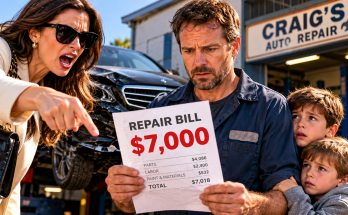
It took almost three weeks to arrange the meeting.
Prosecutors resisted.
Brent’s attorney resisted more.
Dr. Cho insisted the purpose had to be therapeutic, not investigative.
No questions about financial crimes.
No discussion of plea terms.
No coaching.
No promises.
Rick could end it at any moment.
I could end it if he became distressed.
Brent would sit across the room with his lawyer nearby.
A therapist would control the conversation.
By the time everyone agreed, I almost wished they hadn’t.
Rick did not.
He wanted the meeting.
Not eagerly.
Steadily.
That frightened me more.
We arrived at the county family-services building on a gray Thursday afternoon.
Same building where Laura’s early supervised visits had happened.
Same parking lot where Rick told me she had tried to influence his memory.
He held my hand walking inside.
He had not done that in almost a year.
Dr. Cho met us in the hallway.
“Remember, you can stop whenever you want.”
“I know.”
“You don’t have to ask anything.”
“I know.”
“You can change your mind.”
Rick sighed.
“Everybody keeps saying that.”
I almost smiled.
He sounded like me.
Brent entered through another door.
I saw him through a small window before Rick did.
He had lost weight.
His hair was shorter.
No expensive casual confidence.
County-issued ankle monitor visible beneath his pant leg.
For a second I remembered him as a teenager.
BMW.
Easy grin.
The guy who seemed born understanding doors would open.
Then Rick saw him.
His hand tightened around mine.
“Want to leave?”
“No.”
Dr. Cho brought Rick inside.
I remained in the observation room with another therapist.
Not hidden.
Rick knew where I was.
Brent sat opposite him.
His attorney was against the far wall.
Dr. Cho opened.
“Rick has some things he wants to say. Your job is to answer directly and not ask him for reassurance, forgiveness, or anything else.”
Brent nodded.
He looked terrified.
Good.
Rick stared at his shoes.
Then at Brent.
“Were you drunk?”
Brent swallowed.
“Yes.”
“Like really drunk?”
“Yes.”
“Did Mom tell you not to drive?”
Brent’s eyes flicked toward his attorney.
The lawyer nodded.
“Yes.”
“Did you take the keys?”
“Yes.”
Rick’s shoulders rose.
“Why?”
Brent inhaled.
“Because I was angry and thought I could drive.”
“That’s stupid.”
“Yes.”
No defense.
Rick continued.
“Did you know Noah was crying?”
“Yes.”
“Did you know I was scared?”
“I think so.”
“You knew.”
Brent lowered his eyes.
“Yes.”
The room was very quiet.
Then Rick asked the question he had brought with him.
“Why didn’t you stop everything after we crashed?”
Brent looked confused.
Rick leaned forward.
“You could’ve called the ambulance.”
“Yes.”
“You could’ve called police.”
“Yes.”
“You could’ve told Dad.”
“Yes.”
“You could’ve said you were sorry right then.”
“Yes.”
“So why did you keep doing bad stuff?”
Brent’s face collapsed slightly.
No attorney could answer that for him.
No parent.
No Harlow system.
Just Brent.
“I was scared.”
Rick’s expression hardened.
“So?”
The word landed harder than any prosecutor’s question could have.
Brent looked at him.
“I thought I was going to lose everything.”
Rick said, “We could’ve died.”
Brent started crying.
I had never seen him cry.
Rick did not soften.
“You cared more about your stuff.”
Brent covered his mouth briefly.
“Yes.”
It was barely audible.
Dr. Cho watched Rick.
He asked, “Did you love us?”
Brent closed his eyes.
“Yes.”
“Then why wasn’t that bigger than being scared?”
I looked away.
No adult in the room had an answer good enough.
Finally Brent said, “Because I was selfish.”
Rick waited.
Brent continued.
“I kept thinking if I could fix the next thing, I wouldn’t have to face the first thing. Then every choice made another choice worse.”
That was probably the truest thing he had ever said.
“Did Grandma Margaret tell you what to do?”
“Yes.”
“Did Grandpa Tom?”
“Yes.”
“Did Mom?”
“Sometimes.”
Rick frowned.
“But you decided.”
Brent nodded.
“Yes.”
Exactly.
That lesson had taken every adult months to reach.
Rick had it in ten minutes.
“You decided.”
“Yes.”
Rick leaned back.
He looked suddenly exhausted.
Dr. Cho asked whether he had anything else.
Rick shook his head.
Then changed his mind.
“One thing.”
Brent waited.
“I don’t want you to tell Noah you’re sorry yet.”
Everyone looked surprised.
“Why?” Dr. Cho asked.
“He’s little.”
Rick looked at Brent.
“If Noah thinks sorry means everything is okay, he’ll be confused.”
My throat tightened.
Rick was protecting his brother.
Again.
I felt pride and worry in equal measure.
Dr. Cho said, “That’s something adults can decide with Noah’s therapist.”
Rick nodded.
“Okay.”
Then he stood.
Brent said, “Rick.”
Dr. Cho immediately raised a hand.
Brent stopped.
He looked at her.
She said, “No requests.”
He nodded.
Rick walked toward the door.
Before leaving, he turned.
“I’m still mad.”
Brent whispered, “I understand.”
Rick shook his head.
“No, you don’t.”
Then he left.
In the hallway he walked straight into me.
I held him.
He did not cry until we reached the truck.
Then everything came out at once.
“I hate him.”
“I know.”
“I don’t.”
“I know.”
“I wanted him to say something better.”
“I know.”
“He didn’t have anything.”
“No.”
That was the heartbreak of truth.
Sometimes people destroy enormous parts of your life for reasons that sound small when spoken aloud.
Fear.
Money.
Pride.
Selfishness.
Nothing proportional to the damage.
At home, Rick slept for three hours.
Noah asked whether his brother was sick.
“Just tired.”
“From seeing Brent?”
I looked at him.
Kids always knew more than adults thought.
“Yes.”
“Do I have to see Brent?”
“No.”
“Good.”
Simple.
Noah returned to coloring.
The meeting affected Brent’s plea posture.
Not because Rick’s questions became evidence.
They did not.
But according to Ramirez, Brent stopped contesting several crash-related facts afterward.
He accepted responsibility for driving.
Leaving the scene.
Failing to seek medical care.
Concealing the vehicle.
Coercing the children into silence indirectly through threats about custody.
He also agreed to testify against Margaret and Thomas.
His lawyer issued no public statement.
That was probably wise.
Laura’s case moved too.
The judge accepted her plea agreement conditionally.
She would receive a short county sentence followed by probation, mandatory parenting therapy, cooperation requirements, and strict compliance with family-court orders.
No unsupervised contact until Dr. Cho’s team and the court approved.
No contact with Brent.
No contact with Margaret or Thomas except through attorneys when required.
Her sentencing would occur after she testified in the larger case.
I did not write a letter asking for mercy.
I did not write one asking for punishment.
When the prosecutor requested an impact statement, I wrote four pages.
Not about Laura as a wife.
Not about the affair.
Not about money.
Only the children.
Rick becoming afraid of telling truth.
Noah learning to apologize for spilled cereal.
The cracked booster seat.
The missed doctor visit.
The lies.
The way both boys started asking whether adults were angry before answering ordinary questions.
I ended with one sentence:
I do not want the court to punish their mother for my anger; I want the court to understand that choices made to protect adults taught two children that their safety could become negotiable.
Denise read it.
“Don’t change a word.”
So I didn’t.
Harlow Automotive continued restructuring.
Two dealerships were sold.
One closed.
A manufacturer revoked franchise rights.
Hundreds of legitimate employees scrambled.
Tasha heard about former coworkers losing jobs.
She was angry at Thomas.
Also sad.
“Some people worked there twenty years and never touched fraud.”
“I know.”
“They lose health insurance because owners are criminals.”
“I know.”
She tightened a battery terminal harder than necessary.
“I hate how consequences splash.”
That phrase stayed with me.
Consequences splash.
Onto employees.
Children.
Spouses.
Customers.
People who never stood near the original decision.
Maybe accountability meant containing as much of that splash as possible without pretending it did not exist.
I hired another technician from the closing dealership.
His name was Andre.
Forty-six.
Three kids.
Excellent transmission work.
My tiny garage now had four mechanics including me.
We needed another lift.
The idea would have terrified me a year earlier.
Expansion.
Debt.
Responsibility.
Then I remembered Margaret’s note predicting independent failure.
I applied for a small-business loan.
Not because I wanted to prove her wrong.
At least that was what I told myself.
The bank approved it.
Barely.
We ordered the lift.
Marcus said, “Look at you becoming management.”
“Don’t insult me.”
He laughed.
One evening after closing, Laura called through the approved system.
Her sentencing was near.
She wanted to speak to me directly with Dr. Cho present.
I agreed.
“I heard Rick saw Brent.”
“Yes.”
“Was it bad?”
“It was hard.”
“Should he have done it?”
“That was his choice with the therapist.”
She nodded though I couldn’t see her.
“I want to say something before court.”
“Okay.”
“I know your statement doesn’t ask the judge to go easy on me.”
“It doesn’t ask for more either.”
“I know.”
“I kept it about the boys.”
“Thank you.”
There was a long pause.
Then she said, “I used to think you were weak.”
The sentence did not hurt anymore.
“I know.”
“Because you gave in whenever I threatened weekends.”
“Yes.”
“I see now that you were trying to keep access to them.”
“Yes.”
“I made love look like weakness.”
I looked down at my hands.
“That was your mistake.”
“One of them.”
Her voice broke.
“I don’t expect you to forgive me.”
“Good.”
A small laugh through tears.
“I deserved that.”
“No.”
I surprised myself.
“You deserve whatever accountability fits what you did. That doesn’t mean every painful sentence somebody can throw at you is useful.”
She went quiet.
“Craig.”
“What?”
“You’re a better person than I was.”
I hated the comparison.
“I’m not interested in winning that.”
“I know.”
Maybe she finally did.
After the call, I found Rick in the hallway.
He had heard nothing.
He asked, “Mom going to jail soon?”
“Probably for a little while.”
“Can we visit?”
“If you want, and if the therapist thinks it’s okay.”
He nodded.
“I might.”
Then he walked away.
No dramatic decision.
Just possibility.
Two days before Laura’s sentencing, prosecutors executed another warrant at Margaret’s Vermont property.
They had found one memory card in her luggage referencing “contingency audio.”
The property search uncovered a false-bottom drawer.
Inside were recordings of Thomas.
Brent.
Gerald.
Raymond.
Politicians.
Inspectors.
Even Margaret herself dictating instructions.
The woman who trusted no one had documented everything.
One recording concerned the night of the crash.
2:07 a.m.
Margaret speaking to Thomas.
After ordering him to handle police.
After telling Laura to stay quiet.
Thomas said he wanted to send someone to check the boys.
Margaret refused.
Why?
Because anyone examining them could create a medical record.
My hands shook when Park told me.
Thomas had at least briefly suggested help.
Margaret stopped it.
“Does Laura know?”
“Yes.”
“What did she say?”
“She remembered Thomas offering to send a private doctor.”
My stomach turned.
“Private?”
“Possibly someone who would keep quiet.”
“So even his help was corrupt.”
“Yes.”
“But Margaret still said no.”
“Yes.”
“Because records.”
“Yes.”
The difference between them had narrowed to inches.
Neither called emergency services.
Still, the detail mattered.
Margaret had repeatedly chosen concealment even when Thomas showed moments of hesitation.
It strengthened prosecutors’ case that she was not secondary.
She directed.
Laura’s sentencing happened the next morning.
I attended.
Not because I wanted to watch punishment.
Because my statement was part of the record.
Laura stood before the judge.
She did not ask to avoid consequences.
Her attorney emphasized cooperation, lack of prior record, and ongoing therapy.
The prosecutor described the harm.
Then the judge spoke.
She sentenced Laura to six months in county custody, with eligibility for release after four months based on compliance, followed by probation and mandatory family therapy.
Four months minimum.
I had expected less.
Laura closed her eyes.
No collapse.
No pleading.
She nodded.
The judge allowed her two minutes to speak.
Laura turned toward me.
Then toward Rick and Noah’s empty seats.
They were not present.
“I spent years treating fear as permission,” she said. “It wasn’t.”
Her voice shook.
“I told myself I was protecting my children because I was afraid to lose them. But protection that requires children to lie, hide pain, or fear telling their father the truth is not protection.”
The judge listened.
“So I accept this sentence.”
That was all.
Deputies led her away.
I sat still.
Denise whispered, “You okay?”
“No.”
Again.
Always the honest answer.
That evening Noah cried when I told him Mom would be away for a while.
Rick did not.
Later I found him in bed holding Laura’s letter from the supervised visit.
“Want to talk?”
“No.”
I sat anyway.
After several minutes he asked, “Does jail mean she’s bad?”
“We talked about patterns.”
“She did a lot.”
“Yes.”
“She also told the truth.”
“Eventually.”
“That counts?”
“Yes.”
He folded the letter.
“Not enough to erase it.”
“No.”
“Just counts.”
“Yes.”
That seemed to satisfy him.
The next morning, while I was installing the new lift, Agent Park arrived.
She rarely came without calling now.
That made me nervous.
“Something wrong?”
“No.”
She held an envelope.
“Something ended.”
Those words felt unfamiliar.
“What?”
“The state has reached resolution on the repair-bill civil issues and related claims.”
I laughed.
“I thought that ended months ago.”
“Mostly.”
Harlow Automotive’s restructuring administrator had reviewed Laura’s payment.
The company had also reviewed Brent’s defective-repair allegations.
Independent inspection found my work met manufacturer standards.
The forty-thousand-dollar claim had been formally withdrawn with prejudice.
My seven-thousand-dollar invoice was confirmed paid in full.
No lien.
No outstanding dispute.
Just paperwork.
“That’s it?”
“For the repair.”
I stared at the letter.
A whole empire had opened after one invoice.
Now the invoice itself closed with a page saying paid.
Park smiled faintly.
“Sometimes one part of the story gets to be boring.”
I liked that.
I filed the letter in the same cabinet where I kept ordinary customer payments.
Not framed.
Not displayed.
Just closed.
But as Park turned to leave, she stopped.
“One more thing.”
Of course.
I laughed.
“What?”
“Thomas and Margaret are both expected to enter final plea positions next week.”
“Trial?”
“Unclear.”
“Brent?”
“Likely plea.”
“And then?”
“Sentencing. Restitution. Civil cases. Years of cleanup.”
Years.
The criminal story was nearing resolution.
The consequences were not.
Park looked toward the new lift.
“Shop growing?”
“Apparently.”
“Good.”
She left.
I stood beneath the steel columns.
For the first time in months, no urgent call followed.
No new threat.
No hidden device.
No missing person.
No wrecked Mercedes.
Just work.
And the uneasy possibility that life might eventually become ordinary again.