I asked Detective Ramirez one question three times.
“Can I see the video?”
She gave me the same answer each time.
“No.”
The phone had been seized under a warrant. The recording belonged to an active criminal investigation. My relationship to the children did not give me access to raw evidence.
I understood every word.
I hated all of them.
“Describe it again.”
“I already did.”
“Please.”
She sighed.
“The clip begins outside the party house. Timestamp one twenty-eight a.m. Your ex-wife walks to the Mercedes with both boys. She puts Noah in the rear passenger side. Rick enters the other side.”
“And Brent?”
“He appears approximately forty seconds later.”
“Drinking?”
“He has something in his hand. We can’t confirm what’s inside.”
“Bottle?”
“Yes.”
“Then?”
“Laura enters the driver’s seat.”
“Brent passenger.”
“Yes.”
“Car leaves?”
“The clip ends before it moves.”
I rubbed my eyes.
“So Rick could remember Brent driving later.”
“Correct.”
“Why switch drivers?”
“We don’t know.”
“What phone recorded this?”
“Still working on ownership.”
The answer bothered me.
“You have video from somebody’s phone but don’t know whose phone?”
“The device was heavily damaged and apparently wiped. The memory card survived. Metadata is incomplete.”
“Was the phone from the crash?”
“Maybe.”
I looked through the glass toward the garage floor.
Monday afternoon light cut across the concrete.
The shop smelled of oil, metal dust, and burned coffee.
Ordinary things.
I wanted ordinary things back.
“What happens now?”
“We reconstruct the route.”
“How?”
“Traffic cameras. Private security systems. Cell-tower information if we obtain it. Witnesses.”
“Do you think Laura was driving during the crash?”
“I don’t think anything yet.”
She was careful to a degree that felt almost inhuman.
But that discipline was probably why I trusted her.
After we ended the call, I went back to work.
A woman named Evelyn had been waiting two weeks for me to replace the water pump on her Buick.
I had delayed her once because of Laura’s Mercedes.
Then again after the break-in.
I refused to delay her a third time.
There was something calming about a repair with no secrets.
Coolant leaks here.
Bearing fails here.
Replace part.
Bleed system.
Test.
Done.
Human beings were never that cooperative.
At three thirty, the school called.
Rick had punched another child.
I arrived fifteen minutes later.
He sat in the principal’s office with his arms folded, staring at a spot on the carpet.
A boy in his class had apparently said Rick’s mother was going to jail.
Rick hit him once in the mouth.
The principal spoke gently.
“He has never behaved this way before.”
“I know.”
“Given what he’s dealing with, we’re treating this as a serious incident without pretending context doesn’t exist.”
Rick said nothing.
I signed paperwork.
In the truck, we sat for nearly a minute before I started the engine.
“Want to tell me what happened?”
“No.”
“Okay.”
I put the key in the ignition.
“He said Mom’s a criminal.”
I stopped.
Rick stared forward.
“He said his dad read it online.”
“Online?”
“He said everybody knows.”
My stomach sank.
I opened my phone.
There it was.
A local community page had posted photographs of police vehicles outside the Harlow lake property.
The caption mentioned an investigation connected to a suspected hit-and-run.
Comments filled the screen.
People guessed.
People invented.
People recognized the Harlow name.
Some mentioned Brent.
One comment mentioned Laura.
No children were named.
It didn’t matter.
Small towns complete unfinished stories quickly.
“Is Mom a criminal?” Rick asked.
I put the phone away.
“That’s for police and courts to decide.”
“She lied.”
“Yes.”
“She told me to lie.”
“Yes.”
“So is she bad?”
That question was harder than anything Detective Ramirez had asked me.
“People can do bad things without every part of them being bad.”
He frowned.
“That doesn’t make sense.”
“I know.”
“Brent is bad.”
I almost said yes.
Instead I started the truck.
“Brent made choices that put you and Noah in danger.”
“That means bad.”
Maybe children understood certain things more cleanly because they had not yet learned how adults complicate guilt.
At home, Noah wanted macaroni shaped like dinosaurs.
Rick refused dinner.
At seven, the court-approved supervisor brought Laura for her first visit.
The meeting took place at a family-services center.
I waited in another room.
Through a narrow interior window, I saw Laura kneel when the boys entered.
Noah ran to her.
Rick did not.
Laura hugged Noah so hard that he squirmed.
Then she opened her arms to Rick.
He stood three feet away.
I looked down.
The visit lasted one hour.
When the boys returned, Noah carried a new dinosaur.
Rick carried nothing.
Laura appeared behind the supervisor.
Her eyes found mine.
For a second I expected accusation.
Instead she said, “I’m sorry.”
The supervisor immediately stepped between us.
“Please keep communication to parenting logistics.”
Laura nodded.
I led the boys out.
In the parking lot Rick stopped.
“Dad?”
“Yeah?”
“Mom asked if I remembered who was driving.”
I turned.
“When?”
“In there.”
Every nerve in my body lit up.
“What exactly did she say?”
“She said, ‘You remember Brent was driving, right?’”
I looked back toward the building.
The supervisor was still inside.
“Did you answer?”
“I said yes.”
“Did she say anything else?”
“She said sometimes memories get mixed up when people are scared.”
I crouched.
“You didn’t do anything wrong.”
“Was she trying to make me change it?”
“I don’t know.”
I did.
But I would not put the conclusion in his mouth.
I called Denise from the parking lot.
Then Ramirez.
Then the family-services supervisor contacted her own agency.
By nine that night Laura’s visitation privileges were suspended pending review.
The decision made Noah cry.
That was the cruelty of consequences.
Adults could deserve them while children still suffered from them.
Tuesday morning brought another problem.
The bank declined my business card.
I called immediately.
The balance had reached its limit after the Mercedes parts and ordinary shop expenses.
My supplier wanted payment.
Payroll was due Friday.
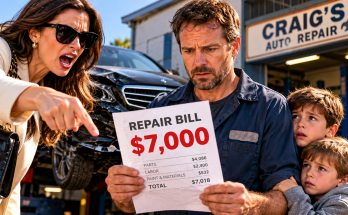
The repair bill Brent refused to pay had moved from insult to threat.
Seven thousand dollars meant very little to a man with multiple dealerships.
To me it could mean missing payroll.
Marcus found me staring at the business account.
“How bad?”
“Manageable.”
“So bad.”
“I said manageable.”
“You only say manageable when something is terrible.”
I shut the laptop.
“I’ll cover payroll.”
“With what?”
“My savings.”
“You have savings?”
“A little.”
“Boss.”
“Don’t.”
He looked angry.
Not at me.
“I can wait.”
“No.”
“I live with my brother.”
“Still no.”
“You might need a lawyer for custody.”
“I already need a lawyer for custody.”
“Exactly.”
I stood.
“This shop doesn’t survive by making employees finance my problems.”
Marcus crossed his arms.
“Then send Brent to collections.”
“I will.”
“Lien the car.”
“Denise is checking.”
His eyes brightened slightly.
“Can we?”
“Maybe.”
“Good.”
It was the first thing all morning that made me smile.
At noon, Denise called.
“You can pursue the repair debt, but we need to be strategic.”
“Why?”
“Because Brent’s attorney is already claiming the work was defective.”
“It wasn’t.”
“I believe you.”
“Then what’s strategic about it?”
“They want a civil fight because civil noise can muddy the criminal narrative.”
I understood.
Brent wanted the public story to become two angry men arguing about a repair bill.
Not a drunk driver and a concealed crash involving children.
“Can I file a mechanic’s lien?”
“On a vehicle titled to Laura, yes, subject to procedural requirements.”
“She’ll say she never authorized seven thousand.”
“You have texts?”
I searched my phone.
There were messages from Laura before the repair.
Need it Friday.
Order whatever you need.
Don’t bother me with every part, just fix it.
I read them aloud.
Denise laughed softly.
“Sometimes people create excellent evidence because they assume they’ll never need to explain themselves.”
We began preparing the lien notice.
At 2:20 Detective Ramirez called.
“We found the phone owner.”
I leaned back in my chair.
“Who?”
“Cynthia Vale.”
The name meant nothing.
“Who is she?”
“A guest at the party.”
“Friend of Laura?”
“Mostly of Brent.”
“What happened to her phone?”
“She says she lost it that night.”
“In the Mercedes?”
“She doesn’t know.”
“Why was it in Laura’s garage?”
“That’s one of several questions.”
I looked at the clock.
“Does Cynthia remember them leaving?”
“Yes.”
“With Laura driving?”
“Yes.”
“Why?”
“Because Brent was too intoxicated.”
That should have simplified everything.
Instead Ramirez continued.
“Cynthia says Laura insisted on driving.”
“Good.”
“Approximately ten minutes after they left, Cynthia received a call from Laura.”
I sat straighter.
“What did she say?”
“She asked whether Brent had left his wallet.”
“That’s it?”
“No.”
Ramirez paused.
“Cynthia says Laura sounded angry.”
“At Brent?”
“Yes.”
“Why?”
“She wouldn’t explain. Then the call ended.”
I tried to construct the route in my mind.
Party house.
Laura driving.
Brent passenger.
Children back seat.
Argument.
Somewhere they stop.
Brent takes over.
Crash.
“What time was the call?”
“One thirty-nine.”
My skin prickled.
“The crash was one forty-two.”
“Yes.”
“Three minutes later.”
“Yes.”
“That doesn’t leave time to switch drivers.”
“Correct.”
I went silent.
If Cynthia’s memory and phone record were right, Laura had been driving at 1:39.
The Mercedes crashed at 1:42.
Rick remembered Brent behind the wheel.
Both things could not be true unless the switch happened almost immediately.
“Where was the call made?”
“We have tower data but not exact location yet.”
Then Ramirez told me why she had called.
A business camera two miles from the party house captured the Mercedes at 1:31.
Laura was driving.
A convenience-store camera captured the same vehicle at 1:34.
Still Laura.
Then nothing.
The next confirmed event was the crash at 1:42.
“We have eight minutes missing,” I said.
“Twelve, depending on which timeline point we use.”
“What road connects the cameras to Lakeshore?”
“Several.”
“Do any require them to stop?”
“No.”
“Then why would they switch drivers?”
“We don’t know.”
That phrase again.
I stood and walked toward the office door.
“Rick said Brent was driving.”
“I believe Rick remembers what he saw.”
“And Cynthia says Laura was driving.”
“Yes.”
“And Laura asked Rick yesterday if he remembers Brent driving.”
“Yes.”
The thought landed slowly.
“She wasn’t trying to convince him Brent drove.”
Ramirez waited.
“She was checking whether he remembered the switch.”
Silence.
“That’s possible,” she said.
A cold feeling spread through me.
“What happened during those missing minutes?”
“We’re trying to find out.”
That evening, after the boys were asleep, I opened the box where I had stored old divorce documents.
I wasn’t sure what I was looking for.
Maybe nothing.
Maybe proof that the past had always contained clues I refused to see.
Near the bottom was a photograph from one of Rick’s school fundraisers three years earlier.
Laura stood beside me.
Brent was in the background.
I had forgotten he attended.
Beside Brent stood another man.
Older.
Gray hair.
Heavy shoulders.
I recognized him only because I had seen his face recently on a dealership website.
Thomas Harlow.
Brent’s father.
Founder of Harlow Automotive Group.
The man who had supposedly retired two years earlier.
I stared at the photograph.
Then I remembered something Rick had said during the diner conversation.
A detail I had barely registered because everything else had been worse.
After the crash, before they went home, Rick said they “waited for another car.”
I had assumed he meant a tow arrangement.
Now I called Ramirez.
She answered.
“What is it?”
“I forgot something.”
I hated the sentence as soon as I said it.
“What?”
“Rick said they waited for another car after the crash.”
“Where?”
“He didn’t say.”
“Did he identify who came?”
“No.”
I looked at Thomas Harlow’s face in the old photograph.
“Ramirez, did anybody call Brent’s father that night?”
A pause.
“We subpoenaed several records.”
“And?”
“I can’t discuss everything yet.”
“That means yes.”
“I didn’t say that.”
“You didn’t need to.”
I heard her exhale.
“Craig, let us do our jobs.”
“I’m trying.”
“I know.”
Before hanging up, she added one thing.
“Keep tomorrow afternoon open.”
“Why?”
“Rick’s second interview is at two.”
“About what?”
“The missing time.”
I looked down the hallway toward the room where my sons slept.
“What do you think he remembers?”
“We’ll find out.”
At two the next afternoon, Rick sat in a quiet interview room with a child specialist while I watched from behind one-way glass.
She did not mention Thomas Harlow.
She did not mention another vehicle.
She simply asked Rick to tell the story again, starting when they left the party.
This time he added a detail.
“Mom was driving first.”
My breath stopped.
The specialist stayed calm.
“And then what happened?”
“Mom and Brent were yelling.”
“What happened next?”
“Mom stopped.”
“Where?”
“By the boat place.”
I looked toward Ramirez.
She was already writing.
“Then what?”
“Brent got out.”
“Did anyone else get out?”
“Mom.”
“What did you and Noah do?”
“Stayed in the car.”
“What happened outside?”
“I couldn’t hear.”
“Did anyone else come?”
Rick nodded.
“A black truck.”
Ramirez’s pen stopped.
“Who was in it?”
Rick stared at the tabletop.
“Grandpa Tom.”
I closed my eyes.
Thomas Harlow.
The missing person nobody had mentioned.
The specialist asked one final question.
“What happened after Grandpa Tom came?”
Rick looked toward the mirrored wall without knowing I was behind it.
“He gave Brent something.”
“What?”
“I don’t know.”
“And then?”
Rick swallowed.
“Grandpa Tom told Mom, ‘If Craig ever finds out about tonight, all of you are finished.’”