Laura was released from county custody five months after sentencing.
Good behavior shortened the final stretch slightly, but not enough to change what the boys felt. Noah counted the weeks on a paper calendar Dr. Cho made with him. Rick refused to count anything.
“Counting makes it slower,” he said.
I understood.
During Laura’s sentence, she wrote regularly.
Not to me.
To Rick and Noah.
Every letter went through the approved process. Dr. Cho reviewed them. Nothing about the cases. No blaming Brent. No excuses involving Margaret. No requests that the boys persuade me to change visitation.
Mostly she wrote about ordinary things.
A book she was reading.
A woman in her therapy group who snored.
A bird that landed outside the recreation-yard fence.
Once she described learning to repair a broken cabinet hinge and admitted she finally understood why I hated watching people use the wrong screwdriver.
Rick laughed at that.
Noah asked whether Mom was becoming a mechanic.
“No,” I said.
“Good. That’s Dad’s job.”
Apparently career territories had been assigned.
My own letters to Laura stayed practical.
School updates.
Medical appointments.
Therapy scheduling.
Photographs the boys chose themselves.
I never wrote about us.
She never asked.
That restraint was new.
So was mine.
The garage kept growing.
Not explosively.
I had learned to distrust explosive growth.
Steadily.
A fifth employee joined us part-time to handle front-desk work three afternoons each week. Her name was Kelly, and within two days she reorganized a filing system I had defended for years while secretly knowing it was terrible.
Marcus passed two certification exams.
Tasha became the person customers specifically requested for electrical problems, which annoyed me only because she enjoyed pointing it out.
Andre repaired transmissions that other shops had already declared dead.
The new lift paid for itself faster than I expected.
We replaced the old coffee machine.
That may have been the biggest improvement.
The Harlow cases faded from national news.
There were still appeals.
Restitution fights.
Civil claims.
Asset auctions.
The kind of legal cleanup that lasts years after television cameras find another disaster.
Several dealership properties reopened under new ownership.
Employees who had nothing to do with fraud found work again.
Some customers recovered money.
Others probably never recovered everything.
There was no version of the ending where every loss became whole.
That stopped bothering me once I understood endings differently.
An ending does not restore what existed before.
Sometimes it only marks the point where new damage finally stops accumulating.
Laura’s release did not change custody.
The court order remained exactly as written.
Sole legal and physical custody with me.
Therapeutic contact for her.
No assumption that release meant progression.
Dr. Cho would decide when the boys were ready.
Laura understood.
At least she said she did.
Her first visit happened in the same family-services building where so many difficult conversations had occurred.
I drove the boys there.
Noah vibrated with nervous energy the whole way.
“Is Mom going to look different?”
“Probably not much.”
“Does jail make your hair different?”
“I don’t think so.”
“Do you know?”
“No.”
Rick looked out the window.
He had become quieter that week.
Not distant.
Careful.
At the entrance he stopped.
“What if I don’t want to hug her?”
“Then don’t.”
“What if Noah does?”
“That’s his choice.”
“What if Mom cries?”
“That’s hers.”
He looked at me.
“You really mean that?”
“Yes.”
He nodded.
That was one lesson I wished he had never needed.
Other people’s emotions were not his responsibility.
Laura waited inside with Dr. Cho.
I saw her through the window before the boys entered.
She had lost weight.
Hair shorter.
Same posture when anxious.
Hands folded too tightly.
No orange uniform.
Simple jeans.
Gray sweater.
No jewelry.
No expensive sunglasses.
Nothing that announced a reinvention.
Noah walked in first.
Stopped.
Then ran.
Laura dropped to her knees.
He hit her with enough force to rock her backward.
She held him.
Her face folded into his shoulder.
She cried.
Noah cried.
Happy crying, apparently, did count differently.
Rick stayed near the doorway.
Laura saw him.
She did not open her arms.
Did not say come here.
Did not ask whether he missed her.
She only said, “Hi, Rick.”
“Hi.”
“I’m really glad to see you.”
He nodded.
That was all.
For the first ten minutes he barely spoke.
Then Laura mentioned his dark-blue bedroom.
He corrected her.
“It’s not dark blue. Dad made me pick medium blue because he said dark would make it look like a cave.”
I watched from the observation room.
Laura smiled.
“That sounds like Dad.”
Rick smiled too.
Tiny.
Real.
The session lasted fifty minutes.
Near the end, Noah climbed into Laura’s lap.
Rick remained beside her chair.
When Dr. Cho announced time, Laura’s face changed, but she controlled it.
She did not say it was unfair.
Did not ask for another ten minutes.
She said, “Okay.”
Then to the boys:
“Thank you for coming.”
Thank you.
Not I need you.
Not don’t leave me.
Not tell Dad.
That mattered.
Noah hugged her again.
Rick stood.
Laura waited.
Then he stepped forward and hugged her briefly.
She made no sound until he let go.
Outside, Rick walked ahead.
Noah talked continuously about everything Mom had said.
Halfway to the truck, Rick stopped.
“Dad?”
“Yeah?”
“She’s different.”
I chose my answer carefully.
“She acted differently today.”
He frowned.
“That’s what I said.”
“No. Different is something we see over time.”
He thought about it.
“Like rust repair.”
“Exactly.”
He rolled his eyes.
“You use car stuff for everything now.”
“You started it.”
He almost smiled.
The visits continued every other week.
Then weekly.
Still supervised.
Laura never missed one.
Never arrived late.
Never asked for faster progress.
That impressed Dr. Cho more than anything Laura could have said.
Months passed.
The house changed too.
We painted.
Fixed the kitchen floor.
Built shelves in the garage shed.
Noah continued his diplomatic campaign to domesticate the squirrel.
Unsuccessful.
Rick joined a robotics club.
He became interested in electric motors and told me gasoline engines were “probably old-person technology.”
I considered eviction.
One Saturday morning, almost a year after the Mercedes first arrived, I found an envelope beneath the garage door.
For one terrible second I assumed the past had returned.
Then I saw the handwriting.
Laura.
No threat.
No secret evidence.
She had left it with Kelly the day before.
Inside was a copy of a document.
Voluntary relinquishment of any claim to proceeds from certain Harlow-related assets.
I called Denise.
“What is this?”
“Laura received a settlement interest connected to property division with Brent.”
“How much?”
“Enough to matter.”
“And she gave it up?”
“Not all of it.”
“What did she do?”
A portion went toward restitution tied to victims affected by the crash and Harlow financial cases.
Another portion had been placed into trust for Rick and Noah.
Education.
Medical needs.
No access by Laura.
No access by me except under the trust rules.
I sat down.
“She didn’t tell me.”
“She specifically asked me not to present it as evidence she had changed.”
That was why it mattered.
“What does she keep?”
“Enough to start over.”
“Where?”
“She rented an apartment.”
“Near here?”
“Twenty minutes away.”
Not a lake house.
Not Brent’s world.
Just an apartment.
Denise continued.
“She also got a job.”
I laughed.
“Doing what?”
“Medical office scheduling.”
That surprised me.
“Why?”
“Apparently someone in her therapy program helped her apply.”
I imagined Laura sitting at a desk answering phones.
The woman who once believed my forty-two-thousand-dollar mechanic salary meant I was going nowhere.
People change in uncomfortable circles.
“Do the boys know about the trust?”
“Not yet.”
“Good.”
They did not need money becoming another symbol of love.
That evening, I asked Laura during the scheduled parenting call why she had done it.
She stayed quiet for several seconds.
“Because some of the money came from a life I don’t want them measuring themselves against.”
“That sounds dramatic.”
She laughed.
“Maybe.”
“You could’ve used it.”
“I kept some.”
“Denise said.”
“I’m not becoming a saint.”
“Good. That would be unsettling.”
The conversation almost felt like something from before everything broke.
Not marriage.
Not friendship exactly.
Familiarity without warfare.
Then Laura said, “Craig?”
“Yeah?”
“I need to ask you something.”
My body tensed out of habit.
She noticed.
“Not about custody.”
“Okay.”
“Do you think you’ll ever forgive me?”
The question sat there.
A year earlier I might have answered with anger.
Six months earlier with uncertainty.
Now I understood the problem better.
Forgiveness sounded like one thing.
It wasn’t.
There was legal forgiveness.
Emotional forgiveness.
Trust.
Reconciliation.
Release.
Memory.
None were interchangeable.
“I don’t know what forgive means anymore.”
Laura exhaled slowly.
“Fair.”
“I don’t want revenge.”
“I know.”
“I don’t wake up angry at you every day.”
“That’s something.”
“But I’m not going to pretend what happened is gone.”
“I’m not asking you to.”
“And I don’t trust you with the boys without structure yet.”
“I know.”
She stayed quiet.
I added, “But I don’t hate you.”
She cried.
Softly.
No performance.
“Thank you.”
“That isn’t forgiveness.”
“I know.”
Maybe it was part of it.
Maybe not.
Several weeks later Dr. Cho recommended the first unsupervised visit.
Three hours.
Daytime.
Public places.
Laura nearly refused.
That surprised everyone.
“What if I mess it up?”
Dr. Cho told me she asked.
The old Laura feared losing control.
The newer version feared misusing it.
Neither was ideal.
But only one could eventually become responsible.
Rick wanted to go.
Noah definitely wanted to go.
So they did.
Museum.
Lunch.
Bookstore.
Laura returned them eleven minutes early.
I noticed because she had once threatened me over one minute.
She noticed me noticing.
Neither of us said anything.
Noah carried a dinosaur book.
Rick carried nothing.
That mattered too.
No bribery.
No gifts beyond a shared book Noah chose.
“How was it?” I asked later.
“Fine,” Rick said.
Noah shouted, “WE SAW A GIANT SLOTH.”
Apparently fine included prehistoric mammals.
Weeks turned into months.
Visits expanded.
No overnights.
Not yet.
Maybe someday.
Maybe not.
The court would move slowly.
So would we.
I was learning not to treat slowness as failure.
One Friday, a black Mercedes pulled into the shop.
My whole body reacted before my brain could stop it.
Marcus saw my face.
“You okay?”
I looked at the vehicle.
Different model.
Different owner.
Older man stepped out holding an estimate from another shop.
“Check-engine light.”
Normal.
Just a Mercedes.
For the first time, I realized the shape of a car could hold fear.
I took the keys.
Ran diagnostics.
Bad oxygen sensor.
Nothing hidden.
No crash data.
No blood.
No dinosaur.
I repaired it.
Customer paid.
Drove away.
Life had become ordinary enough for a Mercedes to be only a car again.
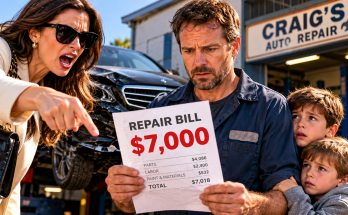
That night I opened the drawer containing Laura’s old seven-thousand-dollar invoice.
Seven thousand eighteen.
Paid.
I put the repaired Mercedes’s new invoice behind it.
Four hundred eighty-six dollars.
Also paid.
I smiled.
Records.
One terrible.
One ordinary.
Both real.
At home, Rick was waiting at the kitchen table.
“Dad?”
“Yeah?”
“Mom asked if she could come to my robotics thing.”
I stopped.
“Did she ask you or me?”
“Me.”
My expression must have changed.
“She said I had to ask you and it was okay if the answer was no.”
Better.
“What do you want?”
“I want her there.”
“Then she can come.”
He studied me.
“You won’t be weird?”
“I’m always weird.”
“Dad.”
“I’ll be fine.”
The event was Saturday.
Laura arrived alone.
Sat three seats away.
No drama.
Rick’s little robot drove off the table and broke a wheel.
He stared at it.
Then laughed.
I did too.
Laura laughed.
For one moment the three of us were looking at the same child, reacting to the same ridiculous failure, without custody or betrayal standing visibly between us.
Nothing erased.
Nothing repaired completely.
Still possible.
On the drive home, Rick said, “That was normal.”
I nodded.
“Yes.”
He looked out the window.
“I like normal.”
So did I.
A few days later, the final notice arrived from federal prosecutors.
The major Harlow cases were closed for practical purposes.
No new cooperation required from me.
No more evidence holds on my records.
No pending subpoena.
If appeals changed anything, they would contact counsel.
I read the notice twice.
Then placed it in the file.
The case was ending.
The family story was not.
That was the difference.
The final part would not be about Thomas or Margaret.
Not really.
They had already made their choices.
The last unresolved thing was whether I would keep building my life around what they had done or finally let what came next belong to us.

One Comment on “PART 29 – Laura Came Home With No Claim to the Boys and One Question I Could Answer Only After Seeing Who She Had Become”