Thomas pleaded guilty first.
Nobody expected it.
His attorneys had spent months preparing for a fight.
Then Margaret refused the joint strategy they had been building.
According to prosecutors, she would not accept language describing Thomas as the primary architect of the fraud.
Thomas responded by refusing to protect her.
Decades of partnership ended in competing plea agreements.
Denise called it predictable.
I found it sad in a way I did not expect.
Not because I felt sympathy.
Because two people had built an entire life around control and reached the end with no one left to trust.
Thomas admitted conspiracy to commit financial fraud.
Bribery.
Obstruction.
Witness interference.
Participation in the crash cover-up.
He admitted arranging my termination and employment interference.
He admitted using Raymond Pike.
He admitted pressuring Larry.
He admitted directing Derek after the garage break-in, though Brent had issued the immediate order.
His plea required testimony against Margaret.
Margaret refused to plead to the most serious racketeering count.
She admitted certain financial offenses and obstruction but denied directing the entire structure.
Prosecutors prepared for trial on remaining counts.
“What sentence is Thomas facing?” I asked Park.
“Likely decades in federal custody depending on calculations.”
“He’s old.”
“Yes.”
“So effectively life.”
“Possibly.”
Brent’s deal followed.
He pleaded guilty to federal fraud conspiracy plus state charges from the crash.
DUI.
Hit-and-run.
Child endangerment.
Obstruction.
The recommendation was substantial prison time.
Less than he might have received without cooperation.
Still years.
I felt no relief hearing that.
Just completion.
Raymond Pike pleaded guilty too.
Gerald eventually did.
Calvin.
Derek received the lightest outcome among the major participants because he cooperated early and his criminal role, though serious, was narrower.
Larry faced separate bribery and employment-related charges plus civil exposure.
Eleanor and Cynthia became witnesses.
Mercer entered his own plea for financial crimes.
Voss received limited immunity for certain conduct in exchange for full cooperation.
Nobody came out clean.
That felt more truthful than any version where one evil mastermind controlled dozens of innocent people.
Thomas and Margaret built the machine.
Others chose whether to keep it running.
Some choices were coerced.
Some greedy.
Some frightened.
Some selfish.
All mattered.
The family court scheduled our final custody hearing six weeks after Laura began serving her sentence.
By then Rick and Noah had lived with me long enough that my apartment no longer felt like Dad’s weekend place.
Their stuff had multiplied.
Shoes everywhere.
School papers on the refrigerator.
Noah’s dinosaurs occupying an entire shelf.
Rick’s model cars lined along the windowsill.
I had moved from the couch into a foldout bed in the small office.
Not comfortable.
Worth it.
The garage had also changed.
New lift.
Andre settled in.
Tasha running diagnostics.
Marcus taking evening certification classes because I told him the shop would pay.
He pretended not to care.
Then studied every night.
I started looking at houses.
Not lake houses.
Nothing impressive.
Three bedrooms.
A small yard.
Close to school and garage.
I found one twelve minutes away.
Ugly kitchen.
Good roof.
Detached shed.
Rick liked the basement.
Noah liked a tree that looked climbable.
The bank approved the mortgage.
When I signed the offer, my hands shook harder than when I opened the shop.
Years earlier Laura had said Brent offered the house, the money, the stability.
Now stability looked different.
Not luxury.
Predictability.
A key in the same bowl every night.
School lunches packed.
Nobody threatening weekends.
Nobody telling children what story to memorize.
Laura appeared at the final custody hearing by secure video.
County uniform.
Hair pulled back.
No makeup.
The sight hit the boys harder than I expected, even though they watched only briefly from a separate room with Dr. Cho.
They did not testify.
Thank God.
The judge had enough.
Denise asked for permanent sole legal and physical custody to me.
Laura’s attorney did not contest.
That was the first shock.
The second came when Laura spoke.
“I agree.”
The judge asked whether she understood.
“Yes.”
“Permanent sole custody is different from temporary placement.”
“I understand.”
“You are giving Mr. Morrison authority over education, medical decisions, residence, and ordinary parenting matters.”
“Yes.”
“You are not surrendering parental status, but contact will remain subject to court conditions.”
“I understand.”
The judge looked over her glasses.
“Why are you agreeing?”
Laura swallowed.
“Because I spent years treating custody like proof that I was the better parent.”
My chest tightened.
She continued.
“It became something I had to win.”
She looked toward the camera.
“But Craig has given the boys something I didn’t.”
The judge waited.
“Safety without conditions.”
I looked down.
Laura’s voice cracked.
“When they were with me, too many things depended on whether adults were angry, whether Brent was drinking, whether Margaret approved, whether I was scared. Craig’s home became the place where telling the truth didn’t change whether they were loved.”
Nobody in the courtroom moved.
“I want contact with my children,” she said. “I want to rebuild trust. But I don’t want them living inside another fight while I prove I deserve something.”
The judge asked whether anyone pressured her into agreeing.
“No.”
“Any promises?”
“No.”
“Do you understand this may remain the arrangement even after your criminal sentence and probation conclude?”
Laura closed her eyes briefly.
“Yes.”
The judge accepted.
Permanent sole custody.
Therapeutic supervised visitation for Laura after release.
Future modifications only through clinical recommendation and court review.
No contact with Brent, Thomas, or Margaret around the children.
No Harlow relative could access school or medical records without my written authorization or a court order.
It was over.
Not parenting.
Not Laura’s relationship with the boys.
The fight.
The legal tug-of-war that had shaped nearly half of Rick’s life.
I sat there expecting triumph.
Instead I cried.
Quietly.
Embarrassingly.
Denise handed me tissues without comment.
After court, Dr. Cho brought the boys out.
Rick immediately knew.
“Dad?”
“They’re staying with me.”
He stared.
“Like for real?”
“Yes.”
Noah asked, “Forever?”
I hesitated.
“Your home is with me.”
“Forever?”
Kids hate legal nuance.
“As far as I’m concerned, yes.”
Noah launched himself at my waist.
Rick stayed still.
Then asked, “Can we still see Mom?”
“Yes.”
His shoulders dropped.
That had been the hidden fear.
Winning me could mean losing her.
He had lived too long inside adult either-or thinking.
“When she gets out?”
“With Dr. Cho helping.”
“Okay.”
Then he hugged me too.
The three of us stood in a courthouse hallway crying like people in a movie I would normally make fun of.
Denise pretended to read her phone.
Outside, reporters waited because of the Harlow cases.
None knew our hearing ended that morning.
I was grateful.
Some moments should remain small.
We drove to the new house.
I had not planned to show the boys until closing completed, but the seller had agreed to let us measure rooms.
Noah ran straight to the tree.
Rick went downstairs.
I stood in the ugly kitchen.
The cabinets were brown.
Countertops chipped.
Linoleum curling near the refrigerator.
Laura would have hated it.
That thought came automatically.
Then disappeared.
This house was not a statement to her.
That mattered.
Rick came upstairs.
“Can I paint my room dark blue?”
“Yes.”
“Really?”
“Probably.”
“What does probably mean?”
“It means your dad wants to see the paint sample first.”
He rolled his eyes.
Noah ran inside.
“There’s a squirrel!”
“Good.”
“Can we keep him?”
“No.”
“Why?”
“Because he belongs outside.”
He looked betrayed.
Normal problem.
Excellent problem.
That afternoon we celebrated with diner milkshakes.
Same booth where Rick had first told me what happened.
Noah put Chompy on the table.
Doreen brought four cherries without being asked.
Rick noticed.
“Last time we sat here everything was bad.”
“Not everything.”
“You found Chompy.”
Noah held the dinosaur up proudly.
“Best day.”
Rick looked at him.
“You cried for like twenty minutes.”
“I was happy.”
“Still crying.”
“Happy crying counts different.”
He was right.
I understood now.
Two days later I received a certified letter from Laura.
Because she was incarcerated, all personal mail had been reviewed.
Inside was a handwritten note.
Not long.
She said she had heard the custody order was final.
She would not appeal.
She would use her time in custody to continue therapy.
She asked me not to promise the boys she would be different.
Only to let her prove whatever change happened later.
That was perhaps the wisest thing she had ever asked.
At the bottom:
You were right to stop giving in.
I read the sentence several times.
For years I thought giving in was the price of staying connected to my sons.
Then the Mercedes came.
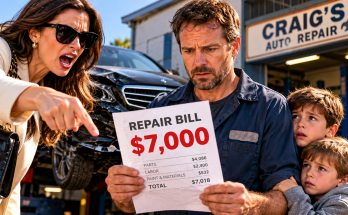
Seven thousand dollars.
One more demand.
One more threat.
I gave in again initially.
Bought parts.
Moved customers.
Worked late.
Then evidence made continuing obedience impossible.
The change did not happen because I became fearless.
I remained afraid constantly.
I simply found something worse than the fear.
Knowing silence could hurt Rick and Noah.
That became the line.
Thomas’s sentencing happened next.
I did not attend.
Park later told me the judge imposed a sentence that, given Thomas’s age, would almost certainly keep him in federal custody for the rest of his life.
Restitution orders reached millions.
Assets seized.
Properties sold.
Dealership victims entered compensation programs.
Thomas apologized in court.
I did not watch the clip.
Brent received more than a decade across combined sentences after federal and state calculations.
Less than maximum.
More than his lawyers wanted.
His driver’s license would be revoked for years if he ever returned to ordinary life outside custody.
Rick asked how long.
I told him.
He said, “That’s a lot.”
“Yes.”
“Is it enough?”
“I don’t know.”
He sighed.
“You really need another answer.”
“No.”
That one was the correct answer.
Margaret chose trial on the remaining charges.
Then, after three former associates testified and Cynthia’s recording was admitted in part, she changed course.
Guilty plea.
Racketeering conspiracy.
Obstruction.
Witness intimidation.
Financial crimes.
Her age also made the sentence effectively life-altering.
When the judge asked if she understood, Margaret said yes.
No visible emotion.
Calm to the end.
That bothered me less than it once would have.
Her calm had power only when other people mistook it for innocence.
Now it was just temperament.
One evening, months after the crash, Marcus and I closed the garage.
The new lift stood empty.
Tasha and Andre had left.
Rick sat at the office desk doing homework.
Noah slept in a chair with Chompy on his chest.
I looked at the black Mercedes invoice in the filing cabinet.
Seven thousand eighteen dollars.
Paid.
I almost threw it away.
Then decided not to.
Not as a trophy.
As a record.
Records mattered.
Write what you saw.
Write what you did.
Remember the truth.
My uncle taught me that about cars.
The last year taught me it applied to people too.
Agent Park stopped by the following week.
No warrant.
No bad news.
She returned a box of materials no longer needed as evidence.
Old photographs.
Copies.
Non-evidentiary shop items.
Among them was the center-console trim from the Mercedes.
The cracked plastic piece where the flash drive had been hidden.
“Want it?”
“No.”
I surprised myself with how fast I answered.
She smiled.
“Good.”
“Destroy it.”
“Evidence disposal process will.”
“Even better.”
I did not need a souvenir of the thing that broke open my life.
I had enough reminders.
The boys.
The business.
The corrected custody order.
The house closing scheduled for Friday.
The truth in official records.
“What happens to the Mercedes?” I asked.
Park shrugged.
“Asset proceedings. Ownership is complicated.”
I pictured Ernesto’s idea.
Petunias.
“Too bad.”
“What?”
“Nothing.”
She left.
Friday morning I signed mortgage papers.
Then picked Rick and Noah up from school.
We drove to the house.
I handed Rick one key.
Noah protested.
“I want key!”
“You’re five.”
“I can key.”
“That is not a verb.”
“It is now.”
I gave him a plastic copy from the hardware store.
He accepted.
We opened the front door together.
Empty rooms.
Dust.
Echo.
No furniture yet except three sleeping bags and a folding table.
Noah ran through every room shouting to hear his voice bounce.
Rick stood in the doorway of the dark-blue bedroom that was not yet dark blue.
“Dad?”
“Yeah?”
“Are we rich now?”
I laughed.
“No.”
“Good.”
That surprised me.
“Why good?”
He shrugged.
“Rich people in our story were weird.”
I laughed harder.
“Money wasn’t the problem.”
“I know.”
He looked around.
“This feels rich.”
That stopped me.
“What?”
“Having our own rooms.”
My throat tightened.
“Yeah.”
Maybe it did.
That evening we ate pizza on the floor.
Mrs. Finch came.
Marcus.
Tasha.
Andre.
Denise.
Dr. Cho declined because boundaries mattered.
Ernesto brought a plant.
Doreen brought a pie.
No reporters.
No lawyers except one friend.
No investigators.
Just people.
At one point I stepped onto the porch.
Through the window I could see Rick arguing with Marcus about whether a model-car engine had been assembled correctly.
Noah chased the squirrel outside until I told him to stop.
Denise handed out paper plates.
Somebody laughed.
For years Laura had chased the kind of house she used to look at through other people’s windows.
Large.
Expensive.
Proof.
I finally understood the part both of us had missed.
The house had never been the point.
What happened inside was.
My phone buzzed.
A message from the county facility.
Approved communication from Laura.
Only one sentence.
Tell them I love them, and tell them the new house sounds perfect.
I showed Rick later.
He read it twice.
Then handed the phone back.
“Can we send her a picture?”
I hesitated.
Court rules allowed approved family photographs.
“Yes.”
He and Noah stood on the porch.
Rick put one arm around his brother.
Noah held Chompy toward the camera.
I took the picture.
Before sending it, I asked, “You both okay with this?”
“Yes,” Rick said.
Noah shouted, “Send Chompy!”
So I did.
Not forgiveness.
Not restoration.
A beginning.
That night, after everyone left, I lay in a sleeping bag in the living room.
The boys slept in their rooms.
The house creaked.
A furnace switched on.
Somewhere outside, the squirrel probably owned half the yard.
I stared at the ceiling.
The criminal cases were resolving.
The custody case was done.
The garage survived.
The repair bill was paid.
Yet one thing remained.
The truth had been established legally.
The boys were safe.
But I still had to decide what kind of relationship, if any, I could eventually have with Laura.
Co-parenting from a distance was one thing.
Trust was another.
Forgiveness was something else entirely.
The next chapter of my life would not be decided by a judge.
That might have been the hardest part.