Brent asked to cooperate three days later.
I heard about it from Denise because his attorneys notified prosecutors across several related cases.
“Everybody eventually talks.”
I had said that before.
This time Denise replied, “Some people wait until silence becomes more expensive than betrayal.”
That sounded like Brent.
I did not attend his proffer.
I did not want to.
But because his statement included the crash and the boys, Ramirez summarized the relevant portions afterward.
Brent admitted most of what evidence had already proven.
He drank heavily at the party.
He struck Voss.
He left with Laura and my sons.
Laura drove first.
He forced the stop near the marina because Thomas had cash and the safety-deposit key.
He took the wheel against Laura’s resistance.
He sped.
He reached for the envelope.
He crashed.
He fled.
No surprise.
Then Ramirez reached the part that changed his motive.
“Brent says he wasn’t trying to deliver the money to Voss.”
I frowned.
“What?”
“He says he intended to keep it.”
“The twenty thousand?”
“And the key.”
“Why?”
“He planned to use the records in the box against his parents.”
I stared.
“Brent was trying to turn on them before the crash?”
“According to him.”
That was unexpected.
“What was he going to do?”
“Take original financial records, copy them, then demand control of part of the dealership group.”
I almost laughed.
“Blackmail his own parents.”
“Yes.”
“Was he trying to stop the fraud?”
“No.”
Good.
At least nobody was pretending that.
“He wanted leverage for ownership.”
“Exactly.”
Brent had spent his life being treated as Thomas’s heir in public while privately Margaret controlled the companies that mattered.
He resented it.
He believed the family intended to keep him wealthy but dependent.
“He wanted independence.”
“With stolen evidence.”
“Yes.”
“Family tradition.”
Ramirez almost smiled.
“Apparently.”
The package at the marina was supposed to help complete the Voss payoff.
Thomas gave Brent the key because he wanted him to retrieve certain originals from the safety-deposit box before meeting Voss.
Brent instead planned to duplicate them.
That explained why he had copied the second flash drive.
He was already building his own insurance file.
“When Laura opened the package…”
“She saw the ledger code.”
“And Brent panicked because she could figure out what he was doing.”
“Partly.”
“What else?”
“He believed Laura might tell Margaret.”
I stopped.
“He didn’t trust his own wife.”
“No.”
That did not surprise me.
Brent had built a marriage with someone he knew had once lied to another husband for him.
Trust must have always been complicated.
“What does he say about Margaret?”
“He says she controlled family money.”
“We know that.”
“He says she controlled him too.”
“With what?”
“Debt. Ownership shares. Personal records.”
Brent had gambling losses.
Affairs.
Tax issues.
Drug use years earlier.
Margaret documented all of it.
She kept enough to destroy his reputation and weaken his claim to the dealerships.
Thomas yelled at Brent.
Margaret managed him.
“Did she know he planned to steal the records?”
“Not before the party.”
“When did she find out?”
“After the crash.”
My attention sharpened.
“How?”
“When Laura called Margaret.”
“Laura didn’t know Brent’s plan.”
“No. But she told Margaret about the key and number.”
Of course.
That was enough.
Margaret understood immediately what Brent had taken.
“So when she said don’t call police…”
“She was protecting more than the fraud.”
“She was protecting herself from Brent’s leverage.”
“Yes.”
My stomach tightened.
Margaret heard Noah was bleeding.
And in the same moment realized her son might possess records that could threaten her.
Her decision became clearer.
Not cleaner.
“What did she tell Brent?”
“After Thomas’s call, Margaret called Brent directly.”
“There’s no recording?”
“No.”
“What does Brent say?”
“She ordered him to bring everything to the lake house.”
“The envelope?”
“And anything copied from the box.”
“But he hid the flash drive in the Mercedes.”
“Yes.”
“So he lied.”
“Yes.”
“Then Mercer searched for it the next morning.”
“Yes.”
Everything connected.
“Why did Brent let Laura bring the Mercedes to me if that drive was still hidden inside?”
“He says he forgot exactly where he put it.”
I laughed.
“Convenient.”
“He was intoxicated, injured, panicking, and several people were searching the vehicle.”
“So maybe true.”
“Maybe.”
“He still remembered enough to worry.”
“Yes.”
Brent said the morning after the crash became chaos.
Thomas wanted the car destroyed.
Margaret wanted every hidden copy found first.
Laura wanted it repaired quietly.
Mercer searched.
Derek looked later.
Calvin moved it.
Brent believed the flash drive might already have been taken.
Then Laura brought the Mercedes to me.
“And Brent agreed because he thought I was controllable.”
“Yes.”
That part never changed.
“He still believed the car was safer with me than inside a dealership where employees might recognize evidence.”
“Yes.”
I looked around my shop.
The least powerful person in their world had become the point where their control stopped working.
“What is Brent offering prosecutors?”
“Financial records. Testimony against Margaret and Thomas.”
“What does he want?”
“Reduced sentencing exposure.”
“For the crash?”
“That remains local and state jurisdiction.”
“Child endangerment?”
“Likely part of any global resolution.”
I felt anger rise.
“How reduced?”
“Craig.”
“No. He drove drunk with my sons.”
“Yes.”
“He crashed.”
“Yes.”
“He left.”
“Yes.”
“He hid it.”
“Yes.”
“And now because his mother is guiltier, he gets to bargain.”
“Cooperation doesn’t erase sentencing.”
“It changes it.”
“Probably.”
I hated the system for needing guilty people to testify against guiltier ones.
Then I remembered Raymond’s recordings.
Mercer’s copied files.
Cynthia’s phone.
Eleanor’s box.
The entire case existed because compromised people eventually chose self-preservation over silence.
Purity was not how this truth had been uncovered.
Pressure was.
“What does Laura’s lawyer say?”
“She may receive more favorable consideration than Brent because she was not part of the underlying fraud.”
That should have mattered.
It did.
Not enough to feel good.
That afternoon I drove to Ernesto Delgado’s house.
I had been meaning to return a photograph he lent investigators through me months earlier.
He opened the door wearing a cardigan despite warm weather.
“You fixed another criminal empire today?”
“Just a Honda alternator.”
“Disappointing.”
His wife called from inside, “Tell him the Honda still runs.”
Ernesto grinned.
“She says the Honda still runs.”
“The wrecked one?”
“No. The replacement.”
We sat on the porch.
His original Accord was gone now.
Insurance finally completed the claim after the hit-and-run case clarified.
He had used part of the settlement to buy another used Honda.
“Dialysis rides okay?”
“Yes.”
He looked down the street.
“You know what bothered me most?”
“What?”
“Not the car.”
I waited.
“The morning after the crash, I stood there thinking whoever did it did not care how many weeks of my life they had complicated.”
I understood.
“You were just damage.”
“Yes.”
He nodded.
“People with money sometimes think payment fixes that.”
“Does it?”
“No.”
Then he smiled.
“But payment is still useful.”
I laughed.
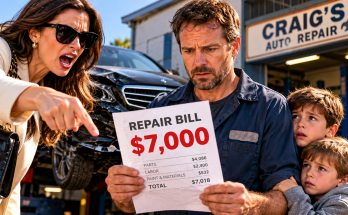
Ernesto knew about my seven-thousand-dollar invoice.
Everybody did.
He asked whether Laura had paid.
“Yes.”
“Good.”
“You sound disappointed.”
“I hoped you kept the Mercedes.”
“Mechanic’s lien would’ve been complicated.”
“You could’ve turned it into a flower planter.”
That image stayed with me.
Black Mercedes full of petunias.
Maybe justice needed more absurdity.
On Monday, Laura entered formal plea negotiations.
She accepted responsibility for child endangerment and obstruction.
Evidence-tampering charges remained part of the deal.
The prosecutor planned to recommend probation combined with a short custodial sentence only if the judge accepted extensive cooperation and no further violations.
“How short?” I asked Denise.
“Potentially months, not years.”
I sat silently.
“You angry?”
“Yes.”
“Want her in prison longer?”
I thought of Noah.
Rick.
The therapist room.
Laura saying I don’t trust you and accepting it.
“I don’t know.”
“Good answer.”
I looked at her.
“I hate when you do that.”
“Do what?”
“Make uncertainty sound mature.”
“It sometimes is.”
I leaned back.
“If she goes away for years, the boys suffer.”
“Yes.”
“If she doesn’t face consequences, they learn hurting people is negotiable.”
“Yes.”
“So what’s right?”
“The sentence is not your job.”
That helped.
A little.
“What is my job?”
“Tell the truth about impact if asked. Protect the boys. Let the court sentence her.”
That night I sat with Rick after Noah went to bed.
He was working on math homework.
“Mom might have to spend some time in jail,” I said.
His pencil stopped.
“How much?”
“I don’t know.”
He gave me a look.
“Yeah, yeah.”
I almost smiled.
“It may not be very long.”
“Because she told the truth?”
“That can matter.”
“Then lying makes it worse.”
“Usually.”
He stared at the worksheet.
“Would you want her to go?”
There was no safe answer.
“I want her to understand there are consequences.”
“That’s not what I asked.”
Again.
Children are good at stripping adult language down.
“No,” I said.
His eyes rose.
“I don’t want your mother in jail.”
“Even after everything?”
“Yes.”
“Why?”
“Because wanting accountability and wanting suffering aren’t always the same thing.”
He thought about that.
“Do you want Brent in jail?”
“Yes.”
The speed made him laugh.
I laughed too.
“Why different?”
“Because Brent put you in direct danger while drunk, drove recklessly, left the scene, and kept making choices that endangered people. Your mom did serious things too, but her role was different.”
“So some bad choices are more bad.”
“Basically.”
“Court sounds complicated.”
“It is.”
He returned to fractions.
For once, fractions seemed easier.
Two days later, Brent’s cooperation produced a new location.
A hunting cabin owned through one of Margaret’s companies.
Agents searched it.
Inside they found copies of the master financial archive.
Not complete.
Enough.
More importantly, they found a locked metal case.
Inside:
Passports.
Cash.
Jewelry.
Several sealed envelopes.
One envelope labeled BRENT.
One labeled THOMAS.
One labeled LAURA.
And one labeled C.
“Cynthia?” I asked Park.
“No.”
She looked at me.
“Craig.”
My stomach tightened.
“What does Margaret have in an envelope with my name?”
“We opened it under warrant.”
“And?”
Copies of every complaint I had ever made at the dealership.
Every warranty note.
Every repair record that created risk for Harlow.
Plus photographs of my garage during construction.
My apartment.
The boys’ school.
Nothing new, exactly.
Then Park reached the final item.
“A draft custody strategy.”
“From Margaret?”
“Yes.”
“What did it say?”
Margaret had written a plan years earlier.
If Laura ever wanted full custody, pressure should be applied in stages.
Employment disruption.
Financial exhaustion.
Schedule instability.
Character attacks if necessary.
Then one final line:
IF CM OPENS OWN BUSINESS, DO NOT DESTROY IT UNLESS REQUIRED. INDEPENDENT FAILURE IS MORE CREDIBLE.
I stared.
She had known opening the garage was possible.
Maybe even hoped for it.
Not because she wanted me to succeed.
Because she believed I would fail publicly.
The business I built had been another test they expected to break me.
Instead it survived.
That night I stood outside after closing.
The sign glowed under one cheap security lamp.
Marcus came beside me.
“You okay?”
“Yeah.”
“You’re staring at plywood again.”
“Apparently people expected this place to fail.”
He looked at the garage.
“People are dumb.”
I laughed.
Then he added, “Good thing you’re stubborn.”
That was probably closer to truth than courage.
Sometimes survival is just refusing to close the door the next morning.
Friday brought Brent’s formal charges on the crash.
DUI causing injury-related endangerment.
Hit-and-run.
Reckless operation with minors.
Obstruction.
Additional counts connected to financial crimes.
Television showed him in court.
For the first time since high school, he looked ordinary.
No polo.
No expensive watch.
No dealership behind him.
Just a man in a suit standing beside counsel while charges were read.
Laura watched separately by video as part of her own case.
Thomas and Margaret remained in custody.
The empire had become individual defendants.
That mattered.
Because power often hides inside plural words.
Family.
Company.
Network.
Eventually courts return everyone to singular.
One person.
One choice.
One consequence.
That evening, Dr. Cho called.
Rick had asked during therapy whether he could see Brent again someday.
The question shocked me.
“Why?”
“He wants to ask him something.”
“What?”
“She didn’t say. Rick asked that it remain private for now.”
My first reaction was no.
Immediate.
Physical.
Then I stopped.
“He’s eight.”
“Yes.”
“Brent is facing charges for nearly killing him.”
“Yes.”
“Why would seeing him help?”
“It may not.”
“Then why consider it?”
“Because Rick’s need for an answer may continue whether Brent is present or not.”
I hated that.
“What kind of meeting?”
“Only if Brent’s counsel, prosecutors, court, and therapist approve. No promises.”
“And I’d be there?”
“Nearby, not necessarily in the room.”
I looked toward Rick’s bedroom.
“What does he want to ask?”
Dr. Cho stayed quiet.
Therapist rules.
Fine.
I said, “If everyone says it’s safe, I’ll consider it.”
After we ended the call, Rick came into the kitchen.
“You talked to Dr. Cho.”
“Yes.”
“Are you mad?”
“No.”
“You look mad.”
“I’m thinking.”
He sat across from me.
“Can I tell you what I want to ask?”
“You don’t have to.”
“I know.”
He twisted his sleeve.
“I want to ask Brent why he didn’t stop after we crashed.”
My throat tightened.
“Stop driving?”
“No.”
He looked at me.
“Stop everything.”
I understood.
Why didn’t he call help?
Why didn’t he tell the truth?
Why didn’t he choose them after the mistake had already happened?
The crash itself had lasted seconds.
The betrayal afterward lasted weeks.
Rick had found the real question.