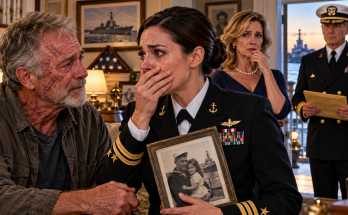
The reunion took place in a modest veterans' hall near Norfolk, far from the ceremonial atmosphere I had feared. Greg had told me there would be no press, no elaborate presentation, and no expectation that I speak about anything beyond what I was comfortable sharing. I arrived in dress uniform because the gathering included formal remembrance of personnel who had died in other operations. The building smelled of coffee, polished wood, and the food volunteers were arranging on long tables. Photographs of former unit members lined one wall. Near the front of the room stood a small table with an empty chair beside it. I recognized the tradition Greg had described. For fifteen years, that chair had represented a person whose name the men did not know.
Greg met me at the entrance. He looked nervous, which made me smile despite my own discomfort. He asked whether I wanted to leave. I said not yet. He led me into the hall, where conversations gradually quieted as people recognized him and noticed the officer beside him. A man with silver hair and a pronounced limp approached first. Greg introduced him as Sergeant Marcus Hale, one of the four men rescued in September 2011. Marcus studied my face with an intensity that reminded me of Daniel's first visit to the family house. Then he looked at my name tape. His eyes filled. He extended his hand and said he had wanted to meet me for a very long time.
I shook his hand. His grip was firm, though his fingers trembled. He told me that he had been the man with the injured leg. I remembered him now in fragments: the way he tried to conceal pain, the difficulty he had keeping his balance, and the moment he nearly stumbled while helping carry the stretcher. He said he had spent years wondering whether the rescuer understood how close they had come to losing one of the wounded men. I told him I remembered the urgency. He nodded. “We all do,” he said. Then he added that he was grateful I had not allowed their fear to dictate our pace. The remark brought back the sound of my own instructions, calm only because panic would have made the situation more dangerous.
Two other men approached, followed by several family members. One had been the senior member of the stranded group. He remembered giving me a hurried explanation of the situation and being told to slow down. He laughed when he described it, then became serious. He said the instruction had embarrassed him at the time because he was accustomed to directing others. Later, he understood that I had needed accurate information, not noise. Another man, younger then and now approaching middle age, remembered the improvised stretcher and the long pauses between movements. He said he had never forgotten the patience required to move through uncertain ground while someone was bleeding nearby. Their accounts were not identical, but the differences made them more credible. Each remembered the event from his own position.
The fourth man, the most seriously wounded, had recovered after a long hospitalization. His name was Daniel Price, and he arrived with his wife and teenage son. He walked carefully, using a cane, but his expression was lively. He told me he remembered almost nothing of the actual rescue. His memories began later, in medical care, with people telling him that several strangers had worked together to bring him out. For years, he had wanted to thank them all. He took my hand between both of his and said he was glad to finally know the name of the officer who helped make his return possible. I felt the familiar discomfort of being placed at the center of a story that had required many people. I told him the rescue had been a team effort. He agreed, but did not release my hand immediately.
Greg introduced me to several spouses and children. Some were old enough to remember the deployment. Others knew it only through family stories. A woman told me she had received a telephone call in 2011 warning that her husband was injured but alive. She had spent hours waiting for further information, imagining the worst. Now she wanted me to know that the word alive had changed the course of her family's future. I listened, thinking of Margaret receiving the false news of Thomas's death. The parallels were uncomfortable. I had helped bring men home to families who feared losing them. My own father had survived but remained hidden from his daughter. The same institution that organized rescue and protection had also become entangled in decisions that distorted our lives.
The gathering included a brief acknowledgment of the corrected identification. Greg's former commanding officer explained that the official review was underway and that supporting statements had been submitted. He did not claim an award had been approved or suggest that administrative work was finished. He simply said the unit was grateful to know the name of the officer who had led the extraction effort. Then he turned toward me and thanked Lieutenant Commander Claire Voss. Hearing my full name spoken in that room was unexpectedly powerful. For decades, my mother had treated Voss as a dangerous relic. Here, the name was being used plainly, accurately, and without embarrassment. I felt my throat tighten.
I spoke briefly. I thanked the men for welcoming me and acknowledged the other personnel involved in the rescue, including my teammate and the medical crews who continued the work after we reached safer ground. I said the operation had succeeded because people followed instructions under difficult conditions and helped one another despite injury and fear. I did not describe myself as a hero. I told them I was grateful to see the men alive and surrounded by people who loved them. Then I stopped. The room remained quiet for a moment before people began applauding. I found the sound difficult to bear, not because I thought it undeserved, but because I had never sought this kind of attention. Greg seemed to understand. He moved closer without making a spectacle of the moment.
Afterward, the men invited me to sit at the table where the empty chair had stood. They explained that the chair would no longer represent an unknown rescuer. They intended to keep the tradition, but now it would honor all the people who had helped bring them home, including those whose names might never appear in public accounts. I liked that. Recognition did not require turning one person into the entire story. The men had survived because many people did their jobs under difficult circumstances. I was one of them. Knowing their families had been able to continue living ordinary lives made the work feel worthwhile in a way no formal citation could fully capture.
Lauren and Greg's daughter approached me during lunch. She was old enough to understand that her father had been injured in Afghanistan but young enough to ask questions without worrying about their emotional weight. She wanted to know whether I had been scared. I told her yes. She looked surprised. “But you helped Daddy.” I explained that being frightened did not mean you stopped doing what needed to be done. Sometimes fear reminded you to be careful. She thought about that, then asked whether I knew Greg was going to become my brother-in-law someday. I laughed for the first time that afternoon. I told her I had no idea. She seemed delighted by the coincidence and ran back to tell her father.
I watched her go, thinking about the years that had passed since the rescue. In 2011, she had been a baby waiting for her father to return. Now she was a lively child who could ask the rescuer questions over lunch. Her existence gave the event a scale that operational reports could not capture. The consequences of bringing someone home extended into birthdays, school days, arguments, ordinary dinners, and countless moments nobody recorded. I thought of Thomas returning as Russ and the life we had shared without knowing its true shape. Survival had given our family years together, but secrecy had changed how those years were understood. I was beginning to see that both realities could be acknowledged without making one erase the other.
Daniel Sandival attended the reunion quietly, standing near the back during the formal remarks. Afterward, he approached me with a small folder. He said the records review had reached an important preliminary finding. The errors affecting my Afghanistan service record appeared to result from administrative misclassification and the persistence of outdated identity-protection flags. There was no evidence at that stage that someone had deliberately targeted my career or attempted to steal credit for the rescue. The review would continue, but corrective action was moving forward. I felt relief. I had wanted the truth, not a more dramatic explanation. A bureaucratic mistake could still be consequential, especially when it persisted for years, but it did not need to become a conspiracy to justify correction.
Daniel also had news concerning the old explosion case. Investigators had compared the family photograph with archival facility records and identified the vehicle in the background as one used by a contractor whose employees had access to sensitive transport information. Alan Mercer had been associated with that contractor, though his precise involvement remained uncertain. The photograph supported a timeline already suggested by other evidence. It did not, by itself, prove criminal responsibility. However, the review had uncovered a discrepancy involving a visitor-access log from the week before the explosion. Someone had entered a correction to the log after the incident, and investigators were trying to determine whether the change was legitimate.
I asked whether the discrepancy involved Mercer. Daniel said his name appeared among the records under review, but he cautioned against drawing conclusions. The original criminal case had resulted in convictions, and the remaining inquiry concerned whether unresolved administrative evidence could clarify the role of individuals who were never charged. Some records were incomplete, and witnesses from 1993 might no longer be available. I understood the limitations. Thirty-three years was a long time for memories, documents, and evidence to survive. I told Daniel I wanted the investigation handled carefully, with no assumptions based solely on Thomas's fear or my family's history. He agreed.
The news unsettled me nevertheless. For days, the family had been reconstructing the personal consequences of the explosion. Now investigators were examining the possibility that someone outside the convicted network had possessed information about Thomas's movements. I thought of the warning he received outside the store and the unfamiliar vehicles near our home. I wondered whether the photograph might help establish who had known his schedule. But I also recognized the danger of assigning guilt to a person because his face appeared beside my father's. I had spent my career insisting on accurate assessment under uncertainty. I would not abandon that discipline simply because the case involved someone I loved.
After the reunion, I drove to my parents' house. The late afternoon light slanted across the driveway, and I noticed that Russ had repaired the loose fence latch near the garden. It was the kind of small task he had always completed without announcing it. Inside, Margaret was sorting photographs into new archival sleeves. She looked up when I entered and asked how the gathering had gone. I told her the men were well, their families had been kind, and the official correction was progressing. She listened carefully. Then she asked whether I had felt uncomfortable being recognized. I admitted that I had, but said the meeting had meant something to the people involved. She nodded. For once, she did not suggest that I should have stayed home or dressed differently.
Thomas came in from the garage while I was speaking. He noticed the small folder in my hand and asked whether Daniel had brought new information. I told him about the preliminary findings. His face softened when he heard that the service-record errors appeared administrative rather than malicious. Then I mentioned the visitor-log discrepancy. He grew quiet. I asked whether he remembered anyone changing access records during the investigation. He said he remembered disputes about who had entered certain facilities, but the details were blurred by the years and by his injuries. He had reviewed some documents during rehabilitation, though not always in their original form. I told him the investigators would handle the matter. He nodded, but I could see the old anxiety returning.
Margaret asked whether the inquiry meant the protective restrictions might be reinstated. I told her there was no indication of that. Daniel had been explicit that no current evidence suggested an immediate threat to the family. The review concerned historical records and unresolved questions about access to information. She seemed relieved, though her hands continued moving nervously over the photographs. I realized how deeply the old fear had shaped her. Even after the major conspirators were convicted and the restrictions lifted, the possibility of renewed danger could still reduce her to the frightened young mother she had been in 1993. I felt compassion for that fear. I also knew it could no longer be allowed to determine what I was told.
We sat together in the dining room, and I described the reunion in more detail. I told Thomas about Marcus Hale, Daniel Price, and the other men. I explained that their families had spent years wondering who brought them home. Thomas listened with an expression I had never seen before: pride unguarded by secrecy. He asked about the extraction route and the difficulty of moving the wounded men. I answered in general terms, avoiding details that did not belong in a family conversation. He nodded as though recognizing the demands of the work. Then he said he was proud of the officer I had become. This time, the compliment did not feel like an attempt to repair our relationship. It felt like one professional acknowledging another.
I told him about Greg's daughter asking whether I had been afraid. Thomas smiled faintly. He said I used to ask him similar questions when I was little. I remembered asking whether the Navy was dangerous and whether he could always come home. He had never promised that he would. Now I understood why. He had known that service involved uncertainty even before the explosion. I asked whether he remembered what he told me that day. He did. He said he would always try to come home. The words settled between us. He had kept the promise in a literal sense, returning under another name. But the truth of his return had been withheld, and I had grown up believing the promise failed.
I asked whether he had ever imagined meeting me as an adult while openly acknowledging who he was. He said he had imagined it often. During rehabilitation, he pictured telling me the truth when I turned ten. Later, he thought perhaps fourteen would be better. When I began preparing for the Navy, he imagined speaking before I left. Each imagined moment passed. Eventually, he stopped picturing a future confession because the gap between the truth and our daily life seemed impossible to close. He looked ashamed as he admitted it. I told him that the gap had not disappeared because he avoided it. It had simply widened until someone else forced the truth into the open.
Margaret sat quietly through the exchange. Then she said she had never understood how much Thomas wanted to tell me. He looked at her. I could see the old argument forming between them, but he did not raise his voice. He reminded her of the letters, the review request, and the handwritten note I had found. She lowered her eyes. He said he had allowed her fear to stop him, but she could not claim ignorance of his wishes. I watched them confront a conflict they had hidden beneath decades of ordinary marriage. They had loved one another, raised children, and built a life. They had also disagreed about a truth that belonged to all of us. Their silence had preserved the appearance of unity while leaving the underlying injury untouched.
Lauren arrived shortly afterward with Greg. She had heard about the reunion and wanted to see photographs. We gathered around my phone while I showed them the men, their families, and the table where the empty chair had stood. Greg's daughter pointed herself out in several pictures, delighted to see that she had been included. The atmosphere softened. For a while, we were simply a family looking at photographs from a meaningful day. I noticed Margaret smiling at an image of Greg and me standing beside Marcus Hale. She did not comment on my uniform. The absence of criticism felt more significant than any compliment she could have offered.
Then Daniel called again. He had received a request from investigators reviewing the old case. They wanted Thomas to provide a supplemental statement concerning Alan Mercer and the facility photograph. The inquiry would be voluntary at this stage, but the information could help clarify the access-log discrepancy. Daniel said the investigators were especially interested in whether Thomas remembered the circumstances under which the photograph was taken and whether Mercer had discussed schedules or transport procedures. I relayed the request. Thomas looked toward the album on the table. He said he would cooperate. His voice was steady, but I noticed his hands trembling.
After the call, I asked whether he was afraid the old case would reopen wounds he had spent decades trying to contain. He said yes. Then he added that he was more afraid of allowing unanswered questions to remain because he had learned what prolonged silence could do. The answer surprised me. He had spent much of his life accepting secrecy as a necessary condition of safety. Now he was choosing to participate in a careful search for truth, even though the process frightened him. I told him I would support him, provided he remained honest about what he remembered and what he did not. He nodded. “That's what I should have done with you,” he said.
Before leaving that evening, I stood beside the family portrait hanging temporarily near the dining room. It showed Greg and me in uniform, Lauren between us, and Thomas at my shoulder. Margaret had not been present for that picture. She had asked whether we could arrange another photograph someday, one that included everyone. I had not answered. Now I looked at the image and thought about the difference between appearances and truth. The original portrait had been planned to create an impression of family harmony. The resulting photograph had captured the moment that impression began to collapse. Perhaps a future picture could show us together again, but only if the relationships inside it had changed.
I walked toward the door with the cracked compass in my pocket. Thomas followed and asked whether I would attend his supplemental interview. I told him I would, if the investigators permitted it and if he wanted me there. He said he did. Margaret stood behind him, watching. I looked at both of them and realized that trust was no longer something I could grant all at once. It would have to be rebuilt through small, repeated acts of honesty. The reunion had allowed me to close one long-unanswered question about Afghanistan. The records review was correcting another. But the explosion that changed my childhood still held uncertainties, and my father was finally willing to face them. I stepped outside knowing that the next part of our story would depend less on what had happened thirty-three years ago than on whether we could now tell the truth about it without hiding.