I placed the handwritten note on the dining room table before my mother had finished pouring her morning coffee. She stopped with the pot tilted above her mug. A thin stream spilled onto the saucer, but she didn't seem to notice. I had not intended to confront her before breakfast. I had planned to speak with Captain Sandival first, review the missing documents, and decide what could be established beyond doubt. Yet the note had changed something in me. For years, I had believed the conflict over my father's memory came from grief that neither of us knew how to share. Now I knew that Thomas had asked to tell me the truth before I left home and Margaret had forbidden it. I wanted to hear her explain that decision without the shelter of official language.
She set down the pot and read the note. Her expression changed slowly. At first, she looked irritated that I had searched through private belongings. Then recognition settled over her face. She touched the edge of the paper but did not pick it up. I asked whether she had written the response. She said yes. I asked whether she had meant it. She looked toward the kitchen doorway, where Russ stood watching us. “At the time, I did,” she answered. Her voice was unusually quiet. I asked what she had believed would be destroyed. She said our family, the life we had rebuilt, and the fragile peace that had allowed us to survive the years after the explosion. I asked whether that peace included the years when I cried over a father who was sitting beside me at dinner. She closed her eyes.
Russ entered and sat opposite her. He looked exhausted. I wondered whether he had spent the night remembering the same events from a different side. He asked if he could read the note. I handed it to him. He studied his own handwriting for a long time. Then he said he remembered writing it after an argument about my approaching adulthood. I had begun asking more serious questions about Thomas, and he feared I would leave home carrying a false story that would become harder to correct. He wanted to tell me before I made decisions about my name, my education, and my future. Margaret had argued that disclosure could reopen security concerns and ruin the family. He had eventually surrendered. I asked why. He said he had been afraid of losing us. I told him he had lost something anyway.
The conversation might have become another exchange of accusations if Lauren had not entered. She sat beside me and asked our mother whether she understood that the secret had harmed both daughters. Margaret looked genuinely confused. Lauren explained that her own childhood now felt uncertain. She had grown up believing Russ was her father and Claire's stepfather. She had accepted that difference without question. Now she learned that her parents had maintained two separate explanations for the same man. She wanted to know why they had trusted her with an ordinary childhood while asking Claire to live with an invented death. Margaret said she had never intended to treat us differently. Lauren replied that intention did not change the result.
I watched my sister speak with a steadiness I hadn't expected. She reminded our mother that I had often missed family gatherings because of duty, then returned to find my work dismissed or minimized. She mentioned the countless times Margaret had introduced me under the wrong surname. She asked whether our mother had ever considered how humiliating that was. Margaret said she had worried about the danger associated with the name Voss. Lauren asked why she had continued after the immediate threat had diminished. There was no quick answer. My mother looked at both of us and seemed, for the first time, unable to make herself the person most injured by the conversation.
Captain Sandival arrived later that morning with Greg and a formal acknowledgment from the records office. He had requested the complete early-2000s review through the appropriate channels, and the request had been accepted for processing. He cautioned that release could still require additional authorization. I understood the limits, but I also knew that the surviving photocopy established enough to make the missing recommendation worth pursuing. Daniel had brought other material in the meantime, including a later summary that referred to the review's outcome. It was not the original decision, but it indicated that authorities had considered disclosure to an adult daughter possible under controlled circumstances. My pulse quickened as I read.
The summary did not say that disclosure was mandatory or that all risks had vanished. It described a process through which the protected individual could request permission to explain his former identity to immediate family members once certain safeguards were satisfied. I looked at Russ. He stared at the paper, his face pale. Daniel emphasized that the wording mattered. The document did not prove that Margaret had deliberately falsified an official instruction. It did, however, contradict the idea that the authorities had categorically forbidden disclosure throughout my adulthood. I asked whether Russ had ever been told about that option. He shook his head. Margaret said she did not remember receiving the summary. I believed she might be telling the truth about the exact document. I did not believe she had forgotten every conversation about whether I should know.
Daniel explained that the old protective arrangement had evolved over time. Early restrictions were severe because the threat was immediate. Later, formal channels existed for reconsidering disclosure, but the family had not consistently pursued them. Some officials may have communicated poorly. Others may have relied on outdated assumptions. Margaret and Russ had also made private decisions that went beyond what the records required. The result was a mixture of legitimate secrecy, bureaucratic inertia, and personal fear. I appreciated that he did not reduce the history to a simple villain. The truth was more complicated and, in some ways, more painful. No single instruction had forced my parents to maintain every lie. They had participated in preserving it.
I asked Daniel whether the protective arrangement itself had been reviewed for misconduct. He said some aspects were under administrative examination because of the irregularities that emerged during his search for the Afghanistan rescuer. He would not speculate about disciplinary outcomes. The review would need to distinguish authorized record protection from improper alteration. I told him I wanted that distinction preserved. My father's identity had been hidden to keep him alive. My service record had been affected by decisions made later, under different circumstances. I would not allow the two issues to be blended into one vague explanation about national security. Daniel nodded. He said that was precisely why the records needed careful examination.
Greg spoke next. He had contacted two men from the Afghanistan operation, both of whom remembered the rescue in considerable detail. They wanted to provide statements if an official review required them. One remembered my surname clearly. The other remembered the order to follow the rescuer's footsteps and the unusual calm of the officer directing them. Neither could explain why later summaries described the rescuer as male. Greg said the men had never cared whether the person who saved them was a man or woman. They cared that the person existed and deserved to be identified accurately. I felt a quiet surge of gratitude. After years of having my work reduced or misunderstood at home, their certainty offered a different kind of recognition.
Lauren asked whether the men knew Greg and I were related by marriage. Greg smiled faintly. He said they had reacted with disbelief when he told them. One had joked that the Navy was smaller than anyone imagined. The other had asked whether I would be willing to attend their next reunion. I hesitated. I had never sought public attention for the rescue, and I didn't want the emerging family scandal to become attached to their gratitude. But I also understood that the men had carried unanswered questions for fifteen years. Their desire to thank the person who helped them was legitimate. I told Greg I would consider attending once the official review had progressed. He accepted that without pressure.
My mother listened to this conversation with an expression I couldn't interpret. When Greg described the men who had survived, she looked down at my uniform folded over the back of a chair. I had arrived in civilian clothes that morning, but the jacket remained there from the previous day. She asked whether I had always been assigned to dangerous work. I almost answered sharply. Then I recognized that she was asking a genuine question for perhaps the first time. I explained that my career involved risk assessment, training, operational planning, and specialized field responsibilities. Not every assignment meant walking toward an explosive device, but the work demanded careful judgment because mistakes could endanger people. She listened without interrupting.
I told her about the preparation required before deployments, the responsibility of reviewing procedures, and the importance of ensuring younger personnel understood why rules existed. I did not describe classified details or attempt to impress her. I spoke about the work as I would to any interested civilian. She asked whether I had ever been frightened. I said often. She looked at me then, and I saw something soften in her expression. For years, she had treated my career as a provocation, an attempt to repeat Thomas's life. Now she seemed to be considering the possibility that I had chosen it for reasons of my own. She said she wished she had asked more questions. I told her I wished that too.
The conversation shifted when Russ asked Daniel whether he could still request access to records concerning his original injuries and rehabilitation. Daniel said he could help identify the proper process, although the records were old and might require retrieval from archives. Russ explained that he wanted to give me a complete account of the years when he was absent, including the medical decisions and protective arrangements that had shaped his return. I was surprised by his willingness. He had spent decades avoiding the past, and now he seemed determined to examine it openly. I asked whether he was doing this because he feared losing me. He looked directly at me and said yes, partly. Then he added that he also believed I deserved the truth even if I never forgave him.
That answer mattered. I had grown weary of being told that disclosure depended on how it might affect the adults who had kept the secret. For the first time, Russ was acknowledging that my right to know existed independently of whether the truth repaired our relationship. I told him I would help obtain the records, but I would not promise forgiveness in exchange. He nodded. I could see how difficult it was for him to accept uncertainty after so many years of trying to control the outcome. He had survived an explosion by following medical instructions and security rules. He had raised me by staying close and saying little. Now he had to allow his daughter to decide what kind of relationship remained possible.
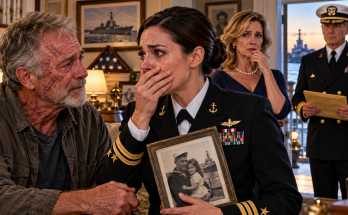
My mother left the room briefly and returned carrying a small envelope. She placed it in front of me without explanation. Inside was an old photograph of Thomas and me at the waterfront. I recognized it immediately. It had once stood on the mantel before disappearing after his reported death. The glass had been removed from the frame, but the photograph was undamaged. I looked at Margaret. She said she had kept it in a drawer for decades. She had told me it was gone because she couldn't bear seeing it every day. I remembered searching the house for that picture when I was six. I had cried because I thought it had been thrown away. Now it lay in my hands.
I asked whether she had kept other photographs. She said yes. There were albums, letters, and a few personal belongings she had stored away. She had never destroyed them. I felt relief and anger arrive together. The things I had mourned as lost had been sitting in her possession all along. I asked why she hadn't given them to me when I was old enough to understand. She looked at the floor. “Because I was afraid you'd ask why I still had them,” she said. The honesty surprised me. She had hidden the evidence not only to protect the family but to avoid questions about her own decisions. I told her that fear had cost me years of connection to my father. She nodded, tears gathering in her eyes.
Lauren asked whether we could see the albums. Margaret hesitated, then said they were in a cedar chest in the upstairs storage room. Russ offered to bring them down. I watched him leave, recognizing the strange ordinariness of the gesture. The man whose disappearance had shaped my childhood was walking upstairs to retrieve photographs of himself. Greg leaned toward me and asked quietly whether I needed a break. I shook my head. I was exhausted, but I wanted to continue while everyone was willing to speak. The previous afternoon had shown how quickly silence could return when people became uncomfortable. I did not intend to allow another decade to pass between questions.
Russ returned with two albums and a smaller box. We spread the photographs across the table. There were pictures of Thomas before the explosion, Margaret during their early marriage, and me as a toddler. Some showed ordinary afternoons in the kitchen. Others captured trips to the waterfront, birthday parties, and a picnic near a naval base. I recognized details that had survived in memory without context: a striped beach towel, a red bicycle, a dog belonging to a neighbor. Russ identified people and places, sometimes correcting Margaret's recollection. For the first time, I heard them speak about Thomas as a man they had known together, not as a subject to avoid.
The photographs did not erase the deception. They made it more human. I saw my mother laughing in a way I had rarely seen after the explosion. I saw Thomas holding me carefully as though I were something precious and fragile. I saw a young family that had been ordinary before violence and secrecy changed it. My parents had not begun as people determined to hurt their child. They had been frightened into decisions that later became habits, then defended those habits because admitting the damage would have required confronting their own responsibility. Understanding that did not absolve them. It helped me see the shape of what had happened.
Near the back of the second album, I found a photograph taken shortly before the explosion. Thomas stood beside another uniformed man in front of a low building near the waterfront. The second man was unfamiliar, but his face seemed oddly recognizable. I studied the image. He had a narrow jaw, closely cropped hair, and a small scar above one eyebrow. I asked Russ who he was. My father leaned forward and looked at the photograph. His expression changed instantly. He took a breath and said the man's name was Alan Mercer. He had worked near the procurement operation that Thomas was investigating. I asked whether Mercer had been implicated in the diversion network. Russ said he had been questioned, but the evidence against him had never been sufficient for prosecution.
Daniel moved closer. He studied the photograph and asked where it had been taken. Russ said it was outside a facility associated with the original investigation, several weeks before the explosion. Daniel examined the background. He pointed to a vehicle partially visible near the building and asked whether anyone remembered its owner. Russ frowned. He said the vehicle belonged to a civilian contractor connected with the disposal program. Daniel took a photograph of the image with his phone, then asked permission to include it in the records review. I felt the atmosphere change. We had been examining family memories, but this photograph appeared to connect directly to the criminal case.
I asked why Mercer mattered after so many years. Daniel explained that certain associates of the original network had never been fully accounted for, even after the major convictions. Mercer had remained a person of interest in some related inquiries, though no charge had been established. His name appeared in several old documents connected to access and transport records. Daniel was careful to avoid accusing him of crimes without evidence. I appreciated the caution. But I also saw why the photograph had caught his attention. It showed Mercer standing beside my father shortly before someone attempted to kill him. The image might establish a connection or meeting that existing records did not fully describe.
Russ said he remembered Mercer as a man who seemed helpful at first. He had offered explanations for inventory discrepancies and introduced Thomas to several civilian contacts. Over time, Thomas began to suspect that Mercer knew more than he admitted. The photograph had been taken during an ordinary visit, before the investigation became dangerous. I asked why Russ had kept it. He said it belonged to an album Margaret had assembled before the explosion. He had forgotten it was there. I believed him. We had been so focused on the deception inside the family that none of us had considered how the photographs might preserve details relevant to the old case.
Daniel asked to examine the album more closely. He noted the date written beneath the photograph and compared it with a reference in his folder. Then he grew quiet. I watched him read the same line twice. He told us that Mercer had appeared in a later report concerning access to restricted records, including information about Thomas's movements before the explosion. The report had not established criminal responsibility, but it placed Mercer near a point where sensitive information could have been compromised. I asked whether the new photograph strengthened that connection. Daniel said it might, but only after authentication and comparison with the original records. He wanted to avoid drawing conclusions from a family album without corroboration.
My mother looked frightened again. She asked whether finding the photograph meant we were in danger. Daniel answered carefully. The old network had been largely dismantled, and there was no current evidence of an immediate threat to our household. However, new information could justify further review of unresolved aspects of the case. He advised preserving the original photograph and not contacting Mercer or anyone associated with the investigation independently. I agreed. I had no intention of turning a family crisis into a private pursuit of suspected criminals. My responsibility was to provide accurate information through appropriate channels, not to act on speculation.
Russ looked at me with a mixture of fear and pride. He said I sounded like the officer he had always hoped I would become. I didn't know how to answer. Compliments from him now carried the weight of both identities. I wanted to believe he was proud of the daughter he had raised. I also wanted him to understand that my judgment had developed in spite of the information he withheld, not because of it. I told him that if we were going to rebuild trust, we would need to stop making private decisions based on what we thought other people could handle. He nodded. Margaret, sitting beside the albums, did not speak.
By late afternoon, Daniel had organized copies of the relevant photographs and prepared a list of formal inquiries. He would submit the new material for review alongside the existing records. I had agreed to provide statements concerning my own service documents, and Greg had arranged for surviving members of his former unit to cooperate if contacted through proper channels. None of these steps guaranteed a quick resolution. The old case was complex, and administrative corrections could take time. But the process was finally moving in the open. For the first time, I was participating in decisions about my own history rather than being informed afterward.
Before Daniel left, he asked whether I would attend a meeting the following week with officials reviewing the identity and personnel records. I agreed, provided I could examine the available material beforehand. He said that was reasonable. Then he turned toward Russ and asked whether Thomas Edward Voss was willing to provide a full statement about the reintegration arrangement. My father stood slowly. I watched him straighten his shoulders, the old military posture emerging beneath the habits of the man I had called Russ. He said he would cooperate. His voice was rough, but the answer was steady. I realized that he was choosing, at last, to speak under the name he had spent most of his adult life concealing.
After the captain departed, my mother began collecting the empty cups. I stopped her. I told her I wanted the albums and letters to remain available until I had finished examining them. She looked at the photographs spread across the table, then nodded. I asked whether she would agree to discuss the past without trying to control what I was permitted to know. She hesitated. I could see how difficult the request was for her. She had spent decades organizing our family around silence, and silence had become the way she managed fear. Finally, she said she would try. I told her trying would have to include answering questions she disliked.
Russ walked with me to the front door as evening settled over the neighborhood. He did not ask whether I forgave him. He did not reach for an embrace. He simply stood beside the entrance, the place where he had first returned to my life under a different name. I looked at his scarred face and tried to imagine the younger Thomas hidden beneath it. I could see traces now: the shape of his eyes, the way he held his head when listening, the careful movements of his hands. Recognition was arriving slowly, not as a sudden miracle but as a series of details I could no longer ignore.
I told him I still didn't know what to call him. He looked down at the threshold. “You can call me whatever feels true,” he said. I thought about the years he had spent as Russ, helping with homework, fixing bicycles, and standing quietly beside me at important moments. I thought about Thomas, the father who had taught me to make pancake ships and promised to return. Neither name contained the whole man. I told him I needed time. He nodded, and for once he did not try to make my uncertainty easier for himself.
I reached my truck and looked back. My mother stood in the doorway behind him, her hand resting against the frame. Lauren and Greg were visible through the window, gathering the albums into careful stacks. The house was the same one where we had posed for a family portrait, yet nothing inside it remained as simple as it had appeared. We had recovered photographs, letters, and a name. We had begun distinguishing genuine danger from decisions made out of fear. We had also uncovered questions about the old investigation that might require more than family honesty to resolve. As I started the engine, my phone vibrated with a message from Captain Sandival. The records office had located a reference to the missing review, and its original recommendation appeared to have been more permissive than Margaret had ever admitted. I read the message twice, then looked toward the house. The next conversation would require more than an apology.