The new photograph was taken six months after Greg recognized my name in the Williamsburg foyer. There was no professional lighting, no staircase arrangement, and no cream-colored sweater waiting beside the door. Lauren had suggested gathering at the waterfront where Thomas used to take me when I was little. The location mattered to me because my earliest memories of my father belonged to that place: gulls circling above the water, wooden boards warm beneath my shoes, and a man in uniform showing me how to skip stones. We arrived on a clear spring afternoon with sandwiches, folding chairs, and a camera Greg had borrowed from a friend. Nobody had been told what to wear. I came in jeans and a navy-blue jacket, with the cracked brass compass in my pocket.
Thomas arrived with Margaret. He moved slowly across the parking area, carrying a small cooler in one hand. His hair was almost entirely white now, and the scars along his jaw remained visible in the bright light. I watched him pause near the water and look toward the pier. For a moment, he seemed far away. Then he saw me and raised his hand. I walked toward him. We had spent the previous months speaking regularly, sometimes about the past and sometimes about ordinary matters. The conversations were not always easy. There were still moments when anger returned unexpectedly, especially when a familiar childhood memory acquired a new meaning. But he no longer avoided difficult questions, and I no longer felt required to protect him from my reactions.
Margaret greeted me without examining my clothes. She asked whether I had eaten breakfast and then laughed at herself before I could answer. She said she was trying to stop sounding like a mother issuing instructions. I told her concern was not the problem; control was. She nodded. We had begun meeting for occasional lunches, usually in neutral places where old household habits were less likely to take over. She had apologized more than once for hiding photographs, using the wrong surname, and belittling my Navy career. I had told her that repeated apologies were unnecessary if her behavior changed. Slowly, it had. She now addressed letters to Claire Voss and asked genuine questions about my work without turning the answers into warnings.
Our relationship was not restored to some imaginary state of innocence. I still remembered the years when I had been made to feel ashamed of loving Thomas. Margaret still struggled when conversations touched the explosion or the period immediately afterward. Sometimes she became defensive, and I had to remind her that explaining fear did not erase responsibility. But she had begun accepting those reminders without ending the conversation. She and Thomas were attending counseling, and Lauren told me they had started speaking more openly about decisions they once treated as settled. The progress was uneven. That seemed appropriate. Thirty-three years of secrecy could not be undone by one confession or a handful of family dinners.
Lauren arrived with Greg and their daughter, who immediately ran toward the water. Greg followed, reminding her to stay away from the edge. I watched them with a quiet sense of gratitude. Fifteen years earlier, he had been an injured officer struggling through dangerous terrain in Afghanistan. I had known him only as a frightened young man who needed to follow instructions. Now he was my brother-in-law, a husband and father whose life had continued in ways neither of us could have imagined. The corrected operational record had officially identified my role in the rescue, and the men from his former unit had sent letters that I kept in a drawer at home. Their gratitude mattered, but I was most thankful that Greg could stand beside his daughter on an ordinary afternoon.
Daniel Sandival joined us later. He was no longer involved in the day-to-day records review, but he had become a welcome presence in our extended family. His search for the unidentified rescuer had begun as a promise to his son and led to a truth none of us expected. He had handled the aftermath with patience, refusing to exaggerate uncertain evidence or turn private pain into a spectacle. I thanked him again for helping correct my service record and for insisting that Thomas's historical case be examined carefully. He said the work had been necessary. Then he looked toward the water, where Greg was helping his daughter balance on a low wooden beam, and added that he was glad the search had brought something good into the open.
The final administrative review of my service record had concluded several weeks earlier. It confirmed the corrected identification of my role in the Afghanistan extraction and found no evidence that another person had deliberately claimed my work. The errors resulted from an early unsupported assumption and the persistence of outdated identity-protection restrictions. The responsible offices had begun implementing changes to prevent similar problems. No additional award had been promised or required for the correction to matter. My career continued, and my responsibilities remained the same. But I no longer had to wonder whether the official record carried an incomplete version of my service. It identified me accurately, under the name I had chosen.
The historical review of the 1993 explosion had reached a more limited conclusion. Investigators confirmed that the sabotage was deliberate and that the principal perpetrators had been convicted years earlier. The newly examined photograph, visitor logs, and related records clarified parts of the timeline but did not establish sufficient evidence to charge Alan Mercer, Bernard Keller, or anyone else with additional wrongdoing. The amended access entry remained incompletely explained. Michael Danner's precise role in the events leading to the explosion also remained uncertain. The investigators documented those limitations rather than presenting speculation as fact. Thomas was disappointed, but he accepted the finding. He had finally learned that an honest ending did not always provide every answer.
What mattered most was that the protective restrictions had ended and his identity could be acknowledged through the appropriate legal and administrative processes. Thomas had begun working with advisers to reconcile his historical records with the life he had lived as Russell Wickham. The process was complicated, involving old documents, medical history, and arrangements created under extraordinary circumstances. He did not pretend that everything could be corrected quickly. But he no longer needed to hide from his daughters. Lauren knew he was her biological father. I knew the man who had raised me as Russ was the same man I had mourned as Thomas. The truth was difficult, but it was finally ours to speak about openly.
We spread a picnic blanket near the water and unpacked lunch. Margaret had made sandwiches, Lauren brought fruit, and Greg's daughter insisted on distributing napkins to everyone. Thomas sat beside me, watching the boats move across the harbor. After a while, he asked whether I remembered the old wooden pier. I told him I remembered the sound it made when I ran across it, though I couldn't recall exactly where it had stood. He pointed toward a newer section of waterfront. The original structure had been replaced years earlier. I looked at the changed shoreline and felt a strange comfort. The place had not remained frozen in my childhood. It had changed, been repaired, and continued serving the people who came there.
Thomas told me that one of his happiest memories was teaching me to skip stones near that pier. I remembered being frustrated because my stones sank immediately while his bounced across the surface. He said I had accused him of choosing special rocks and demanded that he share them. I laughed. The memory had survived all these years, but I had never known whether it belonged to Thomas or something I had invented after his reported death. Now he could confirm it. We spent several minutes comparing details, correcting one another, and discovering that neither of us remembered everything perfectly. It was ordinary conversation, and that made it precious.
I asked whether he wanted to walk along the water. He stood carefully, and we followed the path toward the pier. The breeze carried the smell of salt and damp wood. For a while, neither of us spoke. Then Thomas said he had been thinking about the letter I found in the wooden box. He remembered writing it during rehabilitation, terrified that he might die before seeing me again. He had believed the greatest tragedy would be leaving his daughter without knowing how much he loved her. Later, after he returned as Russ, he told himself that his presence would answer the question. He now understood that love could be real and still be hidden in a way that caused harm.
I told him I had read the letter many times. The words about courage and asking questions had stayed with me. I also told him that the letter had been painful because it showed how clearly he understood what I deserved before he allowed the deception to continue. He nodded. He did not offer another excuse. Instead, he said he wished he had trusted me with the truth sooner, even if doing so frightened him. I looked at the water. “I wish that too,” I answered. We walked several more steps. Then I added that I was glad he had survived. His face changed, and he stopped beside the railing. He looked at me for a long moment before saying he was glad he had lived long enough to hear me say it.
I had not planned those words. They came from a place that had remained difficult to reach through anger. For months, I had been trying to hold two truths together: my father had hurt me by concealing his identity, and his survival was still something I could be grateful for. Neither truth erased the other. I could mourn the childhood understanding I had lost while valuing the man who had been present. I could resent his silence while recognizing the care he gave me. Forgiveness, if it came fully, would not require pretending the deception was harmless. It would mean choosing a relationship that acknowledged the damage without allowing it to define every future conversation.
Thomas asked whether he could hug me. He had stopped assuming physical affection would be welcome after the revelation. I appreciated the question. I stepped toward him, and he wrapped his arms around me carefully. His embrace was familiar, the same steady pressure I remembered from departures, graduations, and difficult days. But this time I understood who held me. The realization brought tears I could not stop. I pressed my face against his shoulder and felt him breathe unevenly. Neither of us spoke. The harbor moved around us, indifferent to the years we had lost and the strange way we had found each other again.
When we returned to the picnic, Lauren was arranging everyone for the photograph. She had chosen a place where the water formed a bright background and the afternoon sun would not be directly in our eyes. Greg set the camera on a tripod. His daughter complained that she wanted to stand beside Grandpa, then changed her mind and insisted on standing between her parents. Margaret laughed and told her she could choose. I noticed the absence of correction in that small exchange. Nobody was demanding perfect symmetry. Nobody was arranging us according to an image of how the family ought to look. We were simply trying to fit everyone into the frame.
Thomas stood beside me. Margaret took his other arm, and Lauren positioned herself near Greg. Daniel joined us at the edge of the group after some persuasion. The camera timer began counting down. Greg hurried into place, nearly tripping over the picnic blanket, and everyone laughed. The first photograph caught us in the middle of that laughter. The second was more composed. The third included Greg's daughter waving both hands above her head. Lauren declared that the first one was her favorite because nobody looked as though they were trying to impress anyone. I agreed. It showed a family that had survived a difficult truth and was still learning how to stand together.
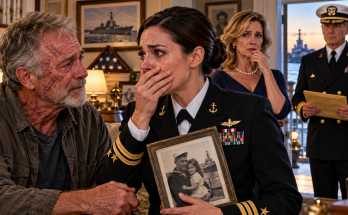
After the photographs, Margaret asked whether I would help her choose one for the mantel. I said I would. She looked at me carefully and asked whether I wanted the older pictures to remain displayed beside it. I told her yes. I wanted Thomas holding me at the waterfront before the explosion, the imperfect portrait from the day Greg recognized my name, and the new picture from the harbor. Together, they showed a history that could not be contained in a single image. The first represented a life interrupted. The second captured the moment the hidden truth emerged. The third showed people who had decided to continue, without pretending that the years between had been simple.
Margaret nodded. She said she would arrange them that way. Then she asked whether I thought the family could ever feel normal again. I considered the question. I no longer trusted the word normal as she had once used it. Our old normal had depended on silence, careful appearances, and the suppression of questions that made adults uncomfortable. I didn't want to return to that. I told her I hoped we could become comfortable with the truth, even when it made us uneasy. She smiled sadly and said that might be better than the kind of normal she had spent years trying to preserve. I believed she meant it.
Lauren joined us and asked whether I would be home for Thanksgiving. I told her my schedule was not finalized but that I would come if duty allowed. She said there would be no matching clothes, no formal portrait, and no instructions about arriving in uniform. I laughed. Then I told her she could plan dessert, but everything else would remain negotiable. She agreed. Our relationship had grown stronger during the months since the revelation. We had spoken honestly about our different childhood experiences and the ways our parents' secrecy affected each of us. Lauren no longer felt responsible for smoothing every family disagreement. I no longer felt like the difficult older sister who refused to follow the rules. We were learning to meet as adults rather than roles assigned in childhood.
Greg approached with the camera and showed us the photographs. He paused beside me and said he still found it astonishing that the officer he had followed through danger in Afghanistan had been sitting across from him at family dinners for years. I told him I felt the same. Then he mentioned the men from his unit had begun planning another reunion. The empty chair would remain as a tribute to everyone who helped bring them home, but they hoped I would attend again. I said I would try. I no longer felt that accepting their gratitude diminished the teamwork involved. Their lives had continued, and I was glad to be part of the story they remembered.
Daniel stood nearby, watching his son and granddaughter. I thought about the promise he had made after Greg returned from Afghanistan. He had searched for the unknown rescuer because gratitude mattered to him. That search had crossed into my family's buried history, exposed old administrative errors, and forced truths into the open that my parents had avoided for decades. He had not intended to transform our lives, and I did not believe the outcome justified every painful moment along the way. But his persistence had given us the opportunity to stop living inside an incomplete story. I thanked him once more. He shook his head and said he was simply glad the right people finally knew one another.
The afternoon grew cooler. We packed the food, folded the chairs, and gathered the blankets. Thomas lingered near the water while the others carried things toward the cars. I joined him. He looked at the harbor and said he had once believed coming home meant reaching the right place. After the explosion, he learned that a person could return physically and still remain lost inside the life he had reclaimed. He had been Russ for so long that he sometimes forgot which memories belonged to which name. Now he was trying to accept that both names were part of him. He asked whether that troubled me. I told him I was still learning to understand it, but I did not need him to choose one identity and erase the other.
He looked relieved. I said I might call him Russ sometimes because that was the name attached to most of my adult memories. I might call him Thomas when we discussed the years before the explosion. And occasionally, when I was ready, I might call him Dad without thinking about either name. His eyes filled. He said I could call him whatever felt true. I smiled because he had said the same thing months earlier, when I could barely look at him. This time, the words felt less like an apology and more like permission for our relationship to grow without forcing it into a single definition.
Before we left, I took the brass compass from my pocket and opened it. The needle remained frozen slightly off center. Thomas watched me turn it in the light. I said I intended to have the case cleaned and preserved, but I would leave the damaged mechanism as it was. He asked why. I told him it was part of the object's history. Repairing it until it looked untouched would make it less truthful. He considered that, then nodded. We stood quietly beside the water, holding a small piece of metal that had survived the explosion and the decades afterward. It no longer guided anyone across open water, but it had helped me understand a man whose life had been divided by danger and secrecy.
At home that evening, I placed the new family photograph on my desk beside the old waterfront picture and the corrected operational summary. I looked at the three items for a long time. They represented different kinds of evidence: a childhood memory, an official account, and a present-day choice. None contained the whole truth alone. Together, they reminded me that identity was not something other people should be allowed to define entirely through fear or convenience. My father had survived. My mother had concealed the truth and finally acknowledged the harm. My service record had been corrected. The old criminal case had reached the limits of what evidence could establish. The important questions were no longer being hidden from me.
I turned off the desk lamp and carried the compass to the small shelf near my front door. For years, I had believed my father's story ended in May 1993. Then I discovered he had been present through much of my life, loving me imperfectly under another name. I could not recover the years when I mourned him unnecessarily, and I would not pretend they had been harmless. But I had the chance to know him now, openly and without rehearsed explanations. The next morning, I planned to call and ask whether he wanted to have breakfast together. Not because the past was resolved perfectly, but because the future no longer needed to be organized around a lie.
The End
Read more original stories on Feel Every Story.