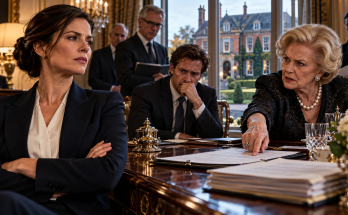
The meeting took place in a conference room at a naval installation where I had attended training years earlier. The building smelled faintly of floor polish and coffee. I arrived early, carrying my service records, copies of the documents Daniel had provided, and the notebook in which I had assembled the family timeline. My uniform was pressed, my insignia correctly placed, and my name tape visible above my pocket. I had considered attending in civilian clothes, then rejected the idea. The issue concerned my military service and the accuracy of official records. I would appear as the officer whose work had been documented incorrectly, not as the daughter of a protected witness whose family history had become complicated.
Daniel arrived with a civilian records specialist and two officers assigned to the administrative review. Greg joined us as a witness to the Afghanistan operation. A legal adviser attended to clarify the limits of what could be discussed and released. I appreciated the formal structure. After days of emotionally exhausting conversations, a room governed by procedure felt almost restful. Each person had a defined role. Questions would be recorded. Claims required support. Nobody could end the discussion by insisting that further inquiry would upset the family. I sat with my hands folded on the table and waited for the review officer to begin.
The first portion addressed the Afghanistan rescue. The officers presented surviving operational reports, casualty movement records, and statements from personnel who had been present. My surname appeared in some documents, while other summaries described the lead specialist without a reliable identifier. One later account referred to a male officer, although the source material did not support that description. The review officer explained that the error appeared to have originated in an early summary prepared by someone who had not directly witnessed the operation. Once the description entered administrative channels, it was repeated in subsequent records. The problem was compounded when identifying information associated with the Voss name was separated from certain searchable records.
I asked who had authorized that separation. The records specialist explained that an older identity-protection flag had been triggered during a personnel review because my surname and family connections overlapped with the protected Thomas Voss case. The flag should have prompted a controlled verification process. Instead, an administrative office applied a broader restriction to some linked information. The decision was recorded as a protective measure, but the documentation did not show that anyone had adequately considered its effect on my operational history. I felt my jaw tighten. An arrangement created to conceal my father's survival had reached forward into my career and interfered with records unrelated to the original threat.
The review officer emphasized that the available evidence did not indicate anyone had intentionally tried to deny me recognition for the rescue. The initial gender error appeared to be an assumption, and the later identity restrictions had been applied through a flawed administrative process. That distinction mattered. I had no desire to invent a conspiracy where negligence and poor coordination provided a more likely explanation. But the absence of malicious intent did not make the consequences harmless. Accurate records were essential to professional accountability. They affected evaluations, historical reporting, and the ability to identify personnel involved in significant operations. I asked what corrective action would be taken.
The officers explained that the review would prepare an amended operational summary identifying the lead specialist accurately, subject to verification and approval. Supporting statements from Greg and other witnesses would be included. The records office would also examine whether the identity flag had affected additional entries in my personnel history. If errors were found, they would be corrected through formal channels. I asked whether the changes could alter past evaluations or promotion considerations. The officer said there was no current evidence of such an effect, but the review would not close that possibility without checking. I accepted the answer. It was cautious, specific, and supported by a defined process.
Greg then gave his statement. I had heard him describe the rescue privately, but listening to him in a formal setting was different. He spoke about the damaged vehicle, the injured men, the uncertain terrain, and the officer who approached despite the risks. He admitted that his memory was incomplete in places and distinguished details he recalled directly from those reconstructed through later conversations. When he described following my footsteps, his voice tightened. He looked toward me only once, when he explained that the rescuer's calm instructions had allowed frightened men to move without making the situation worse. I kept my eyes on the table. I had performed the work as part of my duty, but hearing its effect described so plainly unsettled me.
The officers asked whether he had recognized my voice before seeing my name tape. Greg said he had not. He had known me socially for years without connecting me to the rescue because he believed the specialist was male and had never heard a full name. The surname Voss, combined with my confirmation of the date and specific operational details, had triggered the recognition. He explained how his father had searched for the rescuer using incomplete information. The review officer asked whether Captain Sandival had used any unauthorized access during that search. Daniel answered that he had pursued records through permissible requests and professional contacts, and he provided documentation of those inquiries. The distinction mattered because we wanted the record corrected without creating new questions about improper handling of information.
After a short break, the meeting turned to the identity-protection flag. The legal adviser explained that the original protective arrangement had been established under extraordinary circumstances and that some historical decisions were being reviewed separately. The immediate concern was whether the flag had been applied to my records after the relevant threat had diminished and whether the resulting restrictions were justified. I asked whether the office responsible had been notified when the protective restrictions were lifted six weeks earlier. The records specialist said notification had not been distributed consistently. Some linked systems still treated the old identity as sensitive. That failure had helped preserve the confusion even after the formal restrictions changed.
I felt a familiar frustration. The same pattern had shaped my family life. A temporary measure had become permanent because people failed to revisit it. Each year made the arrangement easier to leave untouched and harder to justify. I asked whether the review could establish a process for removing outdated flags and ensuring that future records were not affected. The specialist said that recommendation would be included. I wanted the correction to extend beyond my own case. Other people might have encountered similar problems without realizing why. Administrative systems could protect sensitive information, but they also needed mechanisms to recognize when protections had become obsolete or overbroad.
Daniel then introduced the historical documents concerning Thomas's case. Only the portions relevant to the personnel-record issue were discussed. The room did not become a forum for examining my parents' marriage or the emotional consequences of their choices. I appreciated that boundary. My father's survival had created a complex legal and administrative history, but it did not require strangers to judge every private decision he and Margaret had made. Still, the documents established that my surname had been linked to the protected identity and that the link had been handled inconsistently. The review officer asked whether I had known about my father's survival when I entered the Navy. I answered no. The simplicity of that answer seemed to surprise her.
She asked whether I had ever been briefed on the identity-protection arrangements. I said no. She asked whether I had been warned that using the Voss surname could affect my records or trigger security reviews. Again, no. I explained that I had legally reclaimed my biological father's name because I believed he had died when I was five. I had no knowledge of his protected identity, the criminal investigation, or the administrative restrictions that might follow. The officer wrote something down. I wondered whether she understood how strange it felt to describe my childhood in the language of official testimony. A lifetime of grief had become a relevant fact in a records review.
At the end of the meeting, the officers confirmed that the Afghanistan rescue would be formally reassessed for accurate attribution. They did not promise a specific award or public ceremony. I hadn't asked for either. The immediate objective was to correct the record and ensure that future references identified the personnel involved properly. Greg looked relieved. Daniel thanked the officers for the review. I gathered my documents and felt a measured satisfaction. The process was incomplete, but it had moved from private suspicion to documented action. For the first time, the question of my service record was being handled by people whose responsibility was to establish the facts rather than preserve an old secret.
Outside the conference room, Greg asked how I felt. I told him I was glad the errors were being examined, but the meeting had not erased the frustration of discovering them. He understood. He said the men from his former unit would be pleased to know their statements mattered. Then he hesitated and asked whether I would consider attending their upcoming reunion. I said I would think about it. The idea of being thanked publicly still made me uncomfortable. Yet I remembered the empty chair they had kept for fifteen years. Perhaps the gathering was not about celebrating me. Perhaps it was about allowing people who had survived a dangerous day to close a question that had remained open.
When I returned to the family house, Thomas was waiting in the garage. He had been working on an old wooden chair, replacing a loose joint near the seat. I recognized the chair from my childhood bedroom. It had once stood beside the window where he checked the lock each night. He looked up when I entered and asked how the meeting had gone. I told him the review had identified the source of the errors and begun the correction process. He set down his tools and listened while I explained the findings. When I described the identity-protection flag, his face tightened. He said he had feared the old case might someday interfere with my career, but he hadn't known it already had.
I asked whether he regretted choosing the protective identity. He considered the question carefully. He said he did not regret surviving or taking precautions that kept the family alive. He regretted allowing the arrangement to become more important than the people it was meant to protect. I asked whether he would make the same decision to return as Russ if he could go back. He looked toward the open garage door. For a long time, he said nothing. Then he answered that he would return to his daughter if any safe path existed, but he would insist on a clear plan for telling her the truth. He would not accept an indefinite arrangement without review. The answer was not dramatic, but it showed he had begun to distinguish the necessary from the avoidable.
I told him about the review officer asking whether I knew my father was alive when I entered the Navy. He looked ashamed. I said that answering no in a formal setting had been strangely painful. For years, I had believed I was carrying my father's memory into the service. Now I knew he had watched me leave from the station, aware of the truth and unable—or unwilling—to speak. I asked him what he had been thinking that day. He said he remembered my bag, the nervous excitement in my voice, and the way I tried to appear confident. He had wanted to tell me that I came from a family of people who understood service, but he feared the confession would distract me at the worst possible moment. He had settled for telling me that a name was nothing to apologize for.
I looked at the chair he was repairing. He had always expressed affection through practical acts. He fixed things because he knew how, and because fixing them allowed him to be useful without speaking about difficult emotions. I asked whether he understood that some things could not be repaired with a screwdriver and glue. He gave a sad smile. “I'm learning.” I told him I wanted to know more about his life before the explosion, but I also needed him to stop treating every conversation as an opportunity to prove how much he loved me. I already knew he loved me. What I needed was evidence that he could respect me enough to tell the truth even when it made him uncomfortable.
He nodded. Then he asked a question I had not expected. Would I be willing to let him tell Lauren the full story of his early service and the protective arrangement, without asking me to mediate? I realized he was trying to take responsibility for his relationship with her rather than relying on me to explain things. I said that was between them. He looked relieved. I added that he should not expect Lauren to respond the same way I did. She had her own questions, and her childhood had been shaped by a different version of the lie. He agreed. For once, I felt that he was beginning to understand how much damage had been caused by deciding in advance what his daughters could handle.
That evening, Lauren and Greg joined us for dinner. Margaret had prepared a simple meal rather than the elaborate arrangement she usually preferred when family gathered. There were no place cards or coordinated decorations. We sat where we wanted. The conversation began awkwardly, with everyone avoiding the obvious subjects. Eventually, Lauren asked Thomas about his medical recovery. He described the long rehabilitation, the difficulty of speaking, and the way ordinary tasks had become exhausting. She listened closely. Then she asked whether he had ever felt guilty that she knew him as her father while I didn't. He looked at me before answering. I shook my head slightly, signaling that he should speak to her. He said yes. He had felt guilty every time the difference became visible.
Lauren asked whether he had ever considered telling her the truth first. He said no. He had believed that would place an unfair burden on her and create another person responsible for keeping the secret from me. She nodded slowly. “At least you understood that part,” she said. The remark was not cruel, but it carried years of unspoken resentment. Thomas accepted it. Margaret began to interrupt, then stopped herself. I noticed the effort. She was accustomed to protecting the family from discomfort by changing the subject. Now she sat quietly while her daughter asked questions that had no easy answers.
After dinner, Daniel called with an update from the historical investigation. The photograph of Thomas and Alan Mercer had been examined alongside archived records. The vehicle in the background appeared to match one associated with a civilian contractor previously investigated for access irregularities. The finding did not establish criminal involvement by Mercer, but it supported a timeline placing him near the facility shortly before the explosion. Investigators wanted to examine the original photograph and any related negatives or documents. I told Daniel the album was available and that we would preserve it carefully. He said the old case might be reopened for limited review of unresolved evidence, though no conclusion had been reached.
I relayed the information to Thomas. He became quiet. I asked whether the possibility of reopening the case frightened him. He said it brought back memories he had spent decades trying to keep contained. He did not fear prosecution of the guilty; he feared renewed uncertainty and the possibility that people might once again make decisions about our family without consulting us. I told him that this time we would ask questions, insist on clear explanations, and keep records. He looked at me with something like relief. The roles had shifted. I was no longer the child whose questions were considered dangerous. I was the officer insisting that uncertainty be handled through evidence.
Before leaving, Greg mentioned that the reunion of his former unit was scheduled for the following month. Several men had expressed strong hopes that I would attend. He said nobody expected a speech or public display. They simply wanted the opportunity to thank the person whose name they had carried for years. I told him I would give him an answer soon. After he left, I stood beside the dining room table looking at the photograph from the family portrait. The photographer had sent a preliminary image. Greg and I stood in uniform, Lauren beside us, and Thomas at my other shoulder. Margaret was absent because she had gone upstairs during the photographs. The picture was imperfect, but it showed something true: people standing together after a revelation none of them could have planned.
I printed the image and placed it beside the old photograph of Thomas holding me at the waterfront. The two pictures belonged to different eras, separated by injury, secrecy, and decades of misunderstanding. In the first, my father was young and recognizable. In the second, he was older, scarred, and known to most people by another name. I studied the position of his hands in both photographs. In each, he stood close enough to steady me if I needed it, but not so close that he blocked my movement. I wondered whether love could remain real while the choices made in its name caused harm. The question had no simple answer. For the moment, I allowed both photographs to remain on the table.